


Biodiversity & Environment
Mitigating Microplastics Crisis
- 30 Mar 2026
- 14 min read
For Prelims: Microplastic, Polymer, Nanoplastics, Persistent Organic Pollutants (POPs), DDT, Heavy Metals, Plankton, Antimicrobial Resistance (AMR), International Maritime Organization (IMO), World Economic Forum, Gram Panchayat, National Ambient Air Quality Standards (NAAQS), Bureau of Indian Standards (BIS).
For Mains: Key facts regarding microplastics and key challenges associated with them, Initiatives to tackle microplastics and further steps needed.
Why in News?
A recent study highlighted that while microplastic abundance in Chennai’s beach sediments is lower than global averages, the high prevalence of nylon fibres poses a disproportionately severe ecological risk.
- Researchers emphasize that polymer type, shape, and aging characteristics are more critical in determining ecological damage than simple numerical abundance.
Summary
- Microplastics pose a severe threat through biomagnification and the creation of AMR hotspots in the Plastisphere.
- While India has introduced QR-based tracking and EPR 2.0, success depends on curbing upstream sources like synthetic textiles and tire wear.
- Holistic management requires integrating microplastic standards into national air and water quality indices.
What are Microplastics?
- About: Microplastics are tiny plastic particles, generally defined as being less than 5 millimeters (5 mm) in size—about the size of a pencil eraser or smaller.
- Some definitions extend the lower limit down to 1 nanometer, distinguishing even smaller nanoplastics (typically under 1 micrometer) that behave differently due to their colloidal properties.
- Types of Microplastics: Microplastics are categorized into two main types based on their origin:
- Primary microplastics: These are intentionally manufactured at small sizes for specific uses. E.g.,
- Microbeads: Used as exfoliants in cosmetics (face scrubs, toothpaste).
- Nurdles: Plastic pellets used as raw material for manufacturing larger plastic goods.
- Secondary microplastics: These result from the breakdown of larger plastic items through environmental processes such as photodegradation (from sunlight), mechanical abrasion, or biological degradation by microorganisms.
- E.g., degraded plastic bags, bottles, packaging, fishing gear, synthetic textiles, car tires, and road markings.
- Primary microplastics: These are intentionally manufactured at small sizes for specific uses. E.g.,
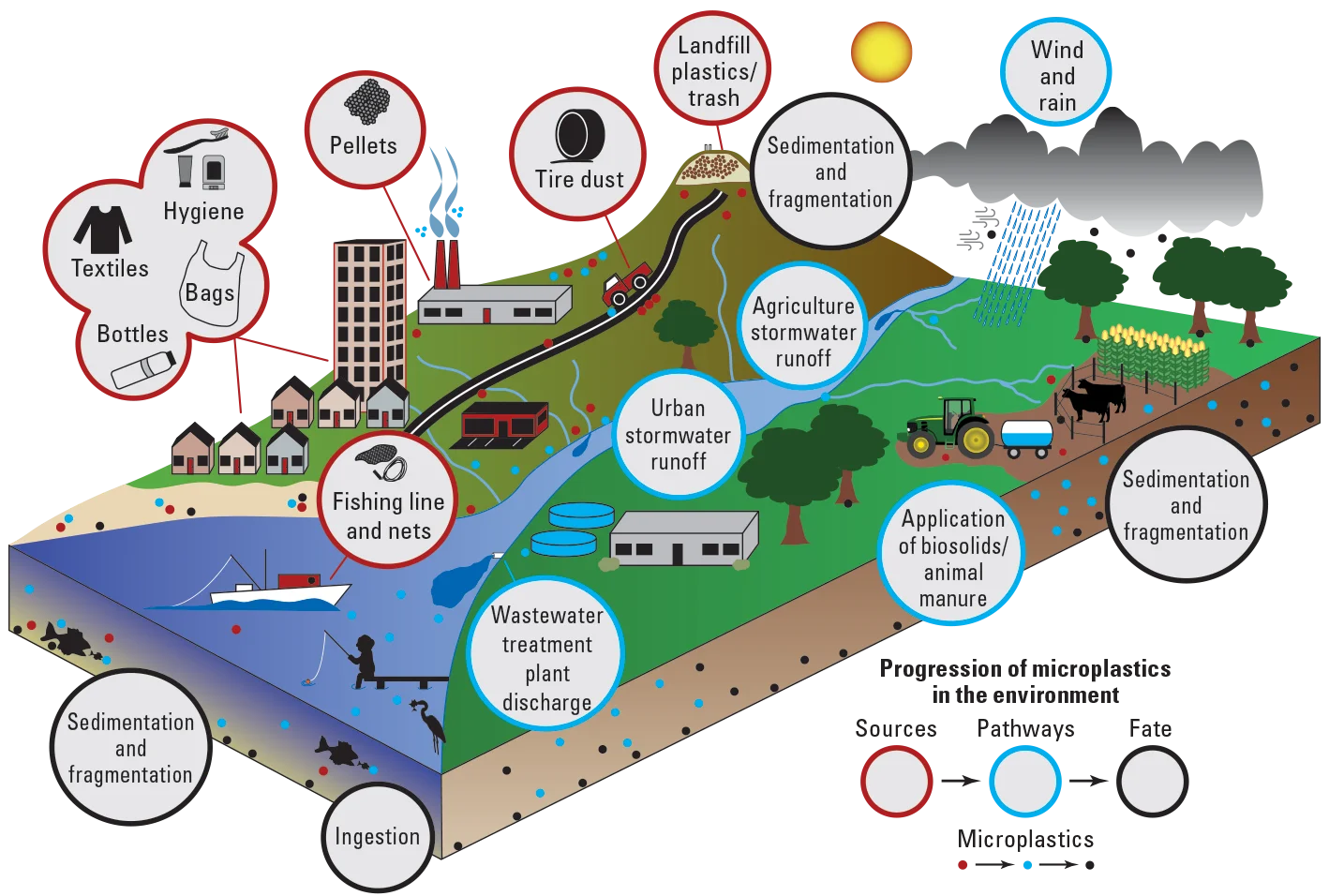
Initiatives to Tackle Microplastics
Global
- UN Global Plastics Treaty: Still in negotiation phase, the primary goal is to formulate a legally binding international instrument that addresses the entire life cycle of plastic.
- Strategy and Action Plan on Marine Litter 2026 (Draft): The International Maritime Organization (IMO) recommended a new mandatory code for the transport of plastic pellets (nurdles) to prevent massive microplastic spills during maritime shipping.
- EU Microplastic Restrictions: The European Union has implemented a phased ban on intentionally added microplastics in products like cosmetics, detergents, and artificial turf.
- Global Plastic Action Partnership (GPAP): Led by the World Economic Forum, GPAP focuses on creating a circular plastics economy, where plastic is reused, recycled, and managed more sustainably.
India
- Plastic Waste Management (Amendment) Rules, 2024: For the first time, Indian law formally defined microplastics as any solid plastic particle (1 to 1,000 microns).
- Manufacturers of compostable and biodegradable plastics must prove their products leave zero microplastics behind to receive CPCB certification.
- Plastic Waste Management (Amendment) Rules, 2025: All plastic packaging must now carry QR codes or barcodes for real-time tracking of waste through a centralized online portal.
- Extended Producer Responsibility (EPR) 2.0: Under EPR 2.0, producers now have mandatory targets for Recycled Content. For example, Category I (Rigid Plastics) must include 40% recycled content in the 2026–27 fiscal year.
- Companies that fail to meet these targets must pay Environmental Compensation based on the "Polluter Pays" principle.
- National Plastic Pollution Reduction Campaign (NPPRC): Launched in late 2025, this campaign specifically targets rural areas (Gram Panchayats) to prevent agricultural plastic from breaking down into soil microplastics.
What are the Key Challenges Associated with Microplastics?
- Ecological and Biological Challenges: Marine and terrestrial organisms often mistake microplastics for food. This leads to physical injury (blockage of digestive tracts) and pseudo-satiety (sensation of being full).
- Biomagnification: Biomagnification is the process where toxin concentrations increase at each higher level of a food chain. Microplastics worsen this by absorbing pollutants from seawater; as apex predators eat contaminated prey, they ingest concentrated doses of plastic and chemicals, ultimately posing significant health risks to humans and ecosystems.
- Human Health Risks: Microplastics often contain additives like BPA (Bisphenol A) and Phthalates, which are known "hormone mimics." These can interfere with reproductive health, metabolism, and fetal development.
- Nanoplastics are capable of crossing the blood-brain barrier and the placental barrier, potentially causing chronic inflammation and oxidative stress at a cellular level.
- Chemical and Toxicological Challenges: Microplastics are chemically "sticky" (hydrophobic). They absorb Persistent Organic Pollutants (POPs) like DDT, and heavy metals from the surrounding water, and deliver them directly into the bodies of organisms.
- Socio-Economic Vulnerabilities: It is estimated that plastic pollution causes USD 75 billion annually in environmental damage. Microplastic contamination in commercial fisheries and salt pans can lead to trade bans and loss of consumer trust, impacting the blue economy.
- Unlike large plastic bottles, microplastics cannot be vacuumed out of the ocean without killing the plankton that forms the base of the entire food chain.
- Trojan Horse for Superbugs: The "Plastisphere" (the biofilm on plastic) provides a stable, crowded platform where bacteria can exchange Antibiotic Resistance Genes (ARGs) much faster than in open water Hence, Microplastics in wastewater create a perfect storm for Antimicrobial Resistance (AMR).
What Measures are Needed to Curb the Menace of Microplastics?
- Product & Manufacturing Bans: Prohibit the use of plastic microspheres in face scrubs, toothpastes, and shower gels, replacing them with natural exfoliants like apricot kernels or sea salt.
- Mandate strict "Zero Pellet Loss" protocols (like Operation Clean Sweep) in plastic manufacturing plants to prevent raw pre-production pellets from washing into drains.
- Consumer Tech Mandates: Implement "Euro 7" style standards for tire manufacturers to reduce the wear-and-tear rate of synthetic rubber. Provide tax breaks for clothing brands that use a minimum of 80% natural fibers (cotton, wool, hemp) to reduce the shedding of non-biodegradable synthetic microfibers.
- Infrastructure & Waste Management: Mandate the use of Tertiary Treatment (such as Membrane Bioreactors or Sand Filtration) in urban plants, which can remove up to 99% of microplastics compared to primary treatment.
- Ensure that "biodegradable" plastics do not simply break down into "invisible" microplastics; they must be certified to completely mineralize in natural soil and water conditions.
- Inclusion in Air & Water Quality Indices: Add "Microplastic Concentration" as a standard parameter in the National Ambient Air Quality Standards (NAAQS) and the Bureau of Indian Standards (BIS) for drinking water.
- Incentivize "Green Chemistry": Provide government grants to startups developing bio-based polymers (from seaweed or starch) that mimic the properties of plastic but are truly biodegradable.
- Hold fast-fashion brands financially accountable for the end-of-life environmental impact of synthetic garments, similar to the existing rules for plastic packaging.
Conclusion
The global microplastic crisis has evolved from a marine litter issue into a complex biogeochemical and public health emergency. While numerical abundance in sediments varies, the persistence of specific polymers like nylon and the emergence of the "Plastisphere" necessitate a shift from volume-based monitoring to risk-based regulatory frameworks and at-source technological interventions.
|
Drishti Mains Question: Discuss the ecological and health implications of microplastics in the food chain. Evaluate the challenges in implementing a global regulatory framework to mitigate this 'silent' environmental crisis. |
Frequently Asked Questions (FAQs)
1. What is the official definition of microplastics under Indian law?
The Plastic Waste Management (Amendment) Rules, 2024, formally define microplastics as any solid plastic particle ranging from 1 to 1,000 microns.
2. What is the "Plastisphere" and why is it significant?
The Plastisphere refers to the biofilm that forms on microplastic surfaces. It is significant because it provides a platform for bacteria to exchange Antibiotic Resistance Genes (ARGs) , linking microplastic pollution to AMR.
3. Why are nanoplastics considered more hazardous than microplastics to human health?
Due to their minute size, nanoplastics can cross biological barriers (blood-brain and placental), causing cellular-level oxidative stress and chronic inflammation.
UPSC Civil Services Examination, Previous Year Question (PYQ)
Prelims
Q. Why is there a great concern about the ‘microbeads’ that are released into the environment? (2019)
(a) They are considered harmful to marine ecosystems.
(b) They are considered to cause skin cancer in children.
(c) They are small enough to be absorbed by crop plants in irrigated fields.
(d) They are often found to be used as food adulterants.
Ans: (a)
Mains
Q. What are the impediments in disposing the huge quantities of discarded solid waste which are continuously being generated? How do we remove safely the toxic wastes that have been accumulating in our habitable environment? (2018)



