


Rapid Fire
1st Inter-State Initiative for Great Indian Bustard (GIB)
- 30 Mar 2026
- 3 min read
A Great Indian Bustard (GIB) chick was hatched in Gujarat’s Kutch after a decade through the “jumpstart” approach, a conservation method involving transferring a fertile, incubated egg from a captive breeding programme to the nest of a wild female, marking a significant milestone.
- This first-of-its-kind inter-State initiative, coordinated by the Ministry of Environment, Forest and Climate Change(MoEFCC) along with the Forest Departments of Rajasthan and Gujarat and the Wildlife Institute of India under Project Great Indian Bustard (launched in 2016), aimed to revive the critically endangered species.
Great Indian Bustard (GIB)
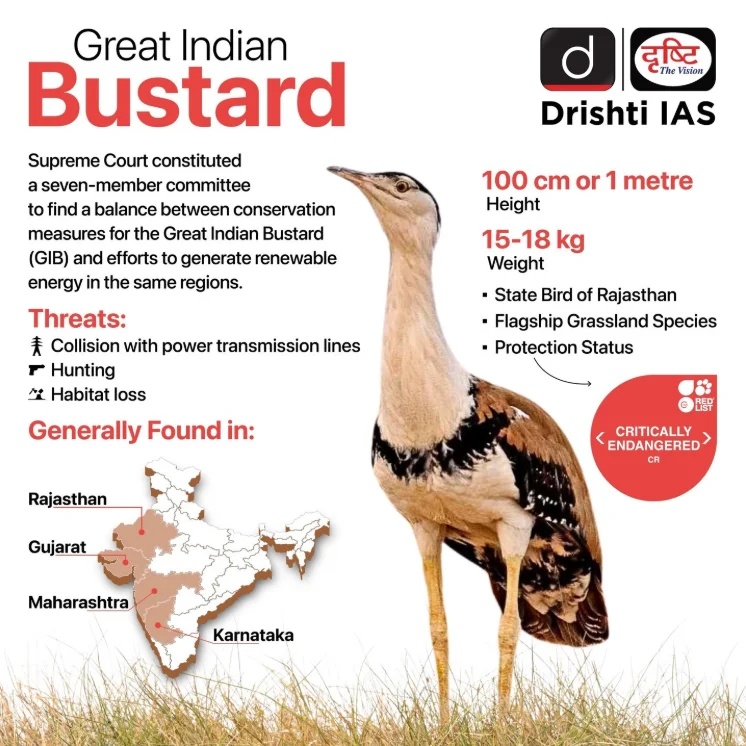
- GIB, Rajasthan’s state bird, is India’s most critically endangered bird. It is one of the heaviest flying birds in the world, and mainly found in Rajasthan’s Thar Desert, with small populations in Gujarat, Maharashtra, Karnataka, and Andhra Pradesh.
- GIB is one among four bustard species found in India, alongside the Lesser Florican, Bengal Florican, and Macqueen's Bustard.
- GIB is omnivorous and vulnerable to power line collisions due to a lack of frontal vision.
- Ecological Importance: GIB acts as an indicator species; it reflects the health of grassland ecosystems. Their decline signals degradation of native grasslands.
- Protection Status: IUCN Red List (Critically Endangered), CITES (Appendix I), Convention on Migratory Species (CMS) (Appendix I), and Wildlife (Protection) Act, 1972 (Schedule I).
- Threats: Habitat loss from agriculture, mining, and infrastructure, along with collisions with power lines (the leading cause of adult mortality), threaten the GIB.
- Conservation Efforts: It is covered under the Integrated Development of Wildlife Habitats of the MoEFCC for focused conservation.
- Project GIB, launched in 2016, aims to create breeding enclosures and reduce human pressure on habitats, ensuring long-term conservation.
| Read more: Great Indian Bustard (GIB) |



