


Rapid Fire
Olive Ridley Turtle Conservation on Hope Island
- 30 Mar 2026
- 3 min read
Nearly 20,000 Olive Ridley turtles eggs have been conserved on Hope Island in Kakinada Bay by the Wildlife Management Authority and Coringa Wildlife Sanctuary.
- Hope Island is a safe nesting ground for Olive Ridley turtles in Andhra Pradesh, where eggs are protected using the in-situ conservation method.
Olive Ridley Turtles
- About: Olive ridley turtles are the world's smallest sea turtle and have a heart-shaped, olive or grayish-green carapace.
- They are found in tropical regions of the Pacific, Indian, and Atlantic Oceans; inhabit both open ocean and coastal waters.
- Diet and Behavior: ORTs are omnivorous, feeding on jellyfish, snails, crabs, and algae. They undertake long-distance migrations from the Pacific to the Indian Ocean, reaching Indian coasts between November and December and remaining until April–May.
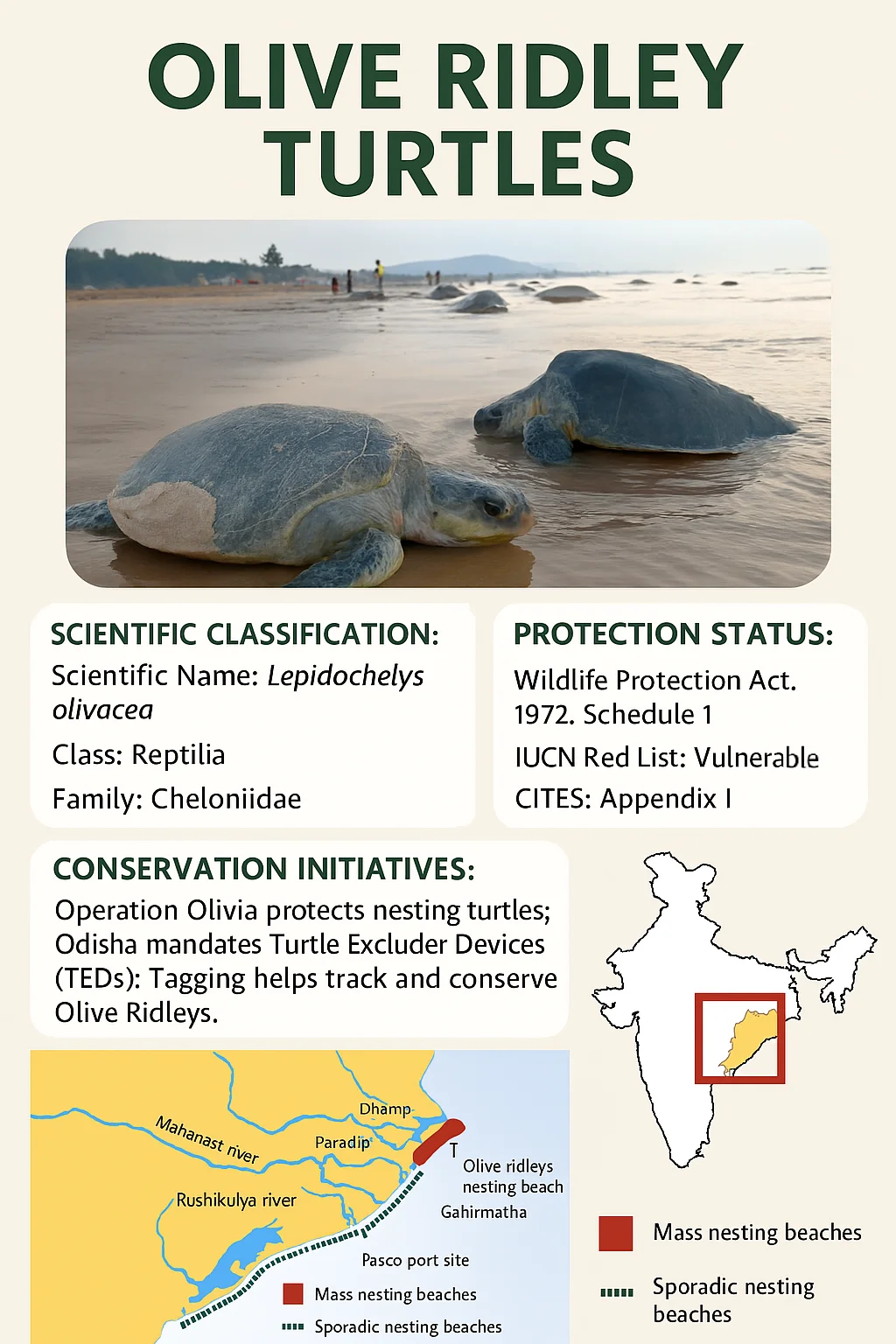
- The species is known for its synchronised mass nesting (arribada) on narrow sandy beaches near estuaries and bays, where each female lays about 100–140 eggs at a time.
- Key Indian sites are Gahirmatha (largest mass nesting), Rushikulya, and the Devi River mouth in Odisha, Visakhapatnam & Kakinada (Andhra Pradesh) and Andaman and Nicobar Islands.
- Legal Protections: All the 5 species of sea turtles occurring in India, including the ORTs, are legally protected under Schedule I of the Wildlife Protection Act, 1972 and Appendix I of the CITES Convention. ORTs are listed as Vulnerable on the IUCN Red List.
- Conservation Measures: Operation Olivia by the Indian Coast Guard enforces fishing bans. Turtle Excluder Devices (TEDs) are mandated in Odisha. Tagging programs help track migration.
- Major Threats: Despite an international trade ban, olive ridley turtles face severe threats from illegal poaching and egg trade, with the most significant mortality caused by accidental bycatch in trawl and gill nets during the nesting season.
| Read more: Olive Ridley Turtles |



