


Important Facts For Prelims
Madhav Gadgil and the WGEEP
- 10 Jan 2026
- 9 min read
Why in News?
Eminent ecologist Madhav Gadgil has passed away after a brief illness. He is remembered as chairman of the Western Ghats Experts Ecology Panel (WGEEP), 2011, whose seminal, though rejected, report continues to be referenced during ecological disasters and landslides in the region.
What was Western Ghats Experts Ecology Panel (WGEEP)?
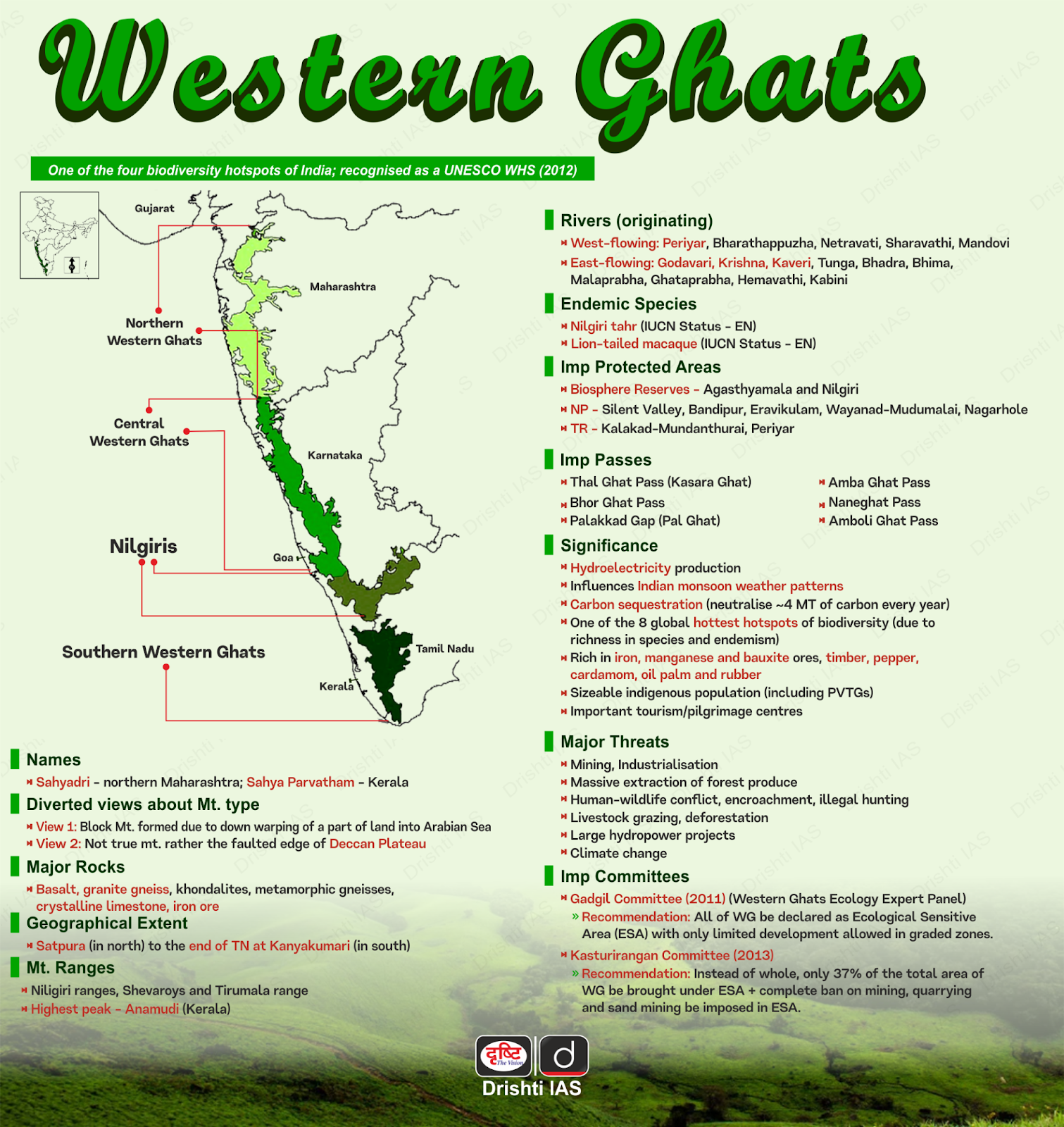
- About: WGEEP, commonly known as the Gadgil Commission, was an environmental research commission established by the Ministry of Environment, Forest and Climate Change (MoEFCC) in 2010 (report submitted in 2011).
- Mandate: It was chaired by Professor Madhav Gadgil to assess the ecological status of the Western Ghats (UNESCO World Heritage Site and global biodiversity hotspot), demarcate its Ecologically Sensitive Areas (ESAs), and recommend measures for conservation, rejuvenation, and sustainable development.
- Core Recommendations:
- Designation as ESA: Designated the entire Western Ghats (1,29,037 sq km) as an ESA and classified Western Ghats into 3 Ecologically Sensitive Zone (ESZ) based on sensitivity levels i.e., ESZ1 (highest sensitivity), ESZ2 (high sensitivity) and ESZ3 (moderate sensitivity).
- Key Sectoral Guidelines: Prohibition on genetically modified crops, new Special Economic Zones (SEZs), and new hill stations.
- No new mining licenses; phasing out of existing mines within five years in the most sensitive zones (ESZ 1 & 2).
- Restrictions on new major infrastructure like railway lines and large roads in ESZ 1 & 2, except where essential.
- Institutional Recommendation: Proposed the creation of a statutory Western Ghats Ecology Authority (WGEA) under the Environment Protection Act, 1986.
- This apex, multi-state body would regulate, manage, and plan activities across all 6 states (Gujarat, Goa, Maharashtra, Karnataka, Kerala, Tamil Nadu) in which Western Ghats lie.
- It would comprise domain experts, resource experts, and government representatives.
- Inclusive Development: The report made a case for inclusionary development by recommending that decisions be taken to all Gram Sabhas, aiming to replace exclusionary models of development and conservation.
- Controversy and Rejection: It faced strong political opposition, particularly from Kerala and Maharashtra, over perceived threats to economic activities like cash crops (e.g., in Idukki & Wayanad), mining, and hydro projects.
- Key objections included institutional conflict with the proposed WGEA and fears that stringent regulations would make agriculture and habitation impossible.
- Ultimately, the report was rejected by the then government at the centre.
- K Kasturirangan Panel: Following opposition to the Gadgil report, MoEFCC constituted a High-Level Working Group (HLWG) under space scientist K Kasturirangan to “examine the WGEEP report in a holistic and multidisciplinary fashion.”
- The HLWG report of 2013 proposed demarcating 56,825 sq km of the Western Ghats as ecologically sensitive, with restrictions on polluting industries, mining, new thermal power plants, and large townships. Unlike the Gadgil panel, it identified specific villages as ESAs.
Madhav Gadgil
- About: Madhav Gadgil was a pioneering Indian ecologist renowned as one of India's foremost voices on ecology and environmental protection. His father, Dhananjay Gadgil, was one of India’s foremost economists and the author of the classic The Industrial Evolution of India in Recent Times, first published in 1924.
- Institution Builder: He established the Centre for Ecological Sciences (CES) at the Indian Institute of Science (IISc), Bengaluru in 1982, which became a premier hub for ecological studies. His research contributed to the establishment of the Nilgiri Biosphere Reserve (1986) and contributed significantly to the Biological Diversity Act 2002, and Forest Rights Act, 2006.
- Western Ghats Ecology Expert Panel (WGEEP): His most prominent public role was as chairman of the WGEEP (Gadgil Committee) set up for protection of the Western Ghats.
- Literary Contribution: He co-authored works like "This Fissured Land: An Ecological History of India" and "Ecology and Equity" with historian Ramachandra Guha.
- Recognitions: He was the recipient of the prestigious Shanti Swarup Bhatnagar Award, Padma Shri and Padma Bhushan awards.
Frequently Asked Questions (FAQs)
1. What was the Western Ghats Experts Ecology Panel (WGEEP)?
The WGEEP, or Gadgil Commission, was established in 2010 under the MoEFCC, chaired by Madhav Gadgil, to assess the ecology of the Western Ghats and recommend measures for conservation and sustainable development.
2. What were the key recommendations of the Gadgil Panel?
Key recommendations included restrictions on mining, GM crops, SEZs, new hill stations, and major infrastructure in sensitive zones, along with the creation of a Western Ghats Ecology Authority (WGEA) for governance.
3. What is the Kasturirangan Panel, and how did it differ from WGEEP?
Constituted in 2013, the Kasturirangan Panel proposed a smaller ESA (56,825 sq km), identifying specific villages for regulation, with a focus on restrictions on industries, mining, and large townships, unlike the broader WGEEP approach.
UPSC Civil Services Examination Previous Year Question (PYQ)
Q. Consider the following statements: (2017)
- In India, the Himalayas are spread over five States only.
- Western Ghats are spread over five States only.
- Pulicat Lake is spread over two States only.
Which of the statements given above is/are correct?
(a) 1 and 2 only
(b) 3 only
(c) 2 and 3 only
(d) 1 and 3 only
Ans: (b)
Q. ‘Gadgil Committee Report’ and ‘Kasturirangan Committee Report’, sometimes seen in the news, are related to (2016)
(a) constitutional reforms
(b) Ganga Action Plan
(c) linking of rivers
(d) protection of Western Ghats
Ans: (d)
Q. In which one among the following categories of protected areas in India are local people not allowed to collect and use the biomass? (2012)
(a) Biosphere Reserves
(b) National Parks
(c) Wetlands declared under Ramsar Convention
(d) Wildlife Sanctuaries
Ans: (b)



