


International Relations
India–Jordan Relations
- 19 Dec 2025
- 16 min read
For Prelims: UPI, Digital Public Infrastructure, Organisation of Islamic Cooperation (OIC), India-Middle East-Europe Economic Corridor (IMEC), UNGA, PARAM Shavak, MSMEs.
For Mains: Key highlights of the India-Jordan relations and significance of Jordan for India, Challenges in India-Jordan relations and steps needed to strengthen the relations.
Why in News?
India's Prime Minister visited Jordan, engaging in extensive discussions with King Abdullah II of Jordan. This marks his first full-fledged bilateral visit to Jordan, having previously visited in February 2018 en route to Palestine.
Summary
- India’s Prime Minister’s landmark 2025 visit to Jordan, marking the 75th anniversary of diplomatic ties, sought to elevate a stable relationship into a future-oriented strategic alliance.
- The visit set ambitious goals such as a USD 5 billion trade target and digital payment integration, while recognizing challenges like a narrow economic base and geopolitical sensitivities in fully leveraging Jordan’s role in India’s West Asia policy.
What are the Key Outcomes of the Visit?
- 5 MoUs Signed between India and Jordan:
- MoU on Technical Cooperation in the Field of New and Renewable Energy.
- MoU on Cooperation in the field of Water resources Management & Development
- Twinning Agreement between Petra (ancient city in Jordan) and Ellora.
- Renewal of the Cultural Exchange Programme for the years 2025-2029.
- Letter of Intent on Cooperation in the field of sharing successful digital solutions implemented at population scale for digital transformation.
- Ambitious Trade Target: Both countries aim to enhance bilateral trade to USD 5 billion over the next 5 years. India is Jordan’s 3rd largest trading partner.
- Regional & Global Alignment: Leaders reiterated strong condemnation of terrorism and shared perspectives on ensuring regional peace and stability.
What is the Strategic Significance of Jordan for India’s West Asia Policy?
- Geopolitical Bridge: Jordan is a key pro-Western, modernizing Arab constitutional monarchy with a peace treaty with Israel.
- It serves as a vital diplomatic bridge enabling India to balance its ties with Israel, Arab states, and Iran without entrapment in sectarian divisions.
- Jordan hosts a large refugee population, primarily Syrians, and its sustained humanitarian role strengthens its position as a regional stabilizer.
- Counter-Terrorism Convergence: Engagement in forums like the Aqaba Process 2015, the 2018 defence MoU, and participation in Special Operations Forces Exhibition and Conference (SOFEX) underscore deepening military-to-military and counter-terrorism ties.
- Core Diplomatic Support: Jordan’s influence in the Organisation of Islamic Cooperation (OIC) provides valuable support for India’s multilateral interests, and helps counter narratives on Kashmir, given Jordan’s generally balanced stance.
- Jordan’s Role in Regional Stability: Jordan's custodianship of Jerusalem makes it central to de-escalation efforts, aligning with India's interest in regional stability and protecting its diaspora and trade routes.
- Corridor Logistics: Jordan is positioned as a linchpin in the India-Middle East-Europe Economic Corridor (IMEC), enhancing India’s trade connectivity and energy transition goals.
- It offers potential as a gateway for reconstruction and logistics in post-conflict Iraq and the Levant.
- During the Red Sea crisis, overland cargo routes from Gulf ports via Saudi Arabia and Jordan into Israel have emerged to bypass maritime chokepoints, underscoring Jordan's rising importance in resilient regional logistics.
Jordan
- Location & Borders: Strategically located in the Middle East, bordering Syria, Iraq, Saudi Arabia, Israel, and the West Bank.
- Physical Features: Dominated by desert (over 80% of land), with the fertile Jordan River Valley, and rocky highlands.
- Population: Predominantly Arab, with a significant Palestinian refugee population (about one-third). Majority Muslim with a Christian minority. Highly urbanized (75% in cities).
- Maritime Access: Gateway via the port of Aqaba to the Red Sea.
- Modern Formation: Established as Transjordan under British mandate (1920), gaining independence in 1946 under King Abdullah I of the Hashemite dynasty.
- Arab-Israeli Conflicts: Fought wars against Israel in 1948 and 1967, losing the West Bank and eastern part of Jerusalem, leading to large Palestinian refugee inflows.
- Peace & Stability: Renounced claims to the West Bank (1988) and signed a historic peace treaty with Israel in 1994 (Wadi Araba Treaty 1994).

What are the Pillars of the India-Jordan Bilateral Relationship?
- Diplomatic Engagement: Established in 1950, diplomatic ties are strengthened by regular summits (e.g., UNGA), mutual counter-terrorism support, as seen after the Pahalgam attack (2025), and shared concerns on regional stability.
- Trade & Economic Integration: India is Jordan’s 3rd largest trading partner, with bilateral trade of USD 2.875 billion in FY 2023-24.
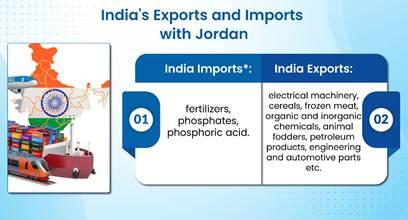
- Joint ventures like Jordan India Fertiliser Company (JIFCO) make Jordan a critical supplier of phosphates and potash for India’s agricultural security.
- Over 15 NRI-owned garment units in Jordan (investment ~USD 500 million) leverage trade agreements to access Western markets.
- Defence & Security Cooperation: India and Jordan signed an MoU on Defence Cooperation in 2018.
- Science & Technology Partnership: The India-Jordan Center of Excellence in IT at Al-Hussein Technical University is equipped with a supercomputer PARAM Shavak, which aims to train 3,000 Jordanian IT professionals. Indian master trainers upskill Jordanians in Cyber Security, AI, and Big Data Analytics.
- People-to-People Ties: Approximately 17,500 Indians in Jordan work in key sectors including healthcare, IT, and education. Strong cultural ties are maintained through Jordan's interest in Bollywood and events like the Jerash Festival.
- Personal Diplomacy: The Jordanian Crown Prince Al Hussein bin Abdullah II personally took the Indian PM to the Jordan Museum, showing the warm ties between India and Jordan.
What Challenges Constrain the Partnership Between India and Jordan?
- Structural Trade Imbalance: Trade is largely confined to a few commodities, with India importing phosphates and potash and exporting cereals and petroleum products, leaving the relationship vulnerable to price fluctuations. High-value and advanced technology exchanges remain minimal.
- Jordan’s economy continues to face notable constraints, including unemployment of around 21% and public debt approaching 90% of GDP as of 2024. These pressures limit fiscal flexibility, suggesting that substantial trade expansion may be challenging to realize in the near term.
- Geopolitical Sensitivities in West Asia: Jordan's foreign policy is heavily constrained by the Palestinian issue and Israel-related developments, making its external alignments highly sensitive during regional crises and complicating stable, long-term cooperation whenever West Asia escalates.
- Connectivity Gaps: The single Amman-Mumbai flight highlights limited people-to-people and business ties, especially compared to India's robust links with Gulf states. This sparse connectivity, coupled with Jordan's economic challenges, constrains growth in trade, investment, and tourism.
How can India and Jordan can Build a more Robust Bilateral Relationship?
- Diversify Economic Relationship: India and Jordan must move from commodity-centric trade to value-chain integration by establishing a Ministerial Strategic Economic & Technology Dialogue, focusing on investment, MSMEs, startups, and supply chains.
- Cooperation can also include sharing India's Digital Public Infrastructure (DPI) expertise to enable payment interoperability and scalable digital solutions in health and e-governance.
- Build a Green & Water-Secure Partnership: Given Jordan's existential challenges of water scarcity and energy transition, India can cooperate in solar and green hydrogen technologies. Collaboration can also extend to water recycling, desalination, smart irrigation, and climate-resilient agriculture.
- Gateway for Regional Stabilisation: India can partner with Jordan in establishing reconstruction supply chains, using it as a base for humanitarian aid, skilling, and health missions, and collaborating on multilateral development initiatives.
- Amplify Cultural Links: Jointly produce cultural content, film festivals, and archaeological collaborations (e.g., Petra–Ellora twinning). Promote Jordan as a film shooting destination for Bollywood and Indian OTT platforms.
- Enhance Connectivity: Incentivize direct flights (Amman–Delhi/Chennai) to boost tourism and business. Create a dedicated digital platform for e-commerce, tech startups, and virtual collaboration to connect businesses and academia.
Conclusion
India’s PM landmark visit elevates a stable 75-year partnership into an ambitious strategic alliance. By targeting trade diversification, digital integration, and deeper security cooperation, India and Jordan are poised to transform diplomatic goodwill into concrete, future-oriented outcomes.
|
Drishti Mains Question: Discuss the strategic significance of Jordan in India’s West Asia policy. How can cooperation in defense and security be enhanced to mutual benefit? |
Frequently Asked Questions (FAQs)
Q. What is the strategic importance of Jordan in India's West Asia policy?
Jordan acts as a vital geopolitical bridge, enabling India to balance ties with Israel, Arab states, and Iran. Its role in the Aqaba Process and as a potential logistics hub for IMEC enhances its significance.
Q. How does Jordan contribute to India’s agricultural security?
Through joint ventures like JIFCO, Jordan supplies phosphates and potash, essential for India’s fertilizer requirements.
Q. How do India and Jordan cooperate in the field of Science & Technology?
Through the India-Jordan Center of Excellence in IT (IJCOEIT) in Amman, which aims to train 3,000 Jordanian IT professionals using Indian expertise in AI, Cyber Security, and Big Data Analytics.
UPSC Civil Services Examination, Previous Year Question (PYQ)
Prelims
Q. Which one of the following countries of South-West Asia does not open out to the Mediterranean Sea? (2015)
(a) Syria
(b) Jordan
(c) Lebanon
(d) Israel
Ans: (b)
Q. The term “two-state solution” is sometimes mentioned in the news in the context of the affairs of (2018)
(a) China
(b) Israel
(c) Iraq
(d) Yemen
Ans: (b)
Mains
Q. “India’s relations with Israel have, of late, acquired a depth and diversity, which cannot be rolled back.” Discuss. (2018)



