


Important Facts For Prelims
Deepavali Inscribed on UNESCO ICH List
- 12 Dec 2025
- 8 min read
Why in News?
At the 20th session of the UNESCO Intergovernmental Committee for Safeguarding of the Intangible Cultural Heritage (ICH) held at New Delhi’s Red Fort, Deepavali, the festival of lights was officially added to UNESCO’s Representative List of the Intangible Cultural Heritage (ICH) of Humanity.
Summary
- The UNESCO ICH List, created under the 2003 Convention, safeguards living cultural traditions; India nominated Deepavali for the 2024–25 cycle.
- Deepavali’s inscription recognises its cultural, social and economic significance, linking it to SDGs through support for livelihoods, well-being, gender participation and community resilience.
- India now has multiple ICH elements on the UNESCO list, including Garba, Durga Puja, Kumbh Mela, Yoga, Nowruz, Sankirtana, Buddhist chanting, Chhau, Kalbelia, Mudiyettu, Ramman, Kutiyattam, Ramlila and Vedic chanting.
What is the UNESCO Intangible Cultural Heritage List?
- About: The list was created under the 2003 UNESCO Convention for the Safeguarding of Intangible Cultural Heritage.
- It aims to protect living cultural traditions threatened by globalisation, promote awareness, respect and cultural diversity, and support community-led safeguarding of rituals, festivals, oral traditions and traditional craftsmanship.
- Intangible Cultural Heritage: UNESCO defines intangible heritage as living traditions inherited across generations, including oral traditions, performing arts, rituals, festive events, social practices, knowledge of nature and the universe, and traditional craftsmanship that communities continue to recreate and safeguard.
- Nominations: To add an element to UNESCO’s ICH Representative List, states must submit a nomination file, with one nomination allowed every two years.
- India nominated the Deepavali festival for the 2024–25 cycle.
- Deepavali: Celebrated on Kartik Amavasya (October–November), Deepavali symbolises light over darkness, hope over despair and renewal and prosperity.
- Significance of Deepavali’s Inclusion: UNESCO’s inscription acknowledges Deepavali as a living heritage that strengthens social bonds, supports traditional craftsmanship, reinforces values of generosity and well-being.
- Deepavali contributes meaningfully to several Sustainable Development Goals, including:
- SDG 1 (No Poverty): Supports seasonal and traditional livelihoods.
- SDG 3 (Good Health & Well-being): Promotes social bonding and hygiene practices.
- SDG 5 (Gender Equality): Engages women artisans and craft traditions.
- SDG 11 (sustainable communities): Encourages cultural continuity and community resilience.
- Deepavali contributes meaningfully to several Sustainable Development Goals, including:
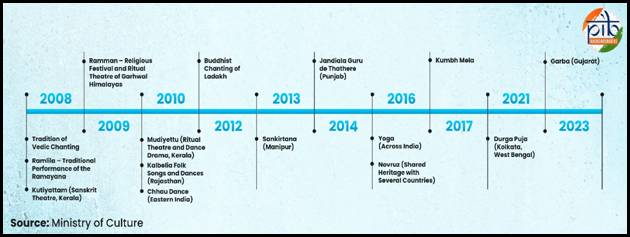
India’s UNESCO Intangible Cultural Heritage list includes
- Garba of Gujarat (2023)
- Durga Puja in Kolkata (2021)
- Kumbh Mela (2017)
- Yoga (2016)
- Nowruz (2016)
- Traditional brass and copper utensil-making by the Thatheras of Jandiala Guru, Punjab (2014)
- Sankirtana of Manipur (2013)
- Buddhist chanting of Ladakh (2012)
- Chhau dance, Kalbelia dance of Rajasthan, and Mudiyettu of Kerala (2010)
- Ramman festival of Garhwal Himalayas, India (2009)
- Kutiyattam Sanskrit theatre, Ramlila, and Tradition of Vedic chanting (2008).
20th session of the UNESCO Intergovernmental Committee for Safeguarding of the ICH
- About: It is the first time India is hosting the ICH Committee session, organised by the Ministry of Culture and the Sangeet Natak Akademi.
- The event marks a key moment in India’s cultural diplomacy, coinciding with the 20th anniversary of India’s ratification of the 2003 UNESCO Convention.
- Key Objectives of the 20th Session: Examine and evaluate new nominations submitted by States Parties for inscription on UNESCO’s ICH Lists.
- Review the status of already-inscribed elements through periodic reports.
- Strengthen international cooperation, capacity building, and exchange of best practices among Member States.
- Significance for India: The session allows India to showcase its national ICH safeguarding model, which integrates documentation, community participation, and institutional support.
- It enhances global visibility for India’s diverse intangible heritage while strengthening the country’s soft power and cultural leadership.
Frequently Asked Questions (FAQs)
Q. What is UNESCO’s Intangible Cultural Heritage (ICH) Representative List?
The ICH Representative List, created under the 2003 UNESCO Convention, identifies living traditions—rituals, performing arts, crafts—whose safeguarding promotes cultural diversity, intercultural dialogue and community-led preservation.
Q. How are elements nominated for the ICH Representative List?
States submit a nomination file (one nomination every two years) demonstrating community consent, safeguarding plans, and cultural significance; nominations are evaluated by the Intergovernmental Committee.
Q. Why is Deepavali’s inscription significant for development policy?
Deepavali’s inclusion recognises its role in sustaining seasonal livelihoods, supporting artisans and cultural tourism, and contributing to SDGs such as No Poverty (SDG 1), Good Health (SDG 3), Gender Equality (SDG 5) and Sustainable Cities (SDG 11).
UPSC Civil Services Examination, Previous Year Questions (PYQs)
Prelims
Q. Recently, which one of the following was included in the UNESCO’s World Heritage list? (2009)
(a) Dilwara Temple
(b) Kalka-Shimla Railway
(c) Bhiterkanika Mangrove Area
(d) Visakhapatnam to Araku valley railway line
Ans: B
Q2.With reference to Manipuri Sankirtana, consider the following statements: (2017)
- It is a song and dance performance
- Cymbals are the only musical instruments used in the performance
- It is performed to narrate the life and deeds of Lord Krishna
Which of the statements given above is/are correct?
(a) 1, 2 and 3
(b) 1 and 3 only
(c) 2 and 3 only
(d) 1 only
Ans: B



