
Governance
Strengthening Policing for India’s Future
This editorial is based on “Police reforms and the making of Viksit Bharat” which was published in The Hindustan Times on 04/12/2025. The article brings into picture the urgent need to shed colonial-era policing mindsets and build a citizen-centric, service-oriented force. This requires implementing Supreme Court-mandated reforms, ensuring autonomy, and modernising policing to restore public trust.
For Prelims: Indian Penal Code, Evidence Act, Bharatiya Nyaya Sanhita (BNS), Bharatiya Nagarik Suraksha Sanhita (BNSS), Bharatiya Sakshya Adhiniyam (BSA), Prakash Singh vs. Union of India, National Investigation Agency, India Justice Report 2025, India's police force
For Mains: Evolution of India’s Police System, Systemic Issues that Hold Back Effective Policing in India
The Indian Prime Minister's recent call to transform public perception of India's police force highlights a critical challenge: 78 years after Independence, we remain saddled with a colonial-era police system designed to serve imperial interests, not democratic values. Building a developed India requires more than economic progress, it demands solid foundations of law and order rooted in justice and public trust. This transformation necessitates a comprehensive, multi-pronged effort beginning with the police themselves, who must replace colonial attitudes with a service-oriented mindset marked by courtesy, professionalism, and responsiveness. Equally crucial is implementing Supreme Court-mandated reforms to ensure operational autonomy, eliminating political interference, and investing in modern infrastructure and technology.
What Key Transformations Define the Evolution of the Police System in India?
- The Legislative "Decolonization" (2023-24): For over 160 years, Indian policing was anchored in the Indian Penal Code, Evidence Act, and Code of Criminal Procedure.
- The most significant recent transformation is the repeal of these colonial laws in favor of the "Bharatiya" codes, marking a symbolic and procedural shift from "Punishment" (Dand) to "Justice" (Nyaya).
- The new laws, Bharatiya Nyaya Sanhita (BNS), Bharatiya Nagarik Suraksha Sanhita (BNSS), and Bharatiya Sakshya Adhiniyam (BSA) mandate the use of forensics in all crimes punishable by 7+ years, recognize electronic records as primary evidence, and introduce community service as a penalty.
- This forces the police to move away from "confession-based" investigation (often leading to third-degree torture) to "evidence-based" policing, requiring a massive upgrade in scientific capabilities.
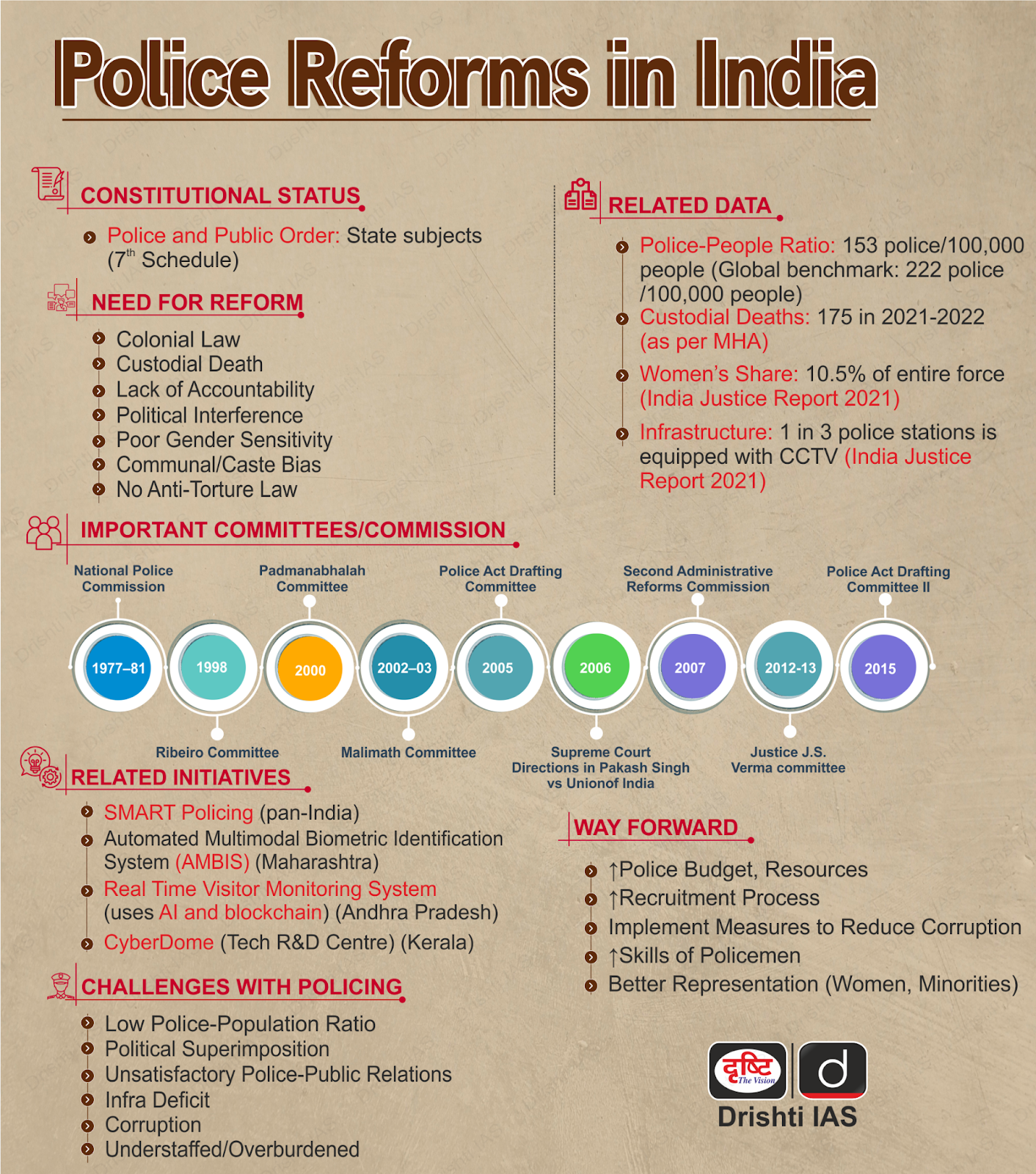
- The "Prakash Singh" Watershed (Judicial Activism): The single most defining moment for structural reform was the Supreme Court's 2006 judgment in Prakash Singh vs. Union of India.
- Before this, police reforms were largely academic discussions in committee reports (like the National Police Commission, 1977).
- The Court bypassed legislative lethargy and issued key binding directives to insulate the police from political pressure.
- Fixed Tenure: Ensuring DGPs and SPs serve a minimum of 2 years to prevent politically motivated transfers.
- Separation of Wings: Mandating a separate "Investigation" wing (for crime solving) from the "Law & Order" wing (for crowd control), though implementation remains patchy.
- Police Establishment Boards (PEB): Taking transfer decisions out of the hands of politicians and giving them to senior police officers.
- The Digital Leap- From "Thana Records" to CCTNS: Historically, Indian policing was disconnected; a criminal in one district was unknown to the police in the next. The aftermath of the 26/11 Mumbai attacks triggered a massive digital transformation.
- Networked Policing: The creation of the Crime and Criminal Tracking Network & Systems (CCTNS) connected over 17,000+ police stations into a single digital grid.
- Data-Driven Intelligence: This evolved into the Inter-operable Criminal Justice System (ICJS), which now integrates police, courts, prisons, and forensics data.
- This shift allows for "predictive policing" and instant background checks, a far cry from the manual registers of the 20th century.
- Centralization of Specialized Policing: While "Police" is a State subject under the Constitution, the nature of modern crime (terrorism, money laundering) respects no borders.
- A key transformation has been the federalization of investigation through specialized central agencies.
- The rise of the National Investigation Agency (NIA) (post-2008) and the empowered Enforcement Directorate (ED) represents a shift where high-stakes policing is increasingly handled by the Centre, bypassing state police limitations.
- The Paradigm of "Smart Policing": In 2014, the Prime Minister introduced the acronym SMART (Strict and Sensitive, Modern and Mobile, Alert and Accountable, Reliable and Responsive, Techno-savvy and Trained).
- Soft Skills & Community: This marked a doctrinal shift from "Force" to "Service."
- Experiments like Janamaithri Suraksha (Kerala) and Friends of Police (Tamil Nadu) moved policing towards community engagement.
- Technology Integration: It pushed for the adoption of body cameras, drones for crowd monitoring, and AI-based facial recognition systems , attempting to reduce human error and bias.
- Soft Skills & Community: This marked a doctrinal shift from "Force" to "Service."
What Systemic Issues Hold Back Effective Policing in India?
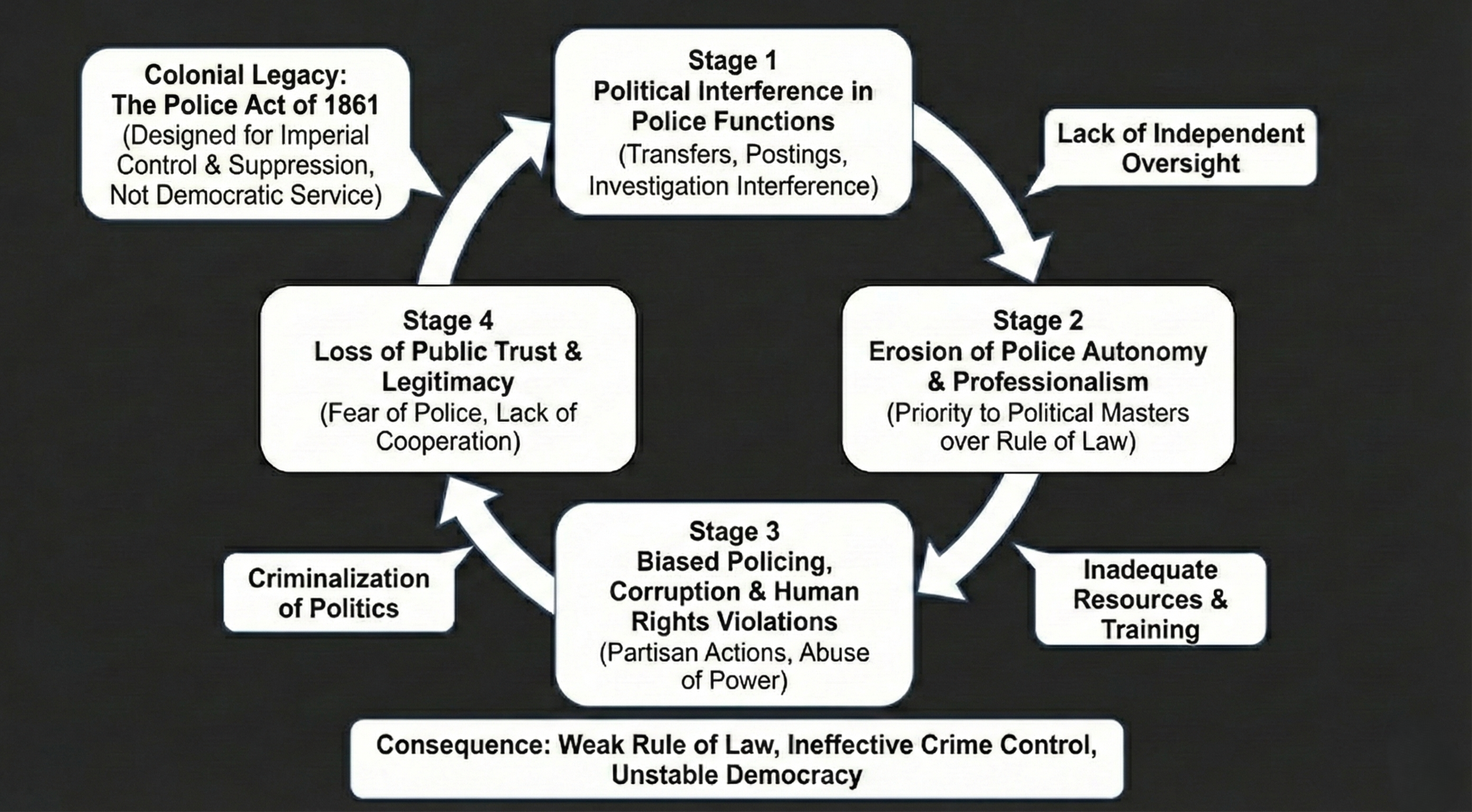
- Politicization and Lack of Operational Autonomy: The police force remains heavily compromised by the "transfer-posting industry," where political executives manipulate tenure to control investigations and suppress dissent, violating the Supreme Court's Prakash Singh directives.
- This lack of functional autonomy forces officers to prioritize political loyalty over the rule of law, eroding public trust and impartial justice delivery.
- For instance, in October 2024, a Tamil Nadu DSP investigating the sensitive Armstrong murder case was abruptly transferred (stayed by the Supreme Court), drawing criticism for political interference.
- Chronic Personnel Deficit and Overburdened Workforce: India's police-to-population ratio remains abysmally low, creating a reactive rather than proactive force that is perpetually exhausted, leading to poor quality investigations and delayed justice.
- This manpower crunch forces the existing staff to work inhumane hours, directly impacting their efficiency and ability to engage in community policing or intelligence gathering.
- The India Justice Report 2025 highlights that actual police strength sits at roughly 155 per 100,000 population, well below the sanctioned strength of 197
- Over 5.3 lakh vacancies exist across state police forces as per government’s 2021 report.
- Toxic Work Culture and Mental Health Crisis: The "constabulary culture" treats lower-ranking personnel as subservient labor rather than professional assets, subjecting them to 14-hour workdays, denied leaves, and abusive hierarchies.
- This systemic neglect has triggered a severe mental health crisis, where stress and burnout are normalized, leading to high rates of suicide and fratricide within the uniformed forces.
- For instance, a sub-inspector in Karnataka died of stress-induced cardiac arrest in August 2024 after alleged harassment over a transfer, sparking state-wide outrage.
- While CISF reported a dip in suicides in 2024, CAPF and state police suicide rates remain alarming.
- Gender Disparity and "Masculine" Policing Structure: Policing in India remains deeply patriarchal, with women largely relegated to desk jobs or "women's help desks" rather than active combat or investigative roles, limiting the force's ability to handle gender-sensitive crimes.
- The systemic bias in recruitment and posting ensures that the force does not reflect the diversity of the society it serves, hindering effective communication with 50% of the population.
- For instance, Karnataka has only 8.91% women in its police force, well below the national average of 12.73%, and far behind States like Bihar, which has the highest share at 23.66%.
- This is despite Karnataka reserving 25% of posts for women, a project study by the National Law School of India University (NLSIU), Bengaluru.
- Infrastructure Gaps vs. "Smart Policing" Rhetoric: While the government pushes for "Smart Policing" and AI integration, the ground reality is a crumbling infrastructure where basic forensic tools, vehicles, and cyber-labs are missing in rural and semi-urban stations.
- This digital divide renders the new criminal laws (implemented July 2024), which mandate video recording of evidence, practically unimplementable in many districts due to lack of cloud storage and devices.
- Recent government data state that 63 police stations in the country do not have any vehicles at their disposal, 628 police stations do not have a landline telephone connection, and 285 police stations function without a wireless set or mobile phone.
- At the beginning of 2017, 273 police stations across the country did not possess a single transportation vehicle.
- Custodial Violence and Lack of Accountability: A culture of impunity persists where "third-degree" torture is viewed as a legitimate investigative tool, driven by the pressure to produce quick "results" in the absence of scientific interrogation skills.
- Internal accountability mechanisms are weak, and the refusal to ratify the UN Convention Against Torture allows these human rights violations to continue unchecked, alienating marginalized communities.
- The Status of Policing in India Report 2025 revealed a disturbing trend where 38% of personnel still justify extrajudicial punishments for minor offenses.
- The National Human Rights Commission reported over 2150 cases of deaths in judicial custody and 155 deaths in police custody in 2021-22.
- Colonial Legal Legacy and Stalled Reforms: Despite the introduction of the Bharatiya Nyaya Sanhita in 2024, the core administrative structure remains tethered to the colonial Police Act of 1861, designed to rule subjects rather than serve citizens.
- The persistent refusal of states to adopt the Model Police Act 2006 or separate the "investigation" wing from "law and order" ensures that policing remains a tool of state control rather than a professional service.
- A 2020 report stated that no Indian state is fully compliant with 14-year-old Supreme Court directives for police reforms.
What are the Key Committees on Police Reforms in India?
|
Committee/Commission |
Reforms Proposed |
|
Malimath Committee (2003) |
Suggested strengthening forensic and investigative machinery, establishing a federal agency for grave national crimes, and introducing a robust witness protection framework. |
|
Gore Committee (1971) |
Advocated for a shift towards a more professional and citizen-centric police force, with strong emphasis on human rights sensitization and ethical standards in police training. |
|
Ribeiro Committee (1998) & Padmanabhaiah Committee (2000) |
Reiterated earlier reforms, calling for independent police complaints authorities, improved training systems, and promoting community-based policing. |
|
National Police Commission (NPC) (1977–1981) |
Recommended separating investigation from law-and-order duties, ensuring fixed tenures for senior officers, and drafting a modern Police Act to replace the colonial-era 1861 Act. |
What Measures can India Adopt to Move Towards Effective Transformation of Policing?
- Structural Decoupling of Investigation and Law & Order: To prevent the dilution of justice by daily urgencies, states must enforce a strict functional separation between the "Law and Order" wing (crowd control, VIP security) and the "Investigation" wing.
- This involves creating a dedicated detective cadre that is immune to diversion for bandobast duties, ensuring that crime-solving remains a specialized, uninterrupted focus.
- By professionalizing the investigative arm with distinct hierarchy and resources, the police can ensure higher conviction rates and scientific case management without the distraction of political rallies or festivals.
- Transitioning to a commissionerate system further reinforces accountability and efficiency, with clear demarcation between executive policing and investigative functions.
- Institutionalizing "Algorithmic Accountability" and Predictive Policing: Moving beyond basic digitization, the force must adopt predictive policing models that utilize AI to analyze crime hotspots and recidivism patterns from the CCTNS database.
- This transition to data-driven decision making allows for the pre-emptive deployment of resources rather than reactive scrambling, effectively preventing crime before it occurs.
- Integrating inter-operable criminal justice data ensures that officers on the ground have real-time intelligence on suspects, transforming the beat constable into a smart, informed first responder.
- Mandatory Forensic-First Investigative Protocols: With the new Bharatiya Nagarik Suraksha Sanhita (BNSS) mandating forensic evidence, there must be a massive, decentralized rollout of Mobile Forensic Units to every district.
- The reform requires a shift from "confession-based" investigation to "evidence-based" prosecution, where scientific collection of DNA and ballistics becomes the primary tool, rendering third-degree torture obsolete.
- This necessitates equipping every station with basic forensic kits and trained scientific officers to preserve the "chain of custody" from the crime scene to the courtroom.
- Community-Led "Participatory Security" Architecture: Reforming the police-public interface requires institutionalizing community policing not just as a soft initiative but as a core operational strategy.
- By creating statutory Citizen-Police Liaison Committees at the ward level, the police can crowdsource intelligence and de-escalate local tensions before they flare into riots.
- This collaborative security model transforms the citizenry from passive subjects into active "prosumers" of safety, bridging the trust deficit and acting as a force multiplier for the overburdened constabulary.
- Operational Insulation via Independent Establishment Boards: To break the nexus between crime and politics, the power of transfers and postings must be strictly vested in independent Police Establishment Boards (PEB) rather than the political executive.
- This ensures that officer tenure is secured against political whims, allowing honest officers to enforce the rule of law without fear of punitive transfers.
- Granting functional autonomy to the police leadership in operational matters is critical to fostering a culture of professional integrity and neutral law enforcement.
- Human Capital Optimization and Psychological Resilience: A transformative reform must address the "invisible crisis" of burnout by mandating a shift system ensuring an 8-hour workday and weekly offs for the constabulary.
- Integrating psychological health support and regular stress management workshops into the service rules will reduce the alarming rates of fratricide and suicide.
- Treating the lower ranks as skilled professionals rather than unskilled labor involves upgrading their housing, allowances, and dignity, which directly correlates to their behavior with the public.
- In the capacity development front, Mission Karmayogi is driving this transformation by training officials to move from a rule-based approach to a role-based mindset.
- Cyber-Capability Integration at the Station Level: As crime migrates to the digital realm, every police station must be upgraded into a Cyber-First Responder node, capable of handling digital financial fraud and social media crimes.
- This involves creating a specialized Cyber-Desk in every Thana staffed by technically proficient personnel, rather than funneling all cases to a central cyber cell.
- Empowering local police with digital forensic tools and cloud-based evidence management systems ensures that the force stays relevant in an era of hybrid warfare and online threats.
Conclusion:
India stands at a decisive moment where policing must shift from colonial control to democratic service. Meaningful transformation will require professional autonomy, scientific investigation, community partnership, and humane working conditions. As new criminal laws and digital systems reshape the justice landscape, implementation must match ambition. Only then can India build a police force that not only enforces the law but also earns the nation’s trust.
|
Drishti Mains Question: “Police reforms are as much about institutional accountability as they are about cultural transformation within the force. Elaborate.” |
FAQs
Q. Why is police reform urgently needed in India?
India continues to operate with a policing structure rooted in the 1861 colonial Police Act. Outdated laws, political interference, manpower shortages, and weak accountability mechanisms hinder effective, citizen-centric policing, making reforms essential for a developed and democratic India.
Q. How will the new Bharatiya criminal laws impact policing?
The BNS, BNSS, and BSA push policing toward forensic-based investigations, digital evidence, and faster justice delivery. They shift the focus from confession-driven methods to scientific, transparent, and accountable policing.
Q. What are the main challenges preventing effective police reforms?
Key obstacles include politicized transfers, inadequate infrastructure, gender imbalance, chronic understaffing, mental health crises, and poor implementation of Supreme Court directives such as the Prakash Singh reforms.
Q. How can community policing improve trust between citizens and the police
Community-led models foster cooperation, encourage local intelligence sharing, prevent conflicts, and humanize policing. They shift the relationship from fear-driven to trust-driven, improving law and order outcomes.
Q. What steps can strengthen India’s police system for the future?
Strengthening the force requires separating law-and-order duties from investigations, adopting predictive policing, enhancing forensic capacity, ensuring operational autonomy, investing in mental health and training, and equipping police with modern cyber capabilities.



