
International Relations
India-West Asia Strategic Reset
This editorial is based on “India’s new idiom for ties with West Asia” which was published in The Hindustan Times on 15/12/2025. The article brings into perspective India’s transition in West Asia from narrow economic engagement to a consolidated, multi-pillar strategic partnership, built through sustained high-level diplomacy.
For Prelims: India-GCC trade, IMEC, Comprehensive Economic Partnership Agreement, Chabahar port, Exercise Desert Flag-10, Exercise Cyclone, I2U2 grouping, North-South Transport Corridor.
For Mains: Key Strides in India-West Asia Relations, Key Areas of Friction Between India and West Asia.
The Indian Prime Minister’s West Asia diplomacy has evolved from breakthrough to consolidation, transforming India's regional engagement beyond oil and remittances into a comprehensive strategic partnership. Through sustained high-level visits and reciprocal exchanges, India has positioned itself as a stabilizing force amid regional turbulence, balancing relationships with all major powers without alienating any ally. The approach blends economic pragmatism, evidenced by $178.56 billion in India-Gulf Cooperation Council trade, with civilizational diplomacy that leverages India's pluralist identity and cultural soft power. Energy security, connectivity initiatives like IMEC, defense cooperation, and diaspora welfare now form the pillars of this multifaceted engagement.
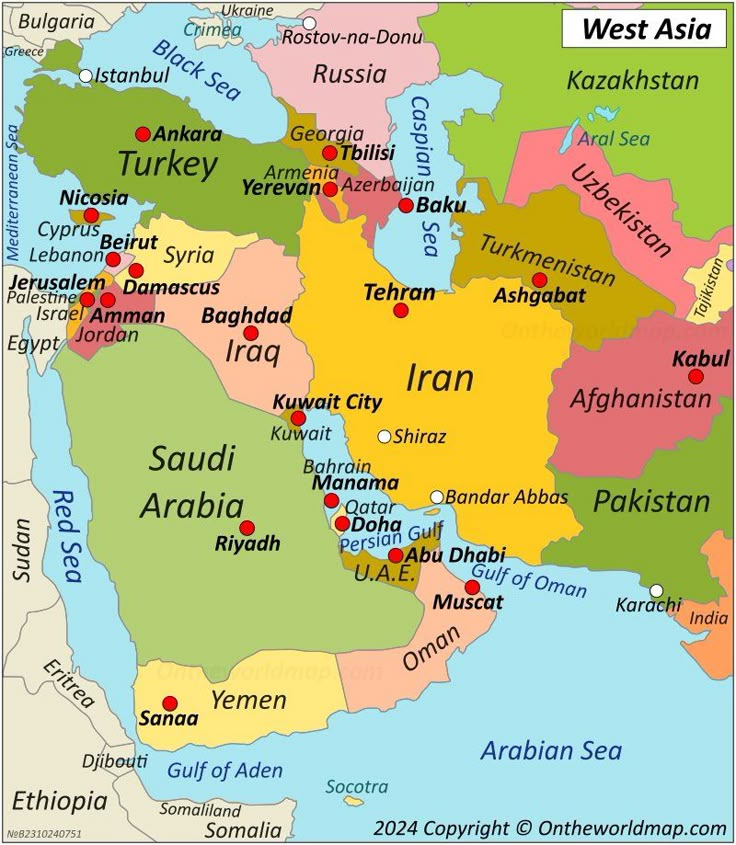
What are the Key Strides in India-West Asia Relations?
- Strategic De-hyphenation & High-Stakes Diplomacy: India has mastered "strategic de-hyphenation," engaging fiercely with Arab nations (UAE, Saudi Arabia) while maintaining robust ties with Israel and Iran, insulated from regional conflicts.
- This maturity was tested during the Israel-Hamas war, where India balanced counter-terror support with humanitarian aid to Palestine, securing its interests without taking sides.
- The 2nd India-Saudi Strategic Partnership Council (SPC) meeting (April 2025) deepened security ties independent of broader regional turbulence.
- Institutionalized Economic Integration: Moving beyond "buyer-seller" oil relations, India is locking in long-term economic interdependence through Comprehensive Economic Partnership Agreements (CEPA).
- The success of the UAE pact has created a template for the region, catalyzing faster negotiations with Oman and the GCC to boost non-oil trade and investment flows.
- For instance, Bilateral trade between India and the UAE surged from $50 billion in 2021 to approximately $85 billion in 2024.
- In December 2025 Cabinet approved the India-Oman Free Trade Agreement that marks the next big milestone.
- Energy Security 2.0-From Hydrocarbons to Green Hydrogen: India is future-proofing its energy basket by securing long-term gas contracts while simultaneously co-developing green energy frameworks with Gulf monarchies.
- This dual strategy ensures immediate fuel stability while leveraging the Gulf's capital for India's National Green Hydrogen Mission and renewable transitions.
- For instance, in February 2024, India signed a $78 billion deal with Qatar to import 7.5 million tonnes of LNG annually for 20 years (until 2048).
- Also, Agreements with UAE and Saudi Arabia on Green Hydrogen and grid interconnection target zero-carbon supply chains.
- Strategic Connectivity Architecture: India is aggressively building alternative trade corridors to bypass Pakistan and counter China's BRI, exemplified by the operational control of Chabahar port and the IMEC vision.
- Despite West Asian instability, India solidified its "Gate to Central Asia" to ensure supply chain resilience and access to Eurasian markets.
- For instance, in May, 2024, India signed a historic 10-year contract to operate the Shahid Beheshti Terminal at Chabahar Port, Iran.
- India committed $120 million in equipment investment and a $250 million credit line to upgrade the terminal’s capacity.
- Defense "Minilateralism" & Security Net Provider: New Delhi has graduated to a "first responder" and security partner in the Gulf, moving from passive observer to active participant in naval security and defense manufacturing.
- Regular high-complexity military exercises signal a shared intent to police the Arabian Sea and protect critical sea lanes of communication.
- For instance, India participated in Exercise Desert Flag-10 in UAE (April 2025) and Exercise Cyclone with Egypt to enhance interoperability.
- Ongoing sales discussions for BrahMos missiles and Pinaka rockets to regional partners mark India's rise as a net security exporter.
- Fintech Diplomacy & Soft Power Projection: India is seamlessly integrating its Digital Public Infrastructure (DPI) with West Asian financial systems to benefit its massive diaspora and facilitate seamless cross-border transactions.
- This "fintech diplomacy" reduces remittance costs and cements the Indian Rupee's global footprint alongside cultural milestones.
- For instance, UPI (Unified Payments Interface) is now live in UAE and Qatar, enabling instant payments for Indian travelers and NRIs.
- Also, the inauguration of the BAPS Hindu Mandir in Abu Dhabi stands as a monumental symbol of cultural acceptance and soft power.
- I2U2 & The Food Security Corridor: The I2U2 grouping (India, Israel, UAE, USA) has successfully operationalized a food security corridor, leveraging Gulf capital and Israeli agritech to transform India’s agricultural output into a reliable supply base for West Asia.
- This strategic interdependence proactively insulates the region from global supply chain shocks and creates a unique "food-for-energy" security balance.
- For instance, the United Arab Emirates has pledged $2 billion to help develop a series of "food parks" in India to tackle food insecurity in South Asia and the Middle East.
What are the Key Areas of Friction Between India and West Asia?
- The "Strategic Neutrality" Stress Test (Israel-Hamas Fallout): India’s "de-hyphenated" stance faces severe strain as the prolonged Gaza conflict alienates the "Arab Street," even if ruling monarchies remain pragmatic.
- New Delhi's refusal to explicitly condemn Israeli actions as "genocide" creates a values-gap with the Global South and West Asian public opinion, complicating its soft power projection in the Islamic world.
- For instance, India in April 2024 abstained on a resolution at the Human Rights Council that called on Israel for an immediate ceasefire in Gaza and called on states to implement an arms embargo, which was adopted by the 47-member Human Rights Council.
- Though recently, India was among the 142 nations that voted in favour of the resolution titled ‘Endorsement of the New York Declaration on the Peaceful Settlement of the Question of Palestine and the Implementation of the Two-State Solution’.
- Sanctions Uncertainty & The Chabahar Dilemma: The persistent threat of US sanctions on Iran cripples India's ability to fully operationalize the Chabahar Port, turning a strategic asset into a diplomatic liability.
- The vacillating US waiver policy forces India to walk a tightrope, delaying the International North-South Transport Corridor (INSTC) and allowing China to entrench its presence in Iranian infrastructure.
- In September 2025, the US briefly revoked the Chabahar waiver before reinstating a 6-month exemption in October 2025, creating investment paralysis.
- The OIC "Kashmir" Irritant vs. Bilateral Warmth: A structural disconnect exists where individual Gulf nations (UAE, Saudi) embrace India, but the Organisation of Islamic Cooperation (OIC) acts as a hostile multilateral bloc.
- Pakistan’s leverage within the OIC ensures regular, harsh resolutions on Kashmir and Indian minority rights. For instance, The OIC Contact Group on Jammu & Kashmir issued a statement condemning "demographic changes" in the region , forcing New Delhi to constantly expend diplomatic capital to "manage" these statements.
- Widening Trade Deficit & Energy Asymmetry Despite Free Trade Agreements (FTAs), the trade relationship remains heavily skewed in favor of West Asia due to India’s inelastic demand for hydrocarbons.
- The "Oil-for-Goods" equation hasn't shifted fast enough, Indian non-oil exports struggle to offset the massive import bill, leading to a recurring balance of payments pressure.
- Oil/Gas still constitutes ~60% of India's import basket from the region. Also, more than 18% of India's crude oil imports are sourced from Saudi Arabia (IBEF).
- Labor Rights & The "Kafala" System Legacy: The structural exploitation of India's blue-collar workforce remains a sensitive humanitarian friction point, exacerbated by occasional tragedies.
- While "Mobility Pacts" exist on paper, the practical enforcement of safety standards and wage protection under the "Kafala" (sponsorship) system is slow, leaving low-skilled workers vulnerable to abuse.
- For instance, the Kuwait Mangaf fire (June 2024) killed more than 40 Indians, exposing sub-standard labor housing enforcement across the GCC.
- Red Sea Security & Houthi Asymmetry: The Houthi militia's attacks on commercial shipping have exposed the limits of India's role as a "Net Security Provider" in the region.
- India faces a dilemma: it must protect its merchant fleet (deploying destroyers) but cannot join the US-led "Operation Prosperity Guardian" coalition to avoid looking like a Western military ally, leading to operational friction.
- For instance, India has deployed over 10 warships with marine commandos in the Arabian Sea and Gulf of Aden, showing its naval presence to deter piracy and drone strikes, but refused to join the US-led coalition, leading to coordination gaps.
- The "China Factor" & Mediation Monopoly: China has successfully positioned itself as the primary political mediator in West Asia (e.g., Saudi-Iran deal), while India is seen largely as an economic partner.
- This "Diplomatic Deficit" restricts India's strategic maneuverability, Beijing’s ability to guarantee security deals (which India cannot) makes it the preferred partner for long-term strategic alignments.
- In 2020, China replaced the European Union (EU) as the GCC's largest trading partner.
- Recently, the Secretary General of the GCC highlighted the importance of strong relations with China. Trade between the two reached over 288 billion dollars in 2024., that dwarfs India’s trade with GCC.
What Measures can India Adopt to Enhance ties with West Asia?
- Institutionalize "Strategic Engagement" via 2+2 Dialogues: India must graduate its diplomatic engagement from leader-centric summitry to institutionalized, bureaucratic consistency by establishing "2+2 Ministerial Dialogues" (Foreign + Defense) with key pillars like Saudi Arabia and the UAE.
- This structural mechanism would insulate bilateral ties from regional volatility, ensure continuous high-level strategic communication, and facilitate real-time coordination on counter-terrorism and maritime security, mirroring India’s robust frameworks with the US and Japan.
- Recalibrate IMEC Focus to the "Eastern Corridor": Given the geopolitical instability in the Levant/Mediterranean impacting the full India-Middle East-Europe Economic Corridor (IMEC), India should aggressively operationalize the "Eastern Leg" (India to Arabian Peninsula) first.
- By prioritizing digital and energy grid connectivity with UAE and Saudi Arabia immediately, India can lock in supply chain integration and reduce logistics costs for its exports, ensuring the project remains viable and strategically potent even while the northern transit routes stabilize.
- Pivot to a "Green Energy Interdependence" Framework: New Delhi needs to proactively align its National Green Hydrogen Mission with the Gulf nations' "Vision 2030" diversification strategies to transition from a buyer-seller oil relationship to a co-production partnership.
- Establishing joint ventures for Green Hydrogen manufacturing and exploring "One Sun One World One Grid" interconnections will create deep, structural economic dependencies that are immune to oil price shocks and position India as a critical partner in the region's post-carbon future.
- Transition from "Manpower" to "Human Capital" Harmonization: To counter labor market nationalization (Nitaqat) policies, India must implement comprehensive "Skill Harmonization Programs" that map Indian certification standards directly to GCC industry requirements.
- By establishing skill-finishing schools in India tailored to high-tech, nursing, and engineering demands of West Asia, India can move up the value chain, ensuring its diaspora remains indispensable while securing higher remittance inflows through "white-collar" migration.
- Leverage "Fintech Diplomacy" for Economic Integration: India should aggressively push for the integration of its Unified Payments Interface (UPI) with local platforms (like Saudi’s SADAD) to create a seamless cross-border remittance corridor.
- Reducing transaction costs for the massive Indian diaspora and enabling local currency trade settlements (Rupee-Dirham/Riyal) will reduce dependence on the US Dollar, shield bilateral trade from western currency fluctuations, and cement India’s financial soft power in the region.
- Offer "Defense Solutions" over Security Guarantees: Recognizing it cannot replace the US as a security guarantor, India should instead position itself as a reliable "Defense Solutions Provider" by accelerating the export of cost-effective, combat-proven platforms like BrahMos missiles and Akash air defense systems.
- Strengthening joint manufacturing ecosystems and offering maintenance, repair, and overhaul (MRO) facilities for naval vessels can create a sticky security partnership that respects "strategic autonomy" while deepening military trust.
- Establish a "Space & Cyber" Diplomacy Corridor India should aggressively market its "New Space" ecosystem by offering ISRO’s cost-competitive commercial launch services and satellite manufacturing expertise to support the burgeoning space ambitions of Saudi Arabia and the UAE.
- Creating specific "Joint Working Groups" for cyber-security training and interplanetary missions will align India with the region's futuristic "Vision" documents, fostering a partnership rooted in scientific prestige rather than traditional hydrocarbon dependency.
Conclusion
India’s evolution from transactional engagement to strategic "de-hyphenation" in West Asia marks a masterclass in realist diplomacy, successfully insulating vital economic corridors from regional turbulence. By pivoting from hydrocarbon dependency to "existential interdependence"—anchored in food security, fintech, and defense—New Delhi has future-proofed its interests against geopolitical shocks. As the global order fractures, this solidified partnership will not just fuel India’s $5 trillion ambition but stand as a decisive pillar of stability for the wider Global South.
|
Drishti Mains Question: “India’s engagement with West Asia has evolved from transactional energy ties to a comprehensive strategic partnership.” Critically examine the drivers of this transformation and assess its implications for India’s foreign policy, economic security, and regional stability. |
FAQs
Q. Why is India’s contemporary engagement with West Asia described as a shift from transactional to strategic?
India’s West Asia policy has moved beyond oil, remittances, and episodic diplomacy to a multi-pillar strategic partnership encompassing energy security, connectivity corridors (IMEC, Chabahar), defence cooperation, digital integration, and food security. Sustained high-level engagements and institutional mechanisms have enabled India to act as a stabilising power rather than a passive economic partner.
Q. How has India managed strategic de-hyphenation in a conflict-prone West Asian region?
India has successfully balanced deepening ties with Arab Gulf states, Israel, and Iran simultaneously, insulating bilateral relationships from regional conflicts. This approach was evident during the Israel-Hamas war, where India combined counter-terror concerns with humanitarian support, maintaining credibility across camps without formal alignment.
Q. What are the emerging economic and energy pillars of India–West Asia relations?
India is institutionalising economic interdependence through CEPAs, long-term LNG contracts, and diversification into green hydrogen and renewable energy cooperation. This dual strategy ensures short-term energy security while aligning Gulf capital with India’s clean-energy transition, transforming hydrocarbons dependency into future-oriented energy partnerships.
Q. What are the major fault lines constraining India–West Asia relations?
Key challenges include the strain on India’s strategic neutrality during the Gaza conflict, uncertainty over US sanctions affecting Chabahar and INSTC, OIC’s adversarial stance on Kashmir, persistent trade deficits driven by hydrocarbon imports, labour rights concerns under the Kafala system, and China’s growing role as a political mediator in the region.
Q. What strategic recalibrations are required for India to deepen its West Asia footprint?
India must institutionalise 2+2 dialogues, prioritise the eastern leg of IMEC, shift towards green-energy co-production, upgrade its diaspora from manpower to human capital, expand fintech and digital payment integration, position itself as a defence solutions provider, and leverage space and cyber diplomacy to anchor long-term strategic relevance.
UPSC Civil Services Examination, Previous Year Question (PYQ)
Prelims
Q. Which one of the following countries of South-West Asia does not open out to the Mediterranean Sea? (2015)
(a) Syria
(b) Jordan
(c) Lebanon
(d) Israel
Ans: B
Q. The term “two-state solution” is sometimes mentioned in the news in the context of the affairs of (2018)
(a) China
(b) Israel
(c) Iraq
(d) Yemen
Ans: B
Mains
Q. “India’s relations with Israel have, of late, acquired a depth and diversity, which cannot be rolled back.” Discuss. (2018)



