


Indian Economy
Year End Review-2025: Ministry of Micro,Small & Medium Enterprises
- 01 Jan 2026
- 15 min read
For Prelims: Micro, Small, and Medium Enterprises (MSME), Prime Minister’s Employment Generation Programme (PMEGP), Credit Guarantee Trust for Micro and Small Enterprises (CGTMSE), Self Reliant India (SRI) Fund, PM Vishwakarma Scheme, Raising and Accelerating MSME Performance (RAMP), World Bank, MSME Champion Scheme, ONDC (Open Network for Digital Commerce), Digital MSME 2.0.
For Mains: Achievements of the Ministry of MSME in the Year 2025, Contribution of MSMEs to Indian economy, associated challenges and way forward.
Why in News?
The year 2025 marked a period of transformative progress for India's Micro, Small, and Medium Enterprises (MSME) sector, reinforcing its pivotal role in employment generation and equitable economic development.
Summary
- In 2025, India’s MSME sector saw 7.3 crore registrations, strong credit support via PMEGP, CGTMSE, and PM Vishwakarma Scheme, driving growth, employment, exports, and innovation.
- Challenges like credit gaps, delayed payments, regulatory burdens, and skill deficits persist, necessitating financial reforms, digitalization, market access, and sustainable entrepreneurship.
What are the Major Achievements of the Ministry of Micro, Small & Medium Enterprises in the Year 2025?
- Massive Formalization: Over 7.30 crore enterprises registered on the Udyam Registration Portal and Udyam Assist Platform (UAP) by December 2025.
- Robust Credit Support: Prime Minister’s Employment Generation Programme (PMEGP) generated estimated employment for over 87 lakh persons since inception, assisting 10.71+ lakh micro-enterprises.
- Credit Guarantee Trust for Micro and Small Enterprises (CGTMSE) approved over 29 lakh guarantees worth Rs 3.77 lakh crore, with enhanced coverage to Rs 10 crore.
- Self-Reliant India (SRI) Fund provided equity funding of Rs 1,823 crore to 682 MSMEs.
- Infrastructure & Artisan Support: PM Vishwakarma Scheme achieved its target of 30 lakh beneficiary registrations, sanctioning Rs 2,257 crore in collateral-free loans (2025).
- Raising and Accelerating MSME Performance (RAMP), a World Bank-supported scheme, approved Rs 3,211.75 crore for states/UTs.
- The Micro and Small Enterprises Cluster Development Programme (MSE-CDP) and a dedicated scheme for the North Eastern Region (NER) promoted industrial clusters and infrastructure.
- Market Access & Inclusive Procurement: Public Procurement Policy mandate of 25% procurement from MSEs was exceeded, achieving 43.58% in 2024-25.
- National SC/ST Hub (NSSH) scheme increased procurement from SC/ST MSEs from Rs 99.37 crore (2015-16) to Rs 3,731.47 crore (2024-25).
- Technology & Skill Upgradation: MSME Champion Scheme (including Zero Defect and Zero Effect (ZED), LEAN, and Innovative components) saw ~2.7 lakh MSMEs register for ZED certification and received 52,369 ideas under Hackathon 5.0.
- New Technology Centres (TCs) and Extension Centres (ECs) were established, skilling thousands.
- Launched the Online Dispute Resolution (ODR) Portal for delayed payments. The CHAMPIONS Portal achieved a 99.38% grievance redressal rate.
- Khadi, Coir & Internationalization: Khadi and Village Industries (KVI) sales crossed Rs 1.27 lakh crore (till Nov 2025).
- Signed bilateral MoUs with Mauritius, Thailand, Slovakia, and Malaysia, and held Joint Working Group meetings with Japan and Taiwan.
Micro, Small, and Medium Enterprises (MSMEs)
- About: MSMEs are businesses defined and categorized based on their investment in plant, machinery, or equipment and their annual turnover.
- These enterprises are a cornerstone of the Indian economy, playing a crucial role in promoting entrepreneurship, generating widespread employment (over 12 crore people), and fostering industrial growth.
- Classification of MSMEs:
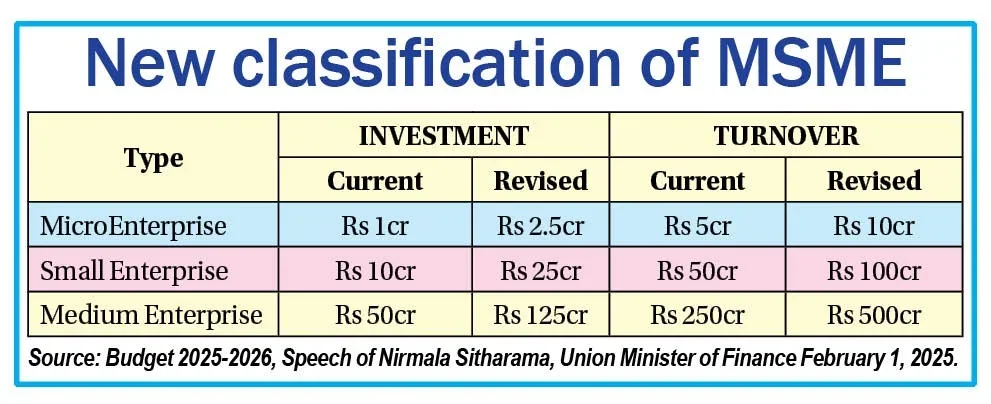
- Regulatory and Policy Framework: The primary legislation governing MSMEs is the Micro, Small, and Medium Enterprises Development Act, 2006. This Act establishes a National Board and formally defines an enterprise.
- Established in 2007, the Ministry of MSME formulates supportive policies, designs developmental programs, and oversees their implementation for the sector.
What is the Significance of MSMEs in the Growth of the Indian Economy?
- Pillar of Industrial Output: MSMEs are the structural core of India's economy, contributing around 30% to GDP and 36% to manufacturing output. They build economic resilience by driving domestic production, forming localized supply chains, and acting as essential ancillary suppliers to large-scale industries.
- Driver of Employment and Inclusive Livelihoods: The MSME sector, as India's largest non-agricultural employer, provides livelihoods for over 12 crore people. It fosters inclusive growth by absorbing semi-skilled and unskilled labor across rural and urban areas, with significant support from schemes like the PM Vishwakarma Scheme and Mudra Yojana.
- Catalyst for Exports and Global Trade Integration: MSMEs are indispensable to India's international trade, accounting for nearly 45% of its total exports. They strengthen the global footprint by dominating niche markets, exemplified by the handicraft sector contributing around 40% of global handmade carpet exports and the Agra footwear cluster representing 28% of India's footwear exports.
- Rural Industrialization and Regional Balance: The MSME sector is pivotal for realizing the PURA (Providing Urban Amenities in Rural Areas) vision by driving decentralized industrial growth. Entities like the Khadi and Village Industries Commission (KVIC) foster this by creating localized job opportunities, empowering communities, reducing migration, and ensuring balanced regional development.
- Innovation, Entrepreneurship, and Digital Transformation: MSMEs are the dynamic force powering India's 3rd-largest global startup ecosystem, fostering innovation in key sectors like e-commerce and fintech. They lead digital adoption, with 72% of transactions now digital, accelerated by initiatives like the ONDC (Open Network for Digital Commerce) and the Public Tech Platform for Frictionless Credit.
- Social Empowerment and Sustainable Development: MSMEs are a powerful instrument for social inclusion, with over 20% being women-owned and significantly supported by credit access through Mudra Yojana. Furthermore, they are leading the green transition by adopting clean energy and circular models, supported by schemes like the RAMP (Raising and Accelerating MSME Performance) programme.

What are the Key Challenges in the Growth of MSMEs in India?
- Financial Constraints and Credit Deficiency: MSMEs face a severe capital crisis due to delayed payments totalling Rs 7.34 lakh crore as of March 2024, which cripples working capital. It has a massive unmet formal credit need of around Rs 25 lakh crore, with only 19% of demand met formally, forcing reliance on expensive informal credit at rates of 30-60%.
- Burdensome Regulatory Environment: A significant compliance burden from overlapping tax, labour, and environmental laws increases costs and complexity, contributing to the high informality of over 90% of MSMEs.
- The transition to formal platforms like the Udyam portal is slow, with only 9% of registered firms having transitioned from unregistered status, which limits access to benefits and structured growth.
- Inadequate Infrastructure: Poor infrastructure, including inefficient logistics (costing 14-18% of GDP), frequent power outages, and limited digital connectivity, hinders MSME competitiveness. Technologically, they lag with only 6% using e-commerce and 45% adopting AI, restricting scalability and global value chain integration.
- Global Integration Barriers: Challenges in exporting include inadequate branding, stringent quality standards, vulnerability to global supply chain shocks (e.g., Red Sea disruptions), and high tariffs (e.g., US 50%). The "Missing Middle" problem, where 97.92% of MSMEs are micro-enterprises, further limits their capacity to compete internationally.
- Acute Skill Gaps and Sustainability Compliance Pressure: There is a persistent skill mismatch, with a 3.9% decline in knowledge-intensive hiring limiting innovation and productivity. Concurrently, MSMEs face growing pressure to meet global ESG standards, as their estimated annual production of 110 million tonnes of CO₂ and the high cost of adopting green technology pose a significant financial and competitive threat.
How can India's MSME sector be Revamped to Enhance its Competitiveness and Growth?
- Overhauling Financial Architecture: To address the massive unmet credit need, reforms should expand collateral-free lending via fintech, better integrate Mudra Yojana and CGTMSE for risk coverage. Furthermore, promoting Invoice Discounting through TReDS and strictly enforcing the 45-day payment timeline via the MSME Samadhaan Portal with automated penalties is crucial to solve the delayed payments crisis.
- Technological Integration and Digital Transformation: Accelerating AI, IoT, and automation adoption requires establishing sector-specific MSME Tech Clinics and Innovation Hubs for affordable consultancy, alongside a Digital MSME 2.0 initiative to boost ONDC integration, and cloud access.
- Market Access and Global Competitiveness: Improving exports requires creating export consortia with grant support for logistics and certifications, along with leveraging FTAs and e-commerce platforms for low-fee MSME storefronts.
- Strengthening Institutional Frameworks: Formalization should be incentivized by making Udyam registration mandatory and linking it to benefits like lower GST rates and priority lending. This should be supported by cluster-based development using Common Facility Centers (CFCs) to provide shared testing and R&D services.
- Sustainable and Inclusive Entrepreneurship: To facilitate a green transition, introduce low-interest green finance, ESG-linked credit, and tax incentives for eco-friendly practices. To promote women entrepreneurship, enhance CGTMSE credit guarantees and expand the dedicated Mudra Yojana fund.
Conclusion
In 2025, India’s MSME sector consolidated its role as an economic backbone, with 7.3 crore enterprises formalised and credit guarantees exceeding Rs 3.77 lakh crore. Sustaining this momentum requires resolving credit gaps, regulatory burdens, and technology deficits through targeted reforms, digitalisation, and sustainable, inclusive entrepreneurship to drive long-term growth.
|
Drishti Mains Question Q. Examine the role of MSMEs as the backbone of the Indian economy and discuss the key challenges hindering their integration into global value chains |
Frequently Asked Questions (FAQs)
1. What are MSMEs in India?
Micro, Small, and Medium Enterprises are defined by investment in plant, machinery, or turnover, forming the backbone of India’s economy.
2. How much do MSMEs contribute to India’s GDP and exports?
MSMEs contribute around 30% to GDP and nearly 45% to India’s total exports.
3. What is the 'Missing Middle' problem in the MSME sector?
It refers to the severe underrepresentation of medium-sized enterprises, with over 97% of MSMEs classified as micro, limiting their capacity for investment, innovation, and global competition.
UPSC Civil Services Examination, Previous Year Question:(PYQ)
Prelims
Q1. Consider the following statements with reference to India : (2023)
- According to the Micro, Small and Medium Enterprises Development (MSMED) Act, 2006, the ‘medium enterprises’ are those with investments in plant and machinery between `15 crore and `25 crore.
- All bank loans to the Micro, Small and Medium Enterprises qualify under the priority sector.
Which of the statements given above is/are correct?
(a) 1 only
(b) 2 only
(c) Both 1 and 2
(d) Neither 1 nor 2
Ans: (b)
Q2. What is/are the recent policy initiative(s)of Government of India to promote the growth of the manufacturing sector? (2012)
- Setting up of National Investment and Manufacturing Zones
- Providing the benefit of ‘single window clearance’
- Establishing the Technology Acquisition and Development Fund
Select the correct answer using the codes given below:
(a) 1 only
(b) 2 and 3 only
(c) 1 and 3 only
(d) 1, 2 and 3
Ans: (d)
Q3. Which of the following can aid in furthering the Government’s objective of inclusive growth? (2011)
- Promoting Self-Help Groups
- Promoting Micro, Small and Medium Enterprises
- Implementing the Right to Education Act
Select the correct answer using the codes given below:
(a) 1 only
(b) 1 and 2 only
(c) 2 and 3 only
(d) 1, 2 and 3
Ans: (d)
Mains
Q.1 “Industrial growth rate has lagged behind in the overall growth of Gross-Domestic-Product(GDP) in the post-reform period” Give reasons. How far are the recent changes in Industrial Policy capable of increasing the industrial growth rate? (2017)
Q.2 Normally countries shift from agriculture to industry and then later to services, but India shifted directly from agriculture to services. What are the reasons for the huge growth of services vis-a-vis the industry in the country? Can India become a developed country without a strong industrial base? (2014)



