


Social Issues
Transgender Persons Amendment Bill 2026
- 19 Mar 2026
- 15 min read
For Prelims: Transgender Persons (Protection of Rights) Act, 2019, Supreme Court, National Legal Services Authority v. Union of India, 2014, Transgender, National Council for Transgender Persons, Ayushman Bharat, World Bank, GDP.
For Mains: Key changes proposed in the Transgender Persons (Protection of Rights) Amendment Bill, 2026 and associated concerns, Key provisions of Transgender Persons (Protection of Rights) Act, 2019, Steps needed to empower transgender persons in the future.
Why in News?
The Ministry of Social Justice and Empowerment has introduced the Transgender Persons (Protection of Rights) Amendment Bill, 2026, that proposes major changes to the Transgender Persons (Protection of Rights) Act, 2019.
- Transgender activists fear the amendments aim to rewrite the legal framework for transgender rights in India, overriding the Supreme Court’s landmark National Legal Services Authority v. Union of India, 2014 judgment.
Summary
- The Transgender Persons (Amendment) Bill, 2026, proposes to replace the right to self-identification with a medical certification process, contradicting the NALSA judgment (2014).
- While introducing stricter punishments for crimes, it narrows the definition of transgender persons.
- This has raised concerns about clinical gatekeeping and the exclusion of gender-fluid individuals.
What are the Key Changes Proposed in the Transgender Persons (Protection of Rights) Amendment Bill, 2026?
- Abolition of Self-Identification: The 2026 Bill removes Section 4(2) of the 2019 Act, which enshrined the right to self-identify as a transgender person. The government argues the original definition was "vague" and made it difficult to identify the "genuinely oppressed" beneficiaries.
- The government is also of the view that the existing definition renders numerous criminal, civil, and personal laws "unworkable" and is "not compatible" with various statutory provisions. The legislation’s intended purpose was never to protect every class of persons with diverse gender identities, self-perceived sex/gender identities, or gender fluidities.
- Narrower Definition: The definition of a 'transgender person' is significantly narrowed. It primarily recognizes those with specific socio-cultural identities (like kinner, hijra, aravani and jogta) or persons with a specified, medicalised list of congenital biological variations (chromosomal patterns, gonadal development, etc).
- Name Change: It proposes that transgender persons can change their first names on birth certificates and ID documents. However, for this, individuals must meet the newly proposed statutory definition of a "transgender person".
- Introduction of Medical Certification: It replaces the administrative process for identity cards with a Medical Board (headed by a Chief Medical Officer). This board's recommendation is now mandatory for the District Magistrate to consider before issuing a certificate of identity.
- Increased Oversight: Representatives on the National Council for Transgender Persons from States/UTs must now hold a minimum rank of Director in the relevant Ministry or Department, indicating a push for higher-level bureaucratic oversight.
- New Criminal Category for Forced Identity: The Bill introduces a distinct category to address the "coerced" assumption of transgender identity. It penalizes the act of compelling a person (through force, deceit, or allurement) to undergo procedures like emasculation or hormonal changes to assume a transgender identity.
- Increased Punishments: The bill introduces stringent penalties:
- Kidnapping an adult to force a transgender identity can lead to minimum 10 years of rigorous imprisonment (RI), extendable to life. The same offence against a child mandates RI for life and a minimum fine of Rs 5 lakh.
- Forcing an adult into begging or bonded labour as a transgender person invites 5-10 years RI. The same offence against a child attracts 10-14 years RI.
What Fears are Associated with the Transgender Persons (Protection of Rights) Amendment Bill, 2026?
- Rejection of Self-Identification Principle: By removing Section 4(2) of the 2019 Act, the bill directly contradicts the core principle of the NALSA verdict, which recognized the Right to Self-Determination and held that it does not need to be proven through external, especially medical, means.
- Clinical Gatekeeping: By requiring a board headed by a Chief Medical Officer to "recommend" a person's gender to the District Magistrate, the Bill returns to a model where transgender identity is treated as a medical condition rather than a social or personal identity.
- For a transgender person, navigating a system with deep-rooted transphobia and proving their identity to a board of doctors would be extremely difficult, humiliating, and regressive.
- Exclusion of Gender Fluidity: By explicitly stating that the law is not for those with "self-perceived" or "gender fluid" identities, it ignores a vast section of the community that does not fit into rigid biological categories. Critics argue that this arbitrarily decides who is "oppressed enough" to deserve rights.
- Threat to those outside "Socio-Cultural" groups: While the Bill recognizes groups like Hijras or Kinner, it potentially delegitimizes trans persons who exist independently of these traditional systems (the guru-chela system), leaving them without legal standing.
- Reversal of Progress and Statistical Impact: With 32,424 transgender certificates and identity cards already issued under the 2019 Act, the amendment creates uncertainty. If the definition changes, it is unclear if these individuals will have to "re-prove" their identity under the new, stricter medical criteria.
- Concerns over "Forced Identity" Clauses: There are concerns that these clauses could be misused to target trans-led communities or families who support a minor's gender transition, labelling it as "allurement" or "inducement" under the new, stricter definitions.
Transgender Persons (Protection of Rights) Act, 2019
The Transgender Persons (Protection of Rights) Act, 2019, enacted following the NALSA v. Union of India (2014) judgment, provides legal recognition and rights to transgender persons in India.
- Definition of Transgender: Defines a transgender person as one whose gender does not match the gender assigned at birth, inclusively covering trans men, trans women, intersex persons, and socio-cultural identities like kinner and hijra, regardless of medical interventions.
- According to Census 2011, India's transgender population stands at approximately 4.88 lakh, with Uttar Pradesh, Andhra Pradesh, and Maharashtra being the top three states.
- Right to Self-Identification: Grants the right to self-perceived gender identity. A certificate of identity is issued by the District Magistrate through a purely administrative process, without any medical examination.
- Prohibition of Discrimination: Forbids discrimination in education, employment, healthcare, and public facilities.
- Institutional Mechanism: Establishes a National Council for Transgender Persons to advise the government on welfare policies, monitor implementation, and coordinate inter-ministerial efforts.
- Offences & Penalties: Prescribes punishment (6 months to 2 years imprisonment and fine) for offences like forced labour and abuse.
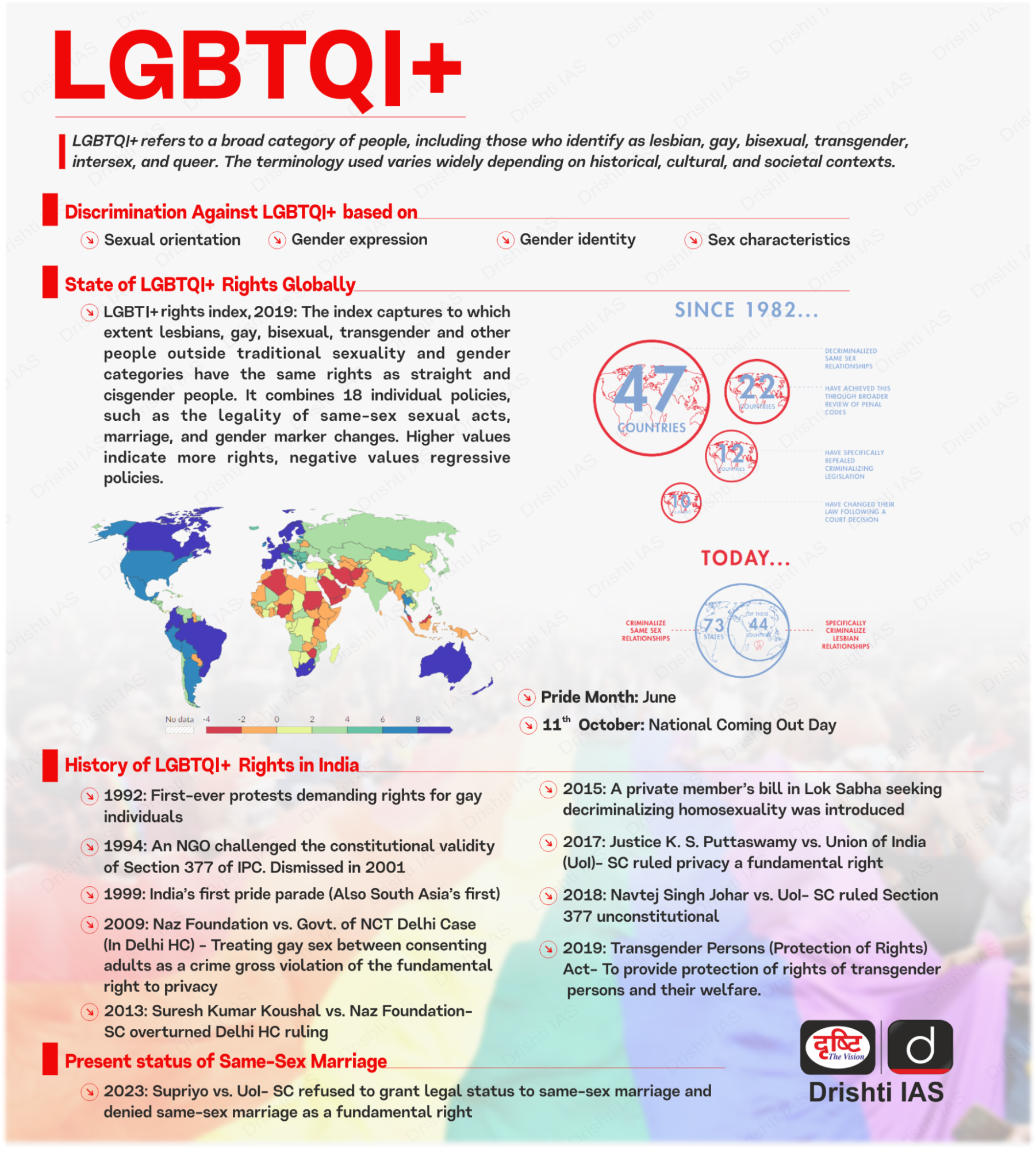
What Steps Should India Take to Empower Transgender Persons in the Future?
- Restoring Self-Identification: Align national laws with the NALSA (2014) judgment to ensure that gender identity remains a matter of personal autonomy rather than medical certification.
- Train District Magistrates, police personnel, and medical boards to interact with the community without prejudice or "gatekeeping" behavior.
- Holistic Healthcare Access: Standardize Gender Reassignment Surgery (GRS) and hormone therapy in government hospitals to make it affordable and safe.
- Explicitly include transition-related healthcare in public schemes like Ayushman Bharat and establish dedicated helplines and community-led counseling centers to address mental health challenges.
- Livelihood Opportunities: Efforts must scale up successful models like Karnataka's 1% job reservation in government services and Tata Steel's corporate diversity hiring. A World Bank report (2021) estimates that integrating transgender persons into the workforce could boost India's GDP by 1.7%.
- Social Awareness & Cultural Change: Sustained public awareness campaigns like "I Am Also Human" and respectful media representation are essential to challenge stigma. This must be supported by amplifying cultural advocacy such as the Koovagam Festival (Tamil Nadu) and inclusive platforms like sports, exemplified by the Ya_All Sports Club (Manipur) all-transgender football team.
Conclusion
The proposed Transgender Persons (Protection of Rights) Amendment Bill, 2026 has sparked debate over the balance between administrative regulation and the right to self-identification recognized in the NALSA (2014) judgment. Ensuring legal recognition, social inclusion, healthcare access, and livelihood opportunities will be crucial for advancing transgender rights and dignity in India.
|
Drishti Mains Question: Discuss the key changes introduced by the Transgender Persons (Amendment) Bill, 2026. How do these changes impact the legal and social recognition of transgender persons in India? |
Frequently Asked Questions (FAQs)
Q. What is the Transgender Persons (Protection of Rights) Amendment Bill, 2026?
It proposes changes to the Transgender Persons (Protection of Rights) Act, 2019, including medical certification for identity and revised definitions of transgender persons.
Q. What was the significance of the NALSA v. Union of India (2014) judgment?
The Supreme Court recognized transgender persons as the third gender and affirmed the right to self-identified gender identity as a fundamental right.
Q. How does the 2026 Amendment Bill change the process of gender identity recognition?
It introduces mandatory recommendation by a Medical Board before the District Magistrate issues a transgender identity certificate.
Q. What is the estimated transgender population in India according to Census 2011?
India recorded about 4.88 lakh transgender persons, with Uttar Pradesh, Andhra Pradesh, and Maharashtra having the largest populations.
UPSC Civil Services Examination, Previous Year Questions (PYQs)
Prelims
Q. In India, Legal Services Authorities provide free legal services to which of the following types of citizens? (2020)
- Person with an annual income of less than Rs. 1,00,000
- Transgender with an annual income of less than Rs. 2,00,000
- Member of Other Backward Classes (OBC) with an annual income of less than Rs. 3,00,000
- All Senior Citizens
Select the correct answer using the code given below:
(a) 1 and 2 only
(b) 3 and 4 only
(c) 2 and 3 only
(d) 1 and 4 only
Ans: (a)
Mains
Q. Women empowerment in India needs gender budgeting. What are the requirements and status of gender budgeting in the Indian context? (2016)



