


Important Facts For Prelims
Statehood Day of Manipur, Meghalaya and Tripura
- 22 Jan 2026
- 7 min read
Why in News?
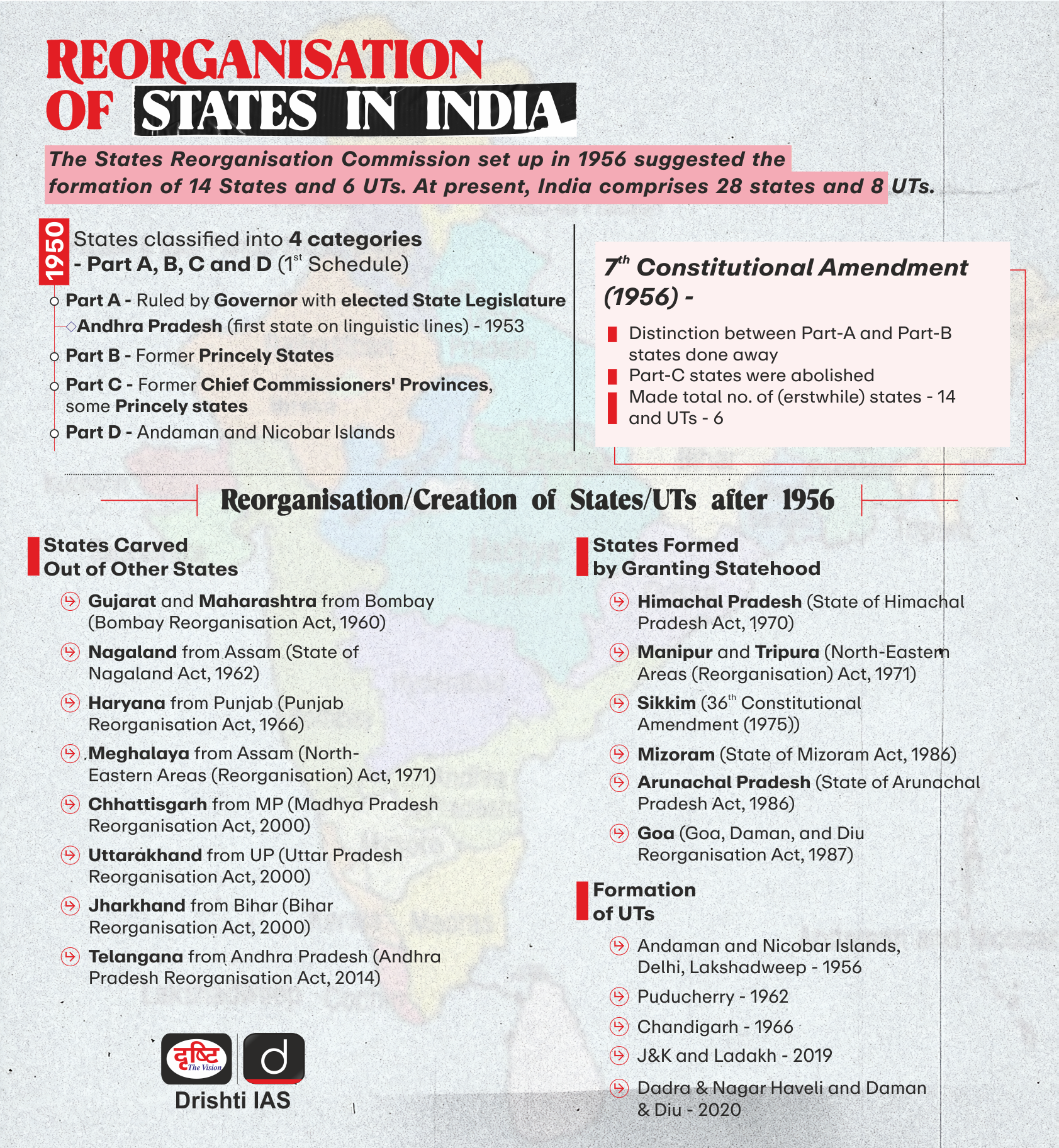
Manipur, Tripura, and Meghalaya celebrated their Statehood Day on 21st January. On this day in 1972, all three became full-fledged states under the North-Eastern Areas (Reorganisation) Act, 1971.
What is the Historical Background & Reorganization of Manipur, Meghalaya, and Tripura?
- Manipur: Before Independence, Manipur was an independent princely state that acceded to India in 1947 through the Instrument of Accession, retaining internal autonomy.
- It conducted India’s first election based on universal adult franchise in 1948, becoming a constitutional monarchy.
- In 1949, the Maharaja signed the Merger Agreement without consulting the elected Assembly, which was subsequently dissolved.
- Manipur was administered as a Part-C State (1949–56), became a Union Territory in 1956, and finally attained full statehood in 1972 under the North-Eastern Areas (Reorganisation) Act, 1971, with special safeguards for hill areas under Article 371C.
- Tripura: Tripura was a princely state ruled by the Manikya dynasty and merged with the Indian Union in 1949 under the regency of Queen Kanchan Prabha Devi.
- Initially administered as a Part-C State, it became a Union Territory in 1956.
- In recognition of regional aspirations and administrative needs, Tripura was granted full statehood in 1972 through the North-Eastern Areas (Reorganisation) Act, 1971, while ensuring tribal self-governance through the Tripura Tribal Areas Autonomous District Council under the Sixth Schedule.
- Meghalaya: Meghalaya’s statehood emerged from demands for autonomy by the Khasi, Jaintia, and Garo Hills to protect their distinct cultural and linguistic identity, particularly in response to Assam’s language policy.
- It was first created as an Autonomous State within Assam under the 22nd Constitutional Amendment Act, 1969.
- Subsequently, the North-Eastern Areas (Reorganisation) Act, 1971, granted Meghalaya full statehood in 1972, making it the 21st state of India, with the entire state governed under the Sixth Schedule through autonomous district councils.
Significance of the North-Eastern Areas (Reorganisation) Act, 1971.
- Fulfilment of Sub-Nationalism: The Act addressed long-standing demands for autonomy from the hill tribes (Khasis, Garos, Jaintias, Mizos) who felt culturally and linguistically distinct from the Assamese-dominated plains.
- By upgrading Union Territories to States, it provided local populations with their own Legislative Assemblies, allowing them to draft policies suited to their unique tribal customs and needs.
- Strategic & Security Imperatives: The Act was implemented shortly after the creation of Bangladesh (1971 War). India needed to consolidate the internal stability of the Northeast to secure the "Chicken’s Neck" corridor and the international borders.
- By converting the North-East Frontier Agency (NEFA) into the Union Territory of Arunachal Pradesh, the Act formally integrated this strategically sensitive region (bordering China) into the Indian political mainstream, removing it from the vague status of a "frontier agency.
- This served as a transitional step before Arunachal Pradesh attained full statehood in 1987 through the 55th Constitutional Amendment.
- By converting the North-East Frontier Agency (NEFA) into the Union Territory of Arunachal Pradesh, the Act formally integrated this strategically sensitive region (bordering China) into the Indian political mainstream, removing it from the vague status of a "frontier agency.
- North Eastern Council (NEC): It is a statutory body established under the North Eastern Council Act, 1971.
- NEC serves as the nodal agency for economic and social development of the North-Eastern Region, comprising Arunachal Pradesh, Assam, Manipur, Meghalaya, Mizoram, Nagaland, Sikkim, and Tripura.
- It functions under the administrative control of the Ministry of Development of the North-Eastern Region (MDoNER) and includes the Governors and Chief Ministers of these states along with three members nominated by the President.
Frequently Asked Questions (FAQs)
1. When did Manipur, Meghalaya, and Tripura attain statehood?
They became full-fledged states on 21 January 1972 under the North-Eastern Areas (Reorganisation) Act, 1971.
2. Which Act reorganised the North-East and granted statehood to these states?
The North-Eastern Areas (Reorganisation) Act, 1971, reorganised the region and granted statehood to Manipur, Meghalaya, and Tripura.
3. What special constitutional provision applies to Manipur?
Article 371C provides special safeguards for the Hill Areas of Manipur.
4. How is tribal autonomy ensured in Tripura and Meghalaya?
Through Autonomous District Councils under the Sixth Schedule of the Constitution.
5. Why was the North-Eastern Areas (Reorganisation) Act strategically important?
It strengthened internal stability of the North-East post-1971 war, secured international borders, and integrated sensitive frontier regions into India’s political framework.
UPSC Civil Services Examination, Previous Year Question (PYQ)
Prelims
Q. The North Eastern Council (NEC) was established by the North Eastern Council Act, 1971. Subsequent to the amendment of NEC Act in 2002, the Council comprises which of the following members? (2024)
- Governor of the Constituent State
- Chief Minister of the Constituent State
- Three Members to be nominated by the President of India
- The Home Minister of India
Select the correct answer using the code given below:
a) 1, 2 and 3 only
b) 3 and 4 only
c) 2 and 4 only
d) 1, 2, 3 and 4
Ans: A



