


Important Facts For Prelims
Somnath Swabhiman Parv
- 06 Jan 2026
- 8 min read
Why in News?
The Prime Minister stated that the thousand-year survival of the Somnath temple symbolizes India's indomitable spirit, as the nation celebrates Somnath Swabhiman Parv (1026–2026) for a millennium of unbroken faith and resilience.
What are the Key Facts Regarding the Somnath Temple?
- About: The Somnath Temple, located at Prabhas Patan on Gujarat’s coast, is the first Jyotirling among the 12 holy Shiva Jyotirlingas, as stated in the Shiva Purana and Dwadasha Jyotirling Stotram.
- References to the temple are found in ancient texts like Skandpuran, Shreemad Bhagavat, Shivpuran, and the Rig-Veda.
- It is also the Neejdham Prasthan Leela site where Lord Shri Krishna took his last journey.
- Identified as a Tirthdham of immense antiquity, revered alongside Ganga, Yamuna, and Saraswati in Vedic literature.
- Construction: According to tradition, it was built in phases—first in gold by Somraj (Moon God), then in silver by Ravana, later in wood by Lord Krishna.
- King Bhimdev I (or Bhima I) of the Solanki dynasty rebuilt the temple in stone after its destruction by Mahmud of Ghazni in 1026 CE.
- Geographical Significance: Situated at the confluence of Kapila, Hiran, and Saraswati rivers with the Arabian Sea.
- Abadhit Samudra Marg (Tirth Stambh) indicates an uninterrupted sea route to the South Pole, with the nearest landmass ~9,936 km away, reflecting ancient Indian geographical knowledge.
- Architectural Features: It is built in the Kailas Mahameru Prasad style. The structure includes Garbhgruh, Sabhamandap, and Nrityamandap. It has a 155-foot-high Shikhar.
- Cycles of Destruction & Rebuilding: First major attack in 1026 AD by Mahmud of Ghazni; documented by Persian scholar Al-Biruni.
- The temple was looted and destroyed multiple times, including in 1026, 1297, 1394, and 1706 CE (Aurangzeb). 2026 marks 1,000 years since the first attack, a significant civilisational milestone.
- The 7th existing temple was rebuilt post-independence as a symbol of national resurgence. Sardar Vallabhbhai Patel initiated the reconstruction in 1947. The Pran-Pratistha was performed by President Dr. Rajendra Prasad on 11th May, 1951. Reconstruction was supported by KM Munshi, author of “Somanatha: The Shrine Eternal”.
- Cultural and Intellectual Significance: Visited by Swami Vivekananda in 1890s, who described Somnath as embodying India’s national life-current—destroyed and reborn repeatedly.
- Revered by saints across traditions, including Jain Acharya Hemchandracharya.
- Maintained ritual continuity by Maharani Ahilyabai Holkar during adverse political conditions.
- Core Civilisational Message: Somnath symbolises faith over fanaticism, creation over destruction, and the eternity of Indian civilisation, echoing the Gita’s message of the indestructible soul.
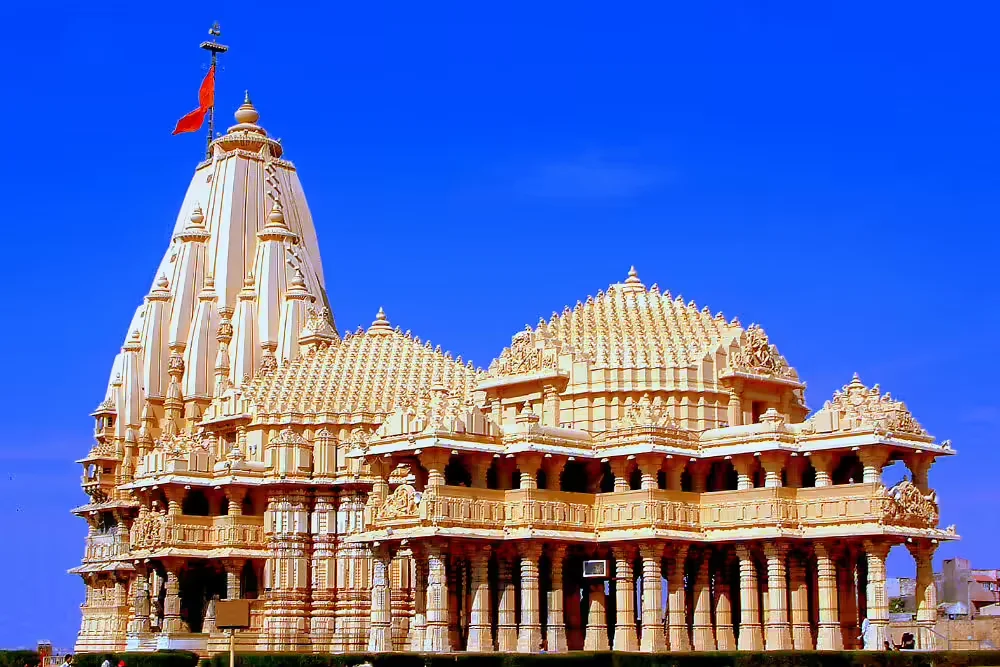
Kailas Mahameru Prasad Style
- About: It refers to a distinctive form of Hindu temple architecture primarily associated with the Chalukya (or Chaulukya/Solanki) tradition, prominent in western India, particularly Gujarat.
- Exemplar and Symbolism: The term Kailas Mahameru Prasad evokes the temple's design as a grand edifice symbolizing Mount Kailasa (abode of Shiva) and Mount Meru (the cosmic mountain in Hindu cosmology), emphasizing a towering, majestic shikhara (spire) and intricate craftsmanship.
- Key Architectural Characteristics: It falls under the broader Nagara school of North Indian temple architecture but incorporates regional elements from the Chalukya/Solanki period (often classified under Māru-Gurjara architecture).
- Features include a high shikhara (around 50 meters in Somnath), elaborate carvings, a garbhagriha (sanctum), sabha mandapa (assembly hall), and nritya mandapa (dance hall).
- The style showcases the expertise of Gujarat's traditional master masons, known as Sompura Salats.
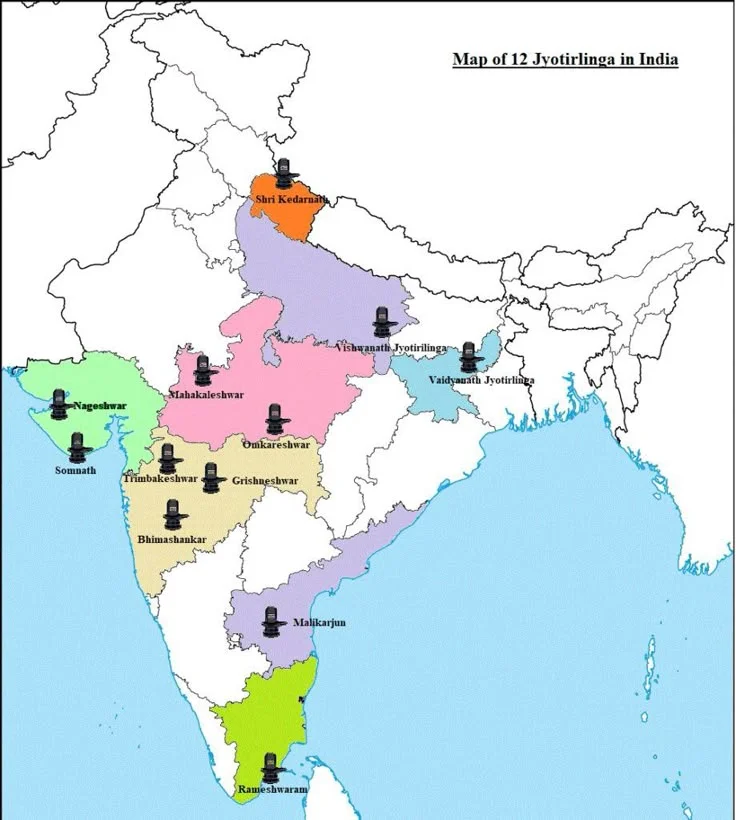
12 Jyotirlingas and their Location
|
Name |
City |
State |
|
Somnath |
Prabhas Patan |
Gujarat |
|
Mallikarjuna |
Srisailam |
Andhra Pradesh |
|
Mahakaleshwar |
Ujjain |
Madhya Pradesh |
|
Omkareshwar |
Mandhata Island |
Madhya Pradesh |
|
Kedarnath |
Kedarnath |
Uttarakhand |
|
Bhimashankar |
Pune (Khed) |
Maharashtra |
|
Kashi Vishwanath |
Varanasi |
Uttar Pradesh |
|
Trimbakeshwar |
Trimbak |
Maharashtra |
|
Baidyanath |
Deoghar |
Jharkhand |
|
Nageshwar |
Dwarka |
Gujarat |
|
Rameshwaram |
Rameshwaram |
Tamil Nadu |
|
Grishneshwar |
Ellora |
Maharashtra |
Frequently Asked Questions (FAQs)
1. What is the historical significance of the year 1026 CE for Somnath?
It marks the first major invasion and destruction of the temple by Mahmud of Ghazni, an event commemorated a millennium later by the Somnath Swabhiman Parv (1026-2026).
2. Who led the reconstruction of Somnath Temple after Independence?
Sardar Vallabhbhai Patel initiated reconstruction in 1947; Pran-Pratistha was performed by Dr Rajendra Prasad in 1951.
3. What is Abadhit Samudra Marg at Somnath?
It is a sea-facing axis (Tirth Stambh) indicating an uninterrupted sea route to the South Pole (~9,936 km).
UPSC Civil Services Examination, Previous Year Questions (PYQs)
Q. The Prime Minister recently inaugurated the new Circuit House near Somnath Temple at Veraval. Which of the following statements are correct regarding Somnath Temple?
- Somnath Temple is one of the Jyotirlinga shrines.
- A description of Somnath Temple was given by Al-Biruni.
- Pran Pratishtha of Somnath Temple (installation of the present day temple) was done by President S. Radhakrishnan.
Select the correct answer using the code given below:
(a) 1 and 2 only
(b) 2 and 3 only
(c) 1 and 3 only
(d) 1, 2 and 3
Ans: (a)



