


Important Facts For Prelims
PSB Reforms under EASE 9.0
- 03 Mar 2026
- 6 min read
Why in News?
Under the EASE 9.0 reforms agenda, public sector banks (PSBs) will pursue important reforms to prepare PSBs to leverage technology and improve productivity and scale through new business models.
What Reforms will be Pursued under the EASE 9.0 Reforms Agenda?
- GCC Strategy and Leadership: Public sector banks will implement a global capability centre (GCC) strategy in FY 2026-27 and prepare a capacity-building roadmap. State Bank of India (SBI), which established the first GCC among state-run lenders earlier this year (in Karnataka), will take the lead.
- GCCs are offshore units of multinational corporations that perform strategic functions like IT, R&D, and business support.
- Technology Infrastructure Plans: Banks are expected to assess active-active data centre models for inclusion in their five-year business plans to ensure business continuity and resilience.
- Develop core AI stacks, including LLM (Large Language Model) licensing, GPU strategies, and private cloud model deployment.
- Build enterprise-wide consent management capabilities.
- Implement at-scale data tokenisation and anonymisation to enable continuity of data usage for business and strategic purposes.
- Collaborative Solutions: Banks will combine strengths to offer complete banking solutions, including blockchain technology, advanced risk assessment, and fraud detection models.
What are Banking, Financial Services, and Insurance (BFSI) GCC?
- About: A BFSI GCC is a 100% owned and operated subsidiary of a global BFSI institution in talent-rich locations like India, serving as strategic extensions that centralize high-value functions, drive innovation, and achieve operational efficiency.
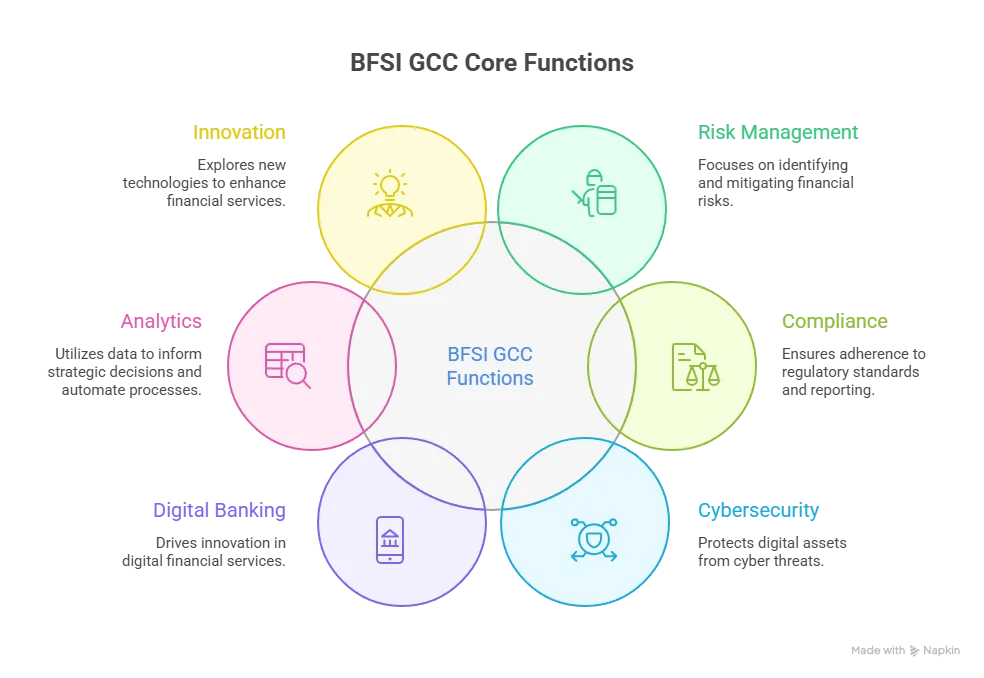
- Unlike general GCCs, BFSI GCCs specifically serve the Banking, Financial Services, and Insurance sector in areas such as risk management, compliance, fintech, and cybersecurity.
- Strategic Evolution: GCCs have evolved significantly from initial cost arbitrage (achieving 50–60% savings compared to home markets) to advanced hubs for proprietary capabilities including artificial intelligence (AI), machine learning (ML), cybersecurity, regulatory technology (RegTech), data analytics, and core platform development.
- Core Functions in BFSI GCCs:
- India's Position in BFSI GCC Ecosystem: India's BFSI GCCs are projected to grow to USD 125 billion by 2032 (from USD 40-41 billion in 2023). Currently, 185-190 BFSI GCCs operate across India, employing approximately 540,000 professionals, representing 25% of all GCC employees in the country.
- Major hubs include Bengaluru (analytics and engineering), Hyderabad (fintech), Mumbai (financial services core), Pune, Chennai, and Gurugram/NCR.
- Examples of BFSI GCCs in India: JPMorgan Chase, HSBC, Wells Fargo, Citigroup, Standard Chartered, Deutsche Bank, Barclays, Bank of America, Goldman Sachs, and Morgan Stanley.
EASE 9.0 Reforms
- About: The EASE 9.0 reforms, launched in February 2026 by the Department of Financial Services, aim to transform PSBs into globally competitive institutions aligned with the national vision of Viksit Bharat @2047.
- It emphasizes technology-led modernization, resilience, and operational excellence through four foundational pillars abbreviated as R.I.S.E.
- Core Structure - Four Foundational Pillars (R.I.S.E.):
- Risk & Resilience: Strengthening financial and credit risk management, operational resilience, and frameworks for enterprise-wide risk oversight.
- Innovation: Driving deep integration of advanced technologies, including AI, generative AI (GenAI), machine learning (ML), cloud architectures, and microservices.
- Socio-economic Impact: Promoting inclusive banking, financial access for underserved segments (including gig and platform workers), and contributions to broader economic goals.
- Excellence: Enhancing operational efficiency, customer-centric processes, governance, and cost-effective next-generation operating models.
Frequently Asked Questions (FAQs)
1. What is EASE 9.0?
EASE 9.0 is a banking reform agenda launched in February 2026 by the Department of Financial Services (DFS) to modernize Public Sector Banks through technology integration and institutional strengthening.
2. What does the R.I.S.E. framework under EASE 9.0 stand for?
It stands for Risk & Resilience, Innovation, Socio-economic Impact, and Excellence, forming the four foundational pillars of banking reforms.
3. What is a BFSI Global Capability Centre (GCC)?
A BFSI GCC is a wholly owned subsidiary of a global financial institution that centralizes high-value functions like risk management, AI, cybersecurity, and regulatory compliance.
4. How significant is India in the global BFSI GCC ecosystem?
India hosts around 185–190 BFSI GCCs, employing about 540,000 professionals, and the sector is projected to reach USD 125 billion by 2032.
5. How does EASE 9.0 promote technological modernization?
It emphasizes AI stacks, LLM licensing, active-active data centres, blockchain integration, data tokenisation, and cloud architectures to enhance resilience and productivity.
UPSC Civil Services Examination, Previous Year Question (PYQ)
Q. With reference to the governance of public sector banking in India, consider the following statements: (2018)
- Capital infusion into public sector banks by the Government of India has steadily increased in the last decade.
- To put the public sector banks in order, the merger of associate banks with the parent State Bank of India has been affected.
Which of the statements given above is/are correct?
(a) 1 only
(b) 2 only
(c) Both 1 and 2
(d) Neither 1 nor 2
Ans: (b)



