


International Relations
India- Finland Relations
- 10 Mar 2026
- 14 min read
For Prelims: Finland, 5G, 6G, Quantum Communications, North Atlantic Treaty Organisation, Baltic Sea
For Mains: India–Nordic Countries Relations, India–European Union Economic and Strategic Cooperation
Why in News?
The President of Finland, Alexander Stubb, paid a State Visit to India as the Chief Guest at the 11th Raisina Dialogue, during which India–Finland relations were upgraded to a Strategic Partnership in Digitalization and Sustainability, along with renewed environmental cooperation agreements.
Summary
- India and Finland upgraded their ties to a Strategic Partnership in Digitalization and Sustainability during the visit of President Alexander Stubb for the Raisina Dialogue, signing agreements on migration, green energy, and emerging technologies such as 5G, 6G, AI, and quantum communication.
- Both countries aim to expand trade, boost startup collaboration, and strengthen environmental cooperation, including co-hosting the World Circular Economy Forum 2026, while addressing challenges like trade imbalance and geopolitical differences.
What are the Key Outcomes of Finland's President Visit to India?
- Elevation of Bilateral Relations: The relationship has been officially upgraded to a "Strategic Partnership in Digitalization and Sustainability," acknowledging a shared vision for a green and technologically advanced future.
- India and Finland agreed to establish a dedicated Consular Dialogue between their respective Foreign Ministries. This mechanism aims to strengthen coordination on consular issues, mobility, and the welfare of citizens.
- Key MoUs and Agreements Signed:
- Migration and Mobility Partnership: Finland is a major destination for Indian tech professionals. This MoU establishes a framework to seamlessly facilitate the mobility of skilled Indian talent to Finland.
- Environmental Cooperation (Renewal): Building on a 2020 agreement, this covers sustainability initiatives including bioenergy, waste-to-energy solutions, power storage, green hydrogen, and renewable energy systems (wind, solar, small hydro).
- Cooperation in Statistics: An MoU to exchange best practices and collaborate in the field of official government statistics.
- Digitalization, Technology, and Innovation
- Joint Task Force on 6G: Established to drive advanced 6G research, partnering the University of Oulu (Finland) with the Bharat 6G Alliance.
- Cross-sectoral Joint Working Group on Digitalization: Created to advance cooperation in emerging technologies like High-performance computing (HPC), 5G, 6G, Quantum Communications/Computing, and Artificial Intelligence (AI).
- Joint Research Calls: An implementation arrangement was established between India's Department of Science and Technology (DST) and the Finnish Innovation Funding Agency (Business Finland).
- Indo-Finland Startup Corridor: Aimed at boosting ecosystem connectivity by ensuring active participation of Indian startups in Finland’s Slush event, and Finnish startups in India’s Startup Mahakumbh.
- Trade and Multilateral Cooperation
- Bilateral Trade Target: Both nations aim to double bilateral trade by 2030, heavily capitalizing on the recently concluded India-EU Free Trade Agreement.
- World Circular Economy Forum (WCEF): India's Ministry of Environment, Forest and Climate Change (MoEFCC) and the Finnish Innovation Fund (SITRA) announced they will co-host the WCEF in India in 2026.
How are India- Finland Relations?
- Trade and Economic Relations: In 2023–24, India’s exports to Finland stood at USD 582.65 million, while imports from Finland reached USD 913.48 million, resulting in a trade deficit of USD 330.83 million for India.
- India’s major exports to Finland include medicinal and pharmaceutical products, textiles and apparel, metal manufactures, and electrical machinery and components.
- India primarily imports specialized industrial machinery, electrical equipment, paper and paperboard products, metalliferous ores, and metal scrap from Finland.
- Exports of heterocyclic compounds, key intermediates used in pharmaceuticals and specialty chemicals, have surged in India’s trade with Finland, rising from 1% in 2022 to 28% in 2025, making them the largest export category.
- Foreign Direct Investment (FDI): In 2023, Finland ranked 40th among countries investing in India.
- However, actual investment will be higher as many Finnish companies like Nokia have been in India since the 1990s and further expansion are not accounted as FDI.
- Technology and Digital Cooperation: A Joint Declaration of Intent on Digitalization was signed between the two countries in 2019.
- Both countries are collaborating in emerging technologies such as 5G and 6G communications, cybersecurity, digital infrastructure, and startup ecosystems.
- With support from Finland architects, India built the world’s highest railway bridge over the Chenab River and established the largest bamboo-to-bioethanol refinery at Numaligarh in Assam.
- Indian Diaspora: About 20,000 Indians live in Finland, making them a significant contributor to Finland’s economy and cultural diversity, despite Finland having a relatively small population of about 5.6 million.
What are the Key Challenges in India-Finland Relations?
- Trade Deficit: The trade balance remains consistently skewed in Finland's favor. India's exports are largely restricted to traditional sectors (apparel, textiles, basic machinery), while it imports high-value tech and electronic equipment.
- Lack of Deep Logistical Connectivity: Unlike major European economic hubs (such as Germany, France, or the UK), direct logistical connectivity between India and Helsinki (capital of Finland) is comparatively weak.
- This lack of seamless connectivity increases freight costs and transit times, inherently discouraging high-frequency Business-to-Business (B2B) exchanges and robust supply chain integration.
- The Russia Factor: Finland, which shares a land border with Russia, abandoned decades of military non-alignment to join North Atlantic Treaty Organisation (NATO) and supports strict Western sanctions against Russia.
- India, however, follows a policy of Strategic Autonomy, maintaining economic, energy, and defence ties with Moscow, creating occasional differences in strategic outlook.
What Steps can Strengthen India-Finland Relations?
- Leveraging the EU-India FTA: With the newly concluded Free Trade Agreement between India and the EU, Indian export sectors (like textiles, pharmaceuticals, and IT services) must aggressively tap into the Finnish market to meet the 2030 bilateral trade doubling target.
- Skilling Ecosystems: India must actively align its vocational education and training standards (under the Skill India Mission) with European standards to fully utilize the newly signed Migration and Mobility MoU.
- Leading the Green Transition: Co-hosting the WCEF in 2026 provides India a unique platform to establish itself as a Global South leader in circular economy practices, waste management, and sustainable development.
- Global Peacemaker Role: As conflicts continue to destabilize the global supply chain, India should leverage its strong relations with both Western nations (like Finland/EU) and the Global South to act as a credible mediator in international forums.
Key Facts About Finland
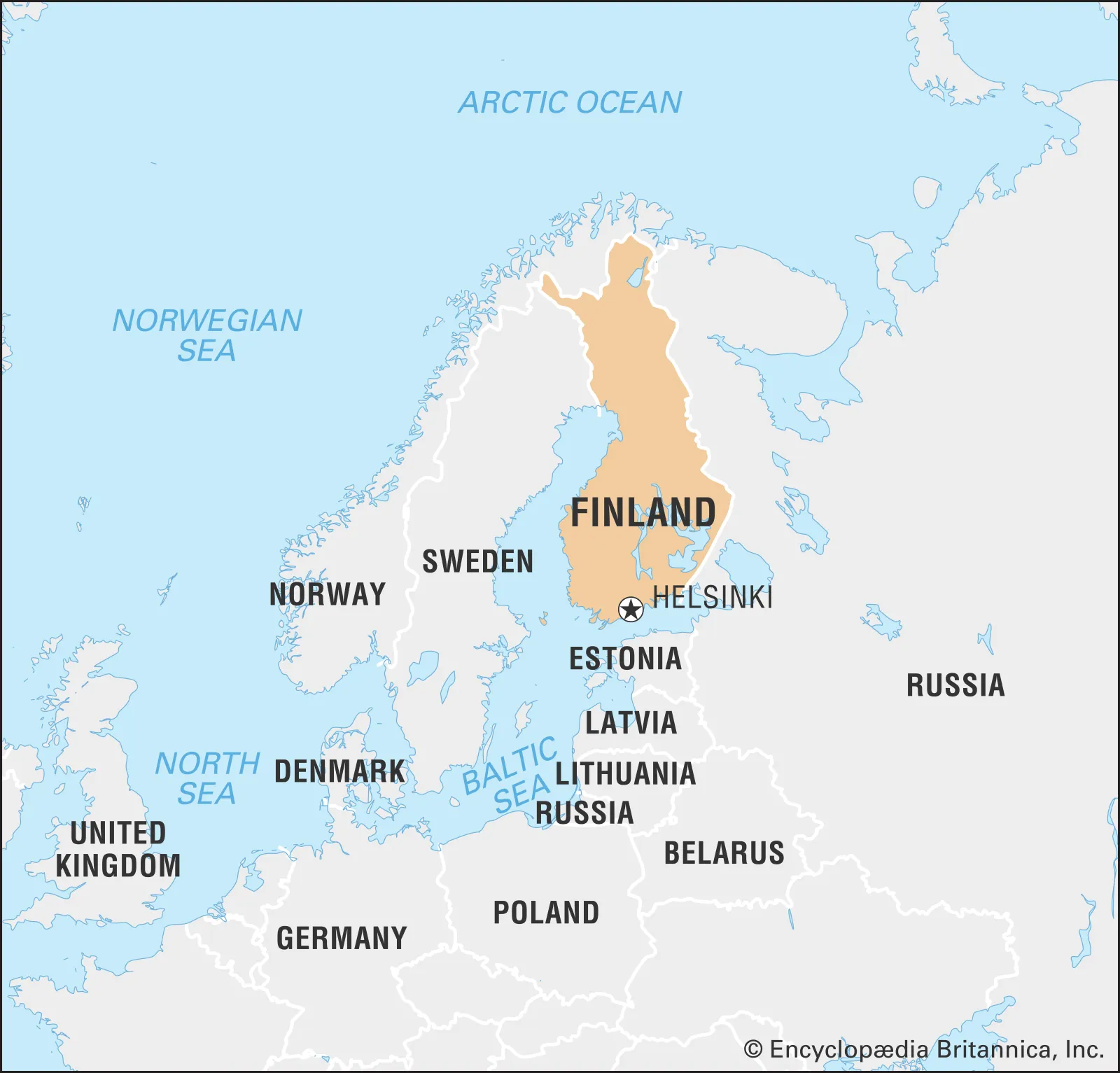
- Geographical Location: Finland is located in Northern Europe and forms an important part of the Fennoscandian Peninsula.
- It shares land borders with Russia (east), Sweden (west), and Norway (north).
- The country is bordered by the Gulf of Bothnia in the west, the Gulf of Finland in the south, and the Baltic Sea in the southwest.
- Physical Geography; Finland is famously known as the “Land of a Thousand Lakes,” though it actually has over 188,000 lakes, with Lake Saimaa being the largest.
- The northern region Lapland lies largely within the Arctic Circle and is inhabited by the indigenous Sámi people.
- Geopolitical and Strategic Significance: Finland joined NATO as a member in April 2023, ending decades of military non-alignment after the Russia–Ukraine war, thereby significantly extending NATO’s land border with Russia.
- It is also a member of the European Union (since 1995) and the Nordic Council, promoting regional cooperation among Nordic countries.
- Role in Arctic Governance: Finland is one of the eight permanent members of the Arctic Council (India is an observer), giving it an important role in Arctic governance, climate research, and polar cooperation.
- This also makes Finland an important partner for India’s Arctic Policy and scientific research.
- Environmental and Economic Highlights: Finland is the most forested country in Europe, with over 70% forest cover dominated by Taiga (boreal) forests.
- It has set an ambitious target to achieve carbon neutrality by 2035 and was the first country to adopt a national circular economy roadmap (2016), hosting the World Circular Economy Forum (WCEF) in 2017.
- Social and Governance Indicators: Finland has been ranked the world’s happiest country for eight consecutive years (2018–2025) in the World Happiness Report, due to strong social welfare systems and high trust in institutions.
- It also ranks among the top countries in the World Press Freedom Index and Corruption Perceptions Index, reflecting strong governance and transparency.
|
Drishti Mains Question: Discuss the strategic significance of India’s partnership with Nordic countries, particularly Finland, in the domains of digital innovation and sustainability. |
Frequently Asked Questions (FAQs)
1. What is the significance of the India–Finland Strategic Partnership in Digitalization and Sustainability?
It strengthens cooperation in emerging technologies, green energy, digital infrastructure, and innovation ecosystems, aligning both countries toward a technology-driven and sustainable future.
2. What is the Migration and Mobility Partnership between India and Finland?
It provides a framework to facilitate the movement of skilled Indian professionals to Finland, especially in technology sectors facing labour shortages.
3. What is the World Circular Economy Forum (WCEF)?
The WCEF is a global platform promoting circular economy practices, and India will co-host the 2026 edition with Finland’s Innovation Fund SITRA.
4. Why is Finland strategically important for India’s Arctic policy?
Finland is a permanent member of the Arctic Council, making it an important partner for Arctic research, climate studies, and polar governance cooperation.
5. What challenge affects India–Finland trade relations?
The trade balance favors Finland, as India mainly exports traditional goods while importing high-value technology and industrial equipment from Finland.
UPSC Civil Services Examination, Previous Year Questions (PYQs)
Mains
Q. The expansion and strengthening of NATO and a stronger US-Europe strategic partnership works well for India.' What is your opinion about this statement? Give reasons and examples to support your answer. (2023)



