


International Relations
India–Canada Strategic Reset
- 05 Mar 2026
- 13 min read
For Prelims: Comprehensive Economic Partnership Agreement, Uranium, G7 Critical Minerals Action Plan, International Solar Alliance (ISA), Global Biofuels Alliance (GBA).
For Mains: India–Canada relations: opportunities and constraints, Energy diplomacy and critical minerals in India’s foreign policy, Diaspora politics and its impact on bilateral relations
Why in News?
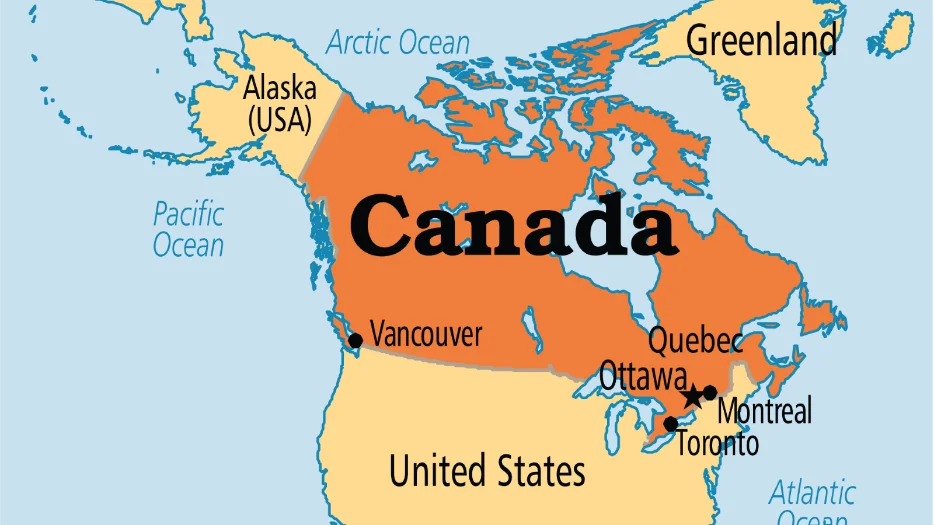
The Prime Minister of Canada, Mark Carney, paid an official visit to India, marking what is widely viewed as a strategic reset in bilateral relations after the diplomatic tensions of 2023–24.
- The visit signals an effort by both countries to refocus on economic cooperation, defence dialogue, and strengthening the overall partnership.
Summary
- The Prime Minister of Canada's visit to India marked a reset in India–Canada relations after the 2023–24 diplomatic tensions. Major outcomes included restarting CEPA trade negotiations, a USD 2.6 billion uranium supply deal with Cameco, cooperation on critical minerals and clean energy, the launch of the first India–Canada Defence Dialogue, and initiatives in innovation, research internships, and food technology.
- India and Canada share strong economic and diaspora ties (1.8 million Indians in Canada) and aim to double trade to $50 billion by 2030. However, issues like Khalistani extremism, trade barriers, and visa delays remain challenges. Stronger security cooperation, early trade agreements, and Indo-Pacific collaboration can help rebuild trust and deepen the partnership.
What are the Key Outcomes of the Visit of the PM of Canada to India?
- Relaunch of CEPA Negotiations: India and Canada signed the Terms of Reference (ToR) to resume talks on the Comprehensive Economic Partnership Agreement (CEPA).
- Both nations have set an ambitious target to double bilateral trade to USD 50 billion by 2030.
- Landmark Civil Nuclear Deal: The Department of Atomic Energy (India) signed a USD 2.6 billion long-term commercial contract with Canada's Cameco for the supply of Uranium Ore Concentrates.
- This is a major boost for India's Viksit Bharat vision to achieve 100 GW of nuclear power capacity by 2047.
- Critical Minerals & Clean Energy: A Memorandum of Understanding (MoU) was signed to develop secure and resilient critical mineral supply chains, aligning with the G7 Critical Minerals Action Plan.
- Canada announced it will officially join both the International Solar Alliance (ISA) and the Global Biofuels Alliance (GBA).
- An MoU was established to share best practices and build capacity in energy storage, solar, wind, and biomass/bio-energy.
- Defense and Security: The two nations announced the establishment of the first-ever India-Canada Defence Dialogue to foster strategic security discussions.
- Political and Diplomatic Ties: The India-Canada Parliament Friendship Group was established to enhance political networking.
- Additionally, India formally announced its support for Canada to join the Indian Ocean Rim Association (IORA) as a Dialogue Partner.
- Private Sector Engagement: The India-Canada CEO Forum has been reconstituted to serve as a key platform for deepening private-sector collaboration across priority industries.
- Innovation and Talent: The India-Canada-Australia Trilateral MoU was signed to advance cooperation in emerging technologies and innovation under the Australia–Canada–India Technology and Innovation (ACITI) Partnership
- An MoU between All India Council for Technical Education (AICTE) and Canada's Mitacs was signed to provide 300 fully-funded research internships for Indian students.
- A Declaration of Intent was signed to establish a joint Joint Pulse Protein Centre of Excellence at National Institute of Food Technology, Entrepreneurship, and Management Kundli (NIFTEM-K).
- This center will focus on advanced protein extraction and fortified food products to address micronutrient deficiencies.
Importance of Uranium for India’s Nuclear Energy Programme
- Primary Nuclear Fuel: Uranium is the main fuel used in nuclear reactors for electricity generation.
- India plans to increase nuclear power capacity from about 9 GW currently to 100 GW by 2047.
- Nuclear energy provides a reliable, low-carbon power source that supports India’s clean energy transition. Long-term uranium contracts ensure a stable supply for upcoming nuclear reactors.
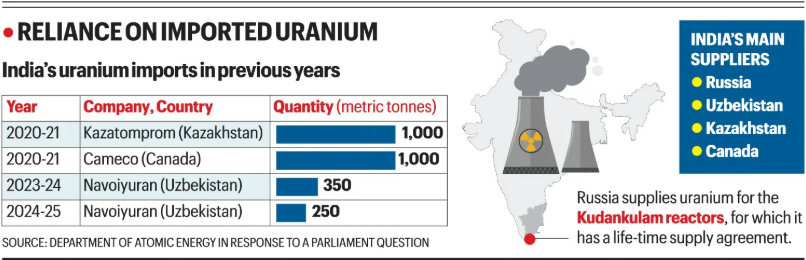
- Need for Uranium Imports: Indian uranium ore contains 0.02%–0.45% uranium, much lower than the global average of 1–2%. India consumes 1,500–2,000 tonnes of uranium per year.
- Annual demand may rise to about 5,400 tonnes with the expansion of nuclear power capacity.
- Some Canadian mines have ore grades as high as 15%, making them far more efficient.
- Due to lower ore quality, domestic uranium extraction is more expensive than imports.
- Over 70% of India’s uranium requirements are currently met through imports.
- Diversification of Uranium Imports:
- International Suppliers: India is importing uranium from several countries to ensure fuel security, including Uzbekistan, Kazakhstan, Canada, and Russia.
- Reactor-Linked Supply Arrangements: Russia provides a lifetime uranium fuel supply for reactors at the Kudankulam Nuclear Power Plant in Tamil Nadu.
- Exploring New Suppliers: India is also considering future supply agreements with countries such as Australia and the United States.
- The Sustainable Harnessing and Advancement of Nuclear Energy for Transforming India Act, 2025 enables greater private sector participation in India’s nuclear sector, facilitating collaboration with global partners including the US.
- Overseas Mining Opportunities: Indian companies like Nuclear Power Corporation of India Limited (NPCIL) are exploring the possibility of investing in or mining uranium deposits abroad to secure long-term fuel supplies.
What is the Significance of India-Canada Relations?
- Strategic Partnership: The two nations share over 75 years of diplomatic relations, which were formally upgraded to a "Strategic Partnership" in 2018.
- Economic Complementarity: Canada aims to reduce dependence on the US market. India provides a vast, fast-growing market and a massive skilled talent pool, while Canada offers advanced technology, natural resources (potash, uranium, critical minerals), and capital.
- Canadian Pension Funds have cumulatively invested over USD 75 billion in India and are increasingly viewing India as a favourable destination for investments.
- In 2024, India was Canada’s 7th largest trading partner, with two-way trade worth USD 30.9 billion, and India maintaining a trade surplus in goods.
- Top Canadian exports to India: Vegetables, mineral fuels and oils, wood pulp, fertilisers, paper and paperboard
- Top Indian exports to Canada: Pharmaceuticals, machinery, electronics, precious stones and metals, iron and steel products.
- Geopolitical Alignment: As two vibrant democracies, both nations share converging interests in maintaining a rules-based, free, and open Indo-Pacific.
- Canada’s Indo-Pacific Strategy specifically identifies India as a critical partner.
- Diaspora and Soft Power: The Indian diaspora in Canada is over 1.8 million strong (around 4% of the population), acting as a vital bridge for people-to-people and economic ties.
- Furthermore, India remains the top source country for international students in Canada.
- Multilateral Alignment: Both nations work closely together to address global challenges in major international forums, including the United Nations (UN), World Trade Organization (WTO), and the International Civil Aviation Organization (ICAO).
- Security Cooperation: It is anchored in the Joint Working Group on Counter Terrorism (1997) and the Framework for Cooperation on Countering Terrorism (2018), while legal collaboration is strengthened through the Extradition Treaty (1987) and the Mutual Legal Assistance Treaty (1994).
What are the Key Challenges and the Way Forward in India–Canada Relations?
|
Challenges |
Measures to Strengthen India–Canada Relations |
|
Khalistani Extremism: India remains concerned about anti-India separatist activities operating from Canadian soil and attacks on Indian consulates and diaspora members. |
Strict Security Cooperation: Implement the action plan between the National Security Advisors (NSAs) to tackle violent extremism and organised crime and rebuild trust. |
|
Trade Barriers: Differences over India’s agricultural tariffs, Canada’s stringent sanitary standards, and disputes regarding intellectual property rights and mobility of professionals. |
Early Harvest Trade Agreement: Pursue an interim trade deal to expand trade in less contentious sectors while negotiations for the Comprehensive Economic Partnership Agreement (CEPA) continue. |
|
Visa and Consular Delays: Diplomatic tensions in 2023–24 led to reduced diplomatic staff, causing visa backlogs affecting students, tourists, and business professionals. |
Cultural and Educational Cooperation: Strengthen cultural and educational cooperation to rebuild trust and facilitate smoother mobility of students, professionals, and tourists. Expand joint cultural and academic programmes between institutions to improve engagement and help streamline visa and consular processes. |
Conclusion
India–Canada engagements signal a shift from tensions to pragmatic cooperation. By advancing economic ties, clean energy collaboration, and security coordination, both countries can rebuild trust. A stable partnership will support economic growth and strengthen a free and resilient Indo-Pacific.
|
Drishti Mains Question: Q. Examine the strategic significance of the recent India–Canada diplomatic reset in the context of Indo-Pacific geopolitics |
Frequently Asked Questions (FAQs)
1. What is the significance of the India–Canada CEPA negotiations?
CEPA aims to expand trade in goods and services, investment, digital trade, and mobility, with a target of reaching USD 50 billion in bilateral trade by 2030.
2. What is the importance of the India–Canada civil nuclear agreement?
The USD 2.6 billion uranium supply deal with Cameco supports India’s target of achieving 100 GW nuclear capacity by 2047 under its Viksit Bharat vision.
3. Why are critical minerals central to India–Canada relations?
Canada’s resource base complements India’s clean energy and manufacturing ambitions, aligning with supply chain resilience and the G7 Critical Minerals Action Plan.
4. What remains the core security concern in India–Canada relations?
India’s primary concern is the presence of separatist elements and extremist activities on Canadian soil affecting diplomatic and diaspora security.
5. How does the Indian diaspora influence bilateral ties?
With over 1.8 million people of Indian origin in Canada, the diaspora strengthens economic, educational, and cultural linkages between the two countries.
UPSC Civil Services Examination, Previous Year Question (PYQ)
Prelims
Q. In which one of the following groups are all the four countries members of G20? (2020)
(a) Argentina, Mexico, South Africa and Turkey
(b) Australia, Canada, Malaysia and New Zealand
(c) Brazil, Iran, Saudi Arabia and Vietnam
(d) Indonesia, Japan, Singapore and South Korea
Ans: (a)



