
Agriculture
Mainstreaming Natural Farming in India
This editorial is based on “Why a transition to natural farming is a necessity” which was published in The Hindu Business line on 17/03/2026. This editorial examines the strategic necessity of transitioning to natural farming to mitigate climate risks and input costs while addressing the structural barriers like the 'transition penalty' and biomass deficits.
For Prelims: National Mission on Natural Farming, Krishi Vigyan Kendras,FPOs,Natural Farming.
For Mains:Significance of natural farming, key issues and measures needed.
India’s food systems remain heavily dependent on energy-intensive inputs, exposing agriculture to fertilizer and energy market shocks. Against this backdrop, natural farming has emerged as a strategic alternative, promoting low-input, ecology-based agriculture rooted in traditional knowledge. Recognising its potential for soil health, climate resilience, and reduced input costs, the Government has launched initiatives like the National Mission on Natural Farming (NMNF). With pilot implementation of Zero Budget Natural Farming (ZNBF) in states like Andhra Pradesh, it is increasingly emerging as a viable pathway for sustainable, resilient, and farmer-centric agriculture in India.
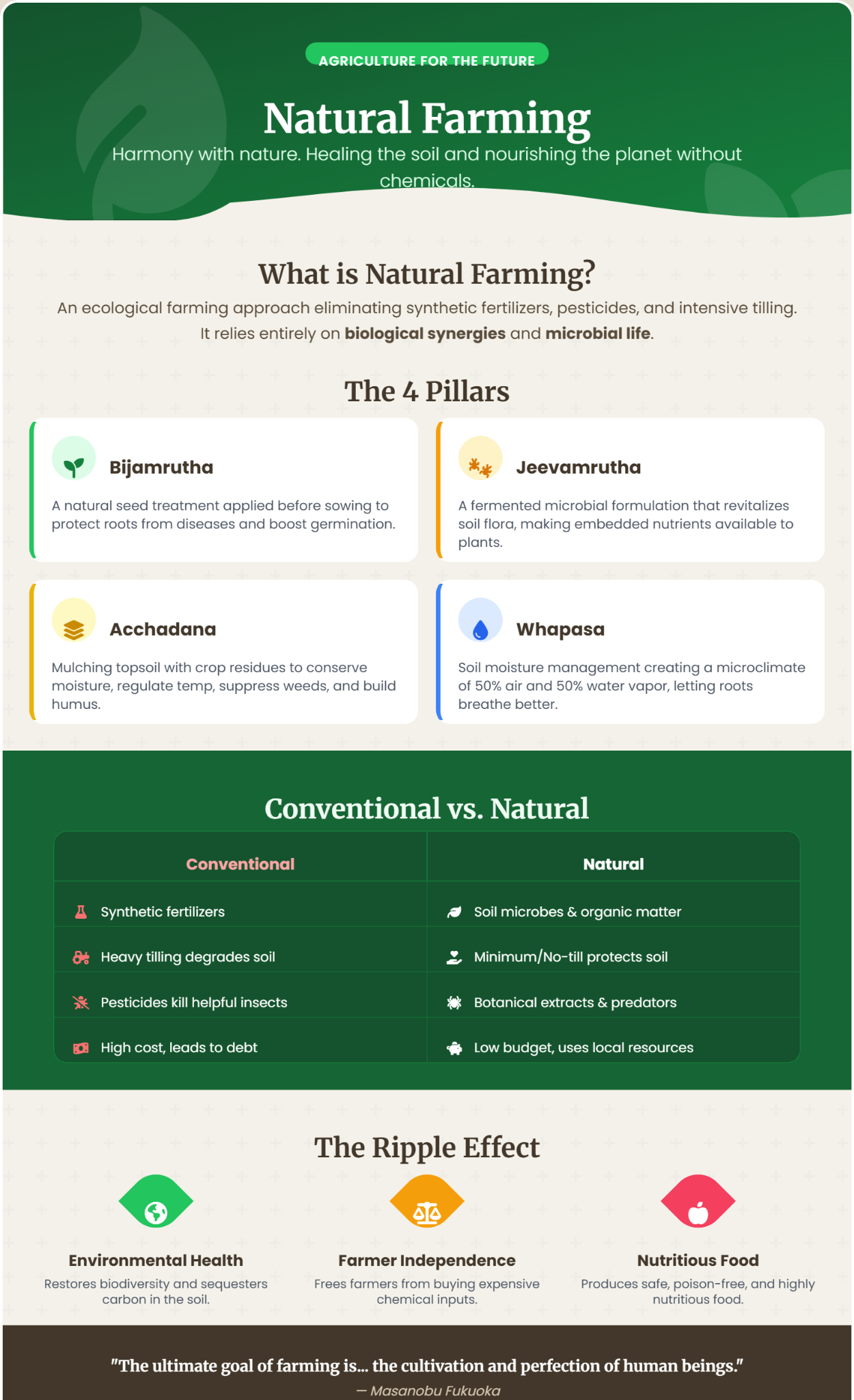
What Factors Necessitate a More Robust Push Towards Natural Farming in India?
- Economic Resilience & Input Cost Reduction: Transitioning to Zero Budget Natural Farming (ZNBF) decisively insulates agricultural economies from volatile global supply chains by eliminating dependence on imported synthetic agrochemicals.
- By relying on locally sourced, farm-made bio-inputs, the model systematically transforms agriculture from a capital-intensive industry into a self-sustaining ecological enterprise.
- Natural farming significantly reduces paid-out cultivation costs by about 5–10% for major crops and up to 20–55% in some cases, while diversified natural farms integrating crops, livestock and trees can generate 20–40% higher net incomes than conventional monocropping systems.
- This makes it particularly beneficial for small and marginal farmers, who constitute over 85% of India’s farming population, by lowering input dependence and improving farm profitability.
- Climate Change Mitigation via Carbon Sequestration: Natural farming acts as a potent tool for climate change mitigation by transforming degraded agricultural lands into active carbon sinks.
- The systemic integration of mulching, green cover, and zero-tillage enhances soil microbial ecology, actively drawing down atmospheric CO2.
- A 2026 Eastern India study demonstrated that natural farming improved Soil Organic Carbon (SOC) stocks by up to 0.62 Mg/ha, while conventional farming saw a decline.
- A CEEW study states that natural farming produces 55–85% lower emissions compared to conventional methods.
- Water Conservation & Aquifer Recharge: Shifting away from chemical-heavy farming is critical for reversing the alarming depletion of groundwater resources in agrarian belts.
- Organic matter enrichment alters soil architecture, vastly improving its porosity, water infiltration rates, and overall moisture retention capacity.
- This drought-proofing mechanism reduces reliance on energy-intensive irrigation, maintaining ecosystem hydration even amid erratic monsoon patterns.
- A CEEW study found that, for irrigated crops, natural farming uses 45-70% less input energy.
- Macroeconomic Stability Against Geopolitical Shocks: A robust push towards agroecology strategically shields national food security from the cascading impacts of geopolitical conflicts and energy crises.
- Modern agriculture's heavy reliance on fossil-fuel-derived fertilizers makes food inflation highly susceptible to sudden global trade disruptions and shipping bottlenecks.
- For instance, following the Red Sea shipping crises and the 2024/2025 energy volatility, global fertilizer prices experienced severe fluctuations that disrupted conventional farming margins.
- In contrast, natural farming clusters remained completely insulated from the 2025 synthetic fertilizer supply shocks, maintaining steady, predictable production costs.
- Biodiversity Restoration & Ecological Balance: The holistic adoption of chemical-free agriculture can reverse the catastrophic decline in local agrobiodiversity and vital pollinator populations.
- By abandoning toxic pesticides, natural farming revitalizes the intricate soil food web, allowing beneficial insects, earthworms, and micro-fauna to thrive.
- This ecological restoration creates a self-regulating biome where natural pest-predator dynamics replace synthetic pest control, ensuring systemic biological equilibrium.
- Recent 2026 microbiological soil assays at a Krishi Vigyan Kendra showed that natural farming increased beneficial bacterial and fungal populations by over 40–47%, thereby promoting soil biodiversity and strengthening ecosystem resilience.
- By abandoning toxic pesticides, natural farming revitalizes the intricate soil food web, allowing beneficial insects, earthworms, and micro-fauna to thrive.
- Public Health & Nutritional Security: Transitioning to chemical-free agriculture is a vital public health intervention that directly tackles the modern epidemic of diet-related non-communicable diseases.
- Eliminating synthetic pesticides prevents the bioaccumulation of toxic residues in the human food chain and the surrounding water tables.
- Furthermore, crops grown in biologically active, nutrient-dense soils express superior phytochemical profiles, offering enhanced nutritional security to populations.
- For example, the pesticide-intensive Malwa region in Punjab highlights the risks of chemical bioaccumulation, while initiatives like Andhra Pradesh’s Community-Managed Natural Farming show that natural practices can restore soil health and produce safer, nutrient-rich crops.
- Eliminating synthetic pesticides prevents the bioaccumulation of toxic residues in the human food chain and the surrounding water tables.
- Circular Economy & Waste Valorization: Natural farming epitomizes the circular economy by systematically converting agricultural and livestock waste into high-value organic inputs.
- The model mandates livestock integration, ensuring that animal by-products like dung and urine are completely recycled back into the soil as potent microbial inoculants.
- Under India's recent GOBARDHAN scheme, organic bio-agro resources are successfully being galvanized.
- The ongoing establishment of 10,000 Bio-Input Resource Centres leverages this circularity, generating rural employment while producing scalable bio-fertilizers.
- The model mandates livestock integration, ensuring that animal by-products like dung and urine are completely recycled back into the soil as potent microbial inoculants.
What Barriers Limit the Adoption of Natural Farming in India?
- Agronomic Risk-The Transition Penalty: The most critical barrier is the "transition penalty," where farmers experience severe yield declines immediately following the abrupt withdrawal of synthetic fertilizers.
- The transition to natural farming involves a short-term yield shock. A 2022 study found that natural farming led to a 59.5% decline in rice yields and a 34% reduction in wheat yields compared to conventional tillage practices.
- Also, depleted soils require several years to rebuild complex microbial networks and nutrient cycles, causing acute short-term financial distress.
- Without substantial capital buffers or dedicated transitional income support, vulnerable smallholders cannot survive this temporary, yet devastating, agronomic shock.
- Supply Chain-The Biomass Deficit: Shifting to natural farming demands massive quantities of local biological inputs, creating a severe supply chain bottleneck due to a chronic shortage of indigenous livestock.
- The foundational bio-inoculants, such as Jeevamrit, rely heavily on fresh dung and urine from native cow breeds, whose populations have drastically dwindled due to farm mechanization.
- Furthermore, the competing demand for crop residues as fodder or industrial fuel severely limits the biomass available for essential mulching and composting.
- As per 20th Livestock Census in 2019, there is a decline of 6% in the total Indigenous (both descript and non-descript) Cattle population over the previous census, making hyper-local bio-input sourcing practically impossible for marginal farmers.
- The foundational bio-inoculants, such as Jeevamrit, rely heavily on fresh dung and urine from native cow breeds, whose populations have drastically dwindled due to farm mechanization.
- Weak Value Realisation in Natural Farming: The absence of dedicated, transparent supply chains for natural produce forces many farmers to sell their chemical-free harvests at conventional, un-remunerative market rates.
- Because natural farming produce lacks immediate visual differentiation from heavily fertilized crops, intermediaries routinely mix them, destroying the potential for premium price realization.
- For instance, farmers often fail to realise premium prices, reflected in the fact that barely ~15% of FMCG volumes fall in the premium segment, highlighting the gap between production and value capture.
- Additionally, retail data indicates that while urban organic demand is growing, rural supply chains remain too fragmented to capture this lucrative value.
- Structural Policy Issue- The Subsidy Skew: The deeply entrenched national fertilizer subsidy regime structurally disincentivizes the transition by keeping synthetic agrochemicals artificially cheap and widely accessible.
- While government rhetoric champions agroecology, the overwhelming majority of the agricultural budget remains locked in underwriting urea and DAP, creating a heavily tilted economic playing field.
- This systemic market distortion ensures that conventional, chemical-intensive farming remains the default, economically safer choice for risk-averse farmers.
- For context, Fertiliser subsidy is projected at Rs 1.86 lakh crore for FY26, an increase of 11% over budget estimate, dwarfing the fund allocated to the NMNF.
- While government rhetoric champions agroecology, the overwhelming majority of the agricultural budget remains locked in underwriting urea and DAP, creating a heavily tilted economic playing field.
- Social Dynamics- Severe Labor Intensiveness: Natural farming is fundamentally a knowledge-intensive and heavily manual labor-driven enterprise, conflicting directly with the contemporary reality of rural labor migration.
- The continuous, hands-on preparation of bio-formulations, meticulous multi-cropping management, and manual weed control require a massive, sustained workforce.
- A February 2026 study in Punjab highlighted that 36% of farmers identified labour-intensive operations as a primary constraint in adopting chemical-free systems.
- The meticulous tasks of preparing bio-inoculants (like Jeevamrit) and managing multi-cropping are noted to require significantly more manual effort compared to conventional methods.
- Institutional Bottlenecks: Navigating the complex, fragmented landscape of natural certification remains a massive bureaucratic hurdle that continuously alienates smallholder farmers.
- The Participatory Guarantee System (PGS), designed to be farmer-friendly, suffers from severe implementation fatigue, administrative delays, and a lack of stringent consumer trust in urban retail markets.
- The 36-month conversion period required for certification of perennial crops under PGS-India creates a significant transition challenge for farmers shifting to natural farming.
- Fragmented Landholdings: India's severely fragmented agricultural landscape makes maintaining ecological purity incredibly difficult for isolated natural farms surrounded by conventional agriculture.
- Current agricultural census data shows that over 86% of Indian farmers operate on holdings smaller than 2 hectares, making landscape-level ecological isolation statistically nearly impossible.
- This spatial vulnerability forces farmers to construct expensive physical buffers, which consume valuable arable land and further diminish their already marginal yields.
- Monsoon-driven runoff from neighbouring chemical-intensive farms can contaminate natural farming fields, as nitrate leaching into groundwater and pesticide mobility across watersheds increase after heavy rains.
- Extension Deficit- The Information Asymmetry: The severe lack of standardized, region-specific, and scientifically validated extension services leaves transitioning farmers vulnerable to catastrophic agronomic errors.
- Natural farming requires profound, hyper-local ecological knowledge regarding soil microbiomes and pest-predator dynamics, which conventional, chemical-focused agricultural extension officers are currently ill-equipped to provide.
- A major constraint in scaling natural farming is the limited agroecology expertise within extension systems, as most scientists in the Krishi Vigyan Kendras (KVKs) are trained in conventional Green Revolution practices.
- Consequently, the shortage of master trainers in natural farming methods poses a significant barrier to achieving the targets of the National Mission on Natural Farming (NMNF).
How can India Effectively Mainstream Natural Farming across its Agricultural Landscape?
- Decentralized Bio-Input Micro-Enterprises: To overcome the critical biomass deficit, policy must catalyze the creation of decentralized, village-level bio-input resource centers operated by rural women’s collectives.
- This institutionalizes the continuous, hyper-local manufacturing of botanical extracts and microbial inoculants, directly solving the supply chain bottleneck for marginal farmers.
- By transforming bio-resource generation into a formal rural micro-enterprise, the state can ensure a steady, affordable supply of essential biological inputs.
- This localizes the economic multiplier effect while entirely eliminating the logistical hurdles of transporting bulky organic matter across vast distances.
- This institutionalizes the continuous, hyper-local manufacturing of botanical extracts and microbial inoculants, directly solving the supply chain bottleneck for marginal farmers.
- Parametric Green Credit and Insurance Architectures: Financial architecture must be fundamentally restructured to offer bespoke green credit instruments and parametric insurance tailored specifically for the agronomic risks of agroecology.
- Traditional yield-based insurance penalizes the temporary transition penalty, necessitating a shift towards weather-indexed, ecosystem-service-based safety nets that underwrite the initial years of soil restoration.
- Banks should offer highly subsidized interest subvention specifically for farmers transitioning to chemical-free models, directly mitigating the immediate shock of yield fluctuations.
- Integration with Rural Employment Frameworks: Scaling agroecology requires the strategic convergence of natural farming objectives with massive rural employment guarantee frameworks to seamlessly subsidize the intense labor demands.
- By formally categorizing the meticulous preparation of biological soil amendments, multi-tier planting, and intensive mulching as compensated public works, the state functionally absorbs transition costs.
- This policy synergy actively transforms ecological restoration into a continuously funded rural livelihood asset rather than an unmanageable private operational expense.
- By formally categorizing the meticulous preparation of biological soil amendments, multi-tier planting, and intensive mulching as compensated public works, the state functionally absorbs transition costs.
- Dedicated Institutional Procurement Corridors: The state must establish segregated supply chain corridors and mandate preferential public procurement quotas for naturally farmed produce within existing national nutritional security programs.
- Integrating these chemical-free harvests into decentralized public distribution and school meal frameworks provides an immediate, massive, and guaranteed captive market for transitioning clusters.
- Consequently, farmers achieve immediate price realization and assured off-take, fundamentally securing the macroeconomic viability of abandoning subsidized synthetic agriculture.
- Integrating these chemical-free harvests into decentralized public distribution and school meal frameworks provides an immediate, massive, and guaranteed captive market for transitioning clusters.
- Landscape-Level Saturation via Producer Collectives: To mitigate the severe risk of cross-contamination from chemical drift, transition strategies must aggressively pivot from individual farm targets to holistic, landscape-level saturation models.
- Utilizing primary producer organizations to transition contiguous tracts of land establishes robust ecological buffer zones that radically protect the integrity of the natural soil biome.
- Such institutionalized, community-managed agriculture drastically reduces individual boundary protection costs while maximizing the ecological synergy required for resilient production.
- Utilizing primary producer organizations to transition contiguous tracts of land establishes robust ecological buffer zones that radically protect the integrity of the natural soil biome.
- AI-Driven Agroecological Extension Platforms: Scaling natural farming necessitates the deployment of artificial intelligence-powered, hyper-local digital extension platforms that bridge the acute information asymmetry in traditional agronomic practices.
- By analyzing localized soil microbiomes and micro-climatic patterns, these digital tools can push real-time, predictive advisories for botanical pest management directly to cultivators.
- These technological leapfrogs severely understaffed conventional extension networks by providing immediate, site-specific biological interventions and automated troubleshooting.
- Digital Frictionless Participatory Certification: The burdensome bureaucratic friction of organic compliance must be entirely eradicated by integrating decentralized digital ledgers into localized participatory guarantee systems.
- This technological approach enables peer-to-peer verification of chemical-free practices to be instantly digitized, creating an immutable, transparent, and universally verifiable chain of market trust.
- Bypassing expensive third-party corporate audits, this digital mechanism empowers smallholder collectives to effortlessly prove their ecological credentials to premium institutional buyers.
- This technological approach enables peer-to-peer verification of chemical-free practices to be instantly digitized, creating an immutable, transparent, and universally verifiable chain of market trust.
- Curricular Overhaul in Agricultural Institutions: A systemic, long-term scale-up mandates the complete ideological and practical overhaul of the curriculum within state agricultural universities and regional research institutions.
- Shifting the academic epicenter away from petrochemical-intensive agronomy towards soil microbiology, holistic ecosystem services, and regenerative polyculture builds essential intellectual capacity.
- This educational restructuring ensures the generation of a massive, specialized cadre of agronomists structurally trained to support, monitor, and innovate within natural farming paradigms.
- Cultivating this new generation of agroecological scientists provides the foundational institutional knowledge base required to continuously refine and adapt chemical-free methodologies.
- Shifting the academic epicenter away from petrochemical-intensive agronomy towards soil microbiology, holistic ecosystem services, and regenerative polyculture builds essential intellectual capacity.
Conclusion:
Scaling natural farming in India requires a systemic transition from chemical-dependency to ecological-resilience by aligning financial incentives with biological realities. By bridging the "transition penalty" through institutional procurement and labor-integrated subsidies, the state can secure a resilient, farmer-centric food system. This paradigm shift not only restores soil vitality but also shields national food security from volatile global petrochemical shocks.
|
Drishti Mains Question "The transition to natural farming is not merely an agronomic shift but a strategic necessity for India’s macroeconomic stability." Substantiate this statement in the context of global geopolitical and energy market volatility. |
FAQs
1. What is the 'Transition Penalty'?
It is the temporary drop in crop yields (approx. 15–30%) occurring during the initial 2-3 years as soil restores its natural microbial health.
2. How does natural farming save water?
By increasing soil organic matter and mulching, it improves porosity and moisture retention, reducing water needs by 50–60%.
3. What is the NMNF?
The National Mission on Natural Farming is a central government initiative to promote chemical-free, low-input, and climate-resilient agriculture.
4. Why is livestock essential for this model?
Indigenous cattle provide the urine and dung required to create bio-inoculants like Jeevamrit, which trigger soil microbial activity.
5. How can it help national security?
It reduces the fiscal burden of fertilizer subsidies (₹1.64 lakh crore) and shields food prices from global oil and gas price shocks.
UPSC Civil Services Examination, Previous Year Question (PYQ)
Prelims
Q. How is permaculture farming different from conventional chemical farming? (2021)
- Permaculture farming discourages monocultural practices but in conventional chemical farming, monoculture practices are predominant.
- Conventional chemical farming can cause an increase in soil salinity but the occurrence of such phenomenon is not observed in permaculture farming.
- Conventional chemical farming is easily possible in semi-arid regions but permaculture farming is not so easily possible in such regions.
- Practice of mulching is very important in permaculture farming but not necessarily so in conventional chemical farming.
Select the correct answer using the code given below.
(a) 1 and 3
(b) 1, 2 and 4
(c) 4 only
(d) 2 and 3
Ans: (b)
Q. Consider the following agricultural practices: (2012)
- Contour bunding
- Relay cropping
- Zero tillage
In the context of global climate change, which of the above helps in carbon sequestration/storage in the soil?
(a) 1 and 2 only
(b) 3 only
(c) 1, 2 and 3
(d) None of them
Ans: (b)



