








.jpg)


.png)

.jpg)

 PCS Parikshan
Rajasthan Switch to Hindi
Rajasthan Achieves Renewable Energy Milestone
Why in News?
Rajasthan has achieved a significant renewable energy milestone by surpassing the 2,000 MW mark under the Pradhan Mantri Kisan Urja Suraksha evam Utthaan Mahabhiyan (PM-KUSUM) scheme — a flagship, farmer-centric solar power initiative.
Key Points
- About: Rajasthan, a leading state in solar energy, has doubled its solar capacity within a short span after first crossing the 1,000 MW mark in May 2025, reflecting strong participation from farmers and private developers.
- A newly commissioned 1.82 MW solar plant in Kolada (Sawai Madhopur district) has taken Rajasthan’s total installed capacity under Component-A and Component-C of the PM-KUSUM scheme to 2,001 MW.
- National Ranking:
- Component-A: Rajasthan ranks 1st in India, utilising semi-barren and barren farmland for grid-connected solar projects.
- Component-C: The state ranks 3rd nationally, behind Maharashtra and Gujarat, focusing on the solarisation of agricultural pumps.
PM KUSUM
- About: The PM-KUSUM was launched by the Ministry of New and Renewable Energy (MNRE) in 2019, in order to endow installation of off-grid solar pumps in rural areas and reduce dependence on grid, in grid-connected areas.
- Objective:
- It aims to enable farmers to set up solar power generation capacity on their arid lands and to sell it to the grid.
- It also seeks to increase the income of farmers by allowing them to sell surplus solar power to the grid.
- Key Features:
- Farmers without capital investment can partner with private developers to establish solar projects.
- Under Component-A, farmers can set up grid-connected solar plants up to 2 MW.
- Under Component-C, the scheme supports solar systems up to 5 MW.
- The Union Government provides financial assistance of ₹1.05 crore per MW, covering 30% of the project cost under Component-C.
Madhya Pradesh Switch to Hindi
Donkey Population Crisis in Madhya Pradesh
Why in News?
The 21st Livestock Census shows that while Madhya Pradesh has a total of 3.75 crore livestock, the donkey population forms only a negligible share and has witnessed a sharp and continuous decline in recent years.
Key Points
- About: Donkeys, once an essential part of rural transport and trade in Madhya Pradesh, are now facing near-local extinction in several districts, raising serious concerns about biodiversity loss and the livelihoods of rural communities.
- Population Decline: The donkey population in the state has declined drastically, from 49,289 in 1997 to just 3,052 in 2025, representing a 94% decrease in less than three decades.
- Districts with the highest donkey populations include Narmadapuram (332), Chhatarpur (232), Morena (228), and Rewa (226).
- Vidisha, which once had over 6,400 donkeys, now has only 171, while Bhopal records just 56.
- Districts such as Dindori, Niwari, Seoni, Harda, and Umaria have reported zero donkeys, indicating local extinction.
- Causes of Decline:
- Illicit Trade in Donkey Hides: Driven by China’s demand for the “Ejiao” industry, where donkey skins are boiled to extract gelatin used in traditional tonics, aphrodisiacs, and anti-ageing products.
- Decline in Traditional Use: Mechanisation of transport and agriculture has reduced the economic utility of donkeys in rural areas.
|
Livestock Population in Madhya Pradesh |
|
|
Species |
Population |
|
Cows |
15.7 million |
|
Buffaloes |
10.2 million |
|
Goats |
10.9 million |
|
Sheep |
558,324 |
|
Horses |
9,971 |
|
Mules |
972 |
|
Camels |
2,896 |
|
Pigs |
89,177 |
|
Donkeys |
3,052 |
Livestock Census
- A livestock census has been conducted across the country every 5 years since 1919.
- As per the 20th Census conducted in 2019, the total Livestock population in India is 535.78 million.
- The total Bovine population (Cattle, Buffalo, Mithun and Yak) was 302.79 Million.
- For the development of livestock, the National Livestock Mission (NLM) scheme, launched in 2014-15, consists of three sub-missions: Breed Development of Livestock & Poultry, Feed & Fodder Development, and Innovation & Extension.
Madhya Pradesh Switch to Hindi
Annual Hingot War Festival
Why in News?
The annual ‘Hingot War’ (Fireball Battle) Festival began on 21st October 2025 in Gautampura village under Depalpur tehsil, around 59 km from Indore, Madhya Pradesh.
Key Points
- About: The festival is organised every year on ‘Dhok Padwa’ (a day after Diwali) to commemorate the Mughal–Maratha conflicts of the 17th–18th centuries.
- Cultural Significance: According to local folklore, the Hingot War originated from the warrior customs of Gurjar soldiers, later evolving into a symbolic and festive sport after real wars ceased.
- The region, largely inhabited by the Gurjar community, is known for its martial traditions, bravery, and horsemanship.
- Festival Rituals:
- The event begins after sunset.
- Villagers gather at a temple to offer prayers, following which the fireball battle commences.
- Villagers from Gautampura and Runji, situated on opposite sides of a river, participate in the ritual battle.
- Gautampura residents represent the Turra army.
- Runji villagers represent the Kalangi army.
- Hingot: The “Hingot” is a local fruit that is plucked, dried, and stuffed with gunpowder, then tied to a wooden stick and lit before being thrown at opponents — flying through the air like a rocket.
National Current Affairs Switch to Hindi
INS Sahyadri Participates in JAIMEX-25
Why in News?
Indian Naval Ship (INS) Sahyadri, an indigenously built Shivalik-class Guided Missile Stealth Frigate, participated in the Sea Phase of JAIMEX-25 (Japan-India Maritime Exercise) from 16th–18th October 2025, followed by a Harbour Phase at Yokosuka, Japan, on 21st October 2025.

Key Points
- Objective:
- JAIMEX-25 reinforces the ‘Special Strategic and Global Partnership’ between India and Japan established in 2014, aiming to promote peace, stability, and security in the Indo-Pacific, while reflecting their shared vision of a free, open, and inclusive maritime region.
- Phases:
- The Sea Phase featured INS Sahyadri, JMSDF ships Asahi, Oumi, and submarine Jinryu, conducting advanced Anti-Submarine Warfare exercises, missile defence drills, flying operations, and underway replenishment to enhance interoperability.
- The Harbour Phase at Yokosuka focused on professional and cultural exchanges such as cross-deck visits, operational planning, sharing of best practices, and a combined Yoga session, as part of INS Sahyadri’s Long Range Deployment in the Indo-Pacific region.
- Other Excercises: Other bilateral exercises between India and Japan include the Malabar exercise (Naval Exercise), ‘Veer Guardian’ (Air Force), and Dharma Guardian (Army).
- About INS Sahyadri:
- INS Sahyadri, commissioned in 2012, represents India’s advancement in indigenous defence technology and aligns with the nation’s vision of ‘Aatmanirbhar Bharat’ (Self-Reliant India).
- The multi-role stealth frigate has actively participated in numerous operational deployments as well as bilateral and multilateral naval exercises.
Rajasthan Switch to Hindi
Decline in Lesser Florican Population
Why in News?
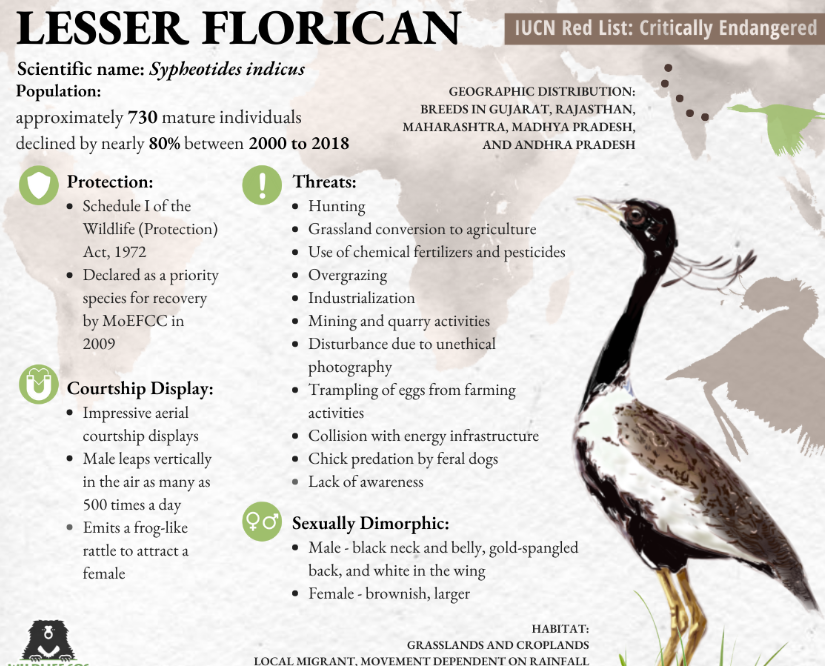
The Lesser Florican (Sypheotides indicus), commonly known as the “grass peacock”, is experiencing a drastic population decline in India.
Key Points
- About:
- According to a recent study by the Wildlife Institute of India (WII), the global population is now estimated to be only 150–200 individuals, with just 19 males sighted during the 2025 breeding season in Gujarat and Rajasthan.
- The population has declined by over 80% in the last 36 years, falling from 4,374 individuals in 1982 to about 150–200 in 2025.
- Repeated surveys conducted in 2017, 2018, and 2025 indicate a consistent and alarming downward trend.
- The remaining breeding populations are restricted mainly to Rajasthan and Gujarat.
- Their wintering sites include Maharashtra, Karnataka, and Telangana, and the birds migrate mainly at night, often covering 20–27 km per day.
- Telemetry studies on 12 individuals showed migration from Ajmer (Rajasthan) to the Deccan regions, covering up to 1,500 km.
- Conservation Efforts:
- A captive breeding centre has been established in Ajmer (Rajasthan), currently housing 10 birds (6 females and 4 males) with incubation and chick-rearing facilities.
- Awareness programmes have been conducted to educate over 3,000 students and 2,500 local villagers near nesting sites.
- The WII has initiated studies on husbandry and breeding protocols to develop long-term conservation strategies.
Lesser Florican (Sypheotides Indicus)
- It is one of three bustard species endemic to India, the others being the Bengal florican (Critically Endangered) and the Great Indian Bustard (Critically Endangered).
- It is the smallest of the bustard family and is renowned for its spectacular leaping breeding display.
- In the local language, the bird is known as ‘tanmor’ or ‘kharmor’, derived from the root word ‘mor’ for peacock.
- Conservation status:
- IUCN Status: Critically Endangered
- Wildlife Protection Act,1972: Schedule I
- CITES: Appendix II
West Bengal Switch to Hindi
FAO Honours SAIME Model
Why in News?
The Nature Environment and Wildlife Society (NEWS), a West Bengal-based NGO, has received Global Technical Recognition from the Food and Agriculture Organisation (FAO) of the United Nations for developing an innovative model — Sustainable Aquaculture in Mangrove Ecosystems (SAIME).
- The recognition was conferred during FAO’s 80th Anniversary and the World Food Forum held at FAO Headquarters in Rome, Italy.
Key Points About SAIME Model
- Objective: To integrate mangrove conservation with sustainable aquaculture practices, promoting climate-resilient livelihoods in coastal regions.
- Coverage: Implemented across 29.84 hectares by 42 fish farmers in the Indian Sundarbans.
- Key Feature: Ensures 5%–30% mangrove coverage within aquaculture ponds to maintain ecological balance.
- Approach: Follows a community participatory model encouraging farmers to adopt eco-friendly aquaculture aligned with climate adaptation goals.
- Implementation: The SAIME model is implemented in Chaital (North 24 Parganas) and Madhabpur (South 24 Parganas) districts of West Bengal’s Sundarbans region.
- Farmers use mangrove litter as natural fodder for cultivating Black Tiger Shrimp (Penaeus monodon), promoting chemical-free aquaculture and aiding mangrove restoration.
- Significance: The SAIME model boosts farmers’ income by over 100% while enhancing mangrove restoration, carbon sequestration, coastal resilience, and reducing pollution and habitat loss.


