























.jpg)

.png)

.jpg)

 PCS Parikshan
Madhya Pradesh Switch to Hindi
NGT Orders Probe into Toxic Waste Discharge from Chhatarpur Brewery
Why in News?
The National Green Tribunal (NGT) has initiated suo motu proceedings against a brewery in Chhatarpur, Madhya Pradesh, over grave allegations of environmental damage and public health risks caused by its discharge of toxic wastewater.
Key Points
- Environmental Contamination: The brewery's chemical waste has polluted water sources within a 1 km radius and caused a foul stench affecting a dozen villages up to 5 km away.
- Severe Health Impact: Local residents are reporting serious health issues, including headaches, eye irritation, breathing difficulties, and vomiting, with long-term risks of kidney disease and other serious health problems due to contaminated water and air.
- NGT's Judicial Response: An NGT bench has formed a joint committee comprising the Chhatarpur District Collector and the Madhya Pradesh Pollution Control Board (MPPCB) to investigate and submit an action-taken report within six weeks.
National Green Tribunal
- Origin: The National Green Tribunal (NGT) was established under the NGT Act, 2010 to adjudicate environmental cases and ensure effective and speedy disposal of disputes related to environmental protection and conservation.
- Powers: The Tribunal has the powers of a Civil Court under the Code of Civil Procedure, 1908. However, it is not bound by the Code of Civil Procedure, 1908 or the Bharatiya Sakshya Adhiniyam, 2023, and functions based on the Principles of Natural Justice.
- Members: The members of the NGT hold office for a term of five years/until age of 65 and are not eligible for re-appointment.
- Eligibility: The Chairperson of the NGT must be a Judge of the Supreme Court or a Chief Justice of a High Court.

Madhya Pradesh Switch to Hindi
Bhavantar Scheme
The ‘Bhavantar’ Scheme in Madhya Pradesh has witnessed a threefold surge in farmer registrations, reaching 9.36 lakh, reflecting strong participation and trust in the government’s price protection initiative.
Key Points
- About: The Bhavantar Scheme is a price deficit payment scheme aimed at bridging the gap between market prices and the Minimum Support Price (MSP) to prevent financial losses for farmers.
- Mechanism: Farmers must register their details and crop area with state authorities before sowing and sell their produce in government-notified mandis.
- The government fixes a Minimum Support Price (MSP)/Model Price and calculates a Model Rate based on average market prices, recording the actual sale price received by the farmer.
- The Direct Benefit Transfer (DBT) is the difference between the higher of MSP/Model Price or Model Rate and the actual sale price, which is directly credited to the farmer's bank account.
- Advantages:
- Price Risk Mitigation: Protects farmers from market volatility and ensures a fair price.
- Reduces Fiscal Burden: Avoids costs of procurement, storage, and transport.
- Promotes Market Freedom: Farmers can sell to any buyer in notified mandis.
- Transparency: DBT ensures direct, timely payments, reducing corruption.
- Challenges:
- Implementation Hurdles: Delays in registration, payments, and technical glitches.
- Data Accuracy: Model Rate may not reflect true market prices, causing inadequate compensation.
- Trader Collusion: Risk of mandi traders keeping prices low.
- Limited Crop Coverage: Scheme often covers only specific oilseeds and pulses.
Soybean (Glycine max)
- About: Soybean is a major crop grown for oil and protein, with a world production of about 176.6 million tons over 75.5 million hectares.
- Growing Conditions: Mainly grown under rainfed conditions, though supplemental irrigation is increasingly used.
- Adapted to tropical, subtropical, and temperate climates. Growth slows above 35°C and below 18°C.
- Top Producers: The major producing states in India are Madhya Pradesh, Maharashtra, and Rajasthan. Brazil, the United States, and Argentina are the top global producers of soybeans.
Bihar Switch to Hindi
Acting CJ of Patna HC
Shri Justice Sudhir Singh has been appointed as the Acting Chief Justice of the Patna High Court by the Collegium System, following the retirement of Chief Justice Pavankumar Bhimappa Bajanthri.
- Article 223 of the Constitution of India allows the President to appoint a Judge of a High Court as acting Chief Justice when the office is vacant or the Chief Justice is absent or unable to perform duties.
Collegium System
- About: It is India’s system for appointing and transferring Supreme Court and High Court judges, evolved from landmark Supreme Court judgments like the Three Judges Cases, not directly from the Constitution.
- Evolution:
- First Judges Case (1981): SC ruled that consultation in Articles 124(2) & 217 did not mean concurrence, giving the executive primacy in judicial appointments.
- Second Judges Case (1993): SC overruled the first, stating CJI’s advice on appointments is binding on the President, after consulting the two senior-most judges, leading to the Collegium System.
- Third Judges Case (1998): SC expanded the Collegium to include the CJI and four senior-most judges; HC Collegium includes the Chief Justice and two senior-most judges. The government can raise objections, but appointments by Collegium are binding if reiterated.
- National Judicial Appointments Commission (NJAC): It was a proposed constitutional body under the 99th Constitutional Amendment Act, 2014, intended to replace the Collegium System with a transparent, merit-based process.
- In the Fourth Judges Case (2015)—Supreme Court Advocates-on-Record Association vs Union of India—the Supreme Court struck it down as unconstitutional, citing excessive executive involvement and a threat to judicial independence.
Maharashtra Switch to Hindi
New Reservation Rotation Rules for BMC Elections
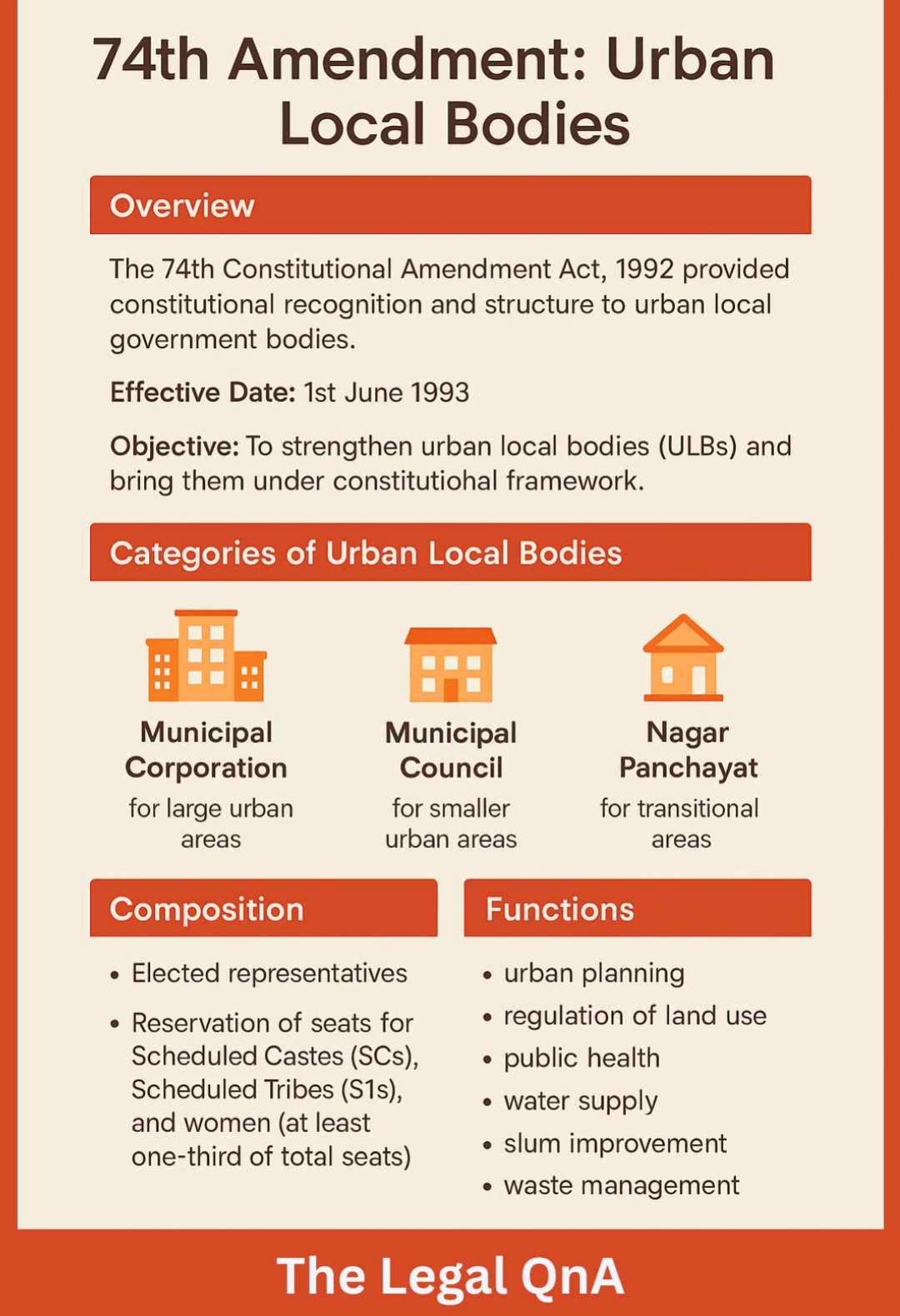
The Maharashtra government has unveiled fresh rules for reservation rotation across all 227 Brihan Mumbai Municipal Corporation (BMC) wards, marking a key step toward conducting the long-pending civic elections.
- The Brihan Mumbai Municipal Corporation (Allotment and Rotation of Ward Councillor Reservations) Rules, 2025 were issued by the Urban Development Department.
Key Points
- New Priority-Based System: Seats will be reserved by first arranging wards in descending order of their SC/ST population percentage, ensuring wards with the highest concentration get reservation first.
- Exclusion of OBC Reservation: The new framework does not apply to Other Backward Classes (OBC); their wards continue to be reserved through a lottery system due to the absence of a caste census.
- 50% Quota for Women: As per existing norms, 50% of the total seats, including those within SC, ST, and OBC categories, are reserved for women, and the new rotation rules will apply to these seats as well.
- Reset of Rotation Cycle: The state has directed that the upcoming polls be treated as the "first election" under this new system, effectively resetting the previous rotation cycle established in 1994.
What is the Significance of the New Reservation Rotation Rules for BMC Elections?
- Ensures Fair Representation: Wards with the highest population of SC, ST, and women are prioritized, ensuring that communities historically underrepresented have better access to political participation.
- Transparency and Standardization: The rules provide a clear, data-based framework for allotting reserved seats based on population percentages, reducing arbitrariness in reservation decisions.
- Women’s Empowerment: With 50% of seats reserved for women, the rules enhance gender representation in municipal governance, including in SC, ST, and OBC reserved wards.
- Legal and Administrative Compliance: Aligns with constitutional provisions for representation of SCs, STs, OBCs, and women in urban local bodies, and follows the Supreme Court verdict on OBC reservation.