


International Relations
India-Bangladesh Relations
- 17 Feb 2026
- 14 min read
For Prelims: 1971 Liberation War, Akhaura-Agartala Rail Link, India-Bangladesh Friendship Pipeline, Maitree Setu
For Mains: India-Bangladesh Relations, Key issues, Measures to address the issue.
Why in News?
The Bangladesh Nationalist Party (BNP), led by Tarique Rahman, has secured a landslide victory in the general elections held in February 2026. This marks a significant paradigm shift in Bangladesh’s politics, ending the interim period that followed the ouster of the Sheikh Hasina regime (Awami League) in August 2024.
- India’s Prime Minister swiftly congratulated Tarique Rahman, signaling India’s readiness to engage with the new dispensation regardless of past animosities.
Summary
- The BNP’s 2026 victory marks a major shift in Bangladesh’s politics, reviving security concerns for India such as insurgency risks, minority safety, China’s growing influence, and anti-India sentiment, while testing India’s Neighbourhood First policy.
- Despite challenges, deep economic, energy, and connectivity interdependence makes engagement essential, requiring India to adopt pragmatic diplomacy, strengthen people-to-people ties, and set clear security red lines to stabilise bilateral relations.
What is the Historical Context of India- Bangladesh Relations under BNP Rule?
- BNP: It was founded by General Ziaur Rahman, who steered Bangladesh away from its initial secular foundations towards a more Islamic identity, often improving ties with Pakistan.
- The 2001-2006 Era (Strained Ties): The previous BNP-Jamaat coalition government is often cited as the "lowest point" in bilateral relations.
- Security Concerns: India accused the regime of harboring Northeast insurgent groups (United Liberation Front of Assam (ULFA), National Democratic Front of Bodoland (NDFB)).
- Terrorism: Increasing radicalization and cross-border terror threats.
- China Factor: A distinct pivot towards China in defense and infrastructure.
- The "Golden Chapter" (2009-2024): Under Sheikh Hasina, relations flourished with the resolution of the Land Boundary Agreement (2015), connectivity projects, and a crackdown on anti-India insurgents.
- India-Bangladesh bilateral trade reached USD 13 billion in FY 2023–24, making Bangladesh India’s largest trade partner in the subcontinent.
- Duty-free access was provided on most tariff lines under the South Asian Free Trade Area (SAFTA) agreement under Hasina’s administration.
- The Interim Period (2024-2026): Following the student-led revolution and Hasina’s flight to India, anti-India sentiment surged in Bangladesh, driven by the perception that India had unconditionally backed an "authoritarian" regime.
India-Bangladesh Relations
- Historical Background: India–Bangladesh relations were built on a strong foundation during the 1971 Liberation War, when India provided decisive military and diplomatic support, fostering trust and shared secular values.
- The partnership was formalised through the 1972 Treaty of Friendship and the 1974 Land Boundary Agreement, which created the initial legal framework for bilateral ties.
- Trade: In FY25, total trade reached USD 13.51 billion, with India exporting USD 11.46 billion and importing USD 2.05 billion.
- India mainly exports fuels, petroleum products, and cotton inputs, while importing garments, footwear, and textile goods, reflecting strong economic complementarity.
- Power and Energy Cooperation: Bangladesh imports 1160 MW of electricity from India. The Maitree Super Thermal Power Plant (1320 MW) built with Indian assistance.
- The India-Bangladesh Friendship Pipeline for High-Speed Diesel; Indian PSUs involved in oil exploration and supply.
- Development Partnership: India has extended 3 Lines of Credits (LoCs) worth nearly USD 8 billion for infrastructure projects in roads, railways, ports, and a dedicated USD 500 million Defence LoC.
- Grant assistance for specific projects like the Akhaura-Agartala rail link and dredging.
- Connectivity & Transport: Cross-border rail links such as Agartala–Akhaura, the use of Chittagong and Mongla ports for Indian cargo, revival of old rail routes like Haldibari–Chilahati and Petrapole–Benapole, expanded inland waterways trade under the Protocol on Inland Water Transit and Trade, and the Maitri Setu over the Feni River (connecting Sabroom in India's Tripura state with Ramgarh in Bangladesh) have together improved connectivity.
What are the Emerging Challenges in India-Bangladesh relations?
- The "Hasina" Factor & Extradition: Sheikh Hasina has been sheltering in India since 2024.
- The new BNP government, under pressure from its base and coalition partners, is likely to demand her extradition to face trial for "crimes against humanity" committed during the 2024 uprising.
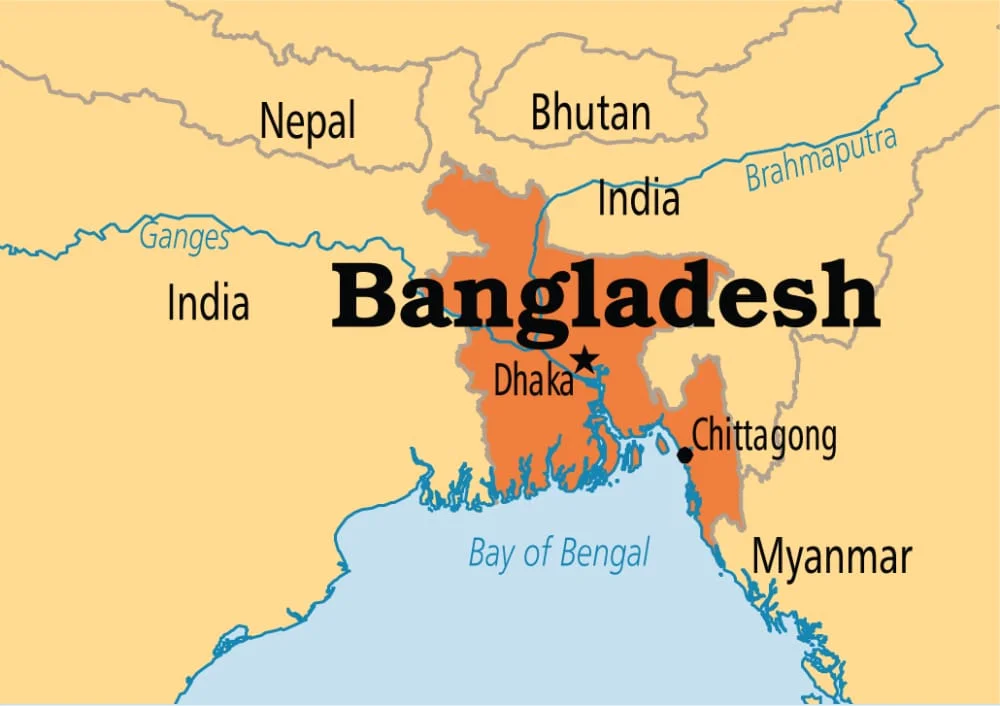
- Security and Insurgency: There are apprehensions in the Indian security establishment that the "Chicken’s Neck" corridor (Siliguri Corridor) could again become vulnerable if the new regime relaxes vigilance on Northeast insurgent groups or allows Pakistan to expand its footprint.
- The return of a hostile regime (BNP-Jamaat) revives the "safe haven" fear for Northeast insurgents (ULFA, etc.).
- Border Control: Notably, Jamaat-e-Islami has won significant seats along the border districts of West Bengal, Assam, and the Siliguri corridor. This poses a direct tactical security threat regarding infiltration and smuggling.
- The Rise of Islamist Politics: Historically, regime changes in Bangladesh (2001, 2024) are accompanied by immediate, widespread violence against religious minorities (perceived as Awami League vote banks).
- There are concerns regarding the safety of minority communities (Hindus) in Bangladesh and the potential rise of radicalism, which could spill over into bordering Indian states (West Bengal, Assam).
- A refugee influx (like in 1971) would destabilize the sensitive demography of Assam and West Bengal.
- Geopolitical Balancing: The BNP has historically advocated a policy of "Look East" (towards China) and closer ties with the Islamic world (including Pakistan) to balance India’s influence.
- Beijing is likely to leverage this shift to fast-track Belt and Road Initiative (BRI) projects.
- The "India Out" Sentiment: Anti-India rhetoric remains potent in university campuses and student movements.
- Even if not explicitly stated in the BNP manifesto, this sentiment limits the new government's ability to be seen as "friendly" to India.
What Steps Can India and Bangladesh Take to Reset Bilateral Relations?
- De-hyphenation from Awami League: India must decisively move past the perception of being an "Awami League-only" ally.
- Engaging with the BNP and the broader Bangladeshi civil society is essential to restore public goodwill.
- India should shift from regime-to-regime deals to people-to-people connect. Easing visa regimes for medical tourism and education can act as a soft power bridge.
- Pragmatic Engagement: Engaging with BNP is a strategic necessity. High-level visits (potentially by the PM) could be offered to confer international legitimacy to the new regime, but strictly in exchange for concrete security guarantees.
- Economic Interdependence as a Stabilising Tool: India can leverage its trade surplus to encourage cooperative behaviour while ensuring fair market access for Bangladeshi goods.
- Continued Indian supply of cotton yarn, power, and essential commodities can stabilise Bangladesh’s economy while reinforcing interdependence.
- CEPA & LDC Graduation: As Bangladesh graduates from the Least Developed Country (LDC) status in 2026, it will lose duty-free access to Western markets.
- India can fast-track the Comprehensive Economic Partnership Agreement (CEPA) to offer duty-free access to the massive Indian market, acting as an economic cushion contingent on political stability.
- Establish Clear "Red Lines": India must unambiguously communicate its non-negotiables to the new government:
- Zero Tolerance for Indian insurgents on Bangladeshi soil.
- Protection of Minorities is a prerequisite for normal ties.
- No Hostile Assets like Chinese developments at Mongla and Payra ports must not evolve into dual-use facilities (e.g., submarine docking) that threaten the Eastern Naval Command.
- Domestic Coordination: The Centre must coordinate effectively with Chief Ministers of border states (West Bengal, Assam, Meghalaya, Tripura, Mizoram) to form a unified political consensus.
- Border security must be depoliticized and treated as a national priority.
Conclusion
The BNP’s 2026 victory signals a structural test for India’s Neighbourhood First policy, raising security concerns. India must adopt a pragmatic, interest-based approach that leverages economic and geographic advantages to safeguard its security.
A stable, neutral, and prosperous Bangladesh remains vital for India’s Act East policy and the security of its Northeast.
Frequently Asked Questions (FAQs)
1. Why is Bangladesh important to India’s Neighbourhood First policy?
Bangladesh is central due to its geographic location, connectivity to the North-East, and role in regional stability and Act East policy.
2. What are the major security concerns for India under BNP rule?
Concerns include insurgent safe havens, ISI influence, minority insecurity, and threats to the Siliguri Corridor.
3. How significant is India–Bangladesh trade?
With trade around USD 13–14 billion annually, Bangladesh is India’s largest trading partner in South Asia, reflecting strong economic interdependence.
4. What role does energy cooperation play in bilateral ties?
India exports electricity, supplies diesel via the Friendship Pipeline, and supports projects like the Maitree Thermal Plant, ensuring mutual energy security.
5. How will Bangladesh’s LDC graduation in 2026 affect relations?
Loss of duty-free access to Western markets may push Bangladesh to seek CEPA with India, deepening economic integration.
UPSC Civil Services Examination, Previous Year Question (PYQ)
Prelims:
Q. With reference to river Teesta, consider the following statements: (2017)
- The source of river Teesta is the same as that of Brahmaputra but it flows through Sikkim.
- River Rangeet originates in Sikkim and it is a tributary of river Teesta.
- River Teesta flows into Bay of Bengal on the border of India and Bangladesh.
Which of the statements given above is/are correct?
(a) 1 and 3 only
(b) 2 only
(c) 2 and 3 only
(d) 1, 2 and 3
Ans: (b)
Mains
Q. Analyze internal security threats and transborder crimes along Myanmar, Bangladesh and Pakistan borders including Line of Control (LoC). Also discuss the role played by various security forces in this regard. (2018)



