


Place In News
Gujarat Reclaims 'Tiger State' Status
- 03 Feb 2026
- 4 min read
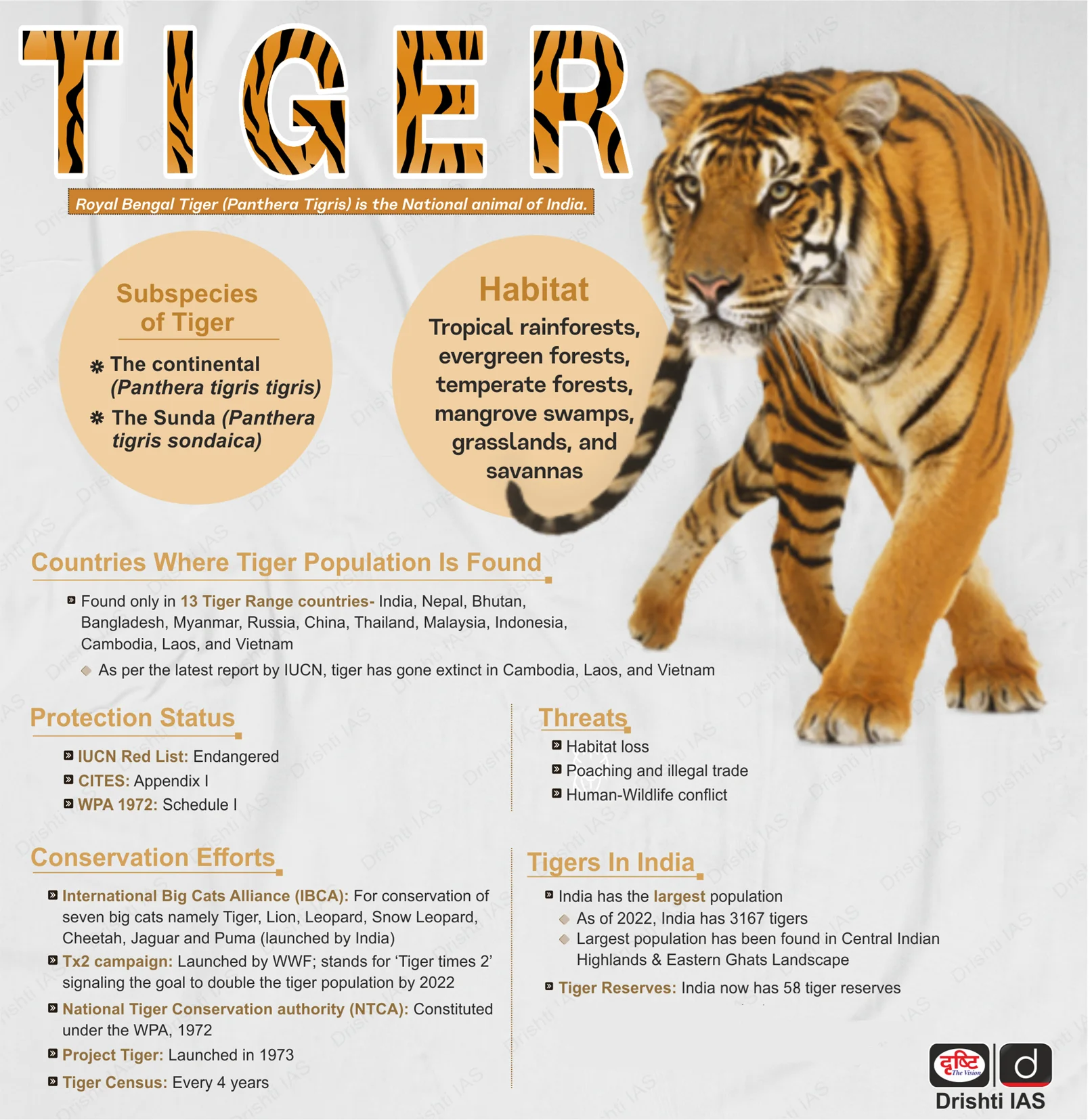
Gujarat is set to regain its tag as a tiger-bearing state following the sustained presence of a Royal Bengal Tiger in the Jambughoda and Ratanmahal forest ranges, marking a significant milestone in India's wildlife conservation history.
- Unique Biodiversity Status: With the confirmation of the tiger's presence, Gujarat claims the distinction of being the only state in India to host three major big cats: Asiatic Lions, Royal Bengal Tigers, and Leopards.
- Migration Corridor: The tiger migrated approximately 60 km from Katthiwada Wildlife Sanctuary in Madhya Pradesh to the Kanjeta range and Jambughoda Wildlife Sanctuary in Gujarat.
- The 90-km corridor connecting Kanjeta, and Jambughoda is identified as a thriving forest patch with natural caves and water sources, suitable for tiger conservation.
- The state forest department is coordinating with the National Tiger Conservation Authority (NTCA) to introduce a female mate, aiming to establish a stable tiger population in the region.
- Prey Base Augmentation: To sustain the tiger and prevent human-animal conflict, a Herbivore Breeding Centre has been established near Kada dam to breed spotted deer (chital) and sambar to release into the wild.
- Jambughoda Wildlife Sanctuary: It is a biodiversity hub characterised by dry southern tropical, dry deciduous, and secondary forests interspersed with grasslands and medicinal herbs.
- The landscape is dominated by thickets of Teak, Mahua, and Bamboo, providing dense cover for a rich variety of fauna.
- The sanctuary supports a significant population of Leopards, alongside Sloth Bears, Chausinghas (four-horned antelope), Nilgais, and Hyenas, making it a critical ecological corridor in the region.
- Ratanmahal Wildlife Sanctuary: Located in Gujarat along the border with Madhya Pradesh, the Ratanmahal Wildlife Sanctuary (est. 1982) is a critical habitat renowned for hosting the state's highest population of Sloth Bears.
- The sanctuary features dry teak and mixed deciduous forests interspersed with Bamboo, Mahua, and Jamun trees, which provide essential forage for the bears.
- Beyond its rich fauna, which includes a significant density of Leopards, the area holds strategic ecological importance as the catchment for the River Panam, sustaining water conservation efforts for the Dahod and Panchmahal districts.
| Read more: Tiger Returns to Gujarat After Three Decades |



