


Rapid Fire
DHRUV64 Microprocessor
- 25 Dec 2025
- 3 min read
On 15th December, the Ministry of Electronics and Information Technology (MeitY) announced the launch of DHRUV64, a fully indigenous 64-bit microprocessor developed by C-DAC under the Microprocessor Development Programme (MDP), aimed at strengthening India’s sovereign semiconductor ecosystem.
DHRUV64
- About:
- DHRUV64: It is part of India’s ecosystem of processors, including SHAKTI from IIT-Madras, AJIT from IIT-Bombay, VIKRAM from the ISRO-Semiconductor Lab, and THEJAS64 from C-DAC (2025).
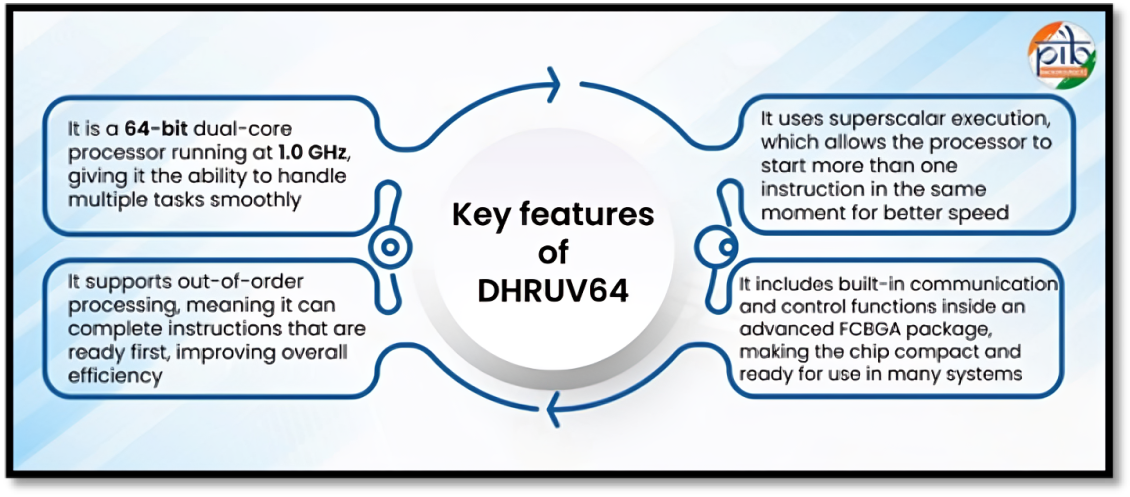
- It is a general-purpose, 64-bit, dual-core microprocessor
- Clock Speed: ~1 GHz
- Developer: Centre for Development of Advanced Computing (C-DAC)
- Architecture: Based on RISC-V
- Programme: Digital India RISC-V (DIR-V)
- Designed for embedded systems as well as operating-system-level workloads
- DHRUV64: It is part of India’s ecosystem of processors, including SHAKTI from IIT-Madras, AJIT from IIT-Bombay, VIKRAM from the ISRO-Semiconductor Lab, and THEJAS64 from C-DAC (2025).
THEJAS32 was the first India-designed chip DIR-V chip to be fabricated (in Malaysia) and THEJAS64 was the second, manufactured at SCL Mohali. DHRUV64 is the third on this list.
- Applications
- Telecom base stations
- Industrial automation and controllers
- Automotive electronics
- Routers and networking equipment
- Strategic and government systems
- Digital India RISC-V (DIR-V) Programme:
- Digital India RISC-V (DIR-V) Programme aims to develop a portfolio of indigenous RISC-V–based microprocessors to reduce India’s dependence on foreign processor technologies.
- It targets strategic and commercial sectors such as industry, defence, space, and consumer electronics, supporting technological sovereignty.
- RISC‑V:
- RISC-V is an open-source instruction set architecture (ISA) that allows anyone to design and customize processors without paying licensing fees.
- Unlike ARM or x86 (Intel/AMD), companies don't pay a "tax" to use the blueprint.
- It supports modular and scalable processor designs, making it suitable for applications ranging from embedded systems to high-performance computing.
- RISC-V is an open-source instruction set architecture (ISA) that allows anyone to design and customize processors without paying licensing fees.
| Read More: Swadeshi Microprocessor Challenge, India’s Semiconductor Ambitions |



