


Facts for UPSC Mains
Article 324 and ECI’s Transfer of Officials
- 07 Apr 2026
- 8 min read
Why in News?
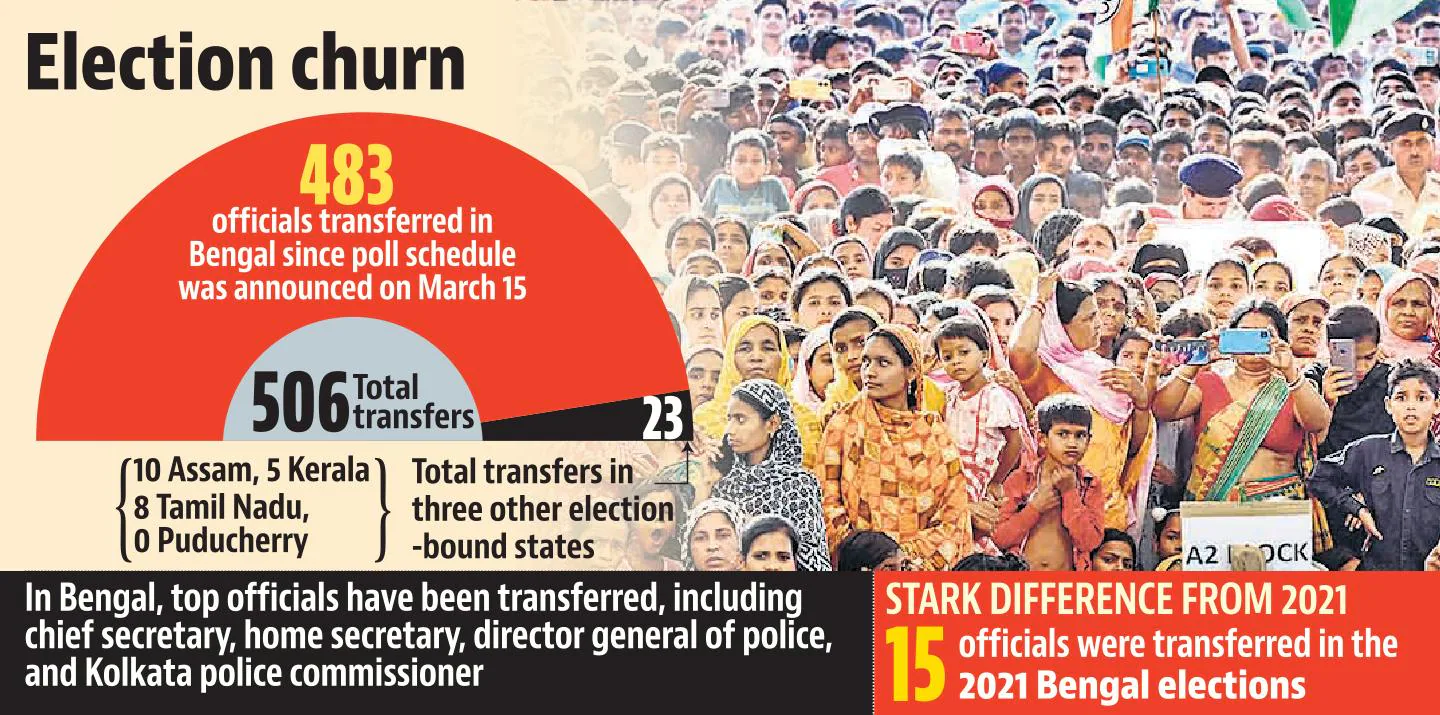
The Election Commission of India (ECI) transferred several senior officials, including the Chief Secretary and Director General of Police in election-bound states like West Bengal, ahead of the 2026 Assembly elections.
- This move, taken without prior consultation with the State government, has sparked a constitutional debate on the scope and limits of the ECI’s powers under Article 324.
What are ECI’s Powers Under Article 324?
- About: Article 324 vests the Election Commission of India with the superintendence, direction, and control of elections.
- Article 324(6) mandates the President or the Governor of a State, when requested by the ECI, to make available to the ECI the staff necessary to discharge its election-related duties.
- The ECI frequently invokes this article as a blanket provision to justify administrative actions, including the transfer of state officials, arguing that it provides unspecified, overarching powers necessary to conduct free and fair elections.
- Supreme Court Stance on Article 324: The Supreme Court of India, in Mohinder Singh Gill vs Chief Election Commissioner (1978), held that Article 324 is a plenary provision and acts as a reservoir of powers to ensure free and fair elections.
- However, these powers are not absolute and they can be exercised only in areas where no law exists.
- Where Parliament or a State Legislature has enacted a valid law on elections, the ECI must act in conformity with it and not in violation, upholding the principle of primacy of statute.
- The Court emphasized that the ECI must be responsible to the rule of law, act bona fide, and adhere to the norms of natural justice. It noted that the ECI cannot act arbitrarily, stating that "unchecked power is alien to our system."
What are the Concerns Regarding the ECI’s Transfer Orders?
- Lack of Statutory Backing: Neither the Representation of the People Act of 1950 nor the RPA, 1951 Act contains any explicit provision that empowers the ECI to unilaterally transfer heads of state administration or police forces.
- Conflict with Existing Legal Frameworks: Under the All India Services Act, 1951 and the Seventh Schedule of the Constitution, the administrative control and the exclusive prerogative to transfer state public service officers lie entirely with the respective State governments.
- Since laws enacted by Parliament already govern civil service transfers, the ECI is arguably bound to act in conformity with those existing laws.
- Undermining Federalism: By bypassing elected state governments and acting unilaterally, the ECI's actions disrupt the federal administrative structure.
- Critics argue that using the objective of "free and fair elections" to justify sweeping interventions in state administration risks upsetting the constitutional balance of power between the Union (via independent constitutional bodies) and the States.
- Demoralization of the Civil Services: Transferring officials specifically on the eve of elections may implicitly brand them as biased, lacking integrity, or incapable of conducting fair polls.
- Moreover, transferring election officials just before elections can disrupt preparedness and affect smooth conduct of polls.
- Arbitrary Exercise of Power: The Supreme Court has explicitly cautioned that the ECI's functions are subject to norms of fairness and reasonableness. There is no clear, documented procedure detailing how the ECI determines that a specific senior officer is unsuitable for their post.
Conclusion
The ECI’s intent to ensure free and fair elections is undeniable, its actions must remain within the boundaries of law and constitutional propriety. A clear legal framework or judicial clarification would help strike a balance between effective electoral oversight and respect for federal principles.
|
Drishti Mains Question: Article 324 provides wide powers to the Election Commission of India, but not without limitations. Critically examine. |
Frequently Asked Questions (FAQs).
1. What does Article 324 of the Constitution provide?
It vests the Election Commission of India with superintendence, direction, and control of elections.
2. What was the key ruling in the Mohinder Singh Gill case?
The Supreme Court of India held Article 324 as a plenary power, but applicable only where no law exists (residual power).
3. Do election laws allow ECI to transfer state officials?
No, neither the Representation of the People Act, 1950 nor the Representation of the People Act, 1951 explicitly grant such powers.
4. Who controls the transfer of All India Services officers?
The All India Services Act vests this power primarily with the Union and State governments.
5. What is the main concern regarding ECI’s recent actions?
It raises issues of federalism, lack of statutory backing, and potential arbitrariness.
UPSC Civil Services Examination, Previous Year Questions (PYQs)
Prelims
Q. Consider the following statements: (2017)
- The Election Commission of India is a five-member body.
- Union Ministry of Home Affairs decides the election schedule for the conduct of both general elections and bye-elections.
- Election Commission resolves the disputes relating to splits/mergers of recognised political parties.
Which of the statements given above is/are correct?
(a) 1 and 2 only
(b) 2 only
(c) 2 and 3 only
(d) 3 only
Ans: (d)
Mains
Q. Discuss the role of the Election Commission of India in the light of the evolution of the Model Code of Conduct. (2022)



