


Social Issues
Rethinking Care in India’s Economy
- 06 Jan 2026
- 21 min read
This editorial is based on “The struggle to count women’s labour” which was published in The Hindu on 05/01/2026. The article highlights the invisibility of women's labour which is neither measured in GDP nor systematically counted in national accounts or policy frameworks.
For Prelims: Beijing Platform for Action, ILO, UN Women,ICDS,Code on Social Security 2020 , The Maternity Benefit (Amendment) Act 2017,Palna Scheme,National Health Mission (NHM),Person with Disabilities in India.
For Mains:Care Economy, challenges in measuring women's labour and practical measures
For centuries, economic systems have systematically ignored the labour that sustains households and reproduces the workforce. This historical negligence continues today, with women globally spending 2.8 hours more per day than men on unpaid care and domestic work (United Nations, 2023). The care economy extends beyond physical tasks to include emotional and mental labour essential for social stability and productivity. Yet, this work remains excluded from GDP calculations, labour laws, and budgetary priorities. Recognising the care economy is therefore central to achieving inclusive and sustainable economic growth.
What is the Care Economy ?
- About: According to the International Labour Organisation (ILO), the care economy refers to “The production and provision of goods and services that are necessary for the physical, social, emotional and intellectual well-being of people.” It includes
- Unpaid Care Work: Cooking, cleaning, fetching water or fuel, childcare, elder care, caring for the sick or persons with disabilities, and managing household routines.
- Emotional and Mental Labour: Providing emotional support, maintaining family relationships, resolving conflicts, planning household needs, and ensuring the well-being of family members.
- Paid care Work: Jobs such as nurses, Anganwadi workers, ASHA workers, domestic workers, teachers, childcare workers, and elder-care providers.
What are the Key Provisions Governing Care Economy in India ?
- Constitutional Provisions:
- Article 14 – Right to Equality: It guarantees equality before the law and equal protection of laws to all persons.
- For working women, it ensures that no arbitrary or unequal treatment is permitted in employment-related matters.
- Article 15 – Prohibition of Discrimination: Article 15 prohibits discrimination on grounds of sex, among other factors.
- In the context of employment, it safeguards women against gender-based exclusion and ensures equal access to public opportunities.
- Article 16 – Equality of Opportunity in Public Employment: This provision ensures equal opportunity for all citizens in matters of public employment.
- It protects women from being denied jobs, promotions, or service benefits solely on the basis of gender.
- Article 39 – Principles to be Followed by State: It lays down important socio-economic principles relevant to working women:
- 39 (a): Men and women have an equal right to an adequate means of livelihood.
- 39(d): Mandates equal pay for equal work for both men and women.
- 39 (e): Directs the State to protect workers’ health, prevent child labour, and avoid forcing citizens into unsuitable employment due to economic necessity.
- Article 42 – Just and Humane Conditions of Work: It directs the State to ensure humane working conditions and provide maternity relief.
- This forms the constitutional basis for workplace safety standards and maternity-related protections for women.
- Article 14 – Right to Equality: It guarantees equality before the law and equal protection of laws to all persons.
- Statutory Labor Protections: These laws provide the legal foundation for paid care workers and maternity rights in the formal sector.
- Maternity Benefit (Amendment) Act, 2017: Mandates 26 weeks of paid maternity leave for the first two children.
- Provides for "Work from Home" options if the nature of the work allows.
- Code on Social Security, 2020: This code aims to extend social security (insurance, maternity benefits, etc.) to unorganized workers, gig workers, and platform workers for the first time.
- Maternity Benefit (Amendment) Act, 2017: Mandates 26 weeks of paid maternity leave for the first two children.
- Institutional Frameworks & Worker Categories: The Indian care economy relies heavily on a large workforce of "voluntary" or "honorary" workers who implement national health and nutrition programs.
- Integrated Child Development Services (ICDS):Governs Anganwadi Workers (AWWs) and Helpers. They are the backbone of early childhood care and nutrition (ECCE) in India.
- National Health Mission (NHM): Governs ASHA (Accredited Social Health Activists). While legally classified as "volunteers," they are the primary providers of maternal and neonatal care in rural India.
- Palna Scheme(National Creche Scheme): A central scheme providing day-care facilities for children (6 months to 6 years) of working mothers, particularly those in the unorganized sector.
- Elderly & Disability Care: Provisions for the aging population and persons with disabilities focus on maintenance and health rights.
- Maintenance and Welfare of Parents and Senior Citizens Act, 2007: Makes it a legal obligation for children/heirs to provide maintenance to senior citizens. It also mandates the establishment of old-age homes in every district.
- Rights of Persons with Disabilities Act, 2016: It promotes inclusion, dignity, and independence, moving beyond a welfare approach to a rights-based framework for 21 recognized disabilities, ensuring accessibility and equal opportunities.
- Evolving Policy & Recognition: Recent shifts indicate a move toward quantifying the "invisible" care economy.
- Time Use Survey (TUS): Conducted by the NSO, this data is now being used to argue for the inclusion of unpaid care work (mostly by women) into the National GDP.
Global Norms Governing Care Economy
- Beijing Platform for Action (1995): It was the first global framework to formally recognise unpaid care and domestic work as an economic and development issue.
- It called for making women’s unpaid labour visible through time-use surveys and satellite national accounts.
- The Platform emphasised redistribution of care responsibilities between men and women, and across the State, market, and households.
- These provisions laid the normative foundation for later frameworks such as SDG 5.4 and ILO care-economy standards.
- International Labour Organization (ILO) Provisions:
- Care Work and Care Jobs for the Future of Decent Work (2018): Recognises care work as productive economic activity, encompassing both paid and unpaid care.
- ILO’s “5R Framework for Decent Care Work”: Recognize, Reduce, and Redistribute unpaid care work, and Reward and Represent paid care work by promoting decent work for care workers and guaranteeing their representation, social, dialogue and collective bargaining.
- ILO Convention No. 156 – Workers with Family Responsibilities: Mandates that workers with caregiving responsibilities should not face discrimination.
- Encourages policies that enable men and women to balance paid work and care duties.
- ILO Convention No. 183 – Maternity Protection: Guarantees maternity leave, health protection, and income security for working women. Establishes care responsibilities as a shared societal obligation, not an individual burden.
- Care Work and Care Jobs for the Future of Decent Work (2018): Recognises care work as productive economic activity, encompassing both paid and unpaid care.
- United Nations (UN) Initiatives:
- Sustainable Development Goals (SDGs)
- SDG 5.4: Explicitly recognises unpaid care and domestic work through public services, infrastructure, and social protection.
- SDG 8: Promotes decent work, including care-sector employment.
- SDG 10: Addresses inequalities arising from unpaid and informal care burdens.
- UN High-Level Panel on Women’s Economic Empowerment: Identifies unpaid care work as a structural barrier to women’s labour-force participation.
- Recommends investment in care services as an economic growth strategy.
- UN Women: Defines the care economy as the foundation of human well-being and economic sustainability.
- Advocates time-use surveys, care-sensitive budgeting, and expansion of public care infrastructure.
- Emphasises redistribution of care between state, market, community, and households.
- Sustainable Development Goals (SDGs)
What are the Key Issues Associated with India’s Care Economy ?
- Invisibility and Undervaluation of Care Work: Most care work, such as cooking, cleaning, childcare, elder care, and emotional support, is not counted as “work” because it does not generate direct income.
- For example, a homemaker who works 10–12 hours daily contributes to the health, productivity, and stability of the family, yet her labour is absent from GDP calculations.
- This invisibility leads policymakers to underestimate the real size and importance of the care economy.
- Gender Gap In Unpaid Care Responsibilities: Women bear a disproportionate share of unpaid care work. In India, of the total time in a day, females spent 16.4% of their time on unpaid domestic work compared to males, who only spent 1.7% of their time on such work. This is not all.
- Other than domestic work, females in India spent 137 minutes a day in caregiving activities, taking care of children and the elderly, compared to 75 minutes spent by males.
- Even working women often manage both paid employment and unpaid household responsibilities, leading to time poverty, stress, and limited career progression.
- Data and Measurement Deficits: India’s Time Use Survey (2019) was an important step in documenting unpaid work, but such data collection remains infrequent and incomplete.
- Unpaid and emotional labour is still absent from national income accounting and policy design.
- The International Labour Organization notes that without regular measurement, care work continues to be ignored in economic planning and resource allocation.
- Unpaid and emotional labour is still absent from national income accounting and policy design.
- Absence Of Comprehensive Legal Framework: India lacks a dedicated legal or policy framework recognising unpaid care and emotional labour.
- Notably the Madras High Court and Delhi High Court have increasingly recognized homemakers' non-financial contributions (domestic chores, childcare) as crucial to building family assets .
- For instance, in the Kannaian Naidu vs Kamsala Ammal (2023) — Madras High Court held that women’s household and caregiving labour contributes indirectly to asset creation, entitling them to equal property share.
- However, without legislative backing, unpaid caregivers remain excluded from social security, pensions, and labour protections.
- Notably the Madras High Court and Delhi High Court have increasingly recognized homemakers' non-financial contributions (domestic chores, childcare) as crucial to building family assets .
- Inadequate Public Care Infrastructure: The limited availability and uneven quality of affordable childcare, eldercare, and mental health services continue to shift the primary responsibility of care onto households, with women bearing a disproportionate burden.
- Insufficient crèches and overstretched Anganwadi centres weaken early childhood care and force women to exit or avoid formal employment, while the severe underinvestment in mental health infrastructure,undermines workforce productivity and social resilience.
- Together, these deficits reveal a structural neglect of the care economy, with long-term implications for gender equality, human capital formation, and inclusive economic growth.
- At the same time, India faces a rapidly ageing population, necessitating an estimated $4.8–$8.4 billion investment by 2030 to meet growing demand for senior living and eldercare infrastructure.
- Precarious Conditions of Paid Care Workers: Paid care workers such as domestic workers, Anganwadi workers, ASHA workers, and caregivers frequently face low wages, informal employment, and weak social protection.
- The COVID-19 pandemic exposed this contradiction, where care workers were labelled “essential” but continued to work without adequate pay, insurance, or job security, reinforcing structural inequality within the care sector.
- ASHA and Anganwadi workers are categorized as "volunteers," denying them the legal status of "workers" and associated minimum wage protections.
- Major 2024-25 protests highlighted that ASHAs often earn only ₹2,000–₹3500 in fixed incentives monthly.
- Weak Fiscal And Policy Prioritisation Of Care: India lacks a dedicated national policy for the "Purple Economy," leading to chronic underfunding and fragmented interventions that fail to treat care as a public good.
- Public spending in India is still largely gender-neutral and does not treat care infrastructure as a key economic investment. As a result, spending on care services is spread thinly across different ministries, with little coordination.
- Although the share of the Gender Budget increased to 8.86% in FY 2025–26, many critics point out that this rise is mainly due to better classification of existing schemes rather than fresh spending targeted specifically at women.
- In practice, schemes meant exclusively for women have seen only limited real growth. This has left the “Purple Economy” without the sustained public investment.
- Deep-Rooted Gender Norms And Social Expectations: Care work is widely perceived as women’s natural responsibility rather than skilled labour. Even when men participate, it is often seen as “help” rather than shared responsibility.
- These entrenched norms hinder redistribution of care between genders and resist policy efforts aimed at achieving equality in household labour.
What Measures are Required to Strengthen India’s Care Economy?
- Recognise Care Work As Economic Work: Governments can take an important step by formally acknowledging unpaid care and domestic work as a valuable economic contribution.
- By gradually integrating care work into policy discussions, development planning, and labour frameworks, along the lines recommended by the International Labour Organization, care activities can be better understood, measured, and supported.
- Recognition is the first step toward visibility, valuation, and reform.
- By gradually integrating care work into policy discussions, development planning, and labour frameworks, along the lines recommended by the International Labour Organization, care activities can be better understood, measured, and supported.
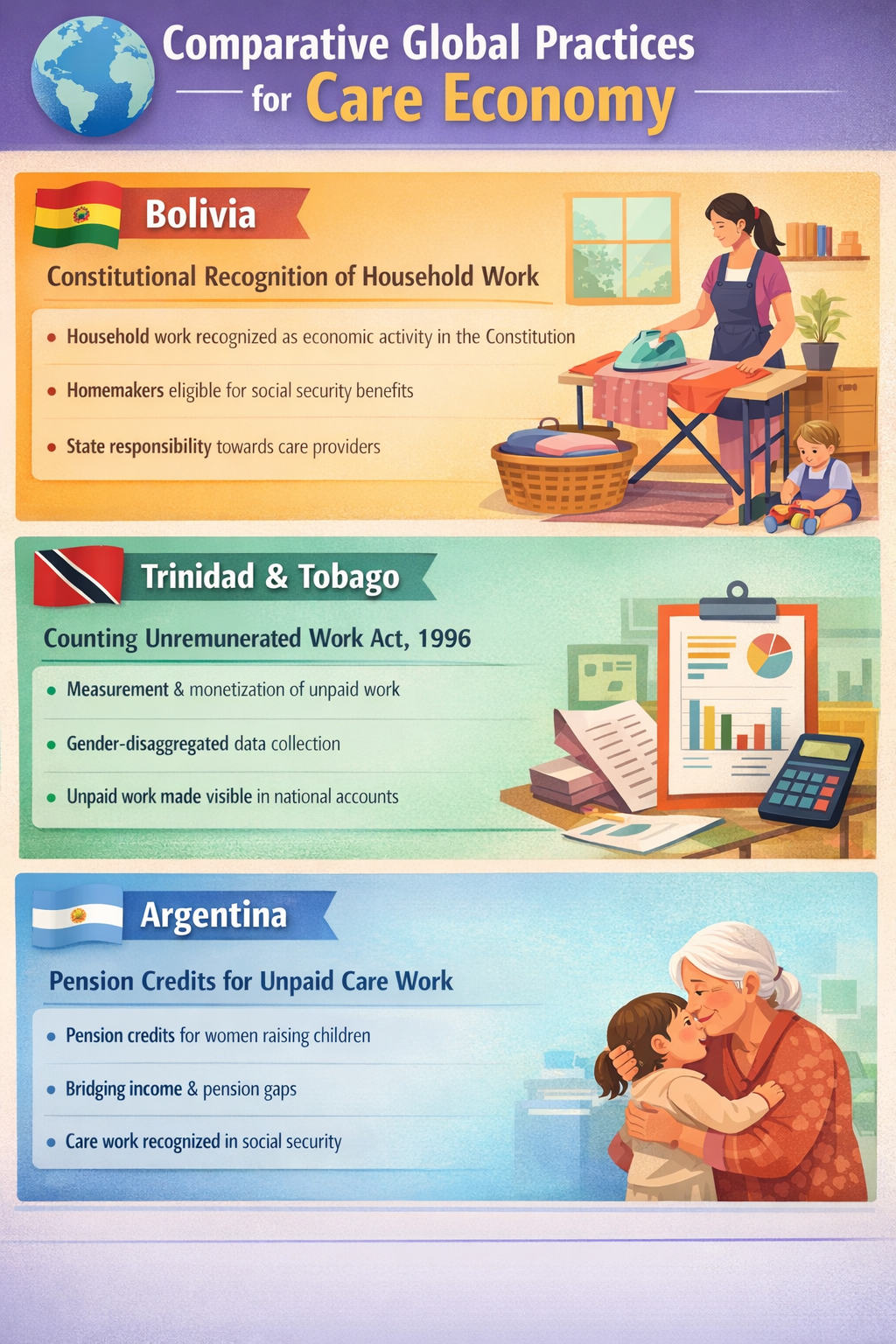
- Measure And Value Unpaid Care Work: Regular Time Use Surveys, gender-disaggregated data, and satellite national accounts should be institutionalised to estimate the economic value of unpaid care work.
- As emphasised by the Beijing Platform for Action, what remains unmeasured continues to be ignored in budgeting and policy priorities.
- Invest In Care As Social Infrastructure: Childcare centres, eldercare services, disability support, and mental health services should be treated as core public infrastructure, similar to roads or power.
- Increased public investment in care services reduces women’s unpaid workload and simultaneously creates decent employment opportunities, a strategy supported by UN Women.
- Redistribute Care Responsibilities: Care work must be shared more equally between women and men, and among households, the State, the market, and communities.
- Policies such as paid parental leave for both parents, flexible work arrangements, and awareness campaigns can help shift care from being a women-only responsibility to a shared social obligation.
- Reward And Protect Paid Care Workers: Paid care workers, such as domestic workers, ASHA workers, Anganwadi workers, nurses, and caregivers should be brought under formal labour protections.
- This includes minimum wages, social security, occupational safety, and career progression, consistent with ILO standards on decent work in the care sector.
- Adopt Care-Sensitive Budgeting: Public budgets should explicitly account for care-related spending and its gendered impact.
- Gender-responsive and care-sensitive budgeting ensures that allocations for childcare, health, nutrition, and social protection are seen as investments in economic productivity, not welfare expenditure.
- Support Women’s Labour Force Participation: Expanding affordable care services enables women to enter, remain, and progress in paid employment.
- This directly contributes to economic growth, poverty reduction, and demographic dividend realisation, aligning with Sustainable Development Goals, especially SDG 5.4 and SDG 8.
- Address Care During Crises And Climate Stress: Disaster response, pandemic planning, and climate adaptation strategies must include care dimensions.
- During crises, unpaid care burdens rise sharply; strengthening public care systems improves societal resilience and prevents women from disproportionately absorbing shocks.
- During crises, unpaid care burdens rise sharply; strengthening public care systems improves societal resilience and prevents women from disproportionately absorbing shocks.
Conclusion:
Strengthening the care economy is essential for achieving inclusive growth and gender equality. Recognising, reducing, and redistributing care work directly advances Sustainable Development Goals, especially SDG 5.4 on unpaid care and SDG 8 on decent work. Investing in care as social infrastructure enhances human capital, labour productivity, and social resilience. A care-centred development approach is therefore not welfare-driven, but growth-enabling and future-ready.
|
Drishti Mains Question Q. Unpaid care and domestic work forms the invisible foundation of India’s economy. Examine the structural reasons behind its invisibility and suggest measures to strengthen the care economy in India. |
FAQs
1. What is the care economy?
It includes paid and unpaid work that supports care, well-being, and daily functioning of individuals and households.
2. Why is care work called “invisible labour”?
Because most care work is unpaid and excluded from GDP and formal labour statistics.
3. Who performs the most unpaid care work in India?
Women, who spend significantly more time than men on domestic and caregiving activities.
4. Which SDG recognises unpaid care work?
SDG 5.4 explicitly recognises and calls for redistribution of unpaid care and domestic work.
5. Why is investing in the care economy important?
It boosts women’s employment, human capital, and inclusive economic growth.
UPSC Civil Services Examination, Previous Year Question
Mains
Q. Distinguish between ‘care economy’ and ‘monetized economy’. How can the care economy be brought into a monetized economy through women empowerment? (2023)



