









.jpg)




.png)

.jpg)

 PCS Parikshan
Madhya Pradesh Switch to Hindi
MP Approves Industrial Package for Bundelkhand
Why in News?
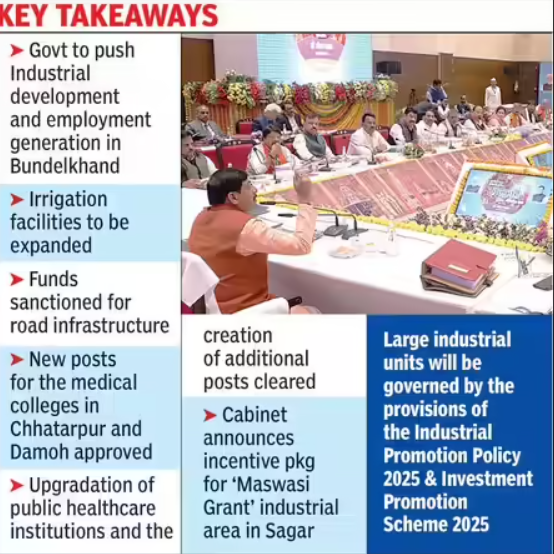
The Madhya Pradesh cabinet has sanctioned a special industrial incentive package aimed at transforming the economic landscape of the Bundelkhand region.
- Chief Minister Mohan Yadav, presiding over the cabinet meeting in Khajuraho, emphasised industrial growth, employment expansion and improved infrastructure.
Key Points
- Investment: The package aims to attract Rs 24,240 crore in investments and generate nearly 29,000 direct jobs in the underdeveloped area.
- Focus: The initiative centres on the Maswasi Grant industrial area in the Sagar division to accelerate regional industrialisation.
- Incentives: Land allotment and lease rates have been fixed at Re 1 per sq metre, with development charges payable in 20 annual instalments and minimal maintenance fees.
- Exemptions: The package offers 100% reimbursement of stamp duty and registration fees, along with a five-year electricity-duty exemption for new industrial units.
- Policies: Large industries will operate under the Industrial Promotion Policy 2025, while MSMEs will follow the MSME Development Policy and Incentive Scheme 2025.
- Exclusions: Cement manufacturing units have been specifically ruled out from availing benefits under this special incentive package.
- Infrastructure: Additional decisions included improvements in irrigation systems and approval of funds for enhancing road connectivity across Bundelkhand.
Bundelkhand
- Bundelkhand is a geographical and cultural region spanning parts of Uttar Pradesh and Madhya Pradesh.
- The semi-arid UP portion includes seven districts, Jhansi, Jalaun, Lalitpur, Mahoba, Hamirpur, Banda and Chitrakoot, while the MP portion includes districts such as Sagar, Chhatarpur, Tikamgarh, Damoh, Panna, Datia and Niwari.
- It is a plateau region with scattered hills.
- Jhansi is the largest city of Bundelkhand.
- Historically known as Jejabhukti or Jejakabhukti during the Chandela period, the region came to be called Bundelkhand after the rise of the Bundela dynasty in the 13th–14th centuries.
Madhya Pradesh Switch to Hindi
National Honour for Bharewa Craft
Why in News?
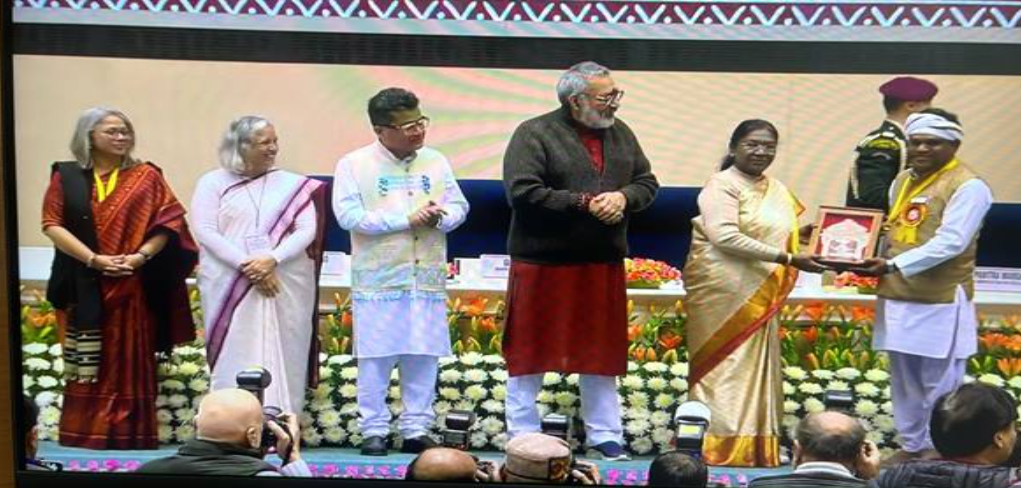
Madhya Pradesh’s Bharewa tribal metal craft gained national recognition as President Droupadi Murmu honoured Betul artisan Baldev Waghmare with the National Handicraft Award.
Key Points
- Origin: The craft belongs to a Gond tribal sub-community, where metal-casting skills are transmitted across generations.
- Tradition: Bharewa artistry is closely tied to Gond rituals, blending tradition with craftsmanship.
- Creations: Artisans produce symbolic deity idols, traditional jewellery, and ritual accessories used in Gond ceremonies.
- Craftwork: Decorative items such as peacock lamps, bullock carts, bells, anklets and mirror frames have gained international appeal.
- Community: Bharewa families are mainly located in the Betul district, around 180 km from Bhopal.
- GI-Status: Bharewa metal craft recently received a Geographical Indication (GI) tag, further strengthening its cultural significance.
- Legacy: Awardee Baldev Waghmare revitalised the dwindling artisan community by transforming Tigriya into a craft hub, preserving the Bharewa art form passed down from his father and sustaining his family’s livelihood.
Gond Tribe
- Large Tribal Group: The Gonds are one of the world’s largest tribal communities and the largest Scheduled Tribe in India.
- Geographical Spread: They primarily live in Madhya Pradesh, Chhattisgarh, Maharashtra, Andhra Pradesh and Telangana, with smaller populations in several other states.
- Subgroups: Major Gond subdivisions include Raj Gonds, Madia Gonds, Dhurve Gonds and Khatulwar Gonds.
- Culture & Beliefs: Their food staples are kodo and kutki millets; rice is reserved for festivals, and their belief system centres on nature deities governing earth, water and air.
- Language: They mainly speak Gondi, a Dravidian language traditionally unwritten, though it is now recognised with emerging scripts.


