


KARNATAKA
Karnataka State GK
- 25 Feb 2026
- 20 min read
Karnataka GK is an important part of preparation for KPSC, Karnataka Police, and other state-level examinations, as well as UPSC and SSC. This page covers essential facts about Karnataka’s geography, history, rivers, national parks, tiger reserves, state symbols, demography, mineral resources, and culture in a concise, exam-focused format. It works as a quick revision guide for static state General Knowledge.
|
As per the Census 2011 |
|
|
Total Population |
6,10,95,297 |
|
Males |
3,09,66,657 |
|
Females |
3,01,28,640 |
|
Rural |
3,74,69,335 |
|
Urban |
2,36,25,962 |
|
Scheduled Castes |
1,04,74,992 |
|
Scheduled Tribes |
42,48,987 |
|
Population Density (Per Sq.Km.) |
319 |
|
Literacy Rate |
75.36% |
|
Sex Ratio |
973 Females/1000 males |
|
Urban Population |
38.67% |
Prepare for KPSC KAS with Drishti IAS
- Formation: After Independence, Kannada-speaking regions were unified to form Mysore State in 1953; it was enlarged in 1956 and renamed Karnataka in 1973 (‘Rajyothsava’ day celebrated on 1st Nov every year); the 7th largest state in terms of area
- Capital: Bengaluru (“Information Technology Capital of India”; earlier famous as “Garden City”)
- High Court: Bengaluru
- State Legislature: Bicameral Legislature
- Divisions: Bangalore Division, Belgaum Division, Kalaburagi Division, and Mysore Division
- Geographical Area: 192000 Sq. Km.
- Revenue Divisions: 4
- District: 31
- Taluks: 176
- Forest Area: 43,382 sq. km
- State Animal: Elephant
- State Bird: Indian Roller
- State Flower: Indian Lotus
- State Butterfly: Southern Birdwing, Sahyadri Birdwing
- State Fish: Carnatic Carp
- State Tree: Indian Sandalwood
- State Fruit: Mango
- State Emblem: Ganda Bherunda, a two-headed mythological figure
- Major Languages Spoken in the State: Kannada (principal language of the state, is a Dravidian language with early evidence seen in Ashokan inscriptions), Telugu, Urdu, Tamil, Tulu, Konkani, Coorgi. etc.
- Geographical Location: Located between 11° 30' and 18° 30' N latitude and 74° 15' and 78° 30' E longitude
- Karnataka consists of a series of uplands with an average elevation of about 610 metres above sea level.
- Coastline: 343.30 Km
- Bounded by: Arabian Sea (West), Goa (Northwest), Maharashtra (North), Telangana (Northeast), Andhra Pradesh (East), Tamil Nadu (Southeast), and Kerala (South).
- Its border touches all four southern Indian sister states.
- State is Divided Into: Coastal region, Western Ghats and vast plains from Ghats to the East.
- Major Rivers: The major river systems draining the entire state are Krishna, Cauvery, Godavari, North Pennar, South Pennar and Palar.
- Major rivers such as the Sharavathi and Kalindi flow westwards. Several rivers in the region have torrential streams and are in full spate during the monsoon season.
- Most of the major rivers originate in the Western Ghats and flow from west to east towards the Bay of Bengal. The Krishna River, along with its tributaries such as the Ghataprabha and Tungabhadra, is among the major rivers of the region. In the southern part of the state, the Cauvery River and its tributaries—Shimsha, Hemavati, and Kapila (Kabani or Kabini)—are prominent.
- Climate: The state exhibits sub-regional climatic variations within the tropical monsoonal zone.
- The state enjoys the benefit of two monsoons and hence it will be called the land of two monsoons because both southwest and northeast monsoons account for a major part of the rainfall.
- Scotland of India: Coorg
- Kunchikal Falls (Varahi River, Shimoga District): Highest waterfall in India (1,493 ft)
- Karnataka is called the Land of waterfalls (over 500 waterfalls; ~10 m in height)
- Jog Falls (Sharavathi River): The 2nd highest plunge waterfall in India
- Major Festivals: Ugadi; Pattadakal Dance Festival; Kambala; Hampi Utsav
- Famous Dance Forms: Yakshagana; Dollu Kunitha; Huli Vesha
- Famous Visual Arts & Crafts: Mysore Paintings; Ganjifa Art; Hase Chitra; Lacquerware; Bidriware; Karnataka Handloom
- First Speaker of Karnataka Legislative Assembly: Shri. V.Venkatappa
- First Deputy Speaker of Karnataka Legislative Assembly: Shri. Pullareddy
- First Chief Minister of Karnataka: Sri K.Chengalaraya Reddy (1947-52)
- First Leader of Opposition of Karnataka Legislative Assembly: Sri. G. V. Anjanappa (1969-70)
- First Woman Speaker of the Karnataka Legislative Assembly: KS Nagarathnamma
- President's Rule (For the First Time in the State): On 19th March, 1971- 20th March, 1972.
- No. of times the President’s rule was imposed in Karnataka– 6 (after independence).
- Mullayanagiri Hill: The highest peak in Karnataka. It is the fourth-highest peak between Nilgiri hills and Himalayas, next to Vavulmala, Chembra Peak and Banasura Hill.
- Mysuru Palace: It is illuminated by over 97,000 light bulbs, making it one of the best-lit places in the world.
- Coffee Production: Largest Producer of Coffee in India, accounting for about 71% of the total coffee production in India.
Historical Timeline
- The Vijayanagara Empire (1336–1646): Founded by Harihara I and Bukka Raya I of the Sangama dynasty, it reached its zenith under Krishnadevaraya of the Tuluva dynasty. It was a golden age for literature, architecture (evidenced by the ruins at Hampi), and trade. The empire effectively ended after the disastrous Battle of Talikota (1565) against the combined Deccan Sultanates.
- The Wodeyar Dynasty (1399–1947): The Wodeyars ruled the Kingdom of Mysore for over five centuries. Post-1800, under progressive rulers like Krishnaraja Wodeyar IV and Diwans like Sir M. Visvesvaraya, Mysore became one of the most modernized princely states in India, pioneering hydroelectric power (Shivanasamudra) and establishing the Bank of Mysore and supporting the establishment of IISc.
- The Anglo-Mysore Wars (1767–1799): The Wodeyar rule was briefly interrupted by Hyder Ali and his son Tipu Sultan, who fiercely resisted British expansion. This era is highly tested for its treaties:
- First War (1767–1769): Ended with the Treaty of Madras.
- Second War (1780–1784): Ended with the Treaty of Mangalore (restored the status quo).
- Third War (1790–1792): Ended with the Treaty of Srirangapatna (Tipu Sultan ceded half his kingdom to the British and their allies).
- Fourth War (1799): Resulted in the fall of Srirangapatna and the death of Tipu Sultan. The British reinstated the Wodeyars under a Subsidiary Alliance.
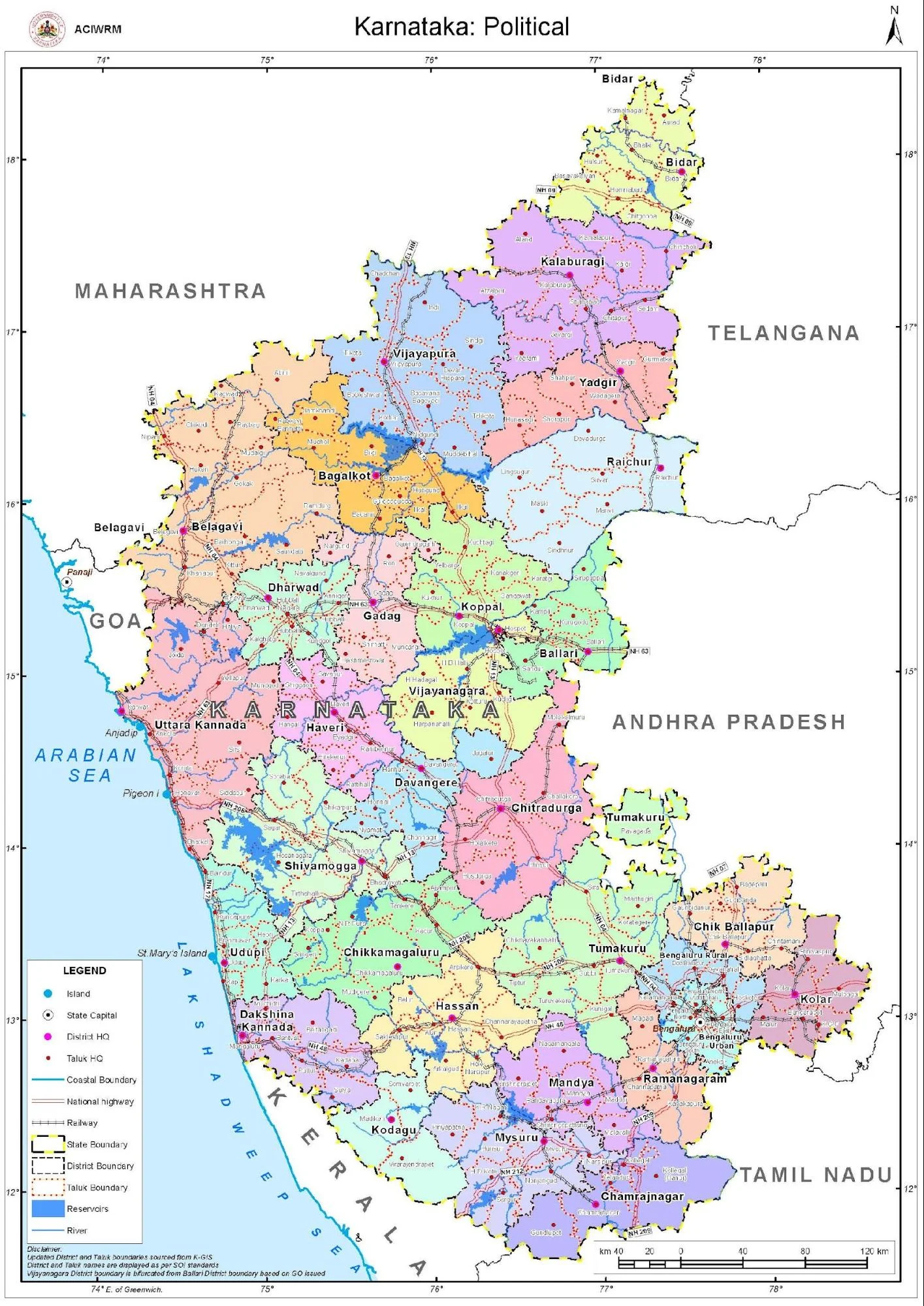
Protected Areas in Karnataka
- Wildlife Sanctuaries In Karnataka: Adichunchanagiri Peacock Sanctuary, Arabithittu WS, Arasikere Slothbear Sanctuary, Attiveri Bird Sanctuary, Bhadra WS, Bhimgad WS, Bramhagiri WS, BRT WS, Bukkapattana Chinkara WS, Cauvery Extension WS, Cauvery WS, Chincholi WS, Dandeli WS, Daroji Sloth Bear Sanctuary (Asia’s first Sloth Bear Sanctuary), Ghataprabha Bird Sanctuary, Gudavi Bird Sanctuary, Gudekote Extension WS, Gudekote Sloth Bear Sanctuary, Jogimatti WS, Kammasandra WS, Kappathagudda WS, Malai Mahadeshwara WS, Melkote WS, Mookambika WS, Nugu WS, Pushpagiri WS, Ranebennur Black Buck Sanctuary, Ranganathittu Bird Sanctuary, Rangayyanadurga WS, Sharavathi Valley Lion Tailed Macaque WS, Shettihalli WS, Someswara WS, Sri Ramadevarabetta Vulture Sanctuary, Talacauvery WS, Thimlapura WS, Uttaregudda WS, Yadahalli Chinkara WS.
|
National Parks & Tiger Reserves |
|
|
Anshi National Park/Kali Tiger Reserve |
|
|
Bandipura National Park/Bandipur Tiger Reserve |
|
|
Bannerghatta National Park |
|
|
Kudremukh National Park |
|
|
Nagarhole National Park/ Nagarhole Tiger Reserve |
|
|
Bhadra Tiger Reserve |
|
|
Biligiriranganatha Swamy Temple (BRT) Tiger Reserve |
|
Note: Karnataka currently has 563 tigers, the second-highest in the country after Madhya Pradesh. (Tiger Census 2022)
UNESCO World Heritage Sites
- Hampi (1986): Once the capital of the Vijayanagara Empire, Hampi is famous for its stunning ruins, temples, and bouldered landscapes.
- Pattadakal (1987): This site features a group of temples showcasing the fusion of architectural styles from northern and southern India.
- Western Ghats (2012): Recognized for its biodiversity, the Western Ghats are also home to ancient temples and historical sites.
- The Sacred Ensembles of the Hoysalas (2023): This group of three temples in Karnataka, India, consisting of Channakeshava Temple Hoysaleswara Temple and Keshava Temple are known for their architectural excellence, sculptural art, and influence on later temples.
Mineral Resources
As per the National Mineral Inventory as on 01.04.2020, Karnataka hosts the country's 79% vanadium ore, 69% iron ore (magnetite), 41% tungsten ore, 36% asbestos, 25% limestone, 19% gold ore (primary), 25% manganese ore, 12% kyanite and 7% PGM (metal) resources.
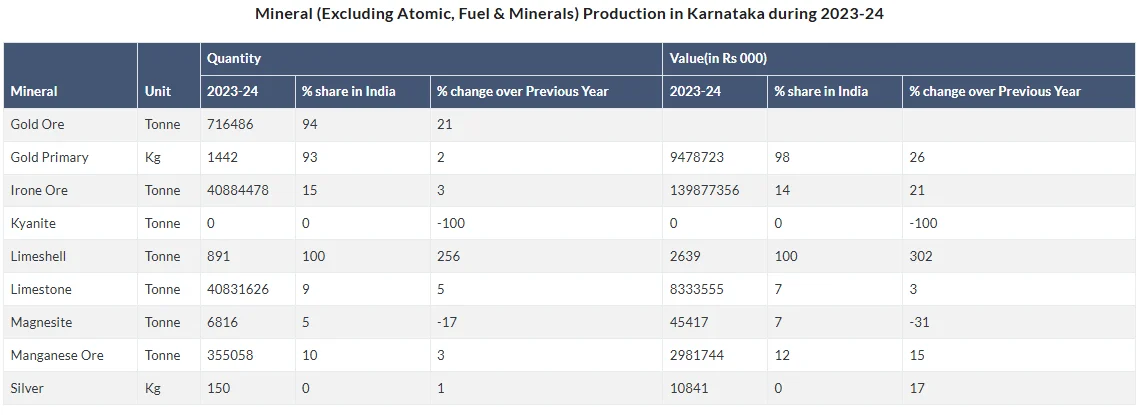
- The principal minerals produced in the state are Gold Ore, Gold Primary, Iron Ore, Kyanite, Limestone Limeshell, Magnesite, Manganese Ore, Minor Mineral and Silver.
- Karnataka continues to dominate the gold sector, producing 94% of the country's gold ore and 93% of primary gold. The state saw steady growth in iron ore, with a 3% rise in production and a 21% increase in its value.
- Limestone production grew by 5%, while magnesite and manganese ore production saw more moderate changes.
- Karnataka also saw a remarkable surge in limeshell production, which increased by 256%, along with a significant rise in its value.
- The number of mines in Karnataka that submitted Mineral Conservation and Development Rules (MCDR) returns during 2023-24 is 177.
|
Mineral |
Districts |
|
Bauxite |
Belagavi, Chikkamagaluru, Uttara Kannada, Dakshina Kannada, Udupi |
|
Chromite |
Chikkamagaluru, Hassan, Mysuru |
|
Gold |
Chitradurga, Dharwad, Kalaburagi, Hassan, Haveri, Hubli, Kolar, Raichur, Tumakuru |
|
Iron ore (Haematite) |
Bagalkot, Bellary, Chikkamagaluru, Chitradurga, Dharwad, Davangere, Gadag, Uttara Kannada, Shivamogga, Tumakuru |
|
Iron ore (Magnetite) |
Chikkamagaluru, Hassan, Uttara Kannada, Dakshina Kannada, Shivamogga |
|
Kyanite |
Chikkamagaluru, Chitradurga, Coorg, Mandya, Mysuru, Shivamogga, Dakshina Kannada |
|
Limestone |
Bagalkot, Belagavi, Bellary, Chikkamagaluru, Chitradurga, Davangere, Gadag, Kalaburagi, Hassan, Mysuru, Uttara Kannada, Dakshina Kannada, Shivamogga, Tumakuru, Udupi |
|
Magnesite |
Coorg, Mandya, Mysuru |
|
Manganese ore |
Belagavi, Bellary, Chikkamagaluru, Chitradurga, Davangere, Uttara Kannada, Shivamogga, Tumakuru |
|
Asbestos |
Chikkamagaluru, Hassan, Mandya, Mysuru, Shivamogga |
|
Pyrite |
Chitradurga |
|
Copper |
Chikkamagaluru, Chitradurga, Kalaburagi, Hassan, Uttara Kannada, Raichur, Shivamogga |
|
Graphite |
Kolar, Mysuru |
|
Molybdenum |
Kolar, Raichur |
|
Nickel |
Uttara Kannada |
|
Platinum Group of Metals |
Davangere |
|
Sillimanite |
Hassan, Mysuru, Dakshina Kannada |
|
Silver |
Chitradurga, Raichur |
|
Titanium minerals |
Hassan, Uttara Kannada, Shivamogga |
|
Tungsten |
Gadag, Kolar, Raichur |
|
Vanadium |
Hassan, Uttara Kannada, Shivamogga |
|
Vermiculite |
Hassan, Mandya, Mysuru |
Static GK remains a core pillar of success in state-level competitive examinations. Use this Karnataka GK page for consistent revision of key facts and data relevant to KPSC and other state exams. Integrating it with current affairs and previous year questions will sharpen conceptual clarity and improve accuracy in state-focused sections.
We hope this structured guide adds value to your preparation. Bookmark the page for quick pre-exam revision and revisit it regularly to strengthen retention and confidence.
|
Related Resources |
|
|
KPSC KAS Exam Syllabus |
|
|
KPSC KAS Previous Year Papers |
|
|
KPSC KAS Exam Pattern |
|
|
Karnataka KAS Exam Strategy |
|
|
Monthly CA Consolidations |
|



