


Strategy
APSC Combined Competitive Examination - Strategy
- 20 Dec 2025
- 18 min read
Table of Contents
- Strategy for APSC CCE Preliminary Examination
- Step 1: Master the Syllabus
- Step 2: Build a Strong Foundation
- Step 3: CSAT - The Qualifying Gatekeeper (Paper II)
- Strategy for APSC CCE Main Examination
- Paper I: Essay (250 Marks)
- Paper II: General Studies I (250 Marks)
- Strategy for Interview (Personality Test)
- General Tips for APSC CCE Success
- Frequently Asked Questions (FAQs)
The Assam Combined Competitive Examination (APSC CCE) is one of the most competitive state civil services examinations in the North-East, recruiting officers for key administrative posts such as Assam Civil Service (ACS), Assam Police Service (APS), Assam Finance Service, and several other Group-A and Group-B positions. The examination demands a structured, disciplined, and state-specific approach, especially due to the evolving pattern, strong emphasis on Assam-related topics, and detailed descriptive Mains papers.
The Assam PCS examination is conducted in three stages: Preliminary, Main, and Interview. Advancement to the next stage depends on successfully clearing the preceding one. Since each stage has its own distinct pattern and requirements, it is crucial to develop stage-specific strategies to maximize the chances of success.
Strategy for APSC CCE Preliminary Examination
Step 1: Master the Syllabus
Understanding the syllabus is the first step. The APSC Prelims syllabus is divided into General topics and Assam-specific topics.
General Topics (Paper I):
- Current Events: National and International importance.
- History of India: Ancient, Medieval, and Modern history (Focus on Indian National Movement).
- Indian and World Geography: Physical, Social, and Economic geography.
- Indian Polity and Governance: Constitution, Political System, Panchayati Raj, Public Policy, Rights Issues.
- Economic and Social Development: Sustainable Development, Poverty, Inclusion, Demographics, Social Sector Initiatives.
- General Issues on Environment: Ecology, Bio-diversity, and Climate Change.
- General Science: Basic principles and recent developments.
Assam-Specific Topics (30-35% Weightage):
- History: Ancient kingdoms (Varman, Pala), Medieval Assam (Ahom Kingdom, Chutiya, Koch), and Modern Assam (Freedom Struggle, Role of Assam Association).
- Geography: Physiography of Brahmaputra and Barak Valley, Climate, Rivers, Soil, and Natural Resources (Tea, Oil, Coal).
- Polity: Administrative structure, 6th Schedule, Autonomous Councils, and specific Acts relevant to Assam.
- Economy: Agriculture, Industries, Major Government Schemes (Orunodoi, etc.), and Economic Survey of Assam.
- Culture: Festivals (Bihu), Literature (Sankardeva, Madhavdeva), Dance forms (Sattriya), and Tribes of Assam.
Step 2: Build a Strong Foundation
- Standard Sources: Start with NCERTs (Classes 6-12) for History, Geography, and Science.
- Key Books:
- Polity: M. Laxmikanth.
- History: Spectrum (Modern India).
- Assam Specifics: Assam Year Book and A History of Assam by Sir Edward Gait or S.L. Baruah.
- Notes: Maintain crisp handwritten notes, especially for Assam geography and history, as these are high-yield and frequently repeated areas. Use:
- Bullet points
- Timelines and flowcharts
- Maps (rivers, national parks, borders)
- Revise these notes regularly to ensure quick recall during exams.
Step 3: CSAT - The Qualifying Gatekeeper (Paper II)
Though qualifying (33%), this paper ensures your entry to the next stage.
- Comprehension: Practice reading passages to enhance clarity and speed.
- Reasoning: Focus on logical reasoning, analytical ability, and problem-solving.
- Basic Numeracy: Refine skills in percentages, ratios, and data interpretation (Class X level).
- Strategy: Aim for a safe score (80+ marks) to avoid stress, but devote the majority of your time to GS Paper I.
Strategy for APSC CCE Main Examination
Paper I: Essay (250 Marks)
- Develop the habit of writing on diverse topics (Social, Economic, Political, Environmental).
- Structure:
- Introduction: Start with a quote, data, constitutional value, or contemporary example.
- Body: Organise into multidimensional paragraphs (historical, social, economic, ethical, environmental, administrative).
- Conclusion: End with a futuristic and solution-oriented outlook aligned with constitutional values or SDGs.
- Assam Value Addition: Use Assam-specific examples to stand out, e.g., Majuli erosion, Brahmaputra floods, tea garden labour issues, or biodiversity conservation.
Paper II: General Studies I (250 Marks)
- Focus: Indian Heritage and Culture, History, and Geography of the World and Society.
- Strategy:
- Build strong basics from NCERTs and standard books.
- Use maps, diagrams, and cultural examples in answers.
- Assam Context:Link topics with Northeast India—river systems, ethnic diversity, tribal culture, seismic vulnerability, and migration patterns—to add analytical depth.
Paper III: General Studies II (250 Marks)
- Focus: Governance, Constitution, Polity, Social Justice, and International Relations.
- Core Strategy:
- Master the Indian Constitution (fundamental rights, DPSPs, federalism).
- Study Representation of People’s Act, local self-governance, and the role of NGOs and SHGs in development.
- Current Affairs Integration: Link static polity with issues like CAA, NRC, border disputes, Centre-State relations, and governance reforms, especially with relevance to Assam.
Paper IV: General Studies III (250 Marks)
- Focus: Technology, Economic Development, Bio-diversity, Environment, Security, and Disaster Management.
- Strategy:
- Thoroughly study the Budget and Economic Survey for economic trends.
- Give special emphasis to Disaster Management, as floods, erosion, landslides, and earthquakes are recurring issues in Assam.
- Assam Linkages: Use case studies on Brahmaputra river management, climate change impacts, and infrastructure challenges in the Northeast.
Paper V: General Studies IV (250 Marks)
- Focus: Ethics, Integrity, and Aptitude.
- Preparation Strategy:
- Understand theoretical concepts such as ethics in public/private relationships, probity, accountability, and Emotional Intelligence.
- Use thinkers, real-life examples, and constitutional values.
- Case Studies: Practice solving case studies involving administrative dilemmas to demonstrate decision-making skills.
Paper VI: General Studies V (Assam-Specific Paper - 250 Marks)
- Syllabus: History, Culture, Geography, Economy, Polity, and Environment of Assam.
- Strategy:
- Study the Ahom Administration (Paik system) and the Moamoria Rebellion.
- Analyze the Industrial Policy of Assam and the Tea Sector crisis.
- Understand the Biodiversity of Assam (National Parks, Man-Animal conflict).
- Resource: Rely on the Assam Year Book, Economic Survey of Assam, and Govt of Assam reports.
Strategy for Interview (Personality Test)
- Stay Updated on Current Affairs: Focus on Assam-specific issues, Northeast regional developments, and national current affairs. Follow newspapers, PIB releases, and official Assam government portals.
- Personality Development: Work on communication skills, confidence, articulation, and body language. Consider mentorship programs (e.g., Drishti Mentorship Programme) or local coaching for structured guidance.
- Know Your DAF: Be thoroughly familiar with your Detailed Application Form (DAF)—academic background, work experience, hobbies, and achievements. Be prepared to discuss these confidently and honestly.
- Revise Core Subjects: Prepare for questions related to your academic subjects, optional paper, and General Studies, emphasizing clarity, analytical ability, and concise expression.
- Understand Assam’s History and Culture: Study Assam’s historical movements, cultural heritage, social issues, and recent developments such as flood management, tea sector, biodiversity, ethnic diversity, and developmental initiatives. Many interview questions focus on local context.
- Practice Communication Skills: Conduct mock interviews to refine articulation, maintain a confident yet respectful tone, and develop the ability to respond thoughtfully under pressure.
- Stay Calm and Ethical: Maintain composure during the interview. If unsure of an answer, admit honestly rather than guess. Ensure responses reflect integrity, ethics, and public service orientation.
General Tips for APSC CCE Success
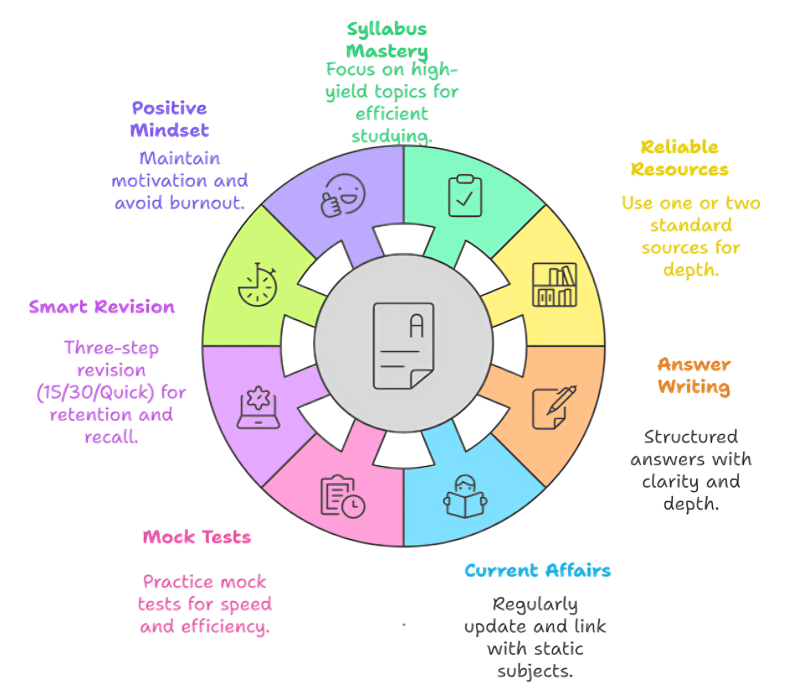
Master the Syllabus – Be Selective, Not Overwhelmed
- The Assam PCS Mains syllabus is vast but not infinite. Instead of trying to cover everything, focus on high-yield topics (such as fundamental rights and duties, Ahom history, etc) that are repeatedly asked in previous years.
- Break down each subject into manageable sections and create a personalized study plan that ensures holistic coverage.
Build a Strong Foundation with Standard Sources
- Avoid book-hopping and stick to one or two reliable sources per subject. Revising these multiple times is better than reading many books superficially.
Develop a Structured Answer Writing Approach
- Introduction: Define key terms or give a fact-based opening
- Body: Use headings, subheadings, and bullet points for clarity
- Conclusion: End with a futuristic outlook, government initiative, or balanced summary
- Incorporate diagrams, flowcharts, and case studies to make answers more appealing.
Regularly Follow Current Affairs
Since the Assam PCS exam is highly dynamic, current events often serve as the bridge between static knowledge and high-scoring answers. Use the following framework to stay ahead:
- For National and International coverage, rely on The Hindu, Indian Express, and PIB.
- Mandatory reading of any reliable newspaper such as The Assam Tribune is essential to cover the 30–35% state-specific weightage in the Prelims, as well as the specialized content for GS Paper V and the Personality Test.
- Use the Drishti IAS Website for curated, exam-oriented current affairs updates and analysis.
- Maintain a monthly current affairs notebook. Always attempt to link static subjects (like Polity or Economy) with recent events to add analytical depth and "value addition" to your Mains answers.
Master the Art of Time Management
- Mastering time management is crucial for excelling in the exam. With limited time to answer multiple questions, practice full-length mock tests under exam-like conditions to enhance speed and efficiency.
- Develop the habit of writing 3-5 answers daily to improve clarity and structured presentation. Use keywords, avoid unnecessary details, and strictly adhere to the word limit to maximize scoring potential.
Revise Smartly
- Regular revision is key to retention.
- First Revision within 15 days,
- Second Revision after a month, and
- Final Quick Revision before the exam using self-made notes.
- Consistent revision strengthens concepts and boosts recall.
Take Mock Tests Seriously
- Regularly attempting full-length tests improves speed, presentation, and answer quality while identifying strengths and weaknesses.
- Mock tests boost confidence, reduce exam anxiety, and refine exam strategy, making them essential for success.
Stay Positive & Consistent
- APSC Mains is a marathon, requiring steady effort and self-motivation. Avoid burnout with short breaks and hobbies, and stay active through exercise or meditation. Keep your goal in sight, trust your preparation, and maintain a positive mindset throughout the journey.
Success in the Assam PCS examination demands a blend of strategic planning, consistent effort, and adaptability. By gaining a thorough understanding of the syllabus, utilizing appropriate study resources, and engaging in regular practice, candidates can tackle each stage of the exam effectively. Maintaining focus, confidence, and dedication throughout the preparation will empower aspirants to achieve their goals and excel in this prestigious state-level examination.
|
Related Resources |
|
|
APSC CCE Exam Pattern |
|
|
APSC CCE Previous Year Papers |
|
|
APSC CCE Exam Syllabus |
|
|
Assam State GK |
|
|
Monthly CA Consolidations |
|



