
-
20 Mar 2026
GS Paper 5
UP Special
Q. Describe the tripartite initiative behind the establishment of the Smart Laboratory on Clean Rivers in Varanasi. (125 words) 8
Approach:
- Introduce the tripartite collaboration behind the Smart Laboratory on Clean Rivers (SLCR) in Varanasi.
- Explain how the SLCR aims to restore the Varuna River through sustainable methods.
- Conclude by emphasizing the significance of this collaborative initiative.
Answer:
Introduction
The Smart Laboratory on Clean Rivers (SLCR) in Varanasi is a collaborative initiative established through a tripartite partnership among the Government of India, the Indian Institute of Technology - Banaras Hindu University (IIT-BHU), and the Government of Denmark. This partnership aims to leverage the expertise of both nations to rejuvenate the Varuna River using sustainable methods.
Body
Key Objectives of SLCR:
- Collaborative Platform: Establish a platform for government bodies, academic institutions, and local communities to share knowledge and develop solutions for maintaining clean river water.
- Hybrid Lab Model: Implement a hybrid lab model at IIT-BHU and an on-field living lab on the Varuna River to test and scale solutions in real-world environments.
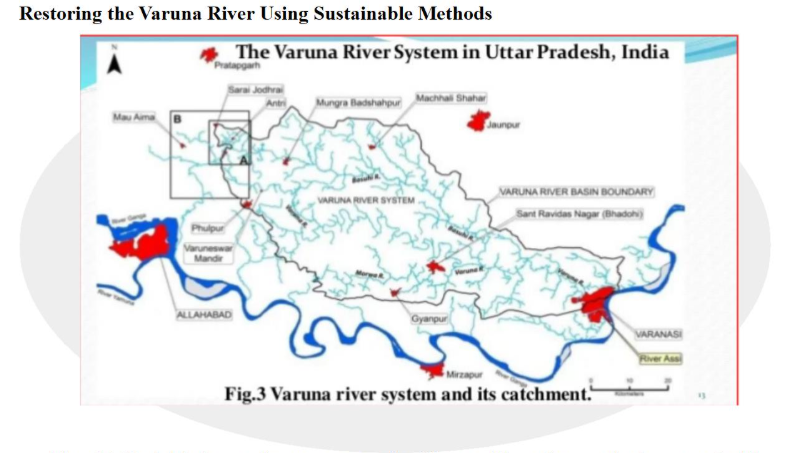
The SLCR initiative seeks to restore the Varuna River by employing sustainable, environmentally friendly techniques. The restoration process is designed to:
- Hybrid Lab Model - A hybrid lab at IIT-BHU will work alongside a "living lab" located on the Varuna River. This will allow researchers to test and scale solutions in real-world environments, ensuring that proposed solutions are effective and applicable to the local context.
- Sustainable Water Management - The initiative will focus on implementing sustainable methods for water management, including the development of a Decision Support System (DSS) that will analyze water dynamics using hydrological models, data analytics, and forecasting tools.
- Pollution Control - The project will characterize emerging pollutants through advanced analytical techniques like chromatography and mass spectrometry, aiming to identify and remove contaminants from the river.
- Hydrogeological Interventions - The Hydrogeological Model of the Varuna Basin will enhance the base flow of the river through Managed Aquifer Recharge (MAR), a method that improves the river's water levels and ensures sustainable groundwater replenishment.
Conclusion
By employing sustainable methods, the project offers a promising approach to river rejuvenation in Varanasi. This initiative exemplifies the importance of collaborative efforts in addressing critical environmental issues.



