
-
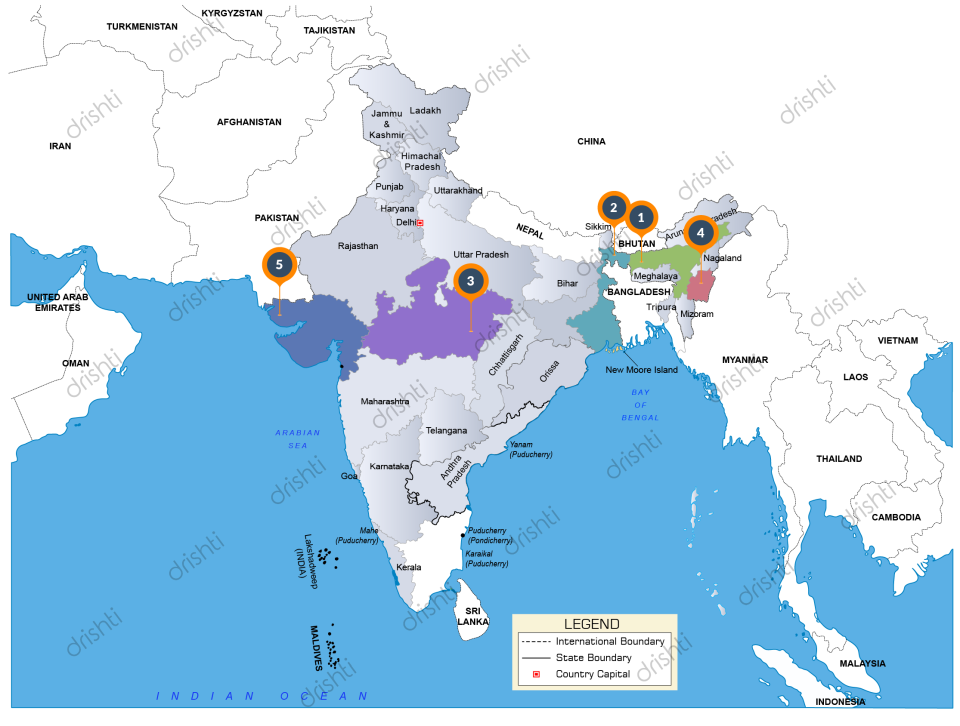
Locate the site that is part of India’s first cross-border railway link with Bhutan, connecting to Gelephu from the Indian side.
Kokrajhar This railway link from Kokrajhar, Assam, to Gelephu, Bhutan, is one of India's first two rail connections with the neighboring country, totaling 89 km. This link reinforces India’s Neighbourhood First Policy and will provide Bhutan access to India's extensive rail network, boosting trade and tourism.
-
Identify the location that forms India’s first cross-border railway link with Bhutan, connecting to the industrial town of Samtse.
Banarhat The railway link connecting Banarhat, West Bengal, to Samtse, Bhutan, is one of the first two such links established between the countries. Samtse is an industrial town in Bhutan, and this connection is expected to enhance trade, industrial growth, and people-to-people connections.
-
Locate the remote, horseshoe-shaped valley that recently received its first health center and is inhabited by Gond and Bharia PVTGs.
Paatalkot Valley The Paatalkot Valley in MP is a remote tribal area that recently saw the opening of its first health center. The valley, inhabited by Gond and Bharia PVTGs, is surrounded by hills and features the Doodhi river, a tributary of the Narmada. It is known for its Archaean era rocks and hosts the Satpuda Adventure Sports Festival.
-
Locate the largest freshwater lake in South Asia, celebrated for its floating islands (phumdis) and listed in the Montreux Record.
Loktak Lake A Nagaland University study has warned of severe ecological degradation in Manipur’s Loktak Lake, citing land-use changes and agricultural runoff. This Ramsar Site is the largest freshwater lake in South Asia and is home to the world’s only floating national park, Keibul Lamjao, which is the habitat for the endangered Sangai deer. The lake is listed in the Montreux Record due to threats from pollution and sedimentation.
-
Locate the Harappan site recently identified as the earliest known caravanserai (2300–1900 BCE), which served as a fortified stopover for traders along inland routes.
Kotada Bhadli Situated in the Kutch district of Gujarat, this Mature Harappan settlement functioned as a rural logistical hub for traders. Excavations revealed a multi-roomed central complex and fortified walls, matching caravanserai-style layouts. The site provides the earliest evidence of a structured overland trade network in the Harappan civilization, pushing back South Asia’s organized trade infrastructure by over 2,000 years before the Silk Route.



