
India's Foreign Policy Recalibration
For Prelims: H-1B, SCO, BRICS, India–Middle East Economic Corridor (IMEC), OPEC, G7, Kailash–Mansarovar Pilgrimage, Cyclone Ditwah, Quad, INSTC, Semiconductors, Critical Minerals, AI Summit.
For Mains: International challenges India confronted in 2025 and its implications on India. Steps needed to navigate diplomatic headwinds in the coming future.
Why in News?
The year 2025 emerged as a period of shock and surprise for Indian foreign policy, with India confronting unforeseen international challenges on multiple fronts, even as it recorded notable diplomatic successes.
Summary
- India faced U.S. policy shocks, regional instability, West Asia conflicts, and global right-wing trends, affecting strategic trust and energy security.
- Reset with Canada, Taliban engagement, China rapprochement, and strengthened neighborhood ties enhanced India’s strategic leverage and regional influence.
- Focus on multipolar diplomacy, issue-based cooperation, domestic resilience, and global agenda-setting, including AI governance, trade, and economic corridors.
What Diplomatic Challenges India Confronted in 2025?
- Strained Relations with the United States: Despite early optimism, India faced punitive tariffs (up to 50%), sanctions-linked pressure (e.g., Nayara Energy) to curb Russian oil imports, and restrictive measures on H-1B, student visas, and deportations.
- Trump’s claims of mediating Operation Sindoor, engagement with Pakistan’s leadership, and approval of F-16 fighter jet upgrades for Pakistan undermined India’s stance on cross-border terrorism, and eroded strategic trust.
- Regional Turmoil: Relations with Pakistan worsened after the Pahalgam terror attack, escalation during Operation Sindoor, and Pakistan Army chief’s consolidation of power as Field Marshal.
- India also confronted political upheaval in Nepal, where Gen Z-led protests toppled the government, and anti-India sentiment in Bangladesh and instability under an interim government.
- Instability in West Asia: India’s reluctance to criticise Israel’s strikes on Iran caused discomfort within SCO and BRICS, where Iran is a member. Simultaneously, the conflict stalled the India–Middle East Economic Corridor (IMEC), affecting India’s connectivity, trade, and regional influence in West Asia.
- Rise of Global Right-Wing Politics: The global trend towards conservative, xenophobic politics, as seen in the US, Europe, Japan, and Chile, created a less predictable and more transactional international order, challenging India's diplomatic playbook. It may intensify immigration restrictions, xenophobia, and job competition, threatening Indian migrants' security and opportunities.
- Energy and Climate Policy Dilemmas: The drop in oil prices due to an OPEC glut threatened to undermine the global push for renewable energy, a sector where India has major investments and commitments.
What were India’s Diplomatic Successes in 2025?
- Reset in Relations with Canada: A major diplomatic achievement was the improvement in India–Canada relations following earlier strains over the killing of a Khalistani separatist. India’s Prime Minister's visit for the G7 outreach, and his engagement with Canada’s new Prime Minister, facilitated the restoration of visas, diplomatic staffing, and envoys.
- Strategic Engagement with Taliban: High-level talks culminated in the Taliban Foreign Minister's official visit to Delhi with full honors. India allowed the Taliban to take over the Afghan embassy and reframed Kabul as "the enemy's enemy," creating strategic leverage amid worsening Pakistan–Afghanistan relations.
- Rapprochement with China: In 2025, India and China pursued cautious re-engagement, reopening the Kailash–Mansarovar pilgrimage, restoring visas and direct flights, and resuming hydrological data sharing. India’s PM met the Chinese and Russian Presidents at the SCO summit 2025 in Tianjin, China.
- Strengthening Neighbourhood Partnerships: India successfully deepened ties with Bhutan, Sri Lanka, and the Maldives. A notable achievement was India’s USD 450 million aid package and swift disaster response to Sri Lanka after Cyclone Ditwah, which reinforced its reputation as a reliable first responder in the region.
What are the Implications of International Challenges in 2025 on India?
- Erosion of Strategic Certainty: The greatest strategic implication was the shattered assumption that the US would be a predictable partner. Trump's transactional policies directly threatened core Indian interests (economic growth, terrorism, energy security).
- This forced a fundamental re-evaluation of India’s foreign policy and accelerated India's push for a multipolar engagement strategy.
- High Cost of Strategic Autonomy: India’s balancing act between Russia and the West proved materially costly, as seen with sanctions on entities like Nayara Energy. This highlighted the limits of non-alignment 2.0 and prompted India for greater domestic resilience.
- Forced Pragmatisation of Foreign Policy: India’s diplomatic engagements with the Taliban, Canada, and China were pragmatic adaptations, not principled triumphs. By prioritizing national interest, India set aside normative positions—engaging the Taliban despite human rights concerns and hosting Putin despite Western criticism.
- Domestic-International Policy Linkage: Trump's visa policies impacted India's tech sector and middle class, while oil price volatility affected inflation and energy goals. This brought foreign policy into everyday domestic life, directly linking the government's popularity to its international actions.
- Challenges for Internal Security: Chinese upgrades to Lalmonirhat airfield in Bangladesh near the strategic Siliguri Corridor and continued Pakistani outreach heighten India’s traditional two-front war concerns. Communal violence and radical groups threaten regional polarisation and could support separatist movements targeting India’s Northeast.
How Should India Navigate Evolving Diplomatic Challenges Ahead?
- Double Down on Issue-Based Alignment: India should pursue discrete, issue-based cooperation with the U.S. and the Quad on maritime security and AI, while insulating these from trade and Russia disputes.
- It must solidify a techno-economic partnership with Europe via an FTA (likely to be signed in January 2026), focusing on green tech and alternative supply chains.
- Concurrently, within BRICS, it should leverage its presidency for practical gains like local currency trade and connecting the INSTC with the IMEC.
- Decouple Diplomacy from Major Power Rivalries: India should maintain border dialogue and functional ties with China while positioning itself as a democratic alternative tech hub. Concurrently, it must build resilient domestic strategies in semiconductors and critical minerals.
- Focus on Neighborhood: Shift from Neighbourhood First to Neighbourhood Stability, prioritizing the containment of internal neighbor turmoil as a security threat.
- This necessitates engaging pragmatically with any electoral outcome in the region and adopting a two-track policy toward Pakistan, i.e., a firm public stance against terrorism, combined with confidential diplomatic channels to maintain a stable, non-violent status quo.
- Lead through Global Agenda-Setting: Cement India's role as a global bridge-builder by championing an equitable AI governance framework at the AI Summit 2026 as an honest broker. Revive the IMEC corridor as an economic peace dividend linked to Gaza stability and position India as a neutral venue for Ukraine peace talks, leveraging its ties with all sides.
- Build Domestic Resilience: The strongest diplomatic foundation is a self-reliant economy, using FTAs (e..g, India and New Zealand FTA) to diversify exports and imports against external shocks. Concurrently, strategic unpredictability necessitates fast-tracking defense Atmanirbharta to reduce dependency on all major foreign suppliers.
Conclusion
In 2025, India's foreign policy faced unprecedented tests, prompting a shift from optimistic engagement to pragmatic realism. Navigating a fractured world requires leveraging strategic autonomy with issue-based partnerships, prioritizing neighbourhood stability, and building domestic resilience to safeguard national interests amid great-power flux and regional volatility.
|
Drishti Mains Question: Q. "The year 2025 marked a strategic inflection point for India's foreign policy." In light of this statement, analyze the key challenges and adaptations that defined India's diplomatic approach. |
Frequently Asked Questions (FAQs)
1. What were India’s main international challenges in 2025?
India faced strained U.S. relations, regional instability with Pakistan, Nepal, and Bangladesh, West Asia conflicts, energy price fluctuations, and rising global right-wing politics.
2. Which trade agreements did India seal in 2025?
India finalized bilateral trade agreements with the U.K., Oman, and New Zealand, while negotiations with the EU, U.S., and EAEU continued.
3. How did India successfully reset relations with Canada in 2025?
India reset ties through a PM-led high-level engagement, firewalling political and economic ties from investigations and restoring visas and diplomatic staffing.
UPSC Civil Services Examination, Previous Year Question (PYQ)
Mains
Q. ‘What introduces friction into the ties between India and the United States is that Washington is still unable to find for India a position in its global strategy, which would satisfy India’s National self-esteem and ambitions’. Explain with suitable examples. (2019)
Q. Project ‘Mausam’ is considered a unique foreign policy initiative of the Indian government to improve relationships with its neighbours. Does the project have a strategic dimension? Discuss.(2015)
Q. In respect of India-Sri Lanka relations, discuss how domestic factors influence foreign policy. (2013)
Year End Review-2025: Ministry of Petroleum & Natural Gas
For Prelims: Pradhan Mantri Ujjwala Yojana (PMUY), Electric Vehicles (EVs), Ethanol, Compressed Bio‑Gas (CBG), Sustainable Aviation Fuel (SAF), Hydrocarbon Exploration Licensing Policy (HELP), 2016, Strategic Petroleum Reserves (SPR), Trade Deficit, Inflation, Strait of Hormuz, Chabahar port, Critical Minerals, Lithium, International Energy Agency (IEA), National Green Hydrogen Mission, National Critical Minerals Mission (NCMM),Small Modular Reactors.
For Mains: Key achievements of the Ministry of Petroleum & Natural Gas in the year 2025, Challenges to achieving energy security for India and way forward.
Why in News?
In 2025, the Ministry of Petroleum & Natural Gas implemented a multi-pronged strategy to secure affordable, sustainable energy by expanding infrastructure, promoting cleaner fuels, and strengthening strategic reserves for energy security.
- Energy Security refers to the uninterrupted availability of energy sources at an affordable price for a nation, ensuring its economic stability, national security, and sustainable development.
Summary
- India in 2025 adopted a multi-dimensional energy strategy combining infrastructure expansion, cleaner fuels, and regulatory reforms.
- Despite diversification, high import dependence, geopolitical exposure, and critical mineral shortages remain major challenges.
- Long-term energy security requires domestic production, clean energy with storage, mineral self-reliance, and geostrategic diplomacy.
What are the Key Achievements of the Ministry of Petroleum & Natural Gas in the Year 2025?
- Clean Cooking Access: Pradhan Mantri Ujjwala Yojana (PMUY) reached ~10.35 crore beneficiaries; 25 lakh new connections approved for FY 2025‑26 while simplified ‘Deprivation Declaration’ eased enrolment.
- Rs 300/cylinder subsidy for PMUY beneficiaries boosted average refill consumption to ~4.85 per annum in FY 2025‑26, indicating sustained LPG adoption.
- Marketing Infrastructure Expansion: >90,000 retail outlets digitised; >8,400 CNG stations & ~1.57 crore PNG connections established; 25,429 km gas pipeline operational (another 10,459 km under execution).
- Clean Mobility & Fuels: >27,400 electric vehicles (EVs) charging stations set up; 4,000 Energy Stations planned as multi‑fuel hubs (1,064 already operational).
- Gas Grid & Tariff Reform: Unified Pipeline Tariff regime (One Nation, One Grid, One Tariff) covers ~90% of pipelines, reducing regional cost disparities.
- Biofuels & Sustainable Aviation Fuel (SAF): Ethanol blending reached 19.24% in Ethanol Supply Year (ESY) 2024‑25.
- Compressed Bio‑Gas (CBG) blending mandated from FY 2025‑26; Sustainable Aviation Fuel (SAF) roadmap set with 1‑5% blending targets from 2027.
- Upstream Reforms: Oilfields (Regulation & Development) Amendment Act, 2025 and Petroleum & Natural Gas Rules, 2025 enacted. Under the Hydrocarbon Exploration Licensing Policy (HELP), 2016, blocks covering over 3.78 lakh sq km were awarded, attracting committed investments of about USD 4.36 billion.
- Strategic Reserves: Phase‑II of Strategic Petroleum Reserves (SPR) facilities advanced, bolstering energy security against supply shocks.
- India’s SPR facilities are located at Visakhapatnam (Andhra Pradesh), Mangaluru (Karnataka), and Padur (Karnataka). Phase II includes a new facility at Chandikhol (Odisha) and an expansion at Padur.
What are the Principal Challenges in Achieving Energy Security for India?
- High and Rising Import Dependence: India imports around 85% of its crude oil and 50% of its natural gas, with domestic crude production falling to 28.7 MT in FY25, (from 29.4 MT in FY24) creating a critical vulnerability to global price shocks.
- This risk was exemplified when the 2022 Ukraine crisis spiked Brent crude to USD 130/barrel, severely worsening India's trade deficit and inflation.
- Geopolitical Vulnerability: India's purchase of Russian oil led to severe economic consequences, including EU sanctions on Nayara Energy, US sanctions on Russian firms, and a 25% tariff and surcharge imposed by the US.
- The majority of India’s crude imports originate in the volatile Middle East, transiting through chokepoints like the Strait of Hormuz and facing disruptions such as the suspended Chabahar port project.
- Critical Minerals Dependency: India is 100% import-dependent for 10 critical minerals including lithium, cobalt, and nickel necessary for energy transition. This creates severe vulnerabilities for its clean energy, EVs, defense, and semiconductor sectors, as China controls over 90% of rare earth processing, 95% of graphite processing, and 79% of refined cobalt production.
- Renewable Energy Infrastructure Bottlenecks: India's non-fossil fuel capacity reached Around 217 GW by January 2025, but faces critical constraints from transmission delays, corridor congestion, and subdued demand.
- Over 60% of large-scale solar and wind projects are concentrated in just 3 states—Gujarat, Rajasthan, and Tamil Nadu, increasing exposure to extreme weather and geopolitical tensions like war or hybrid threats.
- Strategic Petroleum Reserves Inadequacy: India's combined oil storage and Strategic Petroleum Reserves (SPR) can sustain about 77 days of requirement, which is 13 days short of the International Energy Agency (IEA)'s compulsory 90-day mandate. Its quantified storage capacity is a low 39 million barrels, far below China's 550 million and Japan's 528 million barrels.
- Global Competition for Resources: China’s state-backed contracts in Africa and Latin America and the EU’s hydrogen imports strategy intensify global competition for critical minerals and future fuels. India’s limited strategic acquisitions overseas, especially compared to China’s Sinopec and CNPC, weaken its leverage in these energy markets.
India’s Energy Source
- Traditional Dependence (Pre-2005): Over 70% of crude imports came from West Asia, primarily Saudi Arabia, Iraq, Iran, Kuwait, and the UAE.
- Initial Diversification (2005-2015): Sourcing broadened to include African nations (Nigeria, Angola) and Venezuela, though West Asia still dominated (~60% share in 2011-12).
- Impact of Sanctions on Iran: UN and US sanctions post-2010 led to a sharp decline in Iranian oil imports, from ~11% (2011-12) to under 7% by mid-2010s, despite a brief resurgence after 2016.
- Major Shift Post-2022: Following the Ukraine conflict, Russia emerged as India's top supplier, its share jumping from <2% (2021-22) to ~36% (2023-25), driven by significant price discounts.
- Current Import Basket: Sources are now more balanced: Russia (~35%), West Asia (40-45%), Africa (8-10%), and the Americas (10-12%).
What Steps are Needed to Strengthen Energy Security for India?
- Boost Domestic Production: Fully implement the Oilfields (Regulation & Development) Amendment Act, 2025 to streamline clearances and expand Mission Anveshan for exploration in frontier basins like Krishna-Godavari and the Andaman islands. Additionally, deploy Enhanced Oil Recovery (EOR) and Artificial Intelligence in mature fields such as Mumbai High to improve recovery rates.
- Diversification of Energy Imports: To reduce Middle East reliance, India should lock long-term contracts with new suppliers like Guyana, Brazil, and Kazakhstan, and revive Iranian imports via a rupee-rial mechanism if sanctions ease.
- It must also utilize pipelines bypassing the Strait of Hormuz, including the UAE's Habshan-Fujairah pipeline and Saudi Aramco's East-West pipeline, to reduce supply vulnerabilities during regional conflicts.
- Accelerate Clean Energy Transition with Storage: Integrate a 4-hour battery storage mandate into new solar/wind bids and scale up the National Green Hydrogen Mission while developing hydrogen-ready pipelines.
- Concurrently, increase ethanol blending to 30% by 2030 using 2G/3G feedstocks and enforce Compressed Biogas blending mandates in city gas distribution networks.
- Building Critical Mineral Self-reliance: India must accelerate the National Critical Minerals Mission (NCMM), build domestic refining capacity via PPPs, and forge strategic partnerships with Australia and Argentina to secure supply chains. It should also establish a national stockpile and promote a circular economy through advanced recycling for long-term resource security.
- Geostrategic Energy Diplomacy: Champion the International Solar Alliance (ISA) and One Sun One World One Grid (OSOWOG) initiative for cross-border renewable trade. Simultaneously, deploy Small Modular Reactors with partners like the USA, France, and Russia to reduce fossil fuel reliance and build long-term resilience.
Conclusion
India’s energy security strategy in 2025 reflects a calibrated balance between affordability, diversification, sustainability, and strategic autonomy. While reforms, biofuels, gas infrastructure, and cleaner mobility have strengthened resilience, persistent import dependence, geopolitical risks, critical mineral vulnerabilities, and storage gaps necessitate deeper structural reforms and proactive energy diplomacy.
|
Drishti Mains Question: Q. “Energy security is as much a geopolitical challenge as an economic one.” Examine this statement in the context of India’s energy policies in 2025 |
Frequently Asked Questions (FAQs)
1. What is meant by Energy Security?
Energy Security refers to the uninterrupted availability of energy at affordable prices, essential for economic stability, national security, and sustainable development.
2. Why is India vulnerable despite diversification of energy imports?
India still imports 85% of crude oil, faces geopolitical chokepoints, and lacks adequate SPR capacity compared to IEA norms.
3. Why is critical mineral dependency a major vulnerability for India's energy security?
India is 100% import-dependent for key minerals like lithium and cobalt, essential for its clean energy and EV sectors, with China controlling over 90% of global processing, creating severe supply chain risks.
UPSC Civil Services Examination, Previous Year Question (PYQ)
Prelims
Q. Consider the following statements: (2019)
- Petroleum and Natural Gas Regulatory Board (PNGRB) is the first regulatory body set up by the Government of India.
- One of the tasks of PNGRB is to ensure competitive markets for gas.
- Appeals against the decisions of PNGRB go before the Appellate Tribunals for Electricity.
Which of the statements given above are correct?
(a) 1 and 2 only
(b) 2 and 3 only
(c) 1 and 3 only
(d) 1, 2 and 3
Ans: (b)
Q. With reference to the Indian Renewable Energy Development Agency Limited (IREDA), which of the following statements is/are correct? (2015)
- It is a Public Limited Government Company.
- It is a Non-Banking Financial Company.
Select the correct answer using the code given below:
(a) 1 only
(b) 2 only
(c) Both 1 and 2
(d) Neither 1 nor 2
Ans: (c)
Mains
Q. “Access to affordable, reliable, sustainable and modern energy is the sine qua non to achieve Sustainable Development Goals (SDGs)”.Comment on the progress made in India in this regard. (2018)
Suspension of Sentence in Child Protection Cases
Why in News?
The Supreme Court (SC) stayed the Delhi High Court’s (HC) order suspending the life sentence and granting bail to a former MLA from Unnao (Uttar Pradesh) in the 2017 Unnao rape case, raising critical questions on suspension of sentence, and interpretation of the POCSO Act, 2012.
What are the Key Facts Regarding the Case?
- Case Background: The MLA was convicted and sentenced to life imprisonment for the rape of a minor. He was also convicted for the custodial death of the victim’s father.
- Legal Framework for Suspension: Under Section 430 of the Bharatiya Nyaya Sanhita (BNS) 2023, a convict can seek suspension of sentence. However, for serious offences/life imprisonment, suspension is an exception, not the norm.
- It is a discretionary judicial power and suspends only the punishment, not the finding of guilt.
- Delhi HC’s Rationale for Bail: The HC suspended the sentence primarily holding that an MLA is not a “public servant” under Section 21 of the Indian Penal Code, 1860, and thus the aggravated offence under Section 5(c) POCSO Act, 2012 was prima facie not made out.
- It also considered his over 7 years of incarceration. In Kashmira Singh vs. State of Punjab (1977), the SC held that prolonged incarceration may result in injustice if the conviction or sentence is later modified.
- Judicial Precedents on Suspension:
- Bhagwan Rama Shinde Gosai vs. State of Gujarat (1999): The SC held that suspension of a fixed-term sentence under appeal must be exercised liberally.
- Conversely, for serious offences like life imprisonment, as reiterated in Shivani Tyagi Case (2024), suspension is rare and requires an objective assessment of the crime's nature, gravity, and manner of commission.
- Chhotelal Yadav vs. State of Jharkhand (2025): Suspension in life sentence cases is justified only when there is a palpable or gross error in the trial court judgment indicating possible acquittal.
- Jamna Lal vs. State of Rajasthan (2025): The SC set aside a suspension of a 20-year POCSO sentence, holding that the trial court's finding that the victim was a minor cannot be lightly unsettled (should not re-examine or reverse factual finding) at the suspension stage.
- Bhagwan Rama Shinde Gosai vs. State of Gujarat (1999): The SC held that suspension of a fixed-term sentence under appeal must be exercised liberally.
- Delhi HC’s Controversial Interpretation: The Delhi HC adopted a narrow interpretation, relying on the IPC definition of 'public servant' (including judges, military officers, and arbitrators, but excluding legislators).
- This contrasted with the trial court's broader approach under the Prevention of Corruption Act, 1988, which defines it as any person performing a public duty, a key distinction since such offences attract enhanced punishment.
- Only the IPC defines a public servant. POCSO Act, 2012, does not define a public servant.
- SC’s Stance on Interpretation of POCSO Act, 2012: Precedents like Attorney General for India vs. Satish (2021) (rejecting without direct “skin-to-skin” contact, does not amount to “physical contact” narrow interpretation) and Independent Thought vs. Union of India (2017) (reading down marital exception for rape of a minor wife) affirm that child protection laws must be interpreted purposively, not narrowly or literally.
Conclusion
The Supreme Court's stay underscores that suspension of life sentences for heinous crimes must be rare, requiring a high threshold of palpable error, and that child protection laws like POCSO demand a purposive, not literal, interpretation to fulfill their legislative intent.
|
Drishti Mains Question: Q. Judicial discretion in suspending sentences must balance the rights of the convict with the gravity of the crime and societal interest. Comment. |
Frequently Asked Questions (FAQs)
1. What legal provision allows for suspension of a sentence during an appeal?
Under Section 430 of the BNS, 2023 (formerly Section 389 CrPC), an appellate court has the discretionary power to suspend the execution of a sentence and grant bail pending appeal.
2. What is the SC’s approach in interpreting the POCSO Act, 2012?
The SC mandates a purposive interpretation for child protection, avoiding narrow or literal readings, as seen in Attorney General vs. Satish (2021) and Independent Thought (2017).
3. Which precedents guide suspension of sentences in India?
Key precedents include Bhagwan Rama Shinde Gosai (1999), Shivani Tyagi (2024), Chhotelal Yadav (2025), and Jamna Lal (2025), setting conditions for appellate discretion and protection of factual findings.
UPSC Civil Services Examination Previous Year Question (PYQ)
Prelims
Q. Which of the following are envisaged by the Right against Exploitation in the Constitution of India?(2017)
- Prohibition of traffic in human beings and forced labour
- Abolition of untouchability
- Protection of the interests of minorities
- Prohibition of employment of children in factories and mines
Select the correct answer using the code given below:
(a) 1, 2 and 4 only
(b) 2, 3 and 4 only
(c) 1 and 4 only
(d) 1, 2, 3 and 4
Ans: (c)
Mains
Q. Examine the main provisions of the National Child Policy and throw light on the status of its implementation. (2016)
India AI Mission and Emerging AI Ecosystem
India is expanding its AI ecosystem through the IndiaAI Mission with over ₹10,300 crore outlay and 38,000 Graphics Processing Units (GPUs) deployed, strengthening indigenous computing infrastructure, startups, skilling, datasets and responsible AI governance.
What is the IndiaAI Mission?
- About: IndiaAI mission marks a defining step to position India as a global leader in Artificial Intelligence under the vision ‘Making AI in India and Making AI Work for India’.
- Implementation: It is implemented by IndiaAI, an independent business division under the Ministry of Electronics and Information Technology (MeitY), to build a comprehensive AI ecosystem that promotes innovation, supports startups, improves data access, and ensures the responsible use of AI for public good.
- Objectives: To build sovereign indigenous AI capability, promote inclusive and affordable access to AI, reduce dependence on foreign platforms and use AI as a growth engine for social and economic development.
- Key Components: Expansion of high-end computing through 38,000 GPUs, development of Indian foundation models like BharatGen AI, creation of national datasets via AIKosh, and support to AI startups and India-specific applications.
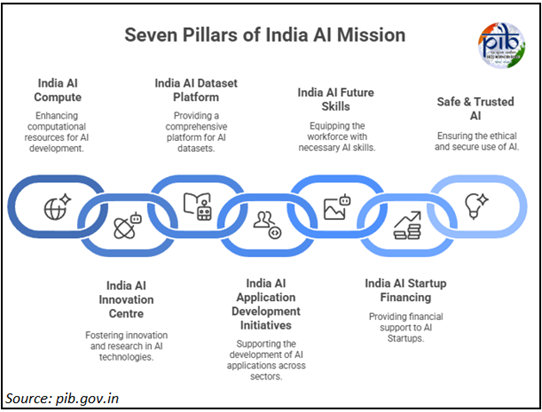
AI Ecosystem in India
- Scale & Employment: India’s technology and AI sector is expanding rapidly, with revenues projected to exceed USD 280 billion and employing over 6 million people.
- India has secured the 3rd position globally in Artificial Intelligence competitiveness, according to a report by Stanford University’s 2025 Global AI Vibrancy Tool.
- Innovation Base: The country hosts 1,800+ Global Capability Centres, including 500+ AI-focused centres, alongside around 1.8 lakh startups.
- Startup Adoption: Nearly 89% of startups launched last year have integrated AI into their products or services.
- Enterprise Usage: India scores 2.45 out of 4 on the NASSCOM AI Adoption Index, with 87% of enterprises actively using AI solutions.
- Sectoral & Maturity Profile: AI adoption is strongest in industrial & automotive, retail, BFSI, and healthcare, contributing about 60% of AI value, while 26% of companies have achieved AI maturity at scale.
What are Major Government Initiatives Related to Artificial Intelligence in India?
- BharatGen AI: India’s first government-funded multimodal multilingual Large Language Model, supporting 22 Indian languages for text, speech and image-based AI applications.
- Sarvam AI (Sovereign LLM Ecosystem): An indigenous generative AI initiative for secure and efficient public service delivery, including smarter Aadhaar services.
- Centres of Excellence (CoEs) for AI: Research and innovation hubs in sectors like healthcare, agriculture, sustainable cities and education for developing scalable AI solutions.
- Bhashini: An AI-powered multilingual platform that provides translation and speech services in 20+ Indian languages, enabling citizens to access digital public services irrespective of language or literacy barriers.
- AI Competency Framework: A globally benchmarked capacity-building programme that equips government officials with essential AI skills for effective policymaking and future-ready governance.
- India AI Impact Summit 2026: India will host the Summit in February 2026 to showcase national AI capabilities and promote innovation. Key flagship initiatives include:
- AI Pitch Fest (UDAAN): Global platform for AI startups to pitch innovations with special focus on women-led enterprises and differently-abled changemakers.
- Global Innovation Challenges: Open challenges for youth, women and other innovators to Promote AI-based solutions to real-world public sector problems across domains.
- Research Symposium: International forum for leading AI researchers from India, Global South and world to enable presentation of research, exchange of methods and global collaborations.
- AI Expo: Exhibition focused on ethical and responsible AI with participation of 300+ exhibitors from India and 30+ countries.

Frequently Asked Questions (FAQs)
1. Why are GPUs important under the mission?
Graphics Processing Units (GPUs) provide high computing power required to train AI models. India has onboarded 38,000 GPUs to offer affordable and accessible AI computing resources
2. How does the mission support AI startups?
Through the IndiaAI Startup Financing pillar, startups receive funding, mentorship and global expansion support (including Europe-focused programmes).
3. How does IndiaAI Mission promote skilling?
Under IndiaAI Future Skills, fellowships are provided to PhD, PG and UG students, and AI labs are set up in Tier-2 and Tier-3 cities.
4. What is Bhashini?
Bhashini is an AI-powered multilingual platform that provides translation and speech services to improve digital inclusion across Indian languages.
UPSC Civil Services Examination Previous Year Question (PYQ)
Q. With the present state of development, Artificial Intelligence can effectively do which of the following? (2020)
- Bring down electricity consumption in industrial units
- Create meaningful short stories and songs
- Disease diagnosis
- Text-to-Speech Conversion
- Wireless transmission of electrical energy
Select the correct answer using the code given below:
(a) 1, 2, 3 and 5 only
(b) 1, 3 and 4 only
(c) 2, 4 and 5 only
(d) 1, 2, 3, 4 and 5
Ans: (b)
Israel’s Recognition of Somaliland
Israel becomes the first country to formally recognise Somaliland (not a UN-recognised state) as an independent state, with implications for regional stability, maritime security, and great power competition.
- Israel claims the recognition is in the spirit of the Abraham Accords, as Israel seeks to normalise relations with non-traditional partners.
Somaliland
- Historical Background: Previously, it was the British Somaliland Protectorate, and it formally became a British colony in 1920. Gained independence as the State of Somaliland in 1960 before voluntarily merging with Italian Somaliland to form Somalia.
- It declared independence in 1991 after the fall of Siad Barre’s regime, following large-scale human rights abuses against the Isaaq clan, which is dominant in Somaliland.
- Operates with de facto autonomy, having its own currency, passports, police, and capital (Hargeisa), but lacks international recognition until now.
- Strategic Location: Somaliland lies in the Horn of Africa, an East African peninsula extending into the Gulf of Aden, Somali Sea, and Guardafui Channel, comprising Djibouti, Eritrea, Ethiopia, and Somalia.
- The region overlooks critical global shipping routes, with the Bab el-Mandeb Strait located near Djibouti and Eritrea, linking the Red Sea to the Indian Ocean.
- Security & Military Dimensions: Somaliland presents Israel with a strategic opportunity, offering a potential forward base for intelligence, logistics, and counter-Houthi operations, as well as a possible location for resettling Palestinians. The UAE operates a military port and airstrip in Berbera (port city).

| Read More: African Union Support and Stabilisation Mission in Somalia |
India Signs Major Defence Contracts
India signed defence procurement contracts worth ₹4,666 crore for the induction of modern infantry weapons and advanced naval torpedoes, reinforcing operational preparedness and indigenisation.
- Over 4.25 lakh Close Quarter Battle Carbines will be procured for the Indian Army and Navy from Bharat Forge Ltd & PLR Systems Pvt Ltd (India) to replace legacy rifles.
- The carbines offer compact design, high rate of fire and enhanced lethality, boosting effectiveness in urban and confined-space combat.
- This strengthens Aatmanirbhar Bharat, Make in India, MSME participation and indigenous defence manufacturing.
- Forty-eight heavyweight torpedoes will be procured from WASS Submarine Systems (Italy) for Kalvari-class (Project-75) submarines, with deliveries scheduled between 2028 and 2030, significantly strengthening India’s underwater warfare capability.
- Kalvari-class (Project-75) submarines are India-built Scorpène-class diesel-electric attack submarines of the Indian Navy, strengthening underwater warfare, stealth surveillance, and sea-denial capabilities in the Indian Ocean Region.
- In FY 2025–26, the Ministry of Defence has signed capital acquisition contracts worth ₹1.82 lakh crore, reflecting sustained focus on defence modernisation and indigenisation.
| Read more: India’s Defense Modernization: Challenges and Opportunities |
HAL Launches Dhruv NG for Civil Aviation
Recently, Hindustan Aeronautics Limited (HAL) conducted the maiden flight of the Dhruv–New Generation (NG) in Bengaluru, marking its formal push into the civil and export helicopter markets.
- Positioning: The Dhruv Civil NG is being projected as a cost-effective indigenous alternative to imported twin-engine helicopters, with lifecycle support spanning manufacturing, maintenance, and upgrades.
- Logistics: HAL plans to ensure higher fleet availability through integrated support models such as Power-By-Hour and performance-based logistics.
- Design: Dhruv NG is a 5.5-tonne, indigenously developed, twin-engine, multi-role helicopter, capable of day-night, all-weather operations, and derived from the Dhruv ALH Mk-III civil platform.
- Capability: Powered by indigenous Shakti engines with Cat-A performance and AS4-compliant systems, it is suitable for demanding roles including offshore operations of Oil and Natural Gas Corporation (ONGC).
- Certification: HAL secured Directorate General of Civil Aviation (DGCA) type certification for indigenous manufacture of the Shakti civil engine (a national first) and restricted certification from the European Union Aviation Safety Agency (EASA) in 2023.
- Significance: Building on a proven Dhruv platform with over 3.75 lakh flying hours, Dhruv NG strengthens Aatmanirbhar Bharat, reduces import dependence, and anchors India’s indigenous civil helicopter ecosystem.
| Read more: Indian Aviation Industry |