
Governor’s Address to State Legislature
For Prelims: Governor, Article 176, Constituent Assembly, Chancellor of Universities,
For Mains: Constitutional position and powers of the Governor, Aid and advice doctrine under Article 163, Governor–State Government relations and federalism
Why in News?
Recently, the Tamil Nadu Governor walked out of the State Assembly during his customary address. Simultaneously, the Kerala Governor omitted specific paragraphs. These incidents have reignited the debate on the discretionary powers of the Governor and the sanctity of Article 176.
Summary
- Recent walkouts and omissions by Governors during Assembly addresses in Tamil Nadu and Kerala have revived the constitutional debate on the limits of gubernatorial discretion under Article 176 and the primacy of elected governments.
- Constitutional provisions, conventions, and Supreme Court judgments consistently affirm that the Governor’s address is a ceremonial executive function to be delivered strictly on the aid and advice of the Council of Ministers, with minimal scope for personal discretion.
How does the Constitution Envisage the Role of the Governor?
Constitutional Provisions
- Article 176: Mandates that the Governor shall address the Legislative Assembly, or both Houses in bicameral States, at the commencement of the first session each year to inform the Legislature of the causes of its summons.
- This address is a constitutional duty and functions as a policy statement of the elected State government, not as a personal expression of the Governor.
- Article 175: Empowers the Governor to address either House or both Houses of the State Legislature and to send messages, particularly in relation to Bills.
- However, this power is exercised as part of executive functioning and does not confer independent discretion, remaining subject to the aid and advice of the Council of Ministers.
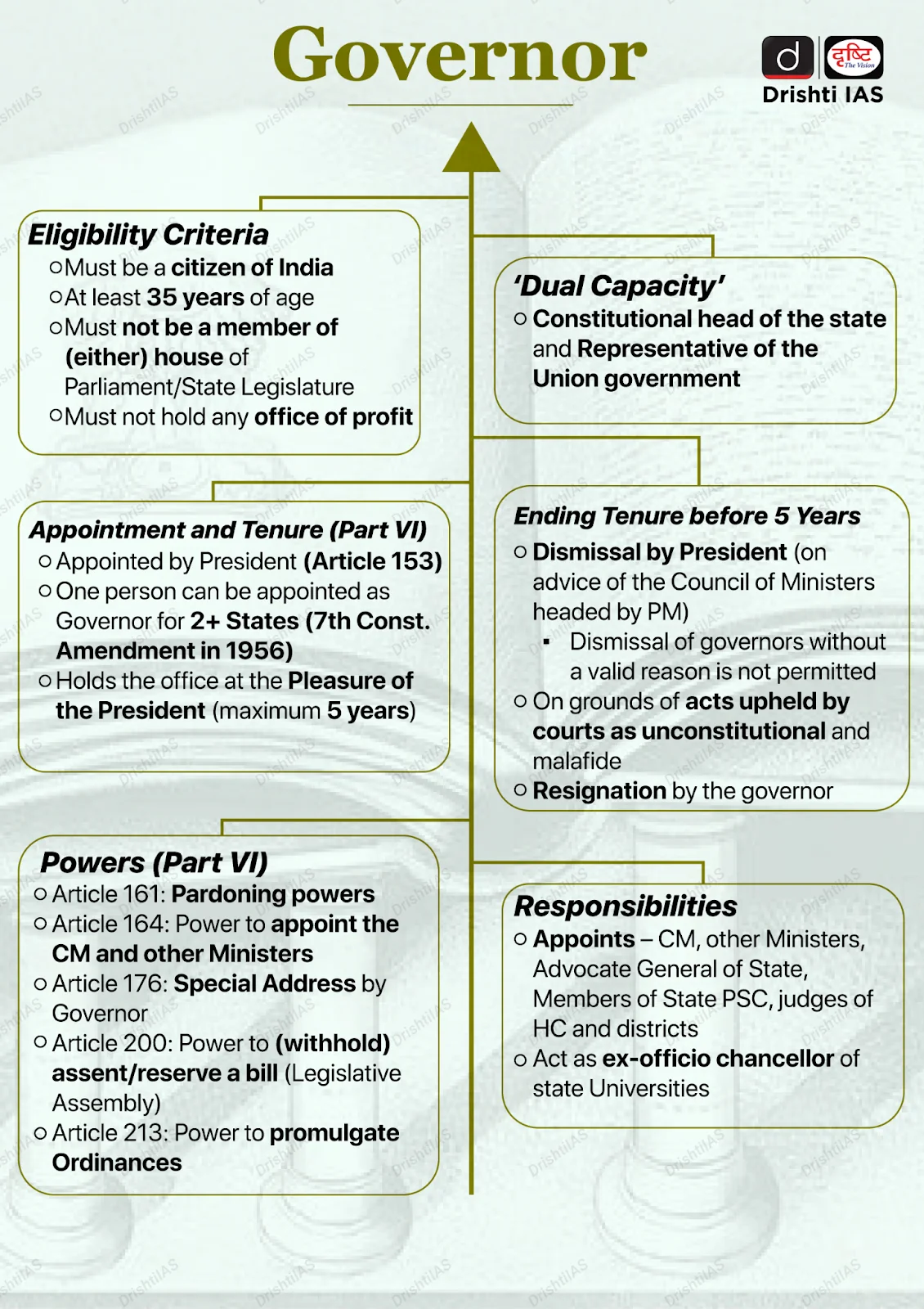
- Article 163: Establishes that the Governor shall act on the aid and advice of the Council of Ministers except in matters where the Constitution explicitly provides discretion.
Constituent Assembly About the Governor’s Role
- The Constituent Assembly envisaged the Governor as a constitutional head rather than an autocratic authority, entrusted with duties but no independent powers.
- The governor is expected to act as a neutral representative of the people of the State as a whole, not as a political actor.
Supreme Court Judgments on Governor’s Role:
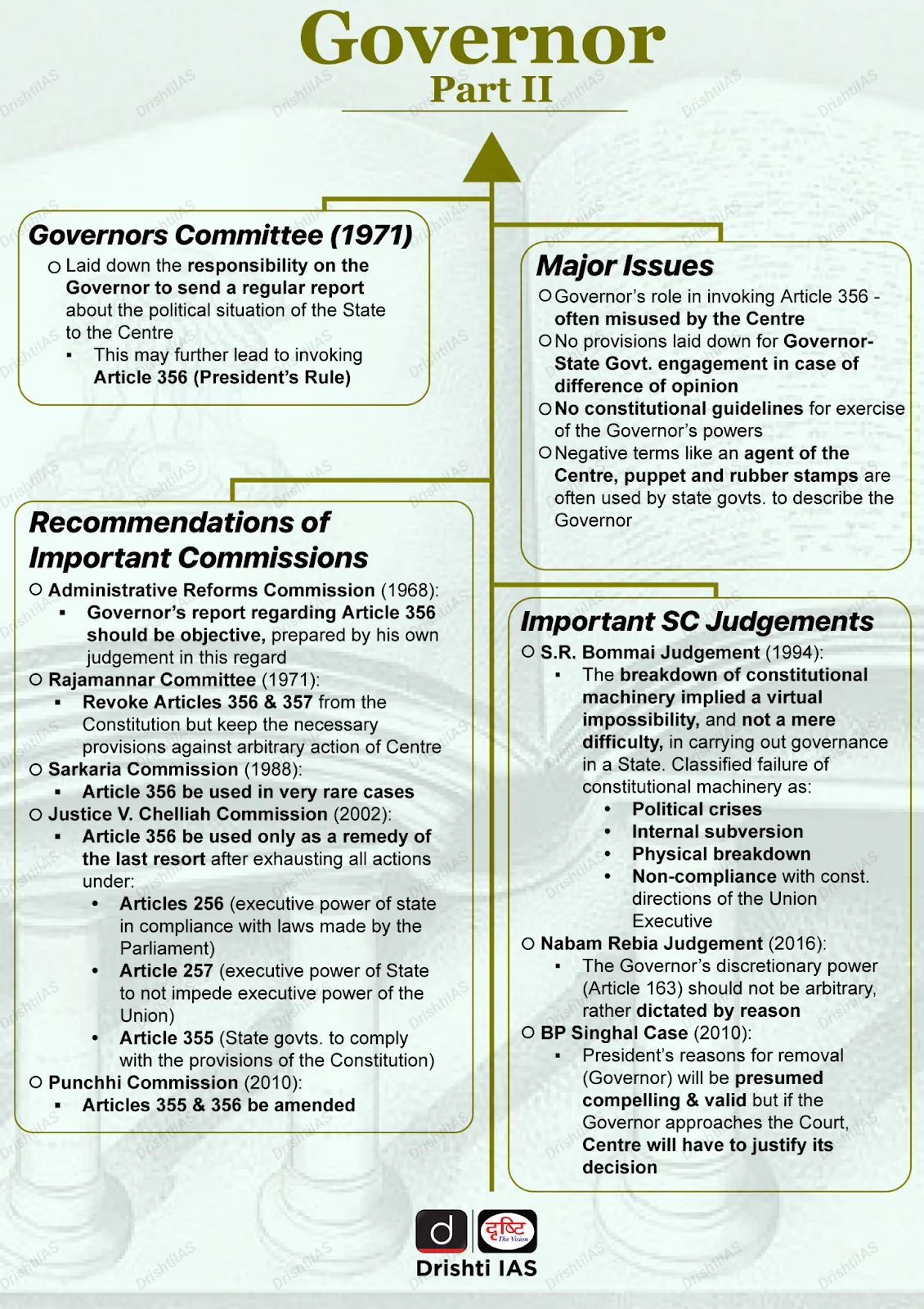
- State of Tamil Nadu v. Governor of Tamil Nadu (2024): The Supreme Court held that the Governor’s discretionary powers cannot be exercised to stall, obstruct, or negate the functioning of an elected government.
- Nabam Rebia v. Deputy Speaker (2016): A five-judge Constitution Bench ruled that the Governor’s discretionary powers are strictly limited and explicitly defined in the Constitution.
- Shamsher Singh v. State of Punjab (1974): A seven-judge Constitution Bench held that the Governor is a constitutional head and must act on the aid and advice of the Council of Ministers in all matters except those where the Constitution expressly grants discretion.
- It held that the Governor cannot exercise personal discretion in executive matters.
Committee Recommendations
- Sarkaria Commission (1988) Recommendations: It emphasized that the Governor must not be an agent of the Centre and should act as a "lynchpin" of federalism, avoiding active politics.
- Punchhi Commission (2007): Recommended that the Governor should not be burdened with positions (like Chancellor of Universities) that open them to political controversies, focusing strictly on constitutional duties.
What are the Arguments Regarding the Governor’s Discretion in Assembly Addresses?
Arguments for Governor’s Discretion
- Constitutional Oath (Article 159): The Governor takes an oath to preserve, protect, and defend the Constitution and cannot be compelled to read material perceived as unconstitutional, factually incorrect, seditious, or undermining constitutional values.
- Right to Dissent and Free Speech: As a high constitutional authority, the Governor is not a mechanical functionary and may refuse to endorse content that directly attacks the office of the Governor.
- Articles 175 and 176 mandate the Governor’s address but do not explicitly prescribe that the Governor must read it verbatim, leaving some interpretive space.
- This constitutional silence is cited to argue that discretion is not entirely excluded.
- Articles 175 and 176 mandate the Governor’s address but do not explicitly prescribe that the Governor must read it verbatim, leaving some interpretive space.
- Representative of the Union: Being the constitutional link between the Union and the State, the Governor is argued to have a responsibility to prevent speeches that may threaten national unity or federal integrity.
- Preventing Institutional Self-Contradiction: If the address contains content directly contradicting constitutional positions earlier taken by the Governor (e.g., assent, reservation of Bills, reports to the President), reading it may amount to institutional inconsistency.
Arguments Against Governor’s Discretion
- Aid and Advice Principle (Article 163): Under the Westminster model adopted by India, the Governor is a ceremonial head. The real power lies with the elected Council of Ministers, thus, the Governor must act on their "aid and advice".
- Nature of the Governor’s Address: The address is a statement of the State Government’s policy, not the Governor’s personal opinion. Altering or refusing it blurs accountability and confuses legislative responsibility.
- Erosion of Federalism: Unilateral edits or walkouts by a centrally appointed Governor are seen as encroachments on State autonomy and disrupt the federal balance.
- Allowing discretion in addresses opens the door to selective obstruction, especially in opposition-ruled States. This undermines the Governor’s expected neutrality and erodes public trust in constitutional offices.
- Threat to Parliamentary Democracy: Allowing discretion in routine executive functions risks creating a parallel authority, weakening the core principle of responsible government.
- Legislative Privilege and Autonomy: The Governor’s address is part of legislative proceedings.
- Interference may infringe upon the legislature’s privilege to debate and reject government policy on the floor, rather than through pre-emptive executive.
- Judicially Preferred Remedy Exists: If content is unconstitutional, the appropriate remedy lies in judicial review, not unilateral refusal by the Governor.
- Constitutional adjudication is the domain of courts, not individual constitutional authorities.
Way Forward
- Codification of Conventions: The "conventions" of the British parliamentary system (where the Monarch never deviates from the speech) should be codified or strictly adhered to.
- The Supreme Court can issue declaratory constitutional guidelines clarifying that the Governor’s address is a mandatory constitutional function without discretionary scope. This would reduce recurring litigation and prevent inconsistent practices across States.
- Orientation and Capacity-Building for Governors: Newly appointed Governors should undergo mandatory constitutional training on federalism, conventions, and judicial precedents. This would improve role clarity and reduce institutional friction.
- Constructive Dialogue: Chief Ministers and Governors must bridge the "trust deficit" through private consultation on the draft speech before the session, rather than public confrontation.
- Time-bound Constitutional Communication Mechanism: A formal, time-bound framework should require Governors to communicate any objections to the address in writing within a fixed deadline.
- If no response is given within this period, concurrence should be presumed. This would eliminate avoidable delays, discourage tactical silence, and ensure smooth constitutional processes.
Conclusion
The constitutional debate hinges on balancing the Governor’s oath-bound duty to the Constitution against the primacy of elected executive authority, with constitutional text, convention, and Supreme Court precedent strongly limiting gubernatorial discretion in Assembly addresses.
|
Drishti Mains Question: The Governor’s address under Article 176 is a constitutional duty, not a discretionary power.” Examine in the light of recent controversies and Supreme Court judgments. |
Frequently Asked Questions (FAQs)
1. What does Article 176 of the Constitution mandate?
It mandates that the Governor shall address the State Legislature at the commencement of the first session each year, conveying the elected government’s policy agenda.
2. Does the Governor have discretion over the content of the Assembly address?
No. Supreme Court jurisprudence holds that the address is an executive function performed strictly on the aid and advice of the Council of Ministers.
3. Which Supreme Court case limits the Governor’s discretionary powers?
Shamsher Singh v. State of Punjab (1974) established that the Governor is a constitutional head with no general discretionary power in executive matters.
4. Why are recent gubernatorial actions seen as constitutionally problematic?
Selective omission or refusal to deliver the address undermines Cabinet responsibility, federal balance, and parliamentary conventions.
5. What reforms are suggested to prevent such conflicts?
Codification of conventions, adherence to Sarkaria and Punchhi Commission recommendations, and greater consultative dialogue between Governors and Chief Ministers.
UPSC Civil Services Examination Previous Year Questions (PYQs)
Prelims
Q. Consider the following statements: (2018)
- No criminal proceedings shall be instituted against the Governor of a State in any court during his term of office.
- The emoluments and allowances of the Governor of a State shall not be diminished during his term of office.
Which of the statements given above is/are correct?
(a) 1 only
(b) 2 only
(c) Both 1 and 2
(d) Neither 1 nor 2
Ans: (c)
Q. Which of the following are the discretionary powers given to the Governor of a State? (2014)
- Sending a report to the President of India for imposing the President’s rule
- Appointing the Ministers
- Reserving certain bills passed by the State Legislature for consideration of the President of India
- Making the rules to conduct the business of the State Government
Select the correct answer using the code given below:
(a) 1 and 2 only
(b) 1 and 3 only
(c) 2, 3 and 4 only
(d) 1, 2, 3 and 4
Ans: (b)
Q. Which one of the following statements is correct? (2013)
(a) In India, the same person cannot be appointed as Governor for two or more States at the same time
(b) The Judges of the High Court of the States in India are appointed by the Governor of the State just as the Judges of the Supreme Court are appointed by the President
(c) No procedure has been laid down in the Constitution of India for the removal of a Governor from his/her post
(d) In the case of a Union Territory having a legislative setup, the Chief Minister is appointed by the Lt. Governor on the basis of majority support
Ans: (c)
Mains
Q. Discuss the essential conditions for exercise of the legislative powers by the Governor. Discuss the legality of re-promulgation of ordinances by the Governor without placing them before the Legislature.(2022)
Q. Though the federal principle is dominant in our constitution and that principle is one of its basic features, but it is equally true that federalism under the Indian Constitution leans in favour of a strong Center, a feature that militates against the concept of strong federalism. Discuss.(2014)
International Data Privacy Day
For Prelims: Council of Europe, International Data Privacy Day, Right to Privacy, Digital Public Infrastructure
For Mains: Data privacy and data protection law in India, Key provisions of Data Protection Act 2023 and Draft Digital Personal Data Protection (DPDP) Rules, 2025.
Why in News?
India observed International Data Privacy Day on 28th January, reaffirming its commitment to responsible data practices, public awareness, and trust-based digital governance amid the rapid expansion of digital platforms.
- The day was designated in 2006 by the Council of Europe to commemorate the signing of the Convention for the Protection of Individuals with Regard to Automatic Processing of Personal Data (Convention 108), the world’s first legally binding international treaty on data protection.
Summary
- On International Data Privacy Day India reaffirmed its commitment to responsible data practices and trust-based digital governance amid rapid digitalisation and expanding use of citizen data.
- While the DPDP Act, 2023 and supporting institutions strengthen India’s data protection framework, addressing gaps in regulatory independence, state exemptions, victim remedies, and AI-era risks is essential to translate legal safeguards into real privacy protection.
Convention 108
- It is a 1981 treaty that safeguards the right to privacy amid the growing cross-border flow of automatically processed personal data.
- The Convention has been modernised since 1985, with major updates approved in 2018, introducing mandatory data breach reporting, stronger accountability of data controllers, and new safeguards against risks from algorithmic decision-making and artificial intelligence.
- All Council of Europe members have ratified it, and several non-European countries have acceded to it. India has not signed or ratified the Convention 108.
What is Digital Footprint and How has the Indian Data Privacy Framework Evolved?
- Digital Footprint: It refers to the vast scale and depth of digital platforms that underpin governance, service delivery, and citizen participation across the country.
- India is the world’s third-largest digitalised economy, with 101.7 crore broadband users, ultra-low data costs of USD 0.10 per GB, and deep digital penetration across daily life, enabling mass digital inclusion at a population scale.
- Its Digital Public Infrastructure (including Aadhaar, UPI, MyGov and eSanjeevani (44+ crore digital health consultations) anchors participatory governance and large-scale service delivery.
- Imperative for Data Privacy: The massive scale and sensitivity of personal data generated across these platforms heighten risks of data misuse, cyber threats, and privacy breaches.
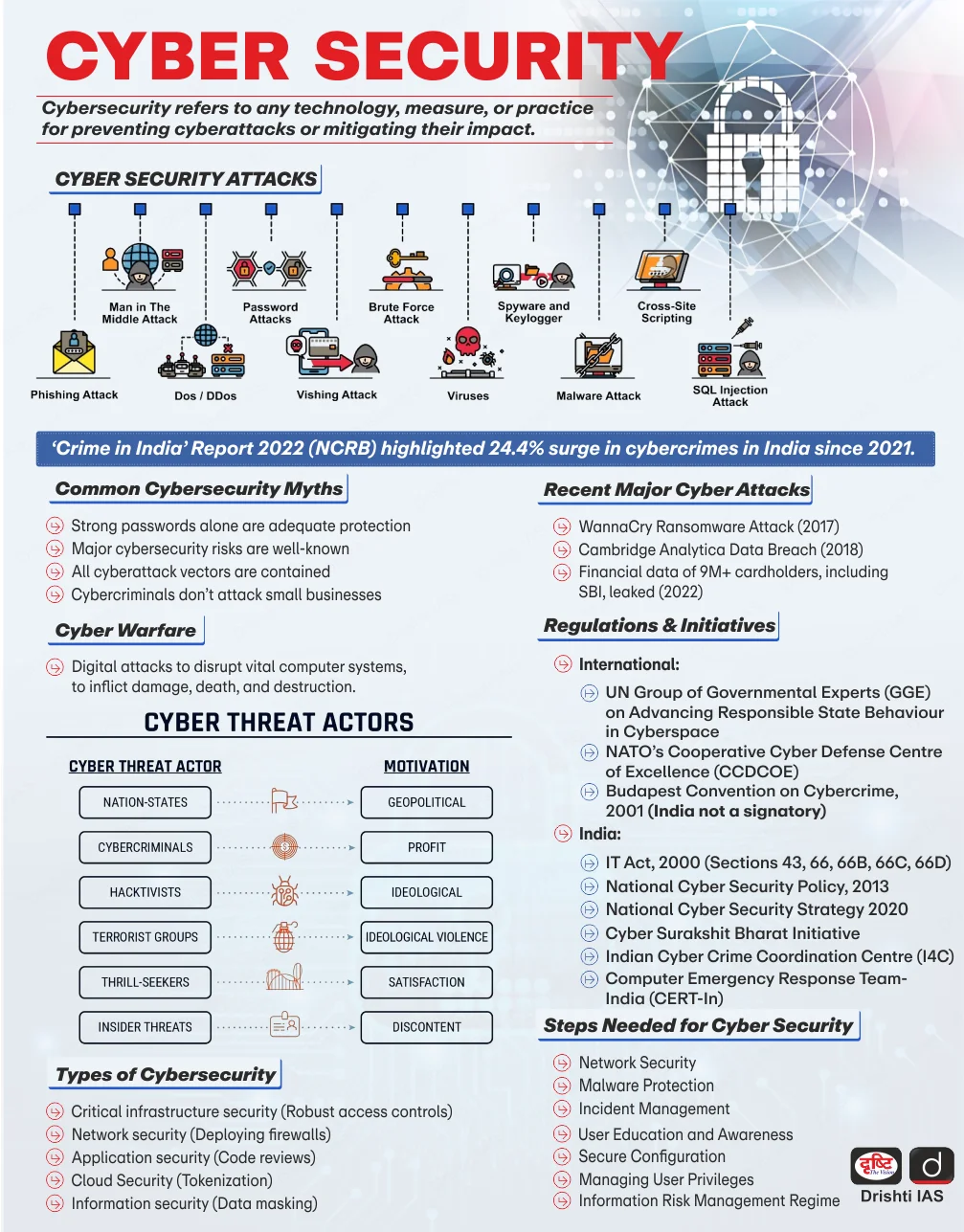
- India is witnessing a surge in phishing, ransomware, identity theft, UPI and online banking frauds. In 2024, the nation recorded 1.91 million cybercrime complaints, reflecting the scale of digital financial vulnerability.
- This makes privacy by design, strong legal frameworks, cybersecurity safeguards, and institutional accountability essential for sustaining public trust, inclusion, and secure digital governance.
- It builds public trust in government-led digital services, strengthens accountability and transparency, and ensures that digital innovation remains citizen-centric, ethical, inclusive, and non-exploitative.
Indian Data Privacy Framework
- Information Technology (IT) Act, 2000: Data protection in India governed by the IT Act, 2000, the country’s core cyberspace law that provides legal recognition to electronic records and digital signatures and enables e-governance and digital commerce.
- The IT Act, 2000, established CERT-In for cyber incident response, with key provisions supporting cybersecurity, adjudication, and content regulation.
- CERT-In is national nodal agency for cybersecurity with a vision of proactive prevention, incident response, and securing India’s communications & information infrastructure
- IT (Intermediary Guidelines & Digital Media Ethics Code) Rules, 2021 (amended in 2025): Prescribe due diligence obligations for intermediaries, mandate time-bound grievance redressal, and aim to ensure a safe, transparent, and accountable online ecosystem aligned with India’s data security needs.
- Intermediaries are defined as entities that store or transmit data on behalf of others, including telecom and internet service providers, online marketplaces, search engines, and social media platforms.
- Digital Personal Data Protection (DPDP) Act, 2023: The roots of this Act can be traced back to the 2017 Supreme Court ruling in Justice K.S. Puttaswamy vs. Union of India, where the right to privacy was officially recognized as a fundamental right under Article 21 of the Constitution. Prior to this, India lacked a dedicated privacy law.
- The Supreme Court held that the right to privacy flows from Article 21 and the freedoms under Part III of the Constitution, and can be restricted only if state action satisfies a three-fold test (it must have legislative backing, pursue a legitimate state aim, and meet the proportionality standard as the least intrusive measure in a democratic society).
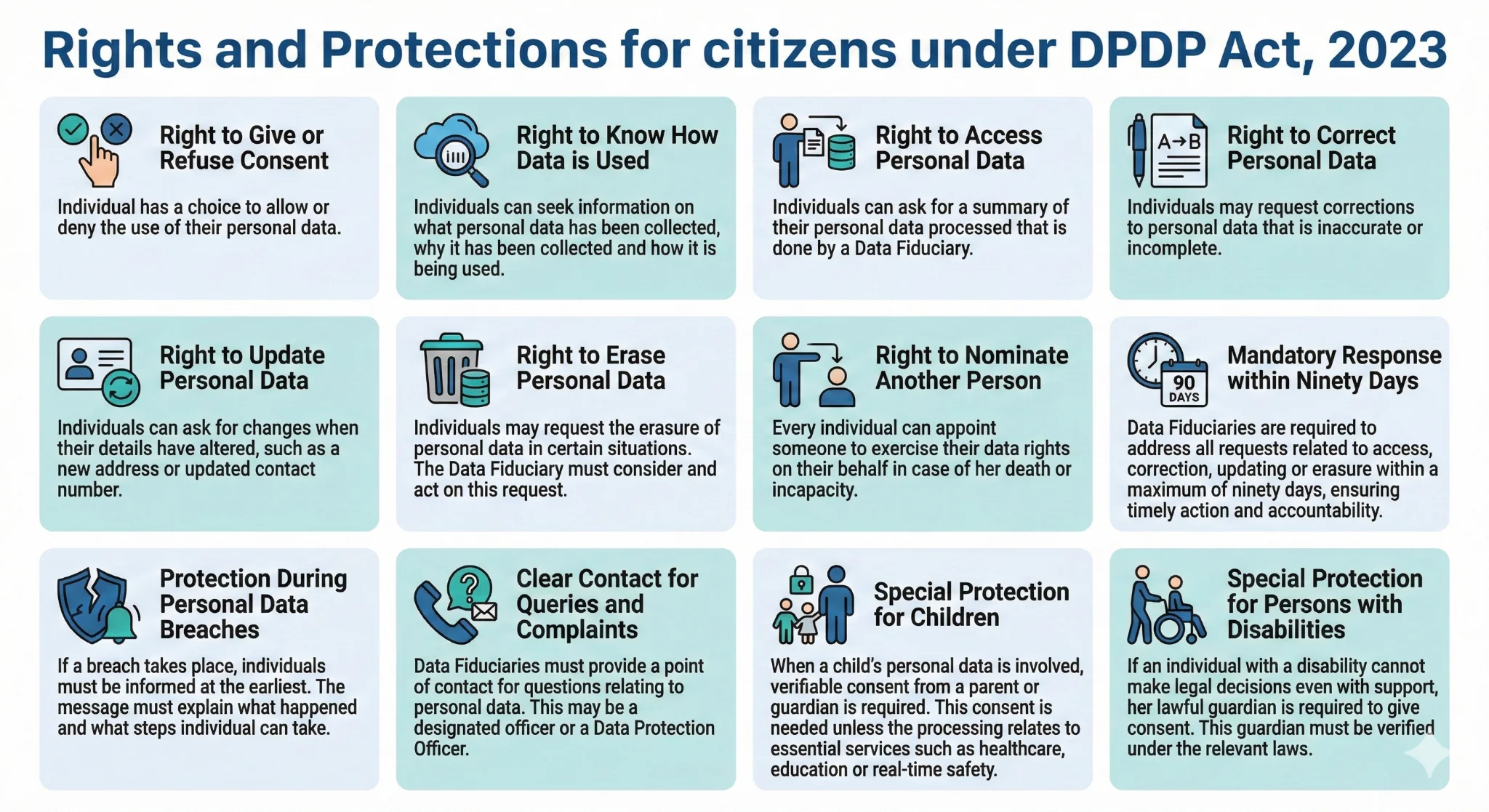
- DPDP Act, 2023, governs digital personal data processing, balancing individual privacy with lawful data use for innovation and growth, and follows a SARAL (Simple, Accessible, Rational, Actionable) compliance approach.
- The Data Protection Board of India was established under the DPDP Act, 2023 to oversee compliance, inquire into data breaches and enforce corrective action. It strengthens accountability, grievance redressal and public trust.
- The Act empowers individuals as Data Principals, granting clear rights and greater control over personal data while ensuring organisations act responsibly, transparently, and accountably.
- Digital Personal Data Protection Rules, 2025: The Rules operationalise the DPDP Act, 2023, establishing a citizen-centric data protection regime that safeguards personal data while enabling innovation and responsible use.
- Along with the DPDP Act, the Rules clearly define rights, responsibilities, and enforcement mechanisms, strengthen institutional accountability, and ensure secure, transparent, and future-ready digital governance in India.
Data Privacy & Security Readiness Initiatives
|
Initiative / Mechanism |
Key Features & Significance |
|
MHA-led nodal body, it focuses on cybercrime prevention, detection & response, especially crimes against women & children. |
|
|
National Cyber Crime Reporting Portal (NCRP) & Citizen Financial Cyber Fraud Reporting and Management System (CFCFRMS) |
Enables real-time reporting of cybercrime & financial frauds; supported by Helpline 1930 for nationwide access |
|
Cyber Fraud Mitigation Centre (CFMC) |
Facilitates real-time coordination among banks, telecoms, and law enforcement to block accounts, SIMs, and devices |
|
Sahyog Platform & Suspect Registry |
Sahyog for expedited takedown of unlawful online content and Suspect Registry for identification of mule accounts & fraud-linked digital identifiers |
|
C-DAC Cybersecurity Solutions |
Development of indigenous tools to reduce dependence on foreign technologies and enhance digital sovereignty |
|
National Cyber Forensic Laboratories |
Provide forensic support for data breach analysis, evidence preservation, and cybercrime prosecution |
|
National Management Information System for cybercrime analytics, inter-State coordination, and geo-mapping of cybercrime infrastructure |
|
|
CyTrain (2019) & Cyber Commando Programme (2024) |
Strengthen skilled cybersecurity workforce across law enforcement and institutions |
|
It acts as a Botnet Cleaning and Malware Analysis Centre, providing free malware detection and removal tools. It also provides daily alerts, and best cyber security practices dissemination. |
What are the Key Challenges to Data Protection in India?
- State Exemptions and Constitutional Imbalance: The DPDP Act, 2023, allows the State to exempt itself from core obligations without independent or judicial oversight.
- This creates an uneven privacy regime where citizens are protected from private actors but not from the government. Such asymmetry weakens the constitutional right to privacy under Article 21.
- Executive-Controlled Regulator: The Data Protection Board is appointed and administered by the executive, which is itself the largest data fiduciary.
- This undermines regulatory independence and raises concerns of biased enforcement. Effective data protection requires an arm’s-length regulator, not executive supervision.
- Penalties Without Victim Compensation: While the law imposes heavy fines on data fiduciaries, affected individuals have no direct right to compensation.
- Penalties flow to the State, not to victims, turning data protection into a revenue mechanism rather than a rights framework.
- Citizens must approach civil courts for compensation, making privacy protection inaccessible in practice.
- AI and “Public Data” Grey Zones: The exemption of publicly available personal data creates ambiguity in AI training and data scraping.
- Personal information shared online can be reused without meaningful consent. This dilutes individual control in the age of generative AI and deepfakes.
- Weak Remedies and Complex Grievance Redressal: The grievance mechanism is multi-layered, requiring citizens to approach the company, regulator, and tribunal sequentially.
- This complexity discourages ordinary users from pursuing privacy violations. Access to justice remains limited in practice.
- Cybersecurity Capacity Deficit: Legal safeguards are undermined by weak cyber enforcement capacity and skill shortages.
- AI-enabled fraud, deepfakes, and social engineering exploit human trust rather than technical loopholes. Data protection without cyber capability remains largely symbolic.
What Measures can Strengthen Data Protection in India?
- Structural Independence of the Regulator: The Data Protection Board of India must function as an autonomous regulator rather than an executive body. Adopting a collegium-based appointment system would insulate it from political influence.
- Such institutional independence is essential for credible adjudication against the State, the largest data fiduciary.
- Judicial Oversight for Government Exemptions: Introducing prior judicial or independent authorization for surveillance would prevent misuse. This ensures security concerns are balanced with constitutional privacy safeguards.
- Victim-Centric Compensation Mechanism: Creating a dedicated Data Protection Compensation Fund from collected fines would enable swift victim compensation. Empowering the DPBI to grant ex-gratia relief would make privacy enforcement citizen-centric.
- Promote Bilateral Data Agreements: Support bilateral and multilateral agreements to facilitate safe data exchange, rather than adopting restrictive or isolationist policies.
- Privacy by Design for Consent Managers: Mandating open, interoperable, non-profit models (similar to Account Aggregators) would prevent manipulation and dark patterns. This ensures consent remains meaningful, informed, and user-driven.
Conclusion
Data Privacy Day highlights trust and data protection as core to India’s digital ecosystem. With the DPDP framework and stronger cybersecurity institutions, India is building a secure digital future. It reinforces the shared responsibility of the State, platforms, and citizens in safeguarding digital rights.
|
Drishti Mains Question: “Data protection is a democratic imperative in a digitally governed society.”Examine this statement in the context of India’s Digital Public Infrastructure. |
Frequently Asked Questions (FAQs)
1. What is International Data Privacy Day and why is it observed?
It is observed on 28 January to raise awareness on data protection and commemorate Convention 108, the world’s first legally binding data protection treaty.
2. What is meant by India’s digital footprint?
It refers to the population-scale use of digital platforms like Aadhaar, UPI, MyGov, and eSanjeevani in governance, services, and daily life.
3. What is the significance of the DPDP Act, 2023?
It establishes a citizen-centric data protection framework, empowering individuals as Data Principals and ensuring accountability of data handlers.
4. Which institution enforces data protection under the DPDP Act?
The Data Protection Board of India, which oversees compliance, investigates breaches, and enforces corrective action.
5. How does India strengthen cybersecurity beyond legislation?
Through CERT-In, I4C, NCRP, CFMC, Cyber Swachhta Kendra, and capacity-building programmes like CyTrain and Cyber Commando.
UPSC Civil Services Examination, Previous Year Question (PYQ)
Prelims
Q.1 In India, under cyber insurance for individuals, which of the following benefits are generally covered, in addition to payment for the loss of funds and other benefits? (2020)
- Cost of restoration of the computer system in case of malware disrupting access to one’s computer
- Cost of a new computer if some miscreant wilfully damages it, if proved so
- Cost of hiring a specialised consultant to minimise the loss in case of cyber extortion
- Cost of defence in the Court of Law if any third party files a suit
Select the correct answer using the code given below:
(a) 1, 2 and 4 only
(b) 1, 3 and 4 only
(c) 2 and 3 only
(d) 1, 2, 3 and 4
Ans: (b)
Q.2 In India, it is legally mandatory for which of the following to report on cyber security incidents? (2017)
- Service providers
- Data centres
- Body corporate
Select the correct answer using the code given below:
(a) 1 only
(b) 1 and 2 only
(c) 3 only
(d) 1, 2 and 3
Ans: (d)
Mains
Q. What are the different elements of cyber security ? Keeping in view the challenges in cyber security, examine the extent to which India has successfully developed a comprehensive National Cyber Security Strategy.(2022)
Year End Review 2025 : Ministry of Skill Development and Entrepreneurship
Why in News?
The Ministry of Skill Development and Entrepreneurship (MSDE) has released a year-end review 2025, highlighting how India’s skilling ecosystem has evolved since its inception in 2014, when millions of young Indians were entering the workforce without industry-ready skills.
How did the Ministry of Skill Development and Entrepreneurship Transform India’s Skilling Ecosystem?
- PMKVY 4.0: Pradhan Mantri Kaushal Vikas Yojana (PMKVY) transition into PMKVY 4.0 marked a shift from target-driven enrolments to demand-driven skilling.
- By December 2025, 27.08 lakh candidates had been trained across 38 sectors and 732 districts, indicating true pan-India reach.
- The introduction of 102 future-skill job roles and 77 customised courses shows that scale was achieved alongside relevance, particularly in Industry 4.0 and green jobs, rather than through generic training expansion.
- PMKVY has been converged with major flagship schemes such as PM Surya Ghar Muft Bijli Yojana, the Vibrant Villages Programme, the National Green Hydrogen Mission, PM-JANMAN, PM SVANidhi and the Jal Jeevan Mission, embedding skilling within core development programmes and reflecting a clear whole-of-government approach.
- Rebuilding Vocational Education via ITI: MSDE expanded and modernised Industrial Training Institutes (ITIs) to restore their role in workforce preparation. The number of enrolments in ITIs rose from 9.5 lakh to over 14 lakh trainees.
- The launch of PM–SETU (Pradhan Mantri Skilling and Employability Transformation through Upgraded ITIs) in May 2025, marked a qualitative shift by linking ITIs to industry-led clusters (Hub-and-spoke model) and State-specific economic strengths, addressing long-standing issues of employability and regional mismatch.
- The World Bank–supported STRIVE project strengthened vocational training by upgrading ITIs and industry clusters.
- Apprenticeships as a Scalable Employment Bridge: Under National Apprenticeship Promotion Scheme (NAPS) apprenticeships were scaled as a core skilling pathway rather than a peripheral option.
- Since 2016, over 49.18 lakh apprentices have been engaged, with nearly 18 lakh engagements during FY 2024–26 alone.
- Women’s participation rose from 11.3% (2018–19) to 22.84% (2024–25), indicating both scale and inclusion.
- Mainstreaming Traditional Skills: Launched in September 2023, PM Vishwakarma addressed the structural neglect of traditional artisans by integrating them into formal skilling and credit systems.
- By 2025, 23.66 lakh artisans across 18 traditional trades had been trained and certified.
- The combination of skill upgradation, toolkits and bank credit reflects a shift from cultural preservation to income-oriented skill modernisation, particularly relevant for informal and rural economies.
- Digital Public Infrastructure: The Skill India Digital Hub (SIDH), launched in 2023, became the backbone of scalable governance.
- By September 2025, SIDH recorded 1.6 crore candidate registrations, 30,000+ training centres, and enabled over Rs 1,100 crore Direct Benefit Transfer (DBT) across schemes.
- The Bharatskills Portal, launched in 2019, continues to complement SIDH as a rich online content repository, with over 75.37 lakh users and 4.44 crore hits, providing digital learning support to ITI trainees and trainers.
- This data indicates that digital integration allowed MSDE to expand skilling rapidly while maintaining transparency, monitoring, and fiscal control.
- Entrepreneurship: Recognising entrepreneurship as a key driver of job creation, MSDE trained over 12.75 lakh individuals by December 2025, leading to the creation of 26,000+ enterprises, supported by targeted initiatives such as the Swavalambini Women Entrepreneurship Programme launched in early 2025 to promote women-led enterprises.
- Complementing capacity-building, the Credit Guarantee Fund Scheme for Skill Development was revamped in 2024, expanding eligible lenders, raising loan limits to Rs 7.5 lakh, and improving guarantee coverage.
- Jan Shikshan Sansthans: It enabled last-mile inclusion by targeting women, tribal and marginalised groups.
- Between 2018 and December 2025, 33.55 lakh beneficiaries were trained, with 7.08 lakh NCVET-compliant certificates issued after digital integration.
- This ensured that nationwide scale did not remain urban-centric, but extended to informal and vulnerable segments of the labour force.
- Globalising Indian Skills: MSDE leveraged Government-to-Government (G2G) Agreements agreements and Skill India International Centres to position India as a global skill supplier.
- By November 2025, 8,313 candidates had been trained at SIICs. This reflects a shift from informal migration to regulated, skill-based global mobility, aligning domestic skills with international labour demand.
- Strengthening Governance and Quality:
- NCVET (2018): Established as the apex regulator to standardise qualifications, ensure quality, and regulate vocational education under NSQF.
- Indian Skill Development Services (ISDS) (2017): Created to professionalise and strengthen administration of skilling schemes.
- SANKALP Programme (2018–2025): The Skills Acquisition and Knowledge Awareness for Livelihood Promotion (SANKALP) programme, a World Bank-supported initiative strengthened institutional capacity and decentralised skilling through district- and state-level planning.
- Skill gap studies: National and global skill gap studies undertaken to align training with domestic and international demand.
National Council for Vocational Education and Training (NCVET)
- The NCVET is the apex regulator for India’s Technical and Vocational Education and Training (TVET) ecosystem.
- NCVET enforces uniform standards by regulating Awarding and Assessment Bodies, approving NSQF-aligned qualifications, and ensuring oversight and grievance redressal, with the framework anchored in National Skills Qualifications Framework (NSQF) and aligned with National Education Policy (NEP) 2020 and National Credit Framework.
- It subsumed the roles of the erstwhile National Skill Development Agency (NSDA) and the former National Council of Vocational Training (NCVT) to address fragmentation, inconsistent norms, and quality gaps in skilling.
- Through the National Skill Qualification Committee, NCVET enabled future-oriented qualifications, micro-credentials and IndiaSkills standards.
- Key Initiatives under NCVET:
- KaushalVerse (Digital Governance): Digitised recognition, approvals, monitoring, and grievance redressal for real-time, data-driven oversight.
- SOAR (Skilling for AI Readiness): Introduced foundational AI literacy for Classes 6–12 and educators through NSQF-aligned micro-credentials.
- Employability & Life Skills Framework: Launched a national framework to strengthen soft skills, workplace readiness, and 21st-century competencies.
- Apprenticeship Creditisation: Standardised apprenticeship learning outcomes and linked credits with DigiLocker and Academic Bank of Credits.
- Semiconductor Workforce Strategy: Developed industry-led, stackable qualifications to build a future-ready talent pipeline for semiconductors.
|
Drishti Mains Question: How has the Ministry of Skill Development and Entrepreneurship shifted India’s skilling strategy from scale-centric to demand-driven outcomes |
Frequently Asked Questions (FAQs)
1. What is PMKVY 4.0 and how is it different from earlier phases?
PMKVY 4.0 focuses on demand-driven skilling, introducing future-skill job roles and customised courses aligned with industry needs rather than mere enrolment targets.
2. What role does NCVET play in India’s skilling ecosystem?
NCVET is the apex regulator that standardises qualifications, regulates Awarding and Assessment Bodies, and ensures quality assurance under NSQF, aligned with NEP 2020.
3. How has apprenticeship participation improved in recent years?
Under NAPS, over 49 lakh apprentices have been engaged since 2016, with women’s participation rising to nearly 23%, supported by DBT and simplified compliance.
4. Why is the Skill India Digital Hub (SIDH) significant?
SIDH acts as a digital public infrastructure for skilling, enabling end-to-end tracking, certification, DBT, and job matching with over 1.6 crore registrations.
5. What is the importance of the PM Vishwakarma Scheme?
PM Vishwakarma integrates traditional artisans into formal skilling, credit and certification systems, shifting focus from cultural preservation to income and productivity enhancement.
UPSC Civil Services Examination Previous Year Question (PYQ)
Prelims
Q. With reference to Pradhan Mantri Kaushal Vikas Yojana, consider the following statements: (2018)
- It is the flagship scheme of the Ministry of Labour and Employment.
- It, among other things, will also impart training in soft skills, entrepreneurship, and financial and digital literacy.
- It aims to align the competencies of the unregulated workforce of the country to the National Skill Qualification Framework.
Which of the statements given above is/are correct?
(a) 1 and 3 only
(b) 2 only
(c) 2 and 3 only
(d) 1, 2 and 3
Ans: (c)
Mains
Q. “Demographic Dividend in India will remain only theoretical unless our manpower becomes more educated, aware, skilled and creative.” What measures have been taken by the government to enhance the capacity of our population to be more productive and employable? (2016)
River Delta Subsidence
Why in News?
A new global study published in Nature warns that several of India’s major river deltas are sinking at alarming rates placing millions at increasing risk of flooding and displacement.
What are Key Findings of the Study?
- About the Study: The research analysed 40 major river deltas across 29 countries, covering areas with over 236 million inhabitants exposed to near-term flood risk.
- In India, the study identifies Ganga-Brahmaputra, Brahmani, Mahanadi, Godavari, Cauvery and Kabani deltas as experiencing significant land subsidence.
- Subsidence Outpacing Sea-Level Rise: Land subsidence exceeds the global mean sea-level rise (~4 mm/year), with over half of deltas subsiding faster than 3 mm/year during 2014–2023. 35% of total delta area globally is sinking, and in 38 of 40 deltas, more than half the area shows subsidence.
- India Related Findings: Brahmani (77%) and Mahanadi (69%) are among the fastest-sinking deltas, with large areas subsiding at over 5 mm per year.
- Nearly 50% of deltas, including the Ganga-Brahmaputra, Brahmani, and Mahanadi, are subsiding across over 90% of their area.
- India Related Findings: Brahmani (77%) and Mahanadi (69%) are among the fastest-sinking deltas, with large areas subsiding at over 5 mm per year.
- Hotspots of Delta Land Loss: 7 major deltas, Ganga-Brahmaputra, Nile, Mekong, Yangtze, Amazon, Irrawaddy and Mississippi, account for 57% of global subsiding delta area (~265,000 sq km).
- Major delta cities such as Kolkata, Alexandria, Bangkok, Dhaka, and Shanghai are sinking at rates equal to or higher than surrounding regions, increasing risks of urban flooding.
- Reasons of Subsidence: Unsustainable groundwater extraction is the primary cause of subsidence in deltas like Ganga-Brahmaputra and Cauvery, leading to irreversible sediment compaction.
- Other deltas, such as the Mahanadi and Kabani, face compounded pressures from groundwater depletion, reduced sediment supply due to river regulation, and population-driven land-use changes.
- Implications: Indigenous and rural communities, often living below one metre above sea level, are disproportionately at risk and face major relocation barriers.
- Without urgent regulation of groundwater extraction, deltas face escalating risks of flooding, land loss, and displacement in the coming decades.
River Delta
- About: A river delta is a depositional landform that develops at the mouth of a river where it discharges into a larger body of water, such as an ocean, sea, lake.
- Over time, these accumulated sediments (silt, sand, and clay) build up, forming a characteristic fan-shaped or triangular area of fertile, low-lying land.
|
Feature |
Delta |
Estuary |
|
Nature |
Landform – built from deposited sediment at a river mouth. |
Water body – a coastal inlet where river and sea water mix. |
|
Formation |
Sediment deposition exceeds removal (waves/tides), building land. |
Flooding of a river valley (e.g., rising sea levels); sediment is flushed out. |
|
Water |
Ranges from fresh to saline. |
Brackish water with varying salinity; highly productive ecosystem. |
|
Shape |
Triangular/fan-shaped with multiple channels. |
Funnel-shaped or irregular, typically a single main tidal channel. |
|
Key Role |
Fertile agricultural land |
Critical marine nursery; high biodiversity from nutrient mixing. |
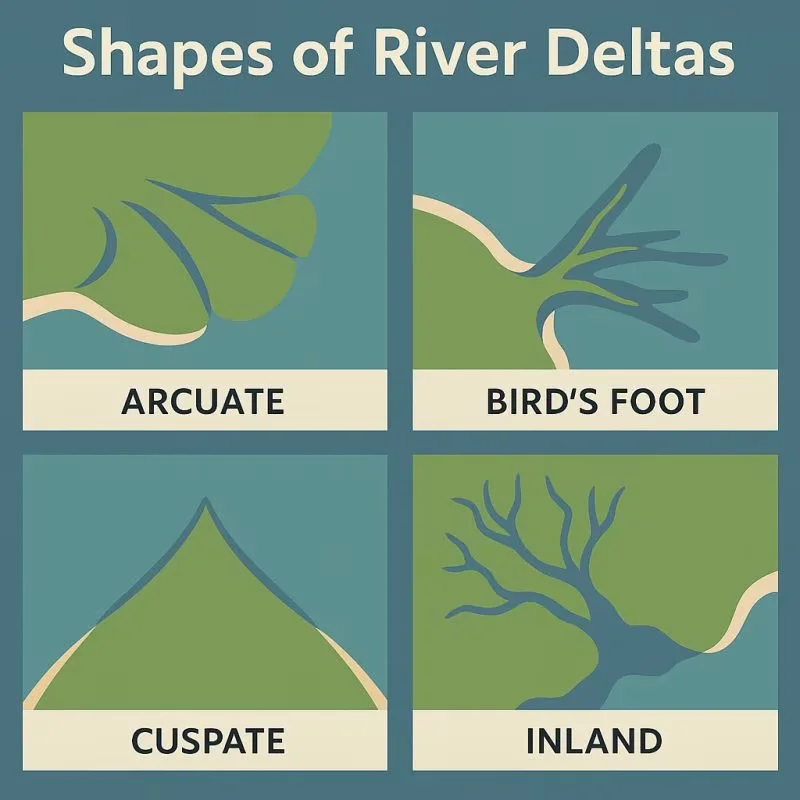
- Types of Deltas:
|
Type |
Key Characteristics |
Examples |
|
Arcuate |
Fan-shaped, convex seaward; formed from coarse sediments with balanced river and wave activity. |
Nile Delta (Egypt), Ganges Delta (India) |
|
Bird's Foot |
Resembles a bird's claw; formed from fine sediments by strong river flow into weak-wave environments. |
Mississippi Delta (USA) |
|
Cuspate |
Tooth-like shape; formed by strong waves pushing sediments along a straight shoreline. |
Tiber River (Italy) |
|
Estuarine |
Deposits form within a submerged river valley or existing estuary. |
Seine River (France), Narmada & Tapi (India) |
|
Lacustrine |
Formed where a river flows into a lake. |
Lough Leanne (Ireland) |
|
Abandoned |
An inactive lobe left when the river shifts its main course. |
Old Yellow River Delta (China), Western Ganga (Hooghly) Delta |
- Major River Deltas in India:
- Ganges-Brahmaputra Delta (the Sundarbans Delta): This is the world’s largest river delta, formed by the Ganges, Brahmaputra, and Meghna rivers, spanning West Bengal (India) and Bangladesh, and home to the world’s largest mangrove forest (Sundarbans).
- Godavari Delta: Formed by the Godavari River in Andhra Pradesh, this delta is one of the largest on India's eastern coast.
- Brahmani Delta: Formed by the Brahmani River and is situated in Odisha.
- Mahanadi Delta: Located in Odisha, formed by the Mahanadi River.
- Cauvery (Kaveri) Delta: Formed by the Cauvery River in Tamil Nadu, this delta is one of the most intensively cultivated regions in South India, often referred to as the "granary of South India."
- Significance of Deltas: Although river deltas occupy only 1% of the world’s land area, they support 350–500 million people (nearly 6% of the global population) and host 10 of the world’s 34 megacities.
- Deltas play a crucial role in agriculture, fisheries, ports, transport, maritime trade, and energy systems, yet are among the most fragile ecosystems on Earth.
Frequently Asked Questions (FAQs)
1. What is a River Delta?
A river delta is a depositional landform that develops at the mouth of a river where it discharges into a larger body of water, such as an ocean, sea, lake.
2. Which Indian river deltas are identified as high-risk in the Nature study?
Ganga-Brahmaputra, Brahmani, Mahanadi, Godavari, Cauvery, and Kabani deltas are experiencing significant subsidence.
3. Why are river deltas significant for India despite their vulnerability?
Though covering only 1 per cent of land area, deltas support agriculture, fisheries, ports, megacities, and livelihoods of millions, making their protection a national priority.
UPSC Civil Services Examination, Previous Year Question (PYQ)
Q. With reference to the Indus river system, of the following four rivers, three of them pour into one of them which joins the Indus directly. Among the following, which one is such a river that joins the Indus direct? (2021)
(a) Chenab
(b) Jhelum
(c) Ravi
(d) Sutlej
Ans: (d)
Q. Consider the following pairs (2019)
Glacier River
- Bandarpunch – Yamuna
- Bara Shigri – Chenab
- Milam – Mandakini
- Siachen – Nubra
- Zemu – Manas
Which of the pairs correctly matched?
(a) 1, 2 and 4
(b) 1, 3 and 4
(c) 2 and 5
(d) 3 and 5
Ans: (a)
Solid Waste Management (SWM) Rules, 2026
The Union Ministry of Environment, Forest and Climate Change (MoEFCC) has notified the Solid Waste Management (SWM) Rules, 2026, superseding the 2016 rules under the Environment (Protection) Act, 1986.
- Effective from 1st April 2026, these rules enforce stricter waste segregation and accountability across both urban and rural local bodies.
- Four-stream Segregation of Solid Waste at Source: The SWM Rules, 2026 mandate four-stream segregation at source into Wet (kitchen waste, food leftovers, fruit & vegetable peels), Dry (plastic, paper, metal, glass), Sanitary (diapers, sanitary napkins), and Special Care waste (bulbs, batteries, medicines).
- Wet waste must be composted or bio-methanated, dry waste sent to Material Recovery Facilities (MRFs) for recycling, sanitary waste securely wrapped and stored separately, and special care waste handed over only to authorised agencies or designated collection centres.
- Polluter Pays Principle: Environmental compensation will be levied for non-compliance, with guidelines prepared by Central Pollution Control Board (CPCB) and enforced by State Pollution Control Boards and Pollution Control Committees.
- Bulk Waste Generators (BWG) Defined: Entities with a floor area of 20,000 square metres or more, water consumption of 40,000 litres/day, or waste generation of 100 kg/day are classified as BWGs.
- This covers residential societies, government buildings, and universities, which account for 30% of total waste.
- As per CPCB (2023–24), India generates about 1.85 lakh tonnes/day of solid waste.
- A Centralized Online Portal will track waste generation, collection, and disposal, replacing physical reporting with digital audits.
- This covers residential societies, government buildings, and universities, which account for 30% of total waste.
- Extended Bulk Waste Generator Responsibility (EBWGR): The rules introduce a EBWGR, mandating bulk generators to process wet waste on-site or obtain a responsibility certificate if on-site processing is not feasible.
- Refuse Derived Fuel (RDF) Mandate: To promote circular economy industries (cement/waste-to-energy plants) must increase RDF usage from 5% to 15% over six years to replace solid fuels.
- RDF is a high-calorific fuel produced by processing non-recyclable municipal solid waste through shredding, drying, and pelletizing. It acts as a sustainable, eco-friendly alternative to fossil fuels in industries like cement kilns and waste-to-energy plants.
- Landfill Restrictions: Landfills are strictly limited to non-recyclable and inert waste with higher fees applicable for depositing unsegregated waste.
- Legacy Waste Management: Mandates time-bound biomining and bioremediation of old dumpsites with quarterly reporting.
- Special Provisions for Hilly Areas: Local bodies in hilly regions and islands can levy user fees on tourists and regulate visitor inflow based on waste management capacity.
- Institutional Mechanism: Committees at the State level, chaired by the Chief Secretary, will oversee implementation.
| Read more: Issue of Solid Waste Management |
Equity Infusion into SIDBI
The Union Cabinet has approved a Rs 5,000 crore equity infusion (over 3 years) into the Small Industries Development Bank of India (SIDBI) to enhance credit flow to Micro, Small, and Medium Enterprises (MSMEs).
- Expected Reach: The infusion is projected to increase the number of MSME beneficiaries from 76.26 lakh (FY25) to 102 lakh by FY28, adding approximately 25.74 lakh new MSMEs.
- Employment Generation: India’s ~6.9 crore MSMEs employ 30.16 crore people, averaging 4.37 persons per unit, with new beneficiaries expected to generate ~1.12 crore additional jobs by FY 2027–28.
- Strong CRAR: Additional capital infusion will help SIDBI maintain a strong capital to risk-weighted assets ratio (CRAR), as risk-weighted assets are likely to rise with expanded MSME lending.
SIDBI
- About: SIDBI is the apex financial institution for promoting and coordinating MSME financing and development in India, operating under the Ministry of Finance.
- Legal & Regulatory Framework: Established under the Small Industries Development Bank of India Act, 1989, it is one of the five All-India Financial Institutions (AIFIs) regulated by the RBI, with its headquarters in Lucknow.
- Other four AIFIs regulated by the RBI are the Export-Import Bank of India (EXIM Bank), the National Bank for Agriculture and Rural Development (NABARD), the National Housing Bank (NHB), and the National Bank for Financing Infrastructure and Development (NaBFID).
- Core Mandate: To execute a triple agenda of promotion, financing, and development of MSMEs, focusing on access to capital, value chain integration, and sustainable growth.
- Key Functions: SIDBI provides refinancing and direct financing—including term loans and working capital—to banks and MSMEs.
- It offers credit guarantee support and undertakes promotional activities like capacity building and fostering innovation.
- Operational Role: It serves as the apex coordinating body for key government initiatives like production-linked incentive schemes and digital credit platforms.
| Read More: Credit Growth for MSMEs |
161th Birth Anniversary of Lala Lajpat Rai
Recently, the Prime Minister paid tribute to Lala Lajpat Rai on his 161th birth anniversary on 28th January, honouring his sacrifices in India’s freedom struggle.
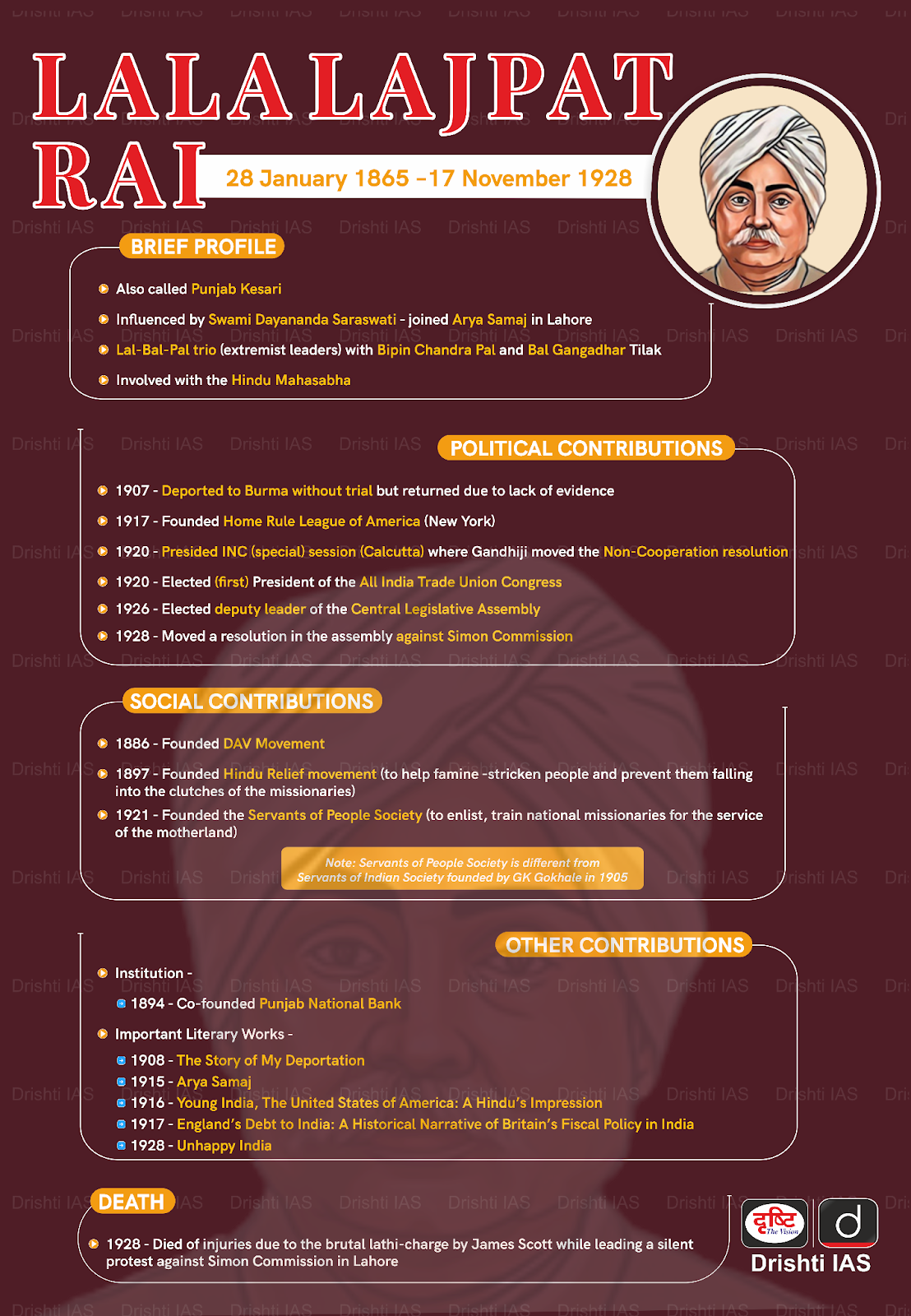
Lala Lajpat Rai
- About: Lala Lajpat Rai, born on 28th January 1865 in Dhudike village, in present-day Punjab, was one of India’s foremost freedom fighters and nationalist leaders, popularly known as “Punjab Kesari” (Lion of Punjab).
- Early life & Education: He studied law at Government College, Lahore, and was deeply influenced by Swami Dayananda Saraswati, joining the Arya Samaj.
- Role in National Movement: Along with Bal Gangadhar Tilak and Bipin Chandra Pal, he formed the Lal-Bal-Pal trio of extremist leaders.
- Contributions: His notable works include Young India, England’s Debt to India, India’s Will to Freedom, and Message of the Bhagavad Gita.
- He co-founded Punjab National Bank (1894) and established several educational and social institutions.
- Death: He died in 1928 after injuries sustained during a lathi-charge while leading a peaceful protest against the Simon Commission in Lahore.
| Read more: Lala Lajpat Rai - Drishti IAS |
Sela Lake and Sela Pass
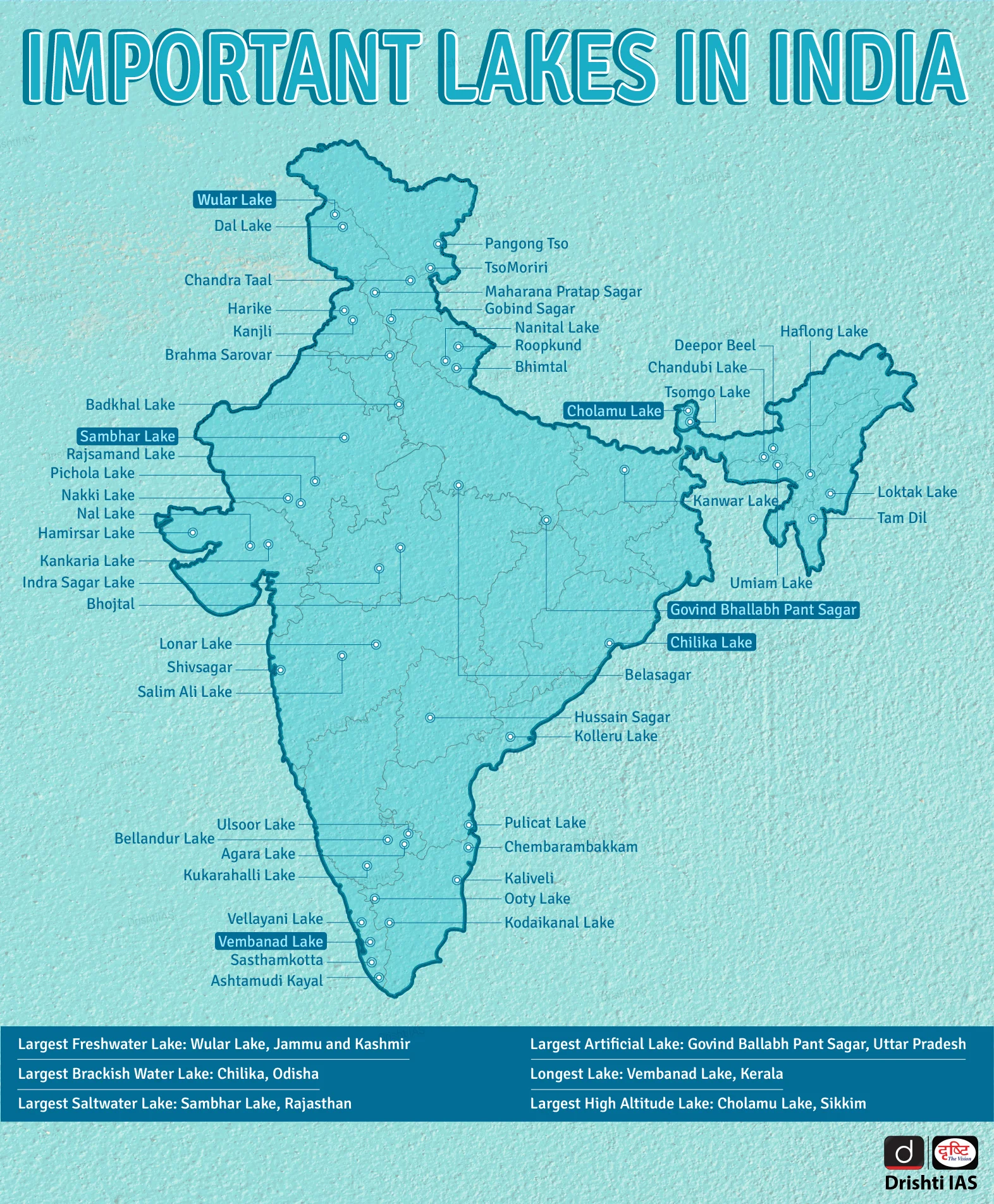
Recently, Sela Lake, a high-altitude glacial lake located near Sela Pass in Tawang district of Arunachal Pradesh, has drawn attention for its geographical, ecological, and strategic significance.
Sela Lake
- About: Sela Lake is a high-altitude glacial lake (over 13,000 feet) situated on the northern side of the Sela Pass in Tawang, in the eastern Himalayas.
- A glacial lake is a body of water formed from glacial meltwater, which is trapped by ice, moraines, or bedrock depressions carved by glacial erosion.
- Geographical Features: It is surrounded by sparse alpine vegetation due to extreme climatic conditions, and is used as a summer grazing ground for yaks.
- It drains into the Nuranang River, a tributary of the Tawang River.
- Cultural Significance: It is known as “Paradise Lake” for its scenic beauty, is one of the sacred lakes in Tibetan Buddhism, and holds deep spiritual importance for the local Monpa communities.
Sela Pass
- About: It is a high-altitude mountain pass in Tawang serving as a strategic logistical corridor connecting Tawang with Assam’s plains.
- It is among the highest motorable passes in India and is maintained year-round by the Border Roads Organisation (BRO).
- Strategic Significance: Located near the Line of Actual Control (LAC), it played a role in the 1962 Sino-Indian War and remains a vital military logistics and troop movement route.
- The Sela Tunnel provides all-weather connectivity across the Sela Pass, linking Tezpur in Assam to Tawang near the LAC with China.
- Nearby, the Jaswant Singh War Memorial commemorates the Indian soldiers who died fighting the Chinese army in 1962.
| Read More: Important Lakes in India |
Lakkundi Excavations Boost UNESCO Bid
Recently, excavations at Lakkundi village in Gadag district, Karnataka, near the Kote Veerabhadreshwar Temple, yielded Neolithic-period relics, giving momentum to efforts to include the site in the UNESCO World Heritage Sites list.
Lakkundi
- About: Lakkundi, earlier known as Lokkigundi, is located about 12 km from Gadag and was historically referred to as the “village of hundred wells and temples”.
- Historical Importance: Lakkundi finds mention in 11th–12th century inscriptions and was once compared to Amaravati, the capital of Indra, for its prosperity.
- Cultural and Religious Legacy: The village was the Karmabhoomi of Queen Attimabbe, a Jain philanthropist renowned for building temples, Jain basadis, and wells.
- In her honour, the State has instituted an award known as the Daana Chintamani Attimabbe Prashasti.
- While Jainism flourished, Lakkundi also nurtured 12th-century sharanas such as Ajaganna and Muktayakka, associated with Basaveshwara’s reformist movement.
- Architectural Features: Though many structures no longer exist, records mention 13 surviving temples in the Kalyana Chalukya architectural style, along with intricately carved stepwells.
- Support: The State, in collaboration with the Indian National Trust for Art and Cultural Heritage (INTACH), is finalising a proposal to include Lakkundi monuments in UNESCO’s Tentative List of World Heritage Sites (WHS).
| Read more: UNESCO World Heritage Sites in India |
National Improvised Explosive Device Data Management System
The Union Home Minister inaugurated the National Improvised Explosive Device Data Management System (NIDMS) of the National Security Guard (NSG), establishing India’s first centralised national digital database of all bomb blasts since 1999.
National Improvised Explosive Device Data Management System
- About: Developed by the National Security Guard (NSG), the NIDMS is a secure national-level digital platform aimed at enabling the systematic collection, collation and dissemination of data related to Improvised Explosive Devices.
- Key Features:
- Two-way, integrated and online platform accessible to NIA (National Investigation Agency), ATS (Anti-Terrorism Squad), State Police Forces, CAPFs (Central Armed Police Forces) and other agencies
- Real-time data sharing to support faster and evidence-based investigations and prosecution
- ‘One Nation, One Data Repository’ approach, treating IED-related data as a national security asset.
- Leveraging AI, NIDMS will integrate multiple data sources to build a robust national security grid.
- Integration with the ICJS-2 – Inter-Operable Criminal Justice System (Phase-II) ecosystem, aligning with ‘One Data–One Entry’ architecture (CCTNS, e-Prisons, e-Forensics, NAFIS, etc.)
National Security Guard
- The National Security Guard (NSG) is India’s federal contingency counter-terrorism force, established following a 1984 Union Cabinet decision and formally constituted in 1986 to tackle all forms of terrorism across the country.
- The concept of raising such a force emerged after Operation Blue Star (1984) and the assassination of the then Prime Minister, Indira Gandhi.
- Guided by the doctrine of swift strike and immediate withdrawal, the NSG is a highly specialised, task-oriented force modelled on the UK’s SAS and Germany’s GSG-9.
- It comprises two complementary components, the Special Action Group (SAG) drawn from the Army for direct counter-terror operations, and the Special Ranger Groups (SRG) drawn from Central Armed Police Forces and State Police to provide operational support.
- NSG’s regional hubs operate from different parts of the country- Mumbai, Chennai, Kolkata, Hyderabad, and Ahmedabad. In addition, a new hub is also being set up in Ayodhya.
- National Bomb Data Centre (NBDC) under NSG functions as the nodal agency to collect, collate, analyse and evaluate all terrorist bombing activities reported in India and abroad.
| Read more: National Security Guard |