
NGT Approved Great Nicobar Project | 17 Feb 2026
For Prelims: National Green Tribunal (NGT), Great Nicobar Project, Coral Reefs, NITI Aayog, Andaman and Nicobar Archipelago, National Commission for Scheduled Tribes (NCST), Exclusive Economic Zone, United Nations Convention on the Law of the Sea, 1982 (UNCLOS), Ten Degree Channel, Tropical Rainforest, Forest Rights Act, 2006.
For Mains: Overview of the Great Nicobar Island project, its strategic value, key challenges, and the path to sustainable implementation.
Why in News?
The National Green Tribunal (NGT) has approved the Rs 81,000-crore Great Nicobar project, stating that it found “no good ground” to intervene, while imposing stringent conditions to safeguard the environment.
- NGT acknowledged the "strategic importance of the project" and noted that "adequate safeguards" have been incorporated in the environmental clearance to mitigate ecological impacts.
Summary
- The National Green Tribunal has approved the strategically vital Great Nicobar Project, imposing stringent conditions to protect coastlines, coral reefs, and endangered species.
- Concerns over deforestation, tribal displacement, and seismic vulnerability persist.
- Successful implementation requires rigorous enforcement of safeguards and genuine consultation with PVTGs like the Shompen and Nicobarese under the Forest Rights Act, 2006.
What Environmental Safeguards Have Been Imposed by the NGT?
- Prevention of Erosion: The NGT directed that construction (including foreshore development) must not cause erosion or adverse shoreline changes near the project area or along any of the islands.
- Protection of Sandy Beaches: It specifically ordered that there shall be "no loss of sandy beaches," recognizing these beaches as critical nesting sites for turtles and birds, and as natural protection for the islands.
- Protection of Coral Reefs: It ordered the Ministry of Environment, Forest and Climate Change (MoEFCC) to take "all measures" to protect coral reefs along the coastal stretch and to ensure "coral regeneration through proven scientific methods." Any existing scattered coral must be "translocated" as per Zoological Survey of India (ZSI) suggestions.
- Protection of Endangered Species: The environmental clearance contains specific conditions for the protection of Leatherback sea turtles, Nicobar megapode, Saltwater crocodiles, Robber crab, Nicobar macaque and other endemic bird species of the Great Nicobar island.
- Binding Nature of Conditions: The NGT stipulated that the government is bound by the conditions in the environmental clearance and must ensure these are not violated at any stage of project implementation.
What is the Great Nicobar project?
- About: The Great Nicobar Island (GNI) Project, conceived by the NITI Aayog and launched in 2021, is a mega infrastructure initiative aimed at transforming the southernmost island of the Andaman and Nicobar archipelago into a strategic and economic hub. It aligns with India's Maritime Vision 2030 and Amrit Kaal Vision 2047.
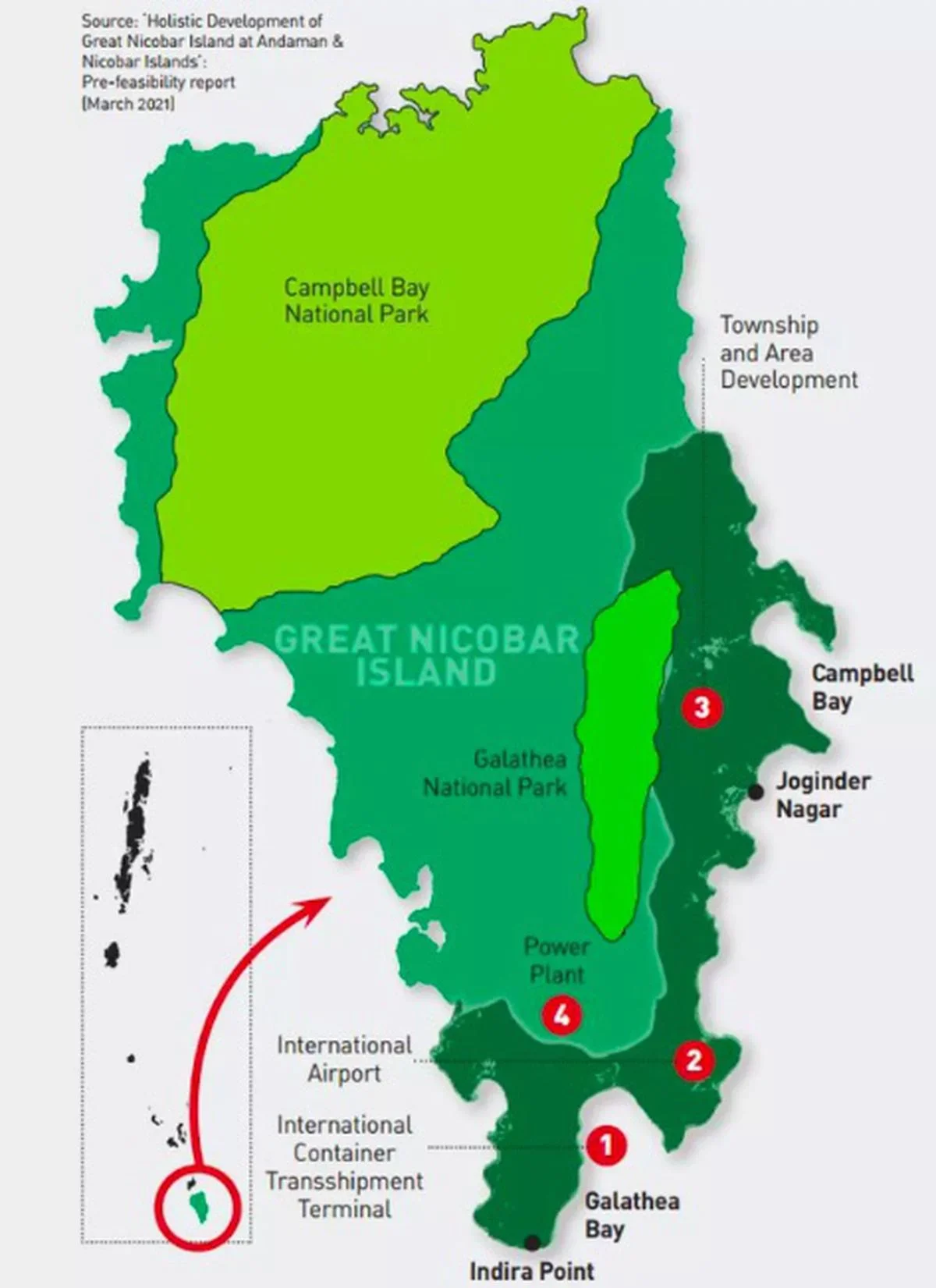
- Project Overview: It involves development at Galathea Bay, Pemmaya Bay, and Nanjappa Bay. The island is approximately equidistant from Colombo (Sri Lanka), Port Klang (Malaysia), and Singapore, placing India at the centre of regional sea trade.
- Key Infrastructure Components:
- International Container Transhipment Terminal (ICTT): Aimed at enabling Great Nicobar to become a major player in the regional and global maritime economy by participating in cargo transhipment.
- Greenfield International Airport: To enhance civilian connectivity, tourism, and provide dual-use defence capability.
- Greenfield Township: To support the projected population and economic activities.
- Gas and Solar-Based Power Plant: To meet the energy requirements of the new infrastructure.
- Tribal Safeguards: Development requires mandatory consultation with tribal welfare bodies (Andaman Adim Janjati VikasSamiti (AAJVS), Ministry of Tribal Affairs), as per the Jarawa (2004) and Shompen (2015) Policies. Consultation with the National Commission for Scheduled Tribes (NCST) under Article 338A(9) confirms tribal interests will be protected.
- Environmental Safeguards: The project includes 8 wildlife corridors for safe animal movement. Compensatory afforestation for felled trees is planned in Haryana, as the islands already have over 75% forest cover.
What is the Strategic Significance of the Great Nicobar Project?
- Chokepoint Proximity: The island's location near the Malacca, Sunda, and Lombok Straits—critical waterways connecting the Indian Ocean to the Pacific—enables India to monitor vital sea lanes for global trade and energy supply.
- It also gives India proximity to Sabang (Indonesia), and the proposed Kra Canal (Thailand), underscoring its central role in Indo-Pacific sea routes.
- Maritime Domain Awareness: It strengthens India's capacity to track naval movements, particularly concerning China's increasing presence in the Indian Ocean Region (IOR) and the military facility being built on the Coco Islands (Myanmar), located just 55 km north of India's Andaman & Nicobar Islands.
- First Line of Defence: The Andaman & Nicobar Islands serve as India's first line of maritime defence, sharing sea boundaries with Myanmar, Thailand, Indonesia, and Bangladesh. This grants India a vast exclusive economic zone and continental shelf under the United Nations Convention on the Law of the Sea, 1982 (UNCLOS).
- Military Deterrence: The project facilitates the deployment of additional military forces, larger warships, aircraft, missile batteries, and troops, enabling close surveillance and building strong military deterrence.
- Economic Significance: The ICTT aims to reduce India's reliance on foreign transhipment ports like Singapore and Colombo, integrating India into global supply chains.
Great Nicobar Island
- Andaman and Nicobar Islands: It consists of 836 islands, geographically divided into the Andaman group to the north and the Nicobar group to the south by the Ten Degree Channel, which is approximately 150 km wide.
- Great Nicobar Island: It is the largest island in the Nicobar group, predominantly covered with tropical rainforest. It hosts Indira Point, the southernmost point of India, located just 90 nautical miles from Sumatra, Indonesia.
- Ecological Significance: The island is home to two national parks namely Campbell Bay National Park and Galathea Bay National Park. It also contains the Great Nicobar Biosphere Reserve, which was included in the UNESCO Man and Biosphere Programme in 2013.
- Demographic Profile: The island has small populations of indigenous tribal communities, including the Shompen and Nicobarese, along with a few thousand non-tribal settlers. Other indigenous tribes historically associated with the region include the Onge and Andamanese.
What Concerns are Associated with the Great Nicobar Project?
- Impact on Indigenous Tribes: The project threatens to dispossess the Nicobarese of their ancestral land, much of which was devastated during the 2004 Indian Ocean tsunami, uprooting communities with deep cultural and historical ties.
- Environmental and Ecological Concerns:
- Rampant Deforestation: The project will clear 130 sq km of primary tropical rainforest (approximately 15% of GNI's land mass). Actual tree felling may exceed 10 million.
- Threat to Wildlife: The project threatens leatherback sea turtles in the Galathea Bay Wildlife Sanctuary, which was designated in 1997 for their conservation but was denotified in 2021 for the port.
- ICRZ Violations Alleged: Petitions alleged that 700 hectares of the proposed project fell within ICRZ areas, where development is strictly prohibited under the ICRZ Notification, 2019.
- Compensatory Afforestation Issues: The diversion of pristine Nicobar forests is being "compensated" with land in Haryana and Madhya Pradesh, which critics argue fails to replicate the lost biodiversity of the unique island ecosystem.
- Geological Concerns: The island's geology comprises tertiary sandstone, limestone, and shale over volcanic rocks, which amplify seismic shaking and are prone to liquefaction during earthquakes.
- Legal Concerns: The Supreme Court-appointed Shekhar Singh Commission (2002) recommended a total ban on tree felling in tribal reserves and national parks, along with afforestation before felling—a rule currently not being followed.
What Steps are Needed to Ensure the Sustainability of the Great Nicobar Project?
- Ecological Conservation Strategies: Consider innovative legal mechanisms such as conferring legal personhood status upon the Great Nicobar ecosystem, ensuring conservation-centric decision-making.
- Establish long-term ecological monitoring for parameters like soil health, coastal erosion, and carbon emissions, with adaptive measures to safeguard turtle nesting sites and prevent habitat fragmentation.
- Safeguarding Tribal Rights: Design resettlement packages that acknowledge pre-tsunami habitation patterns and implement restricted access protocols during construction to protect tribal communities.
- Mandate the inclusion of Tribal Councils of Great and Little Nicobar Islands in project-related deliberations, upholding their statutory rights under the Forest Rights Act, 2006.
- Institutional Oversight and Transparency: Create a multi-stakeholder independent oversight authority comprising environmental experts, tribal representatives, and government nominees to monitor compliance with environmental and social safeguards, ensuring transparency and accountability.
- Sustainable Economic Opportunities: Promote green employment in sectors like renewable energy, ecologically responsible tourism, and low-impact offshore activities. Align project outcomes with India's international commitments to biodiversity conservation and climate action.
Conclusion
The National Green Tribunal's approval of the Great Nicobar Project with stringent environmental conditions represents a calibrated attempt to balance national strategic interests with ecological preservation. However, successful implementation hinges on rigorous enforcement of safeguards, genuine consultation with indigenous PVTGs, and transparent institutional oversight to ensure development does not come at an irreversible cost.
|
Drishti Mains Question: Examine the strategic significance of the Andaman and Nicobar Islands in India's maritime security framework. |
Frequently Asked Questions (FAQs)
1. What is the Great Nicobar Island Project?
It is a mega infrastructure project to develop a transshipment port, international airport, township, and power plant on Great Nicobar Island to serve as a strategic and economic hub.
2. What is the strategic significance of the Great Nicobar Island?
Its proximity to the Malacca Strait and other choke points allows India to monitor vital sea lanes, counter Chinese influence (e.g., Coco Islands), and project military power in the Indo-Pacific region.
3. What were the key environmental concerns raised against the project?
Concerns included massive deforestation (130 sq km), threat to endangered species like leatherback turtles, alleged ICRZ violations, and the ecological impact on coral reefs and the Galathea Bay Wildlife Sanctuary.
UPSC Civil Services Examination, Previous Year Question (PYQ)
Prelims
Q. Consider the following statements: (2018)
- The Barren Island volcano is an active volcano located in the Indian territory.
- Barren Island lies about 140 km east of Great Nicobar.
- The last time the Barren Island volcano erupted was in 1991 and it has remained inactive since then.
Which of the statements given above is/are correct?
(a) 1 only
(b) 2 and 3
(c) 3 only
(d) 1 and 3
Ans: (a)
Q. Which one of the following pairs of islands is separated from each other by the ‘Ten Degree Channel’? (2014)
(a) Andaman and Nicobar
(b) Nicobar and Sumatra
(c) Maldives and Lakshadweep
(d) Sumatra and Java
Ans: (a)
Mains
Q. Environmental impact assessment studies are increasingly undertaken before the project is cleared by the government. Discuss the environmental impacts of coal- fired thermal plants located at Pitheads.(2023)
Q. Project ‘Mausam’ is considered a unique foreign policy initiative of Indian government to improve relationships with its neighbours. Does the project have a strategic dimension? Discuss. (2015)