
India- Ethiopia Relations
For Prelims: G20, Horn of Africa, African Union, International Big Cat Alliance (IBCA), Coalition for Disaster Resilient Infrastructure (CDRI)
For Mains: India–Africa relations and Ethiopia’s role in India’s foreign policy, Significance of Strategic Partnerships in India’s diplomacy
Why in News?
Prime Minister Narendra Modi’s three-nation visit to Jordan, Ethiopia and Oman underscored India’s bid to consolidate its strategic footprint in the Middle East and Horn of Africa. During the Ethiopia leg of the tour, India–Ethiopia relations were elevated to a Strategic Partnership, representing a major upgrade in bilateral ties.
- Prime Minister Narendra Modi was conferred Ethiopia’s highest civilian honour - The Great Honor Nishan of Ethiopia.
Summary
- India–Ethiopia relations entered a new strategic phase with the elevation of ties to a Strategic Partnership, strengthening cooperation in trade, investment, energy, and multilateral forums.
- Ethiopia’s strategic location, AU and BRICS membership, and growing economy make it a key partner for India’s Africa and Global South engagement, despite challenges like logistics and regional instability.
What are the Key Outcomes of the Prime Minister’s visit to Ethiopia?
- Agreements and Institutional Mechanisms: The two sides signed eight MoUs and agreements, including for establishing a Data Centre at Ethiopia’s Ministry of Foreign Affairs and for debt restructuring in respect of Ethiopia under the G20 Common Framework.
- Existing mechanisms such as Foreign Office Consultations and the Joint Trade Committee were reinforced.
- Economic and Investment Outcomes: India highlighted that Indian companies have invested over USD 5 billion in Ethiopia, particularly in manufacturing and pharmaceuticals, creating more than 75,000 local jobs.
- Global Issues: India noted Ethiopia’s solidarity following the Pahalgam terror attack and its support for the global fight against terrorism.
- Parliamentary and People-to-People Engagement: Prime Minister of India addressed a Joint Session of the Ethiopian Parliament, underscoring democratic engagement and people-to-people ties.
- Both sides emphasised education, capacity building, and cooperation through platforms such as the International Big Cat Alliance (IBCA), Coalition for Disaster Resilient Infrastructure (CDRI), Global Biofuel Alliance (GBA) and International Solar Alliance (ISA).
How are India- Ethiopia Relations?
- Historical Foundation: India–Ethiopia relations trace back to the Axumite Empire (1st century AD), when Indian traders exchanged silk and spices for gold and ivory through the ancient port of Adulis.
- In the 16th century, Indians from Goa supported the Ethiopian king alongside the Portuguese, and Indian soldiers later formed a key part of British forces that ended Italy’s occupation of Ethiopia (1936–41).
- India and Ethiopia established diplomatic ties in 1950, which have since grown into a broad partnership.
- Economic and Trade Relations: India is the 2nd largest trading partner for Ethiopia.
- In FY 2024–25, India–Ethiopia bilateral trade stood at USD 550.19 million, with Indian exports at USD 476.81 million and imports at USD 73.38 million, making the relationship strongly export-driven in India’s favour.
- Ethiopia also benefits from India’s Duty-Free Tariff Preference (DFTP) scheme for least developed countries.
- Education and Human Capital Linkages: India has historically shaped Ethiopia’s education system, now reinforced through Indian Council for Cultural Relations scholarships, Indian Technical and Economic Cooperation Programme and India’s role as a major destination for African students.
- Ethiopia served as a pilot country for India’s Pan-African e-Network, enabling tele-education and tele-medicine with institutions like IIT Delhi, and marking an early example of India’s digital public diplomacy in Africa.
- Indian Community:The Indian community in Ethiopia dates back to the late 19th century, with early settlers from Gujarat, and today numbers about 2,500 people contributing to education and industry.
Significance of Ethiopia for India
- Strategic Partner in Africa: Ethiopia is a key political and development partner for India and a gateway to Africa due to its central location in the Horn of Africa .
- Global South & Multilateral Influence: As a BRICS member and host of the African Union and United Nations Economic Commission for Africa (UNECA), Ethiopia amplifies India’s engagement on Global South issues at the UN, G20, and BRICS.
- Economic Opportunities: Ethiopia’s large market, growing manufacturing base, and strong demand for Indian exports make it an important trade and investment destination.
- Energy & Sustainability: Ethiopia’s hydropower and renewable energy potential aligns with India’s clean energy and climate goals.
Ethiopia
- Location: It is a landlocked country in the Horn of Africa, centrally located in East Africa, with Addis Ababa as its capital.
- Ethiopia is bordered by Eritrea (north), Djibouti (northeast), Somalia (east), Kenya (south), South Sudan (west), and Sudan (northwest).
- Geographic Features: Ethiopia is characterised by the rugged Ethiopian Highlands (with Mount Ras Dejen as the highest peak), the Great Rift Valley, major river systems including the Blue Nile (Abay), Tekeze and Baro, and the Danakil Depression, one of the hottest and lowest regions on Earth.
- The Hayli Gubbi volcano is located in the Afar Region of Ethiopia.

What are the Challenges and Opportunities in India–Ethiopia Relations?
Challenges in India–Ethiopia Relations
- Logistics Constraints: Ethiopia’s landlocked geography increases transport costs and dependence on neighbouring transit routes.
- Political and Security Instability: Periodic internal conflicts and Horn of Africa geopolitical tensions (including the Sudan crisis and Red Sea insecurity) elevate country risk perceptions, posing challenges to long-term political stability and Indian investments and engagement in Ethiopia.
- Regulatory Gaps: Ethiopia’s transition to a market-oriented economy faces procedural delays, unclear privatisation rules, restricted private sector access, and regulatory instability, leading to a weaker ease of doing business.
Opportunities in India–Ethiopia Relations
- Deepening the Strategic Partnership: The upgraded partnership provides a framework to expand cooperation beyond trade into defence, digital governance, and development financing.
- Manufacturing and industrial cooperation: Ethiopia’s large domestic market, young workforce, and industrial parks align well with Indian strengths in manufacturing, textiles, pharmaceuticals, and MSMEs, enabling value-chain integration.
- Renewable energy collaboration: Ethiopia’s strong hydropower base and renewable potential offer scope for joint projects in clean energy, grid development, and climate-resilient infrastructure.
- Multilateral coordination: Joint engagement at the African Union, UN, G20, and BRICS can amplify Global South priorities and strengthen collective influence in global governance reforms.
Conclusion
India–Ethiopia ties have entered a new strategic phase, built on historical links and growing economic cooperation. The Strategic Partnership strengthens collaboration across trade, energy, and multilateral forums.
|
Drishti Mains Question: Discuss the strategic significance of Ethiopia in India’s Africa policy in the context of the recently elevated Strategic Partnership. |
Frequently Asked Questions (FAQs)
1. Why is Ethiopia important for India’s foreign policy?
Ethiopia is a key African partner, host of the African Union, a BRICS member, and a gateway to Africa, strengthening India’s Global South outreach.
2. What was the major diplomatic outcome of the PM of India’s visit to Ethiopia?
India–Ethiopia ties were elevated to a Strategic Partnership and eight MoUs were signed, including on a data centre and debt restructuring under the G20 framework.
3. How strong are India–Ethiopia economic relations?
Bilateral trade stood at USD 550.19 million in FY 2024–25, with India as Ethiopia’s second-largest trading partner and a major investor.
UPSC Civil Services Examination, Previous Year Questions (PYQs)
Prelims:
Q1. Consider the following pairs: (2019)
Sea Bordering Country
- Adriatic Sea : Albania
- Black Sea : Croatia
- Caspian Sea : Kazakhstan
- Mediterranean Sea : Morocco
- Red Sea : Syria
Which of the pairs given above are correctly matched?
(a) 1, 2 and 4 only
(b) 1, 3 and 4 only
(c) 2 and 5 only
(d) 1, 2, 3, 4 and 5
Ans: (b)
Mains
Q. ‘The long-sustained image of India as a leader of the oppressed and marginalised nations has disappeared on account of its new found role in the emerging global order.’ Elaborate. (2019)
Parliamentary Privileges in India
For Prelims: Parliamentary Privilege, Viksit Bharat- Guarantee For Rozgar And Ajeevika Mission (Gramin) Bill, 2025, Parliament, Article 105, Article 122, Article 194, Article 212, Members of Parliament (MPs), 44th Amendment Act, 1978.
For Mains: Key provisions regarding parliamentary provisions, Breach of privileges. Concerns regarding Parliamentary provisions and judicial stand regarding it. Way forward to reform parliamentary privileges.
Why in News?
The Lok Sabha Speaker is examining a notice for breach of Parliamentary privilege and contempt of the House over alleged disruptive conduct during the debate on the Viksit Bharat- Guarantee For Rozgar And Ajeevika Mission (Gramin) Bill, 2025.
- The notice cites the actions as misconduct in the presence of the House, disobedience to the Speaker's authority, and obstruction of House officers, constituting a collective breach of MPs' privileges.
Summary
- Parliamentary privileges protect legislative independence, including freedom of speech, immunity from arrest, and authority to regulate proceedings.
- Breach of privilege and contempt are distinct, with procedures for notice, investigation, and punishment defined by parliamentary rules.
- Challenges include misuse, conflict with rights, and lack of transparency; reforms suggest statutory framework, ethics enforcement, and alignment with fundamental rights.
What are Parliamentary Privileges?
- About: Parliamentary privileges are special rights, immunities, and exemptions enjoyed by each House of Parliament, its committees, and its members.
- These privileges extend to the Attorney General of India but do not extend to the President.
- Objective: They are necessary for the effective discharge of parliamentary functions and exceed those possessed by other bodies or individuals.
- Types of Privileges:
- Collective Privileges: Rights of the House as a whole (e.g., right to regulate proceedings, punish for contempt, exclude strangers).
- Individual Privileges: Rights of members (e.g., freedom of speech in Parliament, freedom from arrest in civil cases).
- Sources of Parliamentary Privileges:
- Constitutional Basis: Article 105, Article 122, Article 194 and Article 212 provides various types of privileges to Members of Parliament (MPs) and Members of the Legislative Assemblies (MLAs).
- Legal Basis: Article 105(3) states that until defined by Parliament by law, privileges shall be those of the British House of Commons as of 1950. No comprehensive law has been enacted, so British precedents largely guide the practice.
- The Code of Civil Procedure, 1908, grants freedom from arrest in civil cases during and around parliamentary sessions.
- Parliamentary Conventions: Based on British parliamentary practices.
- Parliamentary Procedure: Rules of Procedure and Conduct of Business (Lok Sabha and Rajya Sabha).
- Judicial Interpretations: Searchlight Case, 1958, JMM Bribery Case, 1998, etc.
- Breach of Privileges: A breach of privilege (BoP) occurs when any individual or collective parliamentary privilege is violated or disregarded.
- Privilege Motion: It is concerned with the breach of parliamentary privileges by a minister. It is moved by a member when he feels that a minister has committed a breach of privilege of the House or one or more of its members by withholding facts of a case or by giving wrong or distorted facts. Its purpose is to censure the concerned minister.
- A Privilege Notice is a formal complaint submitted by an MP against another member or an external entity for an alleged breach of parliamentary privileges, e.g., derogatory remarks against MPs.
- Committee of Privileges: The functions of this committee are semi-judicial in nature. It examines the cases of breach of privileges of the House and its members and recommends appropriate action. The Lok Sabha committee has 15 members, while the Rajya Sabha committee has 10 members.
Contempt of House (CoH)
- Contempt of the House (CoH) is a broader concept than breach of privilege.
- It refers to any act or omission that directly or indirectly obstructs or impedes the functions of either House of Parliament, its members, or its officers, or lowers the authority of the House.
- All breaches of privilege (BoP) amount to CoH, but CoH can occur even without a breach of any specific privilege.
- For example, disobeying an order to appear before a committee or publishing derogatory remarks about a member in their official capacity may constitute CoH.
What Parliamentary Privileges are Enjoyed by MPs?
- Individual Privileges: Individual Privileges are the rights and immunities granted to MPs and State Legislators, allowing them to perform their duties independently and without obstruction. Key Privileges are:
- Freedom of Speech: Members enjoy complete freedom of speech within Parliament, protected under Article 105(1) of the Constitution.
- Immunity from Legal Proceedings: Members cannot face legal action for speeches made or votes cast in Parliament or its committees, as per Article 105(2).
- Protection for Authorized Publications: No legal proceedings can be initiated for publishing any report, paper, vote, or proceeding that has been authorized by Parliament (Article 105(2)).
- Exemption from Judicial Inquiry: Courts are barred from inquiring into the validity of parliamentary proceedings based on alleged procedural irregularities, under Article 122(1).
- Freedom from Arrest: Members are exempt from arrest in civil cases during parliamentary sessions, as well as 40 days before and after a session, according to Section 135A of the Code of Civil Procedure, 1908.
- Exemption from Jury Service: They are exempted from jury service. They can refuse to give evidence and appear as a witness in a case pending in a court when Parliament is in session.
- Collective Privileges: It refers to the collective rights and immunities granted to the Indian Parliament and State Legislatures, as well as their members and officers, to protect their functioning and authority. Key Privileges:
- Publication Rights: Parliament holds the exclusive right to publish its own reports, debates, and proceedings. The 44th Amendment Act, 1978, permits the press to publish accurate reports of these proceedings without prior approval, except during secret sittings.
- Right to Secret Sittings: It can hold confidential discussions by excluding strangers during critical matters.
- Rule-Making and Disciplinary Authority: Parliament can establish its own rules of procedure and conduct business. It also has the power to punish members or outsiders for breach of privilege or contempt through measures like reprimand, imprisonment, suspension, or expulsion.
- Right to Information: The legislature must be immediately informed about the arrest, detention, conviction, imprisonment, or release of any of its members.
- Inquiry and Summoning Powers: It possesses the authority to conduct inquiries, summon witnesses, and demand relevant documents and records.
Procedure for Handling a Breach of Privilege Complaint
- Notice: A member gives written notice to the Presiding Officer (Speaker/Chairman).
- Consent: The Presiding Officer examines it and may give or withhold consent for it to be raised in the House.
- Leave of the House: If consent is given, the member asks for "leave of the House" to raise the issue. If 25 members support it, leave is granted.
- Action: The House may either decide the matter itself or refer it to the Committee of Privileges for investigation and report which is the usual practice.
- Punishment: Based on the House's decision, the offender may be:
- Imprisoned (till the prorogation of the House).
- Reprimanded or Admonished (warned) at the Bar of the House.
- Suspended or Expelled (if the offender is a member).
What are the Key Judicial Pronouncements Concerning Parliamentary Privileges?
- Pandit MSM. Sharma vs Shri Sri Krishna Sinha, 1958 (Searchlight Case): The Supreme Court (SC) ruled that legislative privileges under Article 194(3) prevail over freedom of the press under Article 19(1)(a) in case of conflict, allowing state legislatures to control the publication of their proceedings, similar to the British House of Commons.
- PV Narasimha Rao vs. State, 1998 (JMM Bribery Case): The SC ruled that lawmakers who accepted bribes could not be prosecuted for corruption if they voted or spoke in the House according to the bribe agreement.
- State of Kerala vs. K. Ajith and Others, 2021: The SC clarified that parliamentary privileges and immunities do not exempt members from general laws, including criminal laws that apply to all citizens.
- Sita Soren vs. Union of India, 2024: In a landmark reversal, the SC overturned its ruling in the PV Narasimha Rao case, 1998. The Court held that constitutional immunity does not extend to bribery, affirming that accepting a bribe is a distinct criminal offense that corrupts democratic processes and falls outside a legislator's protected duties.
What are the Key Issues and Debates Surrounding Privileges?
- Codification Debate: There is a long-standing debate on whether to codify privileges into a single law. While this could clarify their scope, successive committees have recommended against codification (e.g., Committee of Privileges of the Lok Sabha 2008), fearing it might restrict the House's inherent ability to address novel forms of contempt.
- Tensions with Other Rights: A persistent tension exists between the legislature's power to punish for misreporting and the constitutional freedom of the press.
- Conflict with Democratic Principles: Certain privileges, such as immunity from arrest, conflict with the fundamental principle of equality before the law.
- Risk of Misuse and Erosion of Trust: Privileges are sometimes exploited to evade legal accountability or to make inflammatory, unsubstantiated statements under the cloak of immunity.
- Inadequate regulatory mechanisms heighten this risk, eroding public trust and allowing privilege motions to be used for political vendettas rather than upholding legislative dignity.
- Opacity and Lack of Oversight: Privileges are frequently invoked through non-transparent processes, severely limiting public scrutiny and undermining confidence in the legislature.
International Practices on Parliamentary Privileges
- United Kingdom: Privileges, including freedom of speech, immunity from arrest, and self-regulation, derive from statutes, common law, and precedent.
- Canada: Privileges such as freedom of speech, immunity from arrest, and authority over breaches are defined in the Constitution Act, 1867 and the Parliament of Canada Act, 1985.
- Australia: The Constitution enshrines privileges similar to the UK and Canada, guaranteeing freedom of speech, immunity from arrest, and the right to regulate proceedings.
What Reforms can be Taken to Reform Parliamentary Privileges in India?
- Balanced Statutory Framework: Instead of rigid codification, a broad statutory framework should define core privileges and set clear principles for their use. This would incorporate key judicial rulings and set boundaries, while preserving parliamentary discretion to address new forms of contempt through its own procedures.
- Transparent Procedures for Privilege Cases: Develop and standardize detailed, publicly accessible procedures for handling privilege complaints—from notice to final disposition—ensuring principles of natural justice (right to be heard, right to representation) are followed.
- Strengthen Internal Ethics: Strengthen the Code of Conduct for Members and explicitly link it to the responsible use of privileges, particularly freedom of speech.
- Empower the Ethics Committees to proactively educate and advise members when privilege claims conflict with public interest or ethical norms, promoting a culture of restraint.
- Clarify the Privilege-Fundamental Rights Interface: Formally endorse the Supreme Court's principle of harmonious construction in the Rules of Procedure, guiding the Houses to interpret their privileges in a manner that respects constitutionally guaranteed rights like freedom of speech and equality before law.
Conclusion
Parliamentary privileges are essential for legislative autonomy but require responsible use to balance independence with accountability. The recent breach of privilege notice highlights the need for clear, transparent procedures and ethical self-regulation to maintain public trust in the institution.
|
Drishti Mains Question: "Parliamentary privileges, though essential for legislative independence, often conflict with democratic principles and fundamental rights." Critically examine. |
Frequently Asked Questions (FAQs)
Q. What are parliamentary privileges?
Special rights, immunities, and exemptions enjoyed by Parliament, State Legislatures, and their members to ensure independent and effective functioning.
Q. Which Articles of the Constitution provide for parliamentary privileges?
Articles 105, 122, 194, and 212 form the constitutional basis for privileges of MPs and MLAs.
Q. What is the difference between breach of privilege and contempt of the House?
Breach occurs when a specific privilege is violated; contempt covers acts obstructing the House or diminishing its authority, even without violating a defined privilege.
UPSC Civil Services Examination, Previous Year Questions (PYQ)
Prelims
Q. The Parliament of India exercises control over the functions of the Council of Ministers through (2017)
- Adjournment motion
- Question hour
- Supplementary questions
Select the correct answer using the code given below:
(a) 1 only
(b) 2 and 3 only
(c) 1 and 3 only
(d) 1, 2 and 3
Ans: (d)
Q. In the context of India, which of the following principles is/are implied institutionally in the parliamentary government? (2013)
- Members of the Cabinet are Members of the Parliament.
- Ministers hold the office till they enjoy confidence in the Parliament.
- Cabinet is headed by the Head of the State.
Select the correct answer using the codes given below:
(a) 1 and 2 only
(b) 3 only
(c) 2 and 3 only
(d) 1, 2 and 3
Ans: (a)
Mains
Q. The ‘Powers, Privileges and Immunities of Parliament and its Members’ as envisaged in Article 105 of the Constitution leave room for a large number of un-codified and un-enumerated privileges to continue. Assess the reasons for the absence of legal codification of the ‘parliamentary privileges’. How can this problem be addressed? (2014)
BRICS in the Era of Geopolitical Shifts
For Prelims: BRICS, Amazon Rainforest, UN, IMF, Purchasing Power Parity, New Development Bank, Contingent Reserve Arrangement (CRA), WTO, UN Security Council, World Bank, SWIFT, Critical Minerals, African Union, ASEAN, Peacekeeping.
For Mains: Key facts regarding BRICS and its relevance in contemporary times. Challenges associated with BRICS and a way forward to strengthen BRICS.
Why in News?
Brazil handed over the BRICS presidency to India, passing a symbolic gavel made of recycled wood from the Amazon rainforest symbolizing sustainability.
- Brazil stated that the relevance of BRICS has grown amid rising mistrust in multilateralism, reinforcing its role as a platform for dialogue and bridge-building.
Summary
- Brazil handed over the BRICS presidency to India amid rising mistrust in multilateralism.
- BRICS, expanded to include nations like Egypt and the UAE, promotes multipolarity through institutions like the NDB and initiatives like the Grain Exchange.
- While its role is growing amid global mistrust, internal divisions and economic asymmetry challenge its effectiveness, requiring stronger institutional and strategic coordination.
What is BRICS?
- About: BRICS is a collaborative intergovernmental organization of major emerging economies, established to enhance economic cooperation and amplify the global political and economic influence of its members.
- The acronym originally stood for Brazil, Russia, India, and China, with South Africa joining later in 2010.
- Key Purpose: Its core objectives include promoting trade and investment among members, reforming global governance institutions like the UN and IMF, and establishing alternative financial systems to reduce dollar dependency.
- It aims to counterbalance Western influence and advocate for a more multipolar world order.
- Foundation and Evolution: The term BRIC was first coined by economist Jim O'Neill in 2001. The group began formal cooperation at the 2006 G-8 Outreach Summit and held its first official summit in Russia in 2009.
- Expansion of Membership: The group expanded in 2024 with the addition of Egypt, Ethiopia, Iran, and the UAE. Indonesia joined in 2025.
- Saudi Arabia has accepted membership but has not yet formalized it, while Argentina opted out after initial consideration.
- In 2024, BRICS introduced a partner countries status, initially granted to Belarus, Bolivia, Cuba, Kazakhstan, Malaysia, Nigeria, Thailand, Uganda, and Uzbekistan. This allows them to attend summits without being full members.
- Sherpa System: BRICS Sherpas are designated leaders who represent their countries within the BRICS bloc and serve as the primary channel of communication among BRICS nations.
- India’s current BRICS Sherpa is Sudhakar Dalela.
- New Development Bank (NDB): NDB is a multilateral development bank established by BRICS countries in 2015 to mobilise resources for infrastructure and sustainable development projects in emerging markets and developing countries (EMDCs).
- Membership is open to United Nations members, with Bangladesh (2021), United Arab Emirates (2021), Egypt (2023), and Algeria (2025) joining as new members.
- The NDB has an initial authorised capital of USD 100 billion. The five BRICS founding members each hold equal voting shares, with 20% of the capital each at establishment, and they are guaranteed to retain at least 55% of the institution’s voting rights, even as new members join.
- Significance: BRICS represents about 45% of the world's population and accounts for 37.3% of global GDP (in purchasing power parity terms), collectively surpassing the economic share of the G7 (29.3%).
- Key Initiatives: Key initiatives are the New Development Bank (NDB, 2014), the Contingent Reserve Arrangement (CRA), the BRICS Grain Exchange, and the Science, Technology and Innovation (STI) Framework Programme (2015).

How has BRICS Increased its Relevance in an Era of Growing Mistrust Toward Multilateral Institutions?
- Pragmatic Response to Multilateral Paralysis: Amid deadlocks in the WTO and UN Security Council, BRICS has enhanced relevance through functional cooperation in food security (BRICS Grain Exchange), digital governance (BRICS Rapid Information Security Channel), technology sharing (STI Framework), vaccine equity during Covid-19, and climate finance via the NDB.
- Rising Representativeness: With Indonesia’s accession and the BRICS partner-country model, the grouping has widened its Global South footprint, countering critiques of limited regional representation while preserving institutional flexibility.
- Material Economic and Energy Weight: Accounting for ~45% of the global population and over 35% of world GDP (PPP), and reinforced by energy-heavy members (Iran, UAE, with Saudi Arabia pending), BRICS wields growing influence over global growth narratives, energy markets, and pricing politics.
- Institutional Alternatives to Western-Led Frameworks: The New Development Bank and the CRA provide development, climate, and liquidity support outside IMF-centric conditionality, helping BRICS evolve from a consultative forum into a credible solutions-oriented institutional platform.
- Multipolar Narrative and Diplomatic Adaptability: By positioning itself as a champion of a fairer multipolar order—while sustaining dialogue during crises such as Covid-19 and the Ukraine War—BRICS resonates with Global South states seeking strategic autonomy and non-aligned diplomatic space amid geopolitical polarization.
What are the Key Challenges Hindering the Effective Functioning of BRICS?
|
Challenge Area |
Description |
|
Geopolitical & Strategic Divergence |
|
|
External Coercion & Political Pressure |
|
|
Economic Asymmetry |
|
|
Institutional Underdevelopment |
|
|
Expansion–Cohesion Trade-off |
|
What Steps can BRICS Take to Strengthen its Effectiveness and Strategic Influence?
- Institutional and Financial Deepening: BRICS should operationalize a unified digital payment platform (e.g., BRICS Pay), expand local-currency lending via the NDB, and create dedicated funds for green energy and strategic sectors to reduce reliance on SWIFT, the US dollar, and IMF-centric financial channels.
- Trade Integration and Supply-Chain Stabilization: A BRICS Common Market Framework—anchored in tariff rationalization, mutual standards recognition, and seamless logistics—alongside the operationalization of the BRICS Grain Exchange, would stabilize food supplies and strengthen trade in critical sectors such as pharmaceuticals and minerals.
- Coordinated Diplomacy and Global South Alignment: Formalizing a unified BRICS voice on global governance reforms and creating a crisis-diplomacy mechanism for regional conflicts (e.g., Sudan, Haiti), while institutionalizing BRICS+ dialogue with blocs like the African Union, and ASEAN, would amplify South–South cooperation and diplomatic influence.
- Permanent Institutional Architecture for Policy Delivery: Establishing a lean, technocrat-led BRICS Secretariat would ensure policy continuity across rotating presidencies, monitor implementation, and convert summit declarations into measurable outcomes, addressing the grouping’s execution deficit.
- Strategic Autonomy Through Protection and Value-Chain Power: Collective legal and financial shield mechanisms (e.g., joint asset-protection funds), combined with coordinated investment in value-chain segments such as refining, processing, logistics, and standards-setting, would enhance sanctions resilience and elevate BRICS from trade coordination to structural economic power.
Conclusion
BRICS has grown into a pivotal platform advocating for multipolarity, leveraging economic heft and institutional innovation. Its future relevance hinges on overcoming internal disparities and external pressures to deliver tangible cooperation for the Global South.
|
Drishti Mains Question: Critically examine the role of BRICS as a counterweight to traditional Western-dominated multilateral institutions. What are its key achievements and limitations? |
Frequently Asked Questions (FAQs)
1. What is BRICS?
BRICS is a cooperative intergovernmental organization of emerging economies—Brazil, Russia, India, China, South Africa—aimed at enhancing economic cooperation and global influence.
2. Which countries joined BRICS in 2024–2025?
Egypt, Ethiopia, Iran, UAE, and Indonesia joined BRICS, expanding the bloc’s outreach under BRICS+; Saudi Arabia’s membership is pending.
3. What are the key financial institutions of BRICS?
The New Development Bank (NDB) and Contingent Reserve Arrangement (CRA) provide alternatives to the IMF/World Bank, promoting local currency trade and financial autonomy.
UPSC Civil Services Examination, Previous Year Questions (PYQs)
Prelims
Q. Consider the following statements: (2016)
- New Development Bank has been set up by APEC.
- The headquarters of the New Development Bank is in Shanghai.
Which of the statements given above is/are correct?
(a) 1 only
(b) 2 only
(c) Both 1 and 2
(d) Neither 1 nor 2
Ans: (b)
Q. The ‘Fortaleza Declaration’, recently in the news, is related to the affairs of (2015)
(a) ASEAN
(b) BRICS
(c) OECD
(d) WTO
Ans: (b)
Q. With reference to a grouping of countries known as BRICS, consider the following statements: (2014)
- The First Summit of BRICS was held in Rio de Janeiro in 2009.
- South Africa was the last to join the BRICS grouping.
Which of the statements given above is/are correct?
(a) 1 only
(b) 2 only
(c) Both 1 and 2
(d) Neither 1 nor 2
Ans: (b)
Mains
Q. India has recently signed to become a founding member of New Development Bank (NDB) and also the Asian Infrastructure Bank (AIIB). How will the role of the two Banks be different? Discuss the strategic significance of these two Banks for India. (2014)
Governor’s Constitutional Powers
Why in News?
The Uttarakhand Governor has returned the amendment Bills on the Uniform Civil Code (UCC) and the Freedom of Religion and Prohibition of Unlawful Conversion Act, 2018 citing technical and legal flaws, renewing focus on the scope of the Governor’s powers.
Summary
- The Uttarakhand Governor returning amendment Bills on the UCC has brought renewed attention to the constitutional powers of Governors, especially their authority under Article 200 to return or withhold assent to State legislation.
- While the Governor functions as a constitutional head acting mainly on ministerial advice, his legislative and discretionary powers are meant as constitutional safeguards, but their use often sparks debates on federalism, democratic accountability, and Centre–State relations.
What are Constitutional Provisions Related to the Governor?
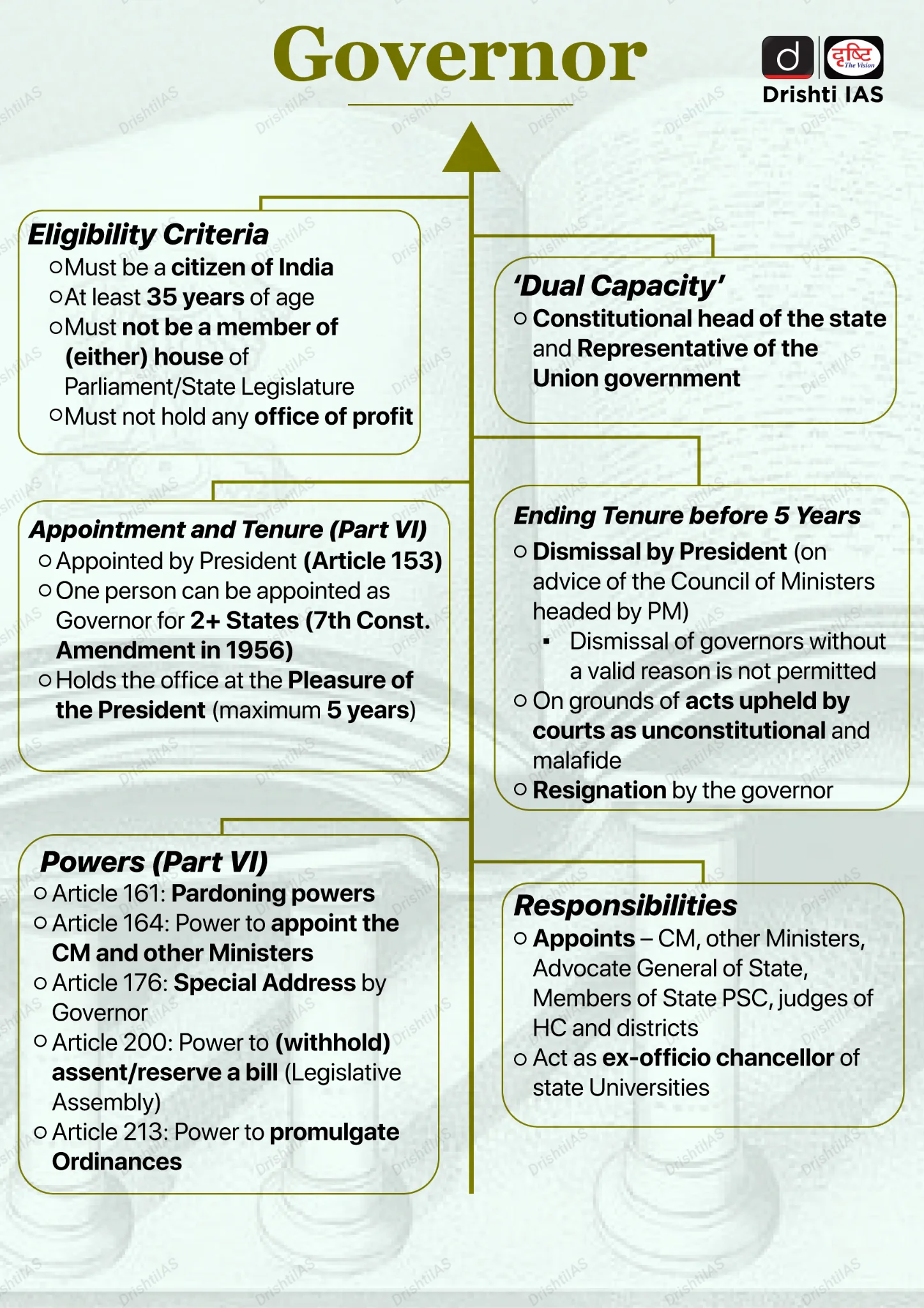
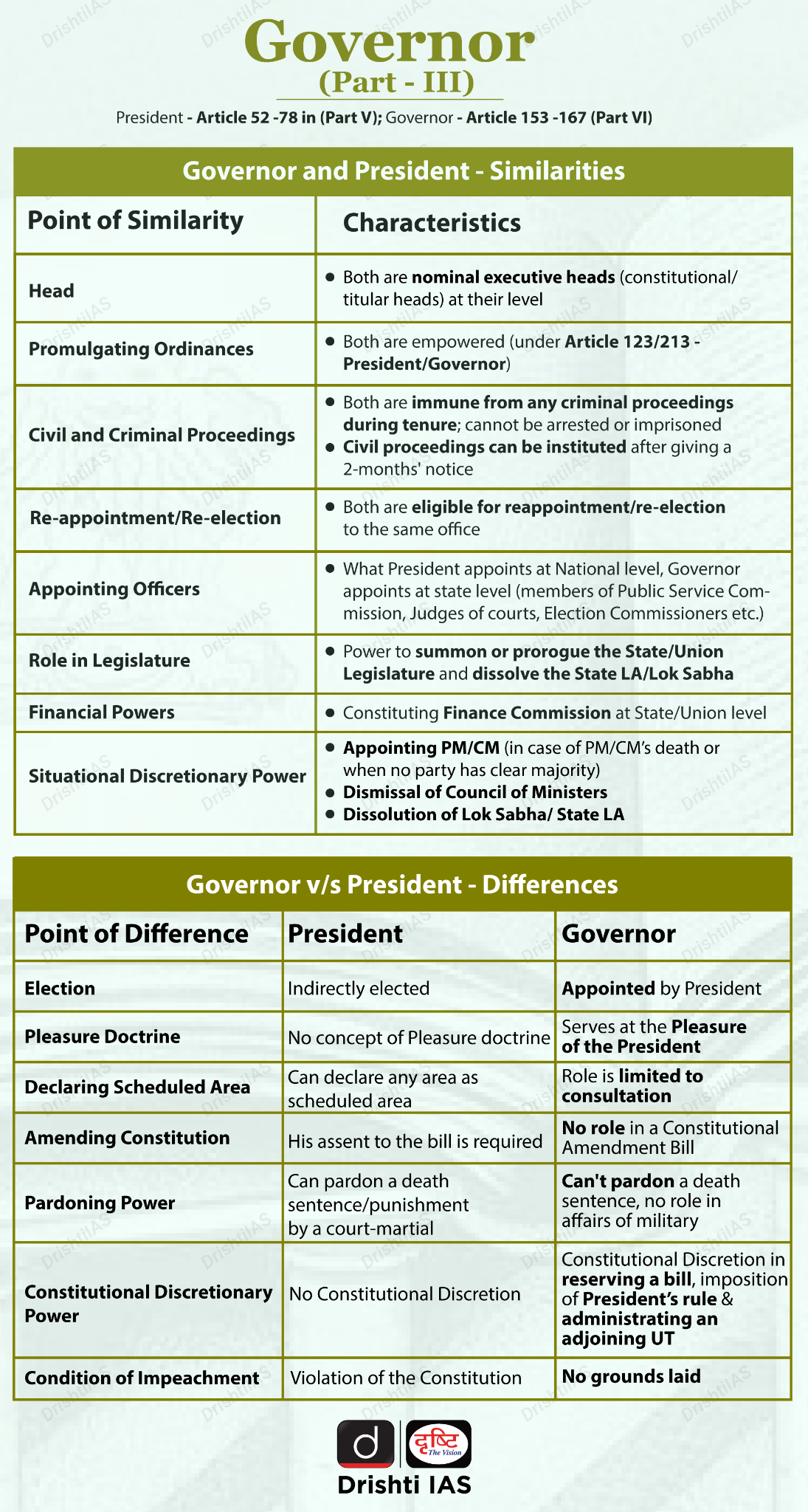
- Constitutional Position of the Governor: The Governor is the constitutional head of the State under Article 153, with the executive power of the State vested in him under Article 154. He acts as a link between the Union and the State.
- Appointment, Status, and Eligibility: The Governor of a State shall be appointed by the President by warrant under his hand and seal (Article 155).
- A person to be eligible for appointment as Governor should be citizen of India and has completed age of 35 years (Article 157).
- The Governor shall not be a member of the Legislature or Parliament; shall not hold any office of profit, shall be entitled to emoluments and allowances. (Article 158)
- Every Governor and every person discharging the function of the Governor shall make a subscribe an oath or Affirmation (Article 159).
- Legislative Powers: The Governor has key legislative functions under Articles 174 to 176, including summoning, proroguing, and dissolving the Legislative Assembly, addressing the House, and sending messages to it.
- Under Article 200, the Governor may assent to Bills, withhold assent, return Bills for reconsideration (except Money Bills), or reserve Bills for the President’s consideration.
- The Governor exercises absolute veto by withholding assent and suspensive veto by returning a non-Money Bill for reconsideration. However, the Governor does not have pocket veto.
- Executive Powers: Under Article 163, the Governor acts on the advice of the Council of Ministers, except in discretionary matters.
- He appoints the Chief Minister and other Ministers under Article 164, appoints the Advocate General of the State under Article 165, and all executive actions of the State are carried out in the name of the Governor as per Article 166.
- Financial Powers:
- Article 202: Causes the Annual Financial Statement (State Budget) to be laid before the Legislature.
- Article 203(3): No demand for grants without the Governor’s recommendation.
- Article 205: Causes supplementary, additional, or excess grants to be laid before the House.
- Ordinance-Making Power: Under, Article 213 Governor may promulgate Ordinances when the Legislature is not in session and immediate action is required.
- Judicial-Related Powers: The Governor exercises clemency powers under Article 161, including granting pardons and commutations.
- He is consulted in the appointment of High Court judges, and judges take their oath or affirmation before the Governor under Article 217.
Note: A five-judge Constitution Bench of the Supreme Court, in its advisory opinion on the 16th Presidential Reference under Article 143, held that courts cannot impose timelines on the President or Governors for granting assent to State Bills, as this would violate federalism and the separation of powers.
Frequently Asked Questions (FAQs)
1. Who appoints the Governor and what is his constitutional position?
The Governor is appointed by the President under Article 155 and acts as the constitutional head of the State under Articles 153–154.
2. What options does a Governor have when a Bill is presented for assent?
Under Article 200, the Governor may grant assent, withhold assent, return the Bill (except Money Bills), or reserve it for the President.
3. Does the Governor enjoy pocket veto over State Bills?
No, the Governor has absolute and suspensive veto powers but does not enjoy pocket veto.
4. What is the Governor’s role in financial matters of the State?
The Governor lays the State Budget before the Legislature and ensures that no demand for grants is made without his recommendation.
UPSC Civil Services Examination Previous Year’s Question (PYQs)
Prelims
Q. With reference to the Indian polity, consider the following statements: (2025)
- The Governor of a State is not answerable to any court for the exercise and performance of the powers and duties of his/her office.
- No criminal proceedings shall be instituted or continued against the Governor during his/her term of office.
- Members of a State Legislature are not liable to any proceedings in any court in respect of anything said within the House.
Which of the statements given above are correct?
a) 1 and 2 only
b) 2 and 3 only
c) 1 and 3 only
d) 1, 2 and 3
Ans: (d)
Q. Consider the following statements: ( 2025)
- The Constitution of India explicitly mentions that in certain spheres, the Governor of a State acts in his/her own discretion.
- The President of India can, of his/her own, reserve a bill passed by a State Legislature for his/her consideration without it being forwarded by the Governor of the State concerned.
Which of the statements given above is/are correct?
a) 1 only
b) 2 only
c) Both 1 and 2
d) Neither 1 nor 2
Ans: (a)
US Operation Hawkeye Strike in Syria
The US launched Operation Hawkeye Strike in Syria, targeting Islamic State (IS) infrastructure and weapons sites in direct response to the attack on US forces in Palmyra, signalling a strong counter-terror response.
- IS, also known as ISIS (Islamic State of Iraq and Syria), is a Sunni extremist terrorist organisation that self-declared itself a pan-Islamic Caliphate, emerging from al-Qaeda in Iraq, with its historic base of operations in northern Iraq and Syria.
- It has committed widespread crimes against humanity, including genocide, mass executions, sexual slavery, and terrorism.
- In India, the Islamic State (IS) and all its manifestations are banned under the Unlawful Activities (Prevention) Act, 1967 (UAPA).
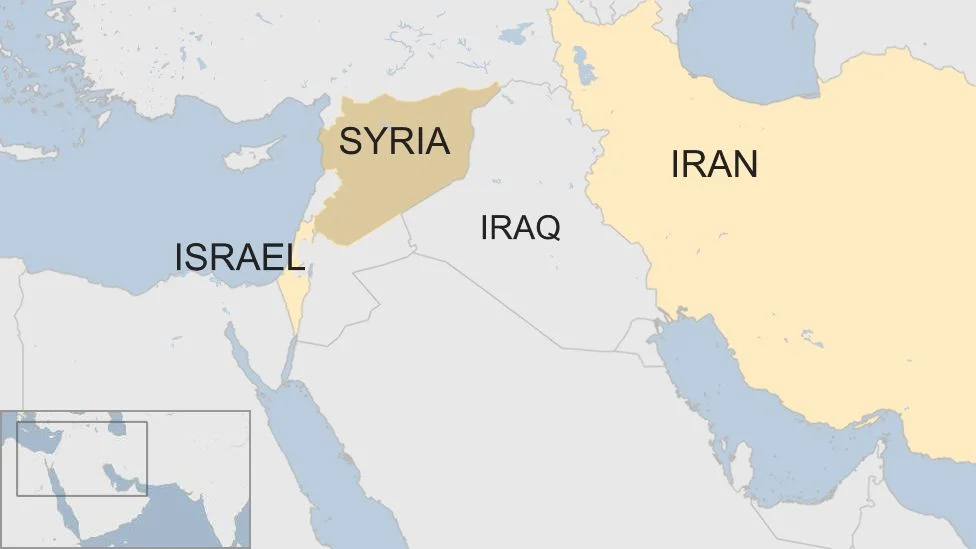
- Syria: It lies in West Asia, bordered by Turkey to the north, Iraq to the east, Jordan to the south, and Israel and Lebanon to the west, with a coastline along the Mediterranean Sea.
- Its geography includes the Syrian Desert, the Euphrates River valley, and the Anti-Lebanon Mountains along the Lebanon border, with Mount Hermon as its highest point.
- Key conflict-affected areas include Aleppo, Homs, Idlib, and the Golan Heights, which remains disputed with Israel.
| Read more: Terror Groups in the Middle East |
India–Netherlands Joint Trade and Investment Committee (JTIC)
India and the Netherlands have established the India–Netherlands Joint Trade and Investment Committee (JTIC) to deepen bilateral trade, investment, and economic cooperation.
- It aims to identify and eliminate trade barriers while promoting two-way investments, particularly for MSMEs.
- It also seeks to enhance cooperation in key sectors, including the transfer of technical know-how and technological innovation.
India and the Netherlands Relations
- Trade and Economic Partnership: The Netherlands is India's 11th largest global trading partner and its largest in the European Union (EU), with bilateral trade at USD 27.34 billion in FY 2023–24 and a USD 17.39 billion surplus for India.
- It is India's largest export destination in Europe and 3rd globally (after the USA and UAE), led by petroleum products, pharmaceuticals, and telecom instruments.
- Core Priority Sectors: Water, Agriculture and Health (WAH) are the three priority sectors, alongside technology and innovation.
- Renewable Energy and Climate Action: Green Hydrogen collaboration, Maritime Cooperation and Green Digital Sea Corridor, International Solar Alliance, Global Commission on Adaptation (GCA) and Coalition for Disaster Resilient Infrastructure (CDRI).
- Indo-Pacific Convergence: The Netherlands’ Indo-Pacific Guidelines (2020) identify India as a key partner.
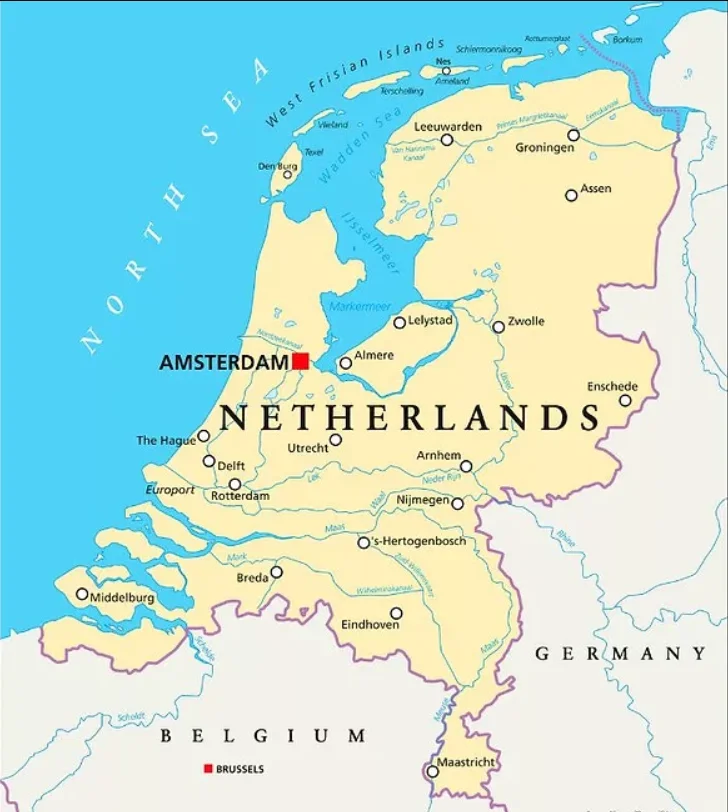
- Netherlands Geographical Location: It is located in Western Europe, bordered by Belgium and Germany. It is the most densely populated country in the European Union.
| Read More: India and Netherlands Relations |
Superkilonova
The study by an international research team, including scientists from IIT Bombay and the Indian Institute of Astrophysics, Bengaluru, reports the possible discovery of a superkilonova, a rare and powerful cosmic explosion.
- Kilonova: When two neutron stars collide, they eject heavy radioactive elements such as gold, platinum and neodymium, whose decay produces optical and infrared emissions known as a kilonova.
- Superkilonova: A superkilonova has an additional energy source, as it begins with a supernova explosion that forms two neutron stars (instead of one).
- These neutron stars later spiral inward and merge, producing a kilonova. This results in a stronger and more complex event, with both supernova and kilonova signatures.
- Studies show that a superkilonova produces intense gravitational waves and a powerful electromagnetic blast, appearing brighter and longer-lasting than a normal kilonova.
- Superkilonovae are still a proposed/observationally emerging class of events, not yet as firmly established as kilonova.

| Read more: String of Pearls Supernova |