
Bank-Centric to Corporate Bond-Based Finance
For Prelims: Union Budget 2026-27, Corporate Bond, Derivatives, Real Estate Investment Trusts (REITs), Small and Medium Enterprises (SMEs), Green Corporate Bonds.
For Mains: Reforms introduced to deepen the corporate bond market in the union budget 2026-27, key challenges faced by banks due to shallow corporate bond market penetration, further steps needed to deepen the corporate bond market in India.
Why in News?
The Union Budget 2026-27 has introduced several financial sector reforms aimed at deepening India's corporate bond market and reducing the structural burden on banks.
- These measures implicitly acknowledge that Indian banks are shouldering risks which, in mature economies, are absorbed and distributed by well-developed financial markets.
Summary
- Budget 2026 introduces market-making, derivatives, and guarantee funds to deepen India's shallow corporate bond market (15-16% of GDP).
- Banks currently overburdened (carry 60-65% corporate debt) face asset-liability mismatches and have required Rs 3.2 lakh crore recapitalisation since 2017.
- Reforms aim to distribute credit risk to markets, improve liquidity, and unlock CPSE assets via REITs for sustainable infrastructure financing.
What Reforms have been Introduced to Deepen Corporate Bond Market in the Union Budget 2026-27?
- Market-Making Framework: Establishes designated intermediaries to provide continuous two-way quotes (buy and sell) for corporate bonds, supported by improved access to funding and derivatives on bond indices.
- Total-Return Swaps (TRS): Introduces synthetic trading tools allowing investors to gain exposure to a bond's total return (interest plus price changes) without owning the underlying asset, facilitating risk hedging.
- Bond-Index Derivatives: Broadens participation and supports risk management through derivatives on corporate bond indices, contributing to greater fixed-income market depth.
- Infrastructure Risk Guarantee Fund: Provides prudently calibrated partial credit guarantees to lenders during infrastructure project development and construction phases.
- CPSE Asset Monetisation: Accelerates capital recycling by unlocking significant underutilised real estate holdings of Central Public Sector Enterprises (CPSEs) through dedicated Real Estate Investment Trusts (REITs).
- De-risking Infrastructure: Strengthens private developer confidence, improves project bankability, and reduces financing hurdles to encourage private participation in high-risk segments.
What are the Key Challenges Faced by Banks due to Shallow Corporate Bond Market Penetration?
- Structural Overburden of Risk: Banks are forced to act as the default warehouse for credit risk due to the absence of a deep corporate bond market, carrying roughly 60-65% of all non-financial corporate debt compared to 30% in the US.
- Extreme Asset-Liability Mismatch: Banks are expected to finance long-gestation infrastructure projects (highways, power plants) using short-term deposits, increasing systemic vulnerability to shocks.
- Recurring Fiscal Dependency: The accumulation of private-sector credit losses has necessitated massive public recapitalisations (over Rs 3.2 lakh crore since 2017), effectively transferring private losses onto the public balance sheet.
- Constrained Lending Capacity (Opportunity Cost): Capital tied up in long-term corporate loans reduces the availability of funds for productive sectors like small and medium enterprises (SMEs), exporters, and first-time borrowers, even after capital clean-ups.
- Impaired Monetary Policy Transmission: Burdened by long-term credit exposures, banks are reluctant to adjust rates smoothly—hesitating to pass on higher costs or constrained from fresh lending when rates fall—distorting the transmission of policy signals.
Status of Corporate Bond Market in India
- Impressive Growth Trajectory: India's corporate bond market has witnessed significant expansion, growing from Rs 17.5 trillion in FY2015 to Rs 53.6 trillion in FY2025 at a CAGR of approximately 12%, signalling a gradual shift in corporate financing patterns.
- Shallow by International Standards: Despite growth, the market stands at only 15-16% of GDP, lagging far behind economies such as the United States (over 80%), South Korea (79%), Germany (55-60%), Malaysia (54%), and China (45-50%).
- Concentrated Issuance Structure: The market is dominated by private placements (98% of issuances) and top-rated (AAA/AA) borrowers, reflecting limited depth and risk diversification.
- Narrow Participation Base: Participation from critical segments remains minimal—retail investors account for less than 2%, and foreign portfolio investors also have a limited presence, while MSMEs remain largely excluded from bond market access.
- Severe Liquidity Constraints: The secondary market suffers from a low annual turnover ratio (0.3) due to a "buy-and-hold" approach adopted by institutional investors such as insurance companies and pension funds, hampering price discovery and market efficiency.
- Future Potential: India's corporate bond market has the potential to exceed Rs 100–120 trillion by 2030, emerging as a critical pillar of financial stability and economic growth.
What Steps are Further Needed to Deepen Corporate Bond Market in India?
- Create a Corporate Bond Repo Market: Establish a dedicated, centrally cleared repo market for corporate bonds, allowing holders to borrow against their bond portfolios. This would transform corporate bonds from "buy-and-hold" instruments into active collateral, dramatically improving liquidity and enabling leveraged trading strategies.
- Introduce "Greenium" Incentives for ESG Bonds: Offer regulatory incentives such as lower listing fees, faster approval pathways, or lower reserve requirements for banks investing in certified green corporate bonds. This would tap into global ESG demand and create a differentiated, liquid green corporate bond segment.
- Mandate "Bond-Only" Project Finance for Infrastructure: Gradually mandate that a fixed percentage (e.g., 20-30%) of new infrastructure project financing must be raised through public bond issuances rather than bank loans. This would force issuers to create market-disciplined, rated, and tradable instruments from the project's inception.
- Launch a "Corporate Bond Credit Default Swap (CDS)" Index: This would allow investors to hedge broad market risk or take views on the corporate credit cycle without picking individual bonds, attracting a new class of macro-oriented investors.
- Create Retail-Focused "Corporate Bond Savings Certificates": Design a simple, low-denomination corporate bond product with tax benefits (similar to tax-saving fixed deposits) but linked to a diversified pool of highly-rated corporates. This would directly channel household savings into corporate debt while creating retail demand pull.
Conclusion
Budget 2026 marks a critical shift toward addressing India's over-reliance on banks for long-term finance. By deepening the corporate bond market through innovative financial instruments and risk-sharing mechanisms, these reforms aim to build a more resilient financial architecture. Success will depend on sustained implementation and broadening participation across retail investors and foreign investors.
|
Drishti Mains Question: Q. “India’s financial system remains structurally bank-centric.” Examine the challenges faced by banks arising from shallow corporate bond markets. |
Frequently Asked Questions (FAQs)
1. What is the current size of India's corporate bond market?
India's corporate bond market has grown from Rs 17.5 trillion in FY2015 to Rs 53.6 trillion in FY2025, growing at approximately 12% CAGR.
2. How does India's corporate bond market depth compare internationally?
At 15-16% of GDP, India's market is significantly shallower than the US (over 80%), South Korea (79%), Germany (55-60%), and China (45-50%).
3. What are the key reforms introduced in Budget 2026 for corporate bonds?
Key reforms include Market-Making Framework, Total-Return Swaps, Bond-Index Derivatives, Infrastructure Risk Guarantee Fund, and CPSE Asset Monetisation through REITs.
UPSC Civil Services Examination, Previous Year Questions (PYQs)
Prelims
Q. Consider the following statements: (2018)
- Capital Adequacy Ratio (CAR) is the amount that banks have to maintain in the form of their own funds to offset any loss that banks incur if the account-holders fail to repay dues.
- CAR is decided by each individual bank.
Which of the statements given above is/are correct?
(a) 1 only
(b) 2 only
(c) Both 1 and 2
(d) Neither 1 nor 2
Ans: (a)
Q. ‘Basel III Accord’ or simply ‘Basel III’, often seen in the news, seeks to (2015)
(a) develop national strategies for the conservation and sustainable use of biological diversity
(b) improve banking sector’s ability to deal with financial and economic stress and improve risk management
(c) reduce the greenhouse gas emissions but places a heavier burden on developed countries
(d) transfer technology from developed countries to poor countries to enable them to replace the use of chlorofluorocarbons in refrigeration with harmless chemicals
Ans: (b)
Mains
Q. Do you agree with the view that steady GDP growth and low inflation have left the Indian economy in good shape? Give reasons in support of your arguments? (2019)
Death Penalty in India
For Prelims: Supreme Court of India, Death sentence, Pardoning power, Article 32 , Article 39
For Mains: Death penalty jurisprudence in India and the “Rarest of Rare” doctrine, Judicial safeguards and procedural fairness in capital sentencing
Why in News?
The annual statistics report on death penalties in India by the Square Circle Clinic, a criminal justice initiative at the NALSAR University of Law, Hyderabad, notes that the Supreme Court of India has not confirmed any death sentences in the past three years, highlighting concerns about wrongful convictions and fairness in capital sentencing.
Summary
- The Supreme Court has not confirmed any death sentences in the past three years, with high acquittal and commutation rates exposing serious trial court errors, procedural violations, and risks of wrongful convictions in capital sentencing.
- Growing concerns over fairness, lack of deterrence evidence, and human rights issues have intensified calls for reforms such as strict adherence to sentencing safeguards, standardised guidelines, and greater use of life imprisonment without remission as an alternative to the death penalty.
What are the Key Highlights of the Report on Death Penalties in India?
- Zero Confirmations: The Supreme Court did not confirm any death penalty in the last 3 years. In 2025, it acquitted 10 death row prisoners, the highest in a decade.
- Trial vs. Appellate Disconnect:
- Sessions Courts: Handed down 128 death sentences in 2025 (1,310 since 2016).
- High Courts: Confirmed only 8.31% of cases placed before them.
- Death Row Surge: As of Dec 2025, the death row population stands at 574 (highest since 2016).
- The average time spent on death row before acquittal was over five years, with some prisoners waiting nearly a decade before being exonerated.
- Procedural Violations & Non-Compliance: The report states that frequent acquittals reveal serious trial court errors leading to wrongful convictions and death sentences.
- Supreme Court rulings in Manoj Vs State of Madhya Pradesh (2022) and Vasanta Sampat Dupare v. Union of India (2025) mandate psychological evaluations, prison conduct reports, and mitigation hearings.
- However, nearly 95% of death sentences in 2025 were imposed without these safeguards.
- Sentencing often occurred within days of conviction, limiting meaningful defence preparation and raising concerns about violations of fair trial rights.
- Supreme Court rulings in Manoj Vs State of Madhya Pradesh (2022) and Vasanta Sampat Dupare v. Union of India (2025) mandate psychological evaluations, prison conduct reports, and mitigation hearings.
- Emerging Alternative Sentences: There is a growing trend of courts using "life imprisonment without remission" or long fixed-term sentences (some up to 60 years) as a middle ground, raising concerns about whether these sentences allow for any rehabilitation.
What is the Death Penalty?
- Definition: Death Penalty or Capital punishment is the execution of an offender sentenced to death after conviction by a court of law.
- It is distinct from extrajudicial executions, which lack due process.
- Philosophical Basis: It is rooted in the principle of retributive justice - the idea that severe crimes, especially murder, warrant a proportional punishment.
- Indian History: The Manusmriti prescribed execution (e.g., by elephants) for offences including theft.
- The Indian Penal Code (1860) prescribed death as a punishment, which was retained after independence.
- Legal Position in India:
- Bharatiya Nyaya Sanhita (BNS), 2023: It retains the death penalty and has expanded it to include offences like mob lynching (if it results in death) and rape of a minor.
- Around 14 categories of crime attract the death penalty, including murder, terrorism, and abetting mutiny.
- Exemptions: Juveniles, pregnant women, and mentally ill persons cannot be executed.
- Appellate Process: A death sentence by a Sessions Court must be confirmed by the High Court. The accused can appeal to the Supreme Court.
- Bharatiya Nyaya Sanhita (BNS), 2023: It retains the death penalty and has expanded it to include offences like mob lynching (if it results in death) and rape of a minor.
- Legal Recourse for Death Row Convicts:
- Mercy Petition: It is a formal request made by someone who has been sentenced to death or imprisonment seeking mercy from the President or the Governor, as the case may be.
- Pardoning Power: The pardoning power is subject to judicial review.
- President (Article 72): Can grant pardons, reprieves, or commutations.
- Governor (Article 161): Has similar powers but typically defers major capital cases to the President.
- Curative Petition: Evolved in Rupa Ashok Hurra v. Ashok Hurra (2002), this allows the SC to reconsider its final judgment to cure a "gross miscarriage of justice."
Key Supreme Court Judgements Regarding Death Penalty
- Jagmohan Singh v. State of U.P. (1973): The Supreme Court upheld the constitutional validity of the death penalty.
- Bachan Singh v. State of Punjab (1980): Upheld the constitutionality of the death penalty but limited it to the "rarest of rare" doctrine.
- It mandated that judges must weigh Aggravating Circumstances (nature of crime) against Mitigating Circumstances (nature of criminal, e.g., age, background, possibility of reform).
- The death penalty should only be imposed when the "alternative option is unquestionably foreclosed."
- Machhi Singh v. State of Punjab (1983): The SC laid down specific guidelines to identify the "rarest of rare" cases in which the death penalty can be imposed.
- The Court established five categories to assess if a case meets this extreme threshold: the manner of the crime, the motive, the socially abhorrent nature of the crime, the magnitude of the crime, and the personality/vulnerability of the victim.
- Shatrughan Chauhan v. Union of India (2014): Ruled that undue, inordinate delay in execution amounts to torture and is a ground for commutation. It also deemed executing the mentally ill unconstitutional.
- Manoj Vs State Of Madhya Pradesh (2022): The Supreme Court made it mandatory for trial courts to obtain mitigating circumstance reports from probation officers, jail authorities, and mental health experts before awarding the death penalty, ensuring sentencing considers the accused’s background and potential for reform.
- Vasanta Sampat Dupare v. Union of India (2025): The Supreme Court ruled that it may revisit death penalty sentencing under Article 32 when procedural safeguards are violated.
- The Court mandated that the Manoj v. State of Madhya Pradesh guidelines must be followed in sentencing and limited such review to rare cases involving grave procedural lapses.
Law Commission Stance on Death Penalty
- 35th Report, 1967: Strongly supported the death penalty.
- 187th Report, 2003: Acknowledged the procedural flaws in sentencing, though it did not advocate abolition.
- 262nd Report, 2015: Called for doing away with the death penalty for all crimes except terrorism and related offences.
What are the Arguments For and Against the Death Penalty in India?
Arguments in Favour
- Retributive Justice: Based on the principle of lex talionis (an eye for an eye).
- For crimes of extreme brutality (e.g., the Nirbhaya Gang Rape case), society believes that the punishment must be proportional to the suffering caused to the victim.
- It provides "moral closure" to the victim's family and satisfies the collective conscience of society.
- Deterrence Theory: The primary penological goal is to deter potential offenders. The fear of death is presumed to be the ultimate deterrent against committing heinous crimes.
- A rational individual will weigh the cost (death) against the benefit of the crime and refrain from it.
- The "Taxpayer Burden" Argument: Housing high-risk violent offenders for decades places a heavy financial strain on public resources, as the state must fund their long-term food, shelter, and medical care.
- Public Will: A vast majority of citizens often favor retention. For instance, a survey after the December 2012 Delhi rape case found nearly 70% of Indians favored continuing the death penalty.
Arguments Against
- No Empirical Evidence of Deterrence: The Justice Verma Committee (2013) noted that there is no evidence to suggest the death penalty acts as a deterrent to rape.
- Global studies (e.g., by the UN) show that countries without the death penalty do not necessarily have higher crime rates than those that retain it.
- Judicial Arbitrariness: The application of the “rarest of rare” doctrine remains inherently subjective.
- Although the Machhi Singh case laid down guidelines to help identify what qualifies as a “rarest of rare” case, these principles are often interpreted differently by judges, making the threshold flexible and variable in practice.
- In 2012, 14 former judges appealed to the President to pardon 13 convicts who were erroneously sentenced to death per the Supreme Court’s own admission.
- The justice system is fallible. Executing an innocent person is a miscarriage of justice that cannot be reversed.
- Socio-Economic Bias: The poor often lack access to quality legal representation, leading to a higher probability of conviction compared to wealthy defendants.
- Reformative Justice: Modern jurisprudence focuses on reformation rather than retribution. "Hate the crime, not the criminal" (Mahatma Gandhi).
- The "Death Row Phenomenon" (prolonged solitary confinement waiting for execution) is considered a form of torture (Shatrughan Chauhan vs. UOI, 2014).
Global Status of the Death Penalty
- UN Push for Abolition: UN General Assembly resolutions since 2007 show increasing global support for a moratorium on executions, reflecting a clear international trend toward abolition.
- Regional Trends: Europe and Central Asia are nearly death-penalty-free, while most African and American nations have abolished it in law or practice.
- Retention Zones: West Asia and parts of South, Southeast, and East Asia remain the main regions retaining capital punishment, with China being the world’s largest executioner.
- South Asia’s Position: Nepal and Bhutan have abolished the death penalty, while Pakistan, Bangladesh, and Afghanistan continue to retain it.
What Measures are Needed to Reform the Capital Punishment Framework?
- Strict Adherence to "Manoj" Guidelines: High Courts must ensure that Trial Courts strictly comply with the Supreme Court's mandate in Manoj v. State of MP (2022).
- No death sentence should be awarded without a comprehensive Mitigation Analysis.
- Standardizing Sentencing: Establish a Sentencing Council (similar to the UK model) to codify guidelines for capital punishment.
- This will reduce judicial arbitrariness and ensure the "Rarest of Rare" doctrine is applied uniformly across all benches, ending the "judicial lottery."
- Evidence-Based Policing: Shift the investigative focus from "confession-centric" (often coerced/tortured) to "scientific and forensic-based" evidence gathering. This reduces the high acquittal rate at appellate stages.
- As per Article 39A, the state must ensure competent legal representation for indigent accused at the trial stage itself, preventing wrongful convictions due to poor defence.
- Life Without Remission: Legislatively codify "Life Imprisonment without Remission" (for 25-30 years or natural life) as a statutory alternative to the death penalty.
- This satisfies society’s need for incapacitation and retribution without taking a life.
- Long-Term Vision: The Parliament should consider the Law Commission’s 262nd Report, which recommended the abolition of the death penalty for all ordinary crimes, retaining it only for terrorism and waging war against the state.
Conclusion
"The death penalty is an irreversible punishment in a reversible system." India must move from a retributive justice system to a restorative one. Until then, the "Rarest of Rare" doctrine must be applied with the highest degree of judicial scrutiny to ensure that the "alternative option is unquestionably foreclosed."
|
Drishti Mains Question: Critically examine the effectiveness of the “rarest of rare” doctrine in ensuring fairness and consistency in death penalty sentencing in India. |
Frequently Asked Questions (FAQs)
1. What is the “rarest of rare” doctrine?
It is a principle fromBachan Singh v. State of Punjab (1980) that limits the death penalty to exceptional cases where life imprisonment is unquestionably inadequate.
2. What safeguards were mandated inManoj v. State of Madhya Pradesh(2022)?
Courts must obtain mitigation reports, including psychological evaluation, prison conduct, and social background, before awarding the death penalty.
3. What is the significance of Articles 72 and 161 of the Constitution?
They grant the President and Governors pardoning powers, including commutation or pardon of death sentences, subject to judicial review.
4. What is the “death row phenomenon”?
It refers to prolonged solitary confinement and psychological trauma faced by prisoners awaiting execution, recognized as cruel and inhuman treatment.
5. What alternative to the death penalty is increasingly used by courts?
Life imprisonment without remission or long fixed-term sentences, aimed at balancing retribution with the possibility of reform.
UPSC Civil Services Examination Previous Year Question (PYQ)
Mains
Q. Instances of the President's delay in commuting death sentences has come under public debate as denial of justice. Should there be a time limit specified for the President to accept/reject such petitions? Analyse. (2014)
Rajya Sabha Elections
Why in News?
The Election Commission of India (ECI) has announced the schedule for biennial elections to fill 37 Rajya Sabha seats across 10 States.
What are the Key Facts About the Rajya Sabha?
- Rajya Sabha: Council of States i.e. Rajya Sabha is the Upper House of the Indian Parliament.
- Rajya Sabha consists of the representatives of the States and the Union Territories and persons nominated by the President of India.
- Constitutional Provisions: Article 80 of the Constitution fixes the maximum strength of the Rajya Sabha at 250, including 12 members nominated by the President for expertise in fields like literature, science, art, and social service.
- At present, the House has 245 members (233 representing States and Union Territories (Delhi, Puducherry, and Jammu & Kashmir) and 12 nominated members).
- Allocation of Seats: Seats are allocated to States/UTs based on population as per the Fourth Schedule.
- Eligibility: Article 84 of the Constitution lays down the qualifications for membership of Parliament.
- To be eligible for the Rajya Sabha, a person must be a citizen of India, take an oath or affirmation before a person authorized by the Election Commission as per the Third Schedule, be at least 30 years of age, and possess any additional qualifications prescribed by Parliament through law.
- Tenure: The Rajya Sabha is a permanent House and is not subject to dissolution; one-third of its members retire every two years, and each serves a six-year term.
- Bye-elections are held to fill vacancies caused by resignation, death, or disqualification, and the elected member serves only the remainder of the original term.
- Under the Representation of the People Act, 1951, a member elected to fill a casual vacancy serves only for the remainder of their predecessor’s term.
- Chair: The Vice-President of India acts as the ex-officio Chairperson of the House.
Special Powers of Rajya Sabha
- Under Article 249, it can empower Parliament to legislate on a State List subject in the "national interest" by passing a resolution with a two-thirds majority of members present and voting.
- Additionally, under Article 312, it possesses the exclusive authority to initiate the creation of new All-India Services (common to both the Union and the States) using the same two-thirds majority requirement.
- Beyond legislation, the Rajya Sabha ensures continuity of governance during emergencies.
- Under Articles 352, 356, and 360, if a Proclamation of Emergency is issued while the Lok Sabha is dissolved, the Rajya Sabha holds the power to approve and keep the proclamation effective until the lower house is reconstituted.
Process for Election
- Election Mechanism: Members are elected by Indirect Election by the elected members of Legislative Assemblies of States and UTs respectively, in accordance with the system of proportional representation by means of the single transferable vote.
- Under this mechanism, MLAs do not vote for a single candidate but instead rank candidates in order of preference (1, 2, 3, etc.) on a ballot.
- To be declared elected, a candidate must secure a specific quota of votes.
- If a candidate secures surplus votes beyond the required quota, those votes are transferred to the next preferred candidate at a diminished value.
- Similarly, if seats remain vacant, the candidate with the lowest votes is eliminated, and their votes are redistributed to the remaining contestants based on subsequent preferences.
- Under this mechanism, MLAs do not vote for a single candidate but instead rank candidates in order of preference (1, 2, 3, etc.) on a ballot.
- Electoral College: Only the Elected Members of Legislative Assemblies (MLAs) of the States and UTs.
- Domicile Requirement:
- Pre-2003: A candidate had to be a resident of the state from which they were contesting from.
- Post-2003: A candidate can be an elector from any parliamentary constituency in India. (Removed by the Representation of the People (Amendment) Act, 2003).
- "Open Ballot" System: Voting is not secret for MLAs belonging to political parties.
- Every MLA from a political party must show their marked ballot to the party’s authorized agent before dropping it in the box, aiming to prevent cross-voting and corruption (money power).
- Independent MLAs do not show their ballot to anyone.
- Every MLA from a political party must show their marked ballot to the party’s authorized agent before dropping it in the box, aiming to prevent cross-voting and corruption (money power).
- Anti-Defection: The Supreme Court has ruled that voting against the party whip in a Rajya Sabha election does not attract disqualification under the 10th Schedule (Anti-Defection Law).
- The party can take disciplinary action (suspension/expulsion), but the MLA retains their assembly seat.
- NOTA: The Supreme Court scrapped the 'None of the Above' (NOTA) option for Rajya Sabha elections in 2018 (Shailesh Manubhai Parmar vs. Union of India).
- NOTA defeats the principle of proportional representation and the single transferable vote.
Frequently Asked Questions (FAQs)
1. How are Rajya Sabha members elected?
They are elected indirectly by elected MLAs through proportional representation using the Single Transferable Vote system.
2. What is the maximum and current strength of the Rajya Sabha?
Article 80 fixes the maximum strength at 250, while the current strength is 245 members, including 12 nominated by the President.
3. What is the purpose of the open ballot system in Rajya Sabha elections?
Introduced in 2003 and upheld inKuldip Nayar (2006), it aims to prevent cross-voting and corruption by requiring party MLAs to show ballots to authorized agents.
4. Does the anti-defection law apply to Rajya Sabha elections?
No. Voting against the party candidate does not lead to disqualification under the Tenth Schedule, though parties may take disciplinary action.
5. What special powers does the Rajya Sabha have under the Constitution?
It can authorize Parliament to legislate on State List matters (Art. 249), create All India Services (Art. 312), and approve Emergency Proclamations when the Lok Sabha is dissolved.
UPSC Civil Services Examination, Previous Year Questions (PYQs)
Prelims
Q. Rajya Sabha has equal powers with Lok Sabha in: (2020)
A. the matter of creating new All India Services
B. amending the Constitution
C. the removal of the government
D. making cut motion
Ans: (B)
Q. Which of the following statements is/are correct? (2016)
- A Bill pending in the Lok Sabha lapses on its prorogation.
- A Bill pending in the Rajya Sabha, which has not been passed by the Lok Sabha shall not lapse on dissolution of the Lok Sabha.
Select the correct answer using the code given below:
A. 1 only
B. 2 only
C. Both 1 and 2
D. Neither 1 nor 2
Ans: (B)
Q. Consider the following statements: (2015)
- The Rajya Sabha has no power either to reject or to amend a Money Bill.
- The Rajya Sabha cannot vote on the Demands for Grants.
- The Rajya Sabha cannot discuss the Annual Financial Statement.
Which of the statements given above is/ are correct?
A. 1 only
B. 1 and 2 only
C. 2 and 3 only
D. 1, 2 and 3
Ans: (B)
India’s Expanding Drone Ecosystem
Why in News?
Recent government data highlights the rapid expansion of India’s regulated drone ecosystem, transforming governance, agriculture, infrastructure monitoring, and national security.
What is India’s Drone Regulatory and Promotion Framework?
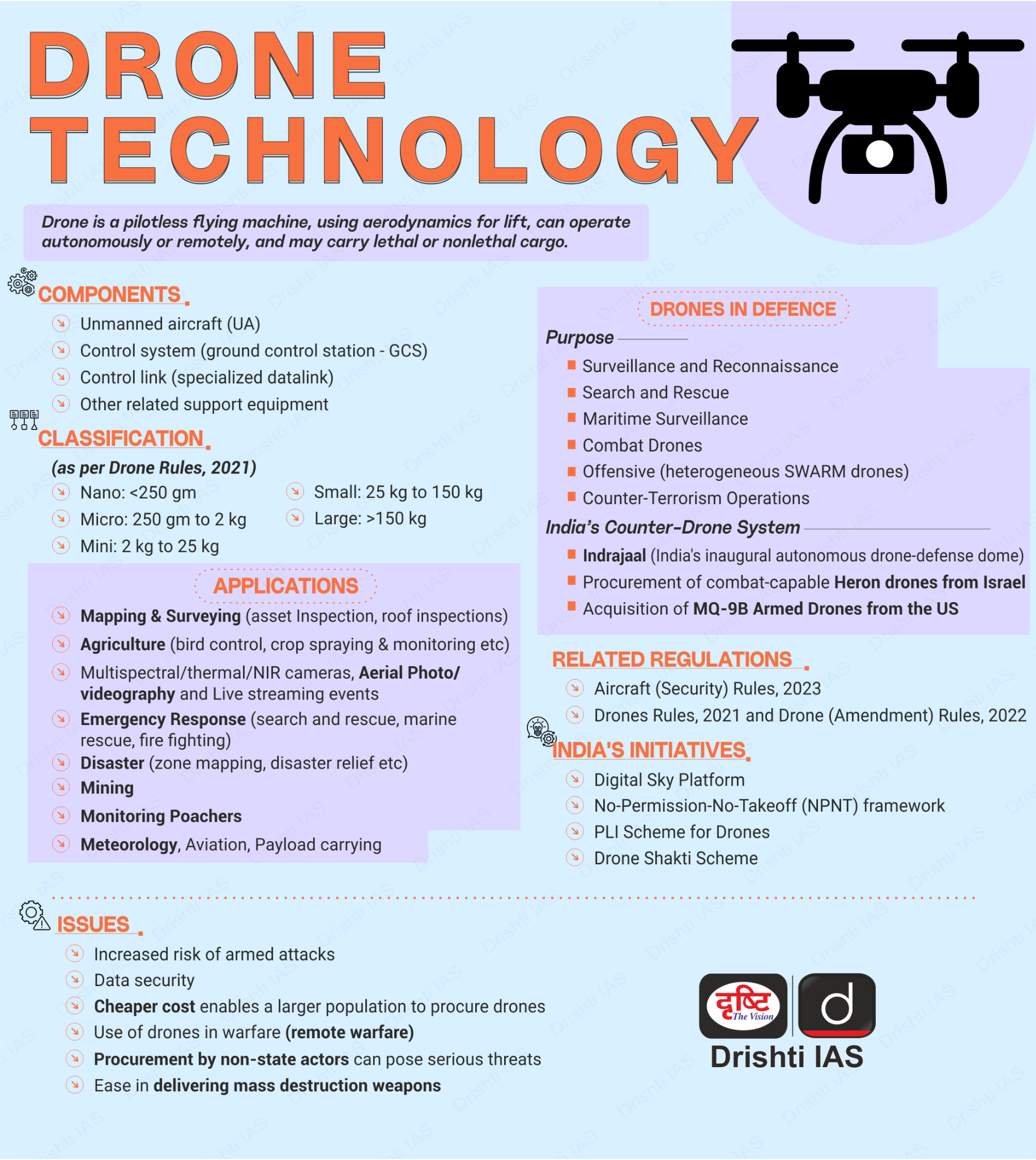
- Regulatory Framework: The Drone Rules, 2021, along with amendments in 2022 and 2023, have significantly liberalised India’s drone ecosystem by simplifying procedures and expanding operational scope.
- Reforms reduced approvals and forms, rationalised fees, expanded green airspace access, permitted wider civilian use, and replaced traditional pilot licences with Directorate General of Civil Aviation (DGCA)-issued Remote Pilot Certificates.
- Digital Governance Platforms: Digital Sky platform and e-Governance for Civil Aviation (eGCA) enable drone registration, pilot certification, type certification and airspace permissions through a single-window system.
- By February 2026, over 38,500 drones were registered and nearly 39,900 remote pilot certificates issued, enabling regulated drone operations nationwide.
- Manufacturing Support: Production Linked Incentive (PLI) scheme with ₹120 crore outlay promotes domestic drone and component manufacturing and supports start-ups and MSMEs.
- Tax Incentive: GST on drones reduced to 5%, lowering costs and encouraging commercial adoption and training infrastructure.
- Capacity Building: SwaYaan Programme focuses on human resource development in unmanned aircraft systems through training and partnerships, while the National Innovation Challenge for Drone Application and Research (NIDAR) encourages autonomous drone innovation and start-up incubation.
What are the Key Applications of Drones?
- Agriculture and Farmer Services: The Namo Drone Didi Scheme, launched in November 2023, aims to provide drones to Women Self Help Groups (SHGs) to promote modern farming practices, improve farm efficiency and crop productivity, reduce input costs, and create sustainable livelihood opportunities for women.
- Land Mapping (SVAMITVA Scheme): Under the SVAMITVA scheme, drone surveys map rural abadi areas to issue legal property cards, reducing land disputes and improving access to bank credit, mapping completed in about 3.28 lakh villages, with 2.76 crore property cards prepared.
- Highway Monitoring (NHAI Projects): Monthly drone recordings track construction progress, enable comparison of project stages and serve as digital evidence in dispute resolution and quality verification.
- Disaster Management: Drones are enhancing India’s response during natural disasters, with the North East Centre for Technology Application and Reach (NECTAR) developing a special drone system that can remain stable in the air for long durations, carry heavy equipment, monitor flood- and landslide-affected areas, and transmit live aerial visuals to help rescue teams assess situations quickly and carry out faster, better-coordinated search and rescue operations.
- Railway Monitoring: Railways deploy drones to inspect tracks, bridges and yards, while the Railway Protection Force uses them for surveillance, crowd monitoring and preventing trespassing.
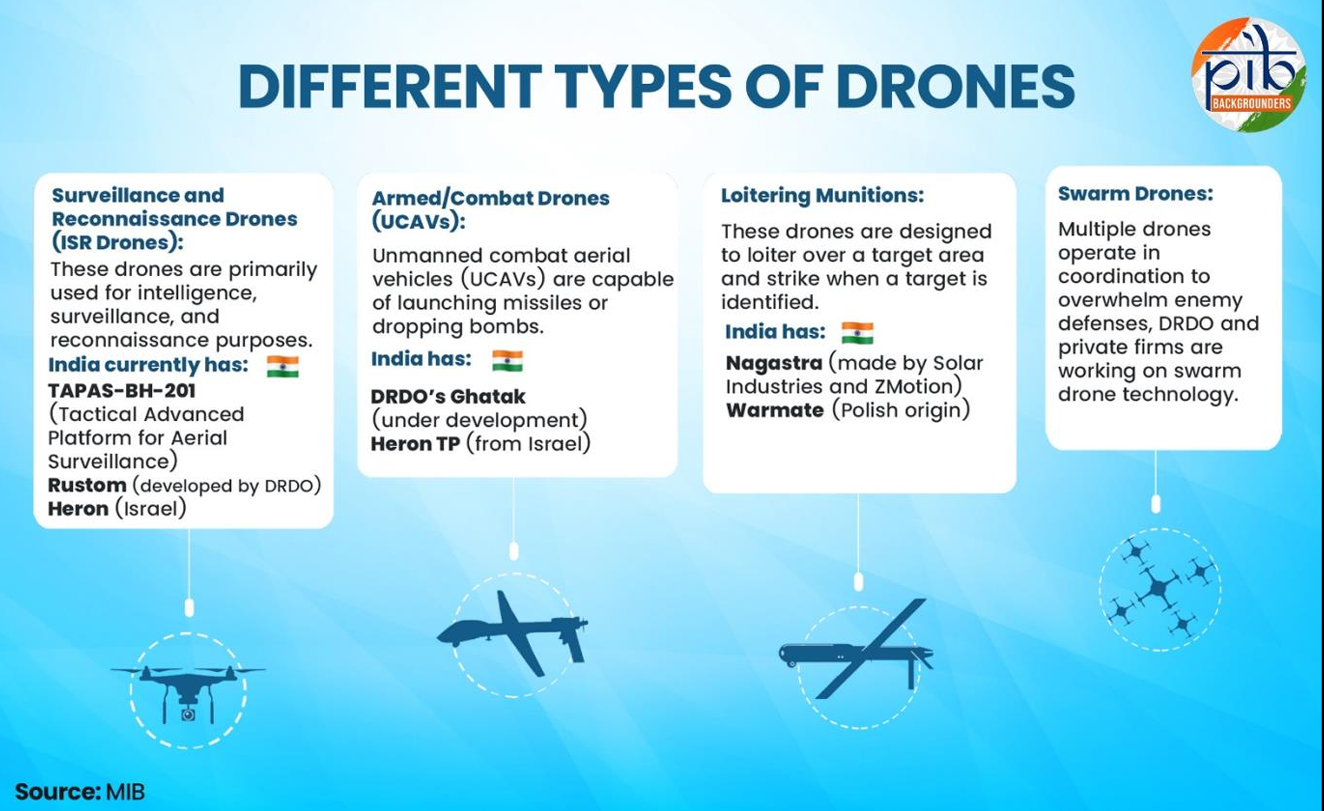
- Defence Applications: Drones support border surveillance, intelligence gathering, and precision strikes, as seen in Operation SINDOOR, while working with air defence systems and radar networks to protect critical infrastructure and respond swiftly to threats.
Frequently Asked Questions (FAQs)
1. What is the SVAMITVA scheme?
A drone-based rural mapping programme for property documentation and land dispute resolution.
2. What is Digital Sky?
An online platform for drone registration, certification and airspace permissions in India.
3. What is Namo Drone Didi?
A scheme providing drones to women self-help groups to support precision agriculture and rural livelihoods.
UPSC Civil Services Examination Previous Year Question (PYQ)
Prelims
Q. Consider the following activities: (2020)
- Spraying pesticides on a crop field
- Inspecting the craters of active volcanoes
- Collecting breath samples from spouting whales for DNA analysis
At the present level of technology, which of the above activities can be successfully carried out by using drones?
(a) 1 and 2 only
(b) 2 and 3 only
(c) 1 and 3 only
(d) 1, 2 and 3
Sarvam-30B and Sarvam-105B
Bengaluru-based Sarvam AI has unveiled two new Large Language Models (LLMs) named Sarvam-30B (a 30-billion parameter model) and Sarvam-105B (a 105-billion parameter model), at the India-AI Impact Summit 2026.
- At the summit, the Sarvam AI introduced Vikram, a multilingual chatbot enabling seamless conversations across Indian languages, named in honour of physicist Vikram Sarabhai to reflect indigenous scientific innovation.
- The models launch comes amid OpenAI’s introduction of IndQA, a benchmark to assess AI understanding of Indian languages and cultural contexts, reflecting its growing focus on India
- Indigenous Development: A 30B-parameter multilingual model designed for real-time conversations, with a 32,000-token context window (the amount of text it can read and retain at once), offering strong reasoning and instruction-following for long interactions.
- A 105B-parameter model with a 128,000-token context window, suited for complex reasoning, multi-step problem-solving, and long-form analysis across Indian languages.
- Both use a mixture-of-experts architecture, activating only relevant components during computation to reduce costs while maintaining high performance.
- Parameters are the internal variables or "brain cells" of an AI model learned during training; a higher parameter count generally indicates a model with greater complexity, reasoning ability, and capacity to handle nuanced tasks.
- Key Features & Capabilities
- Indian Language Mastery: Unlike global models like GPT-4, which are primarily trained on English data, Sarvam’s models are built to excel in all 22 Indian languages with voice-first optimisation, making AI more accessible to the masses despite its smaller 105B-parameter scale (one-sixth the size of DeepSeek’s 600B R1 model).
- It addresses the "data scarcity" problem in Indic languages, allowing for accurate translation and content generation in local dialects.
- Open Source: The models will be released as open source, meaning developers and researchers can access the code/weights to build their own applications on top of Sarvam’s models.
- Indian Language Mastery: Unlike global models like GPT-4, which are primarily trained on English data, Sarvam’s models are built to excel in all 22 Indian languages with voice-first optimisation, making AI more accessible to the masses despite its smaller 105B-parameter scale (one-sixth the size of DeepSeek’s 600B R1 model).
- Training Infrastructure: Training LLMs requires immense computing power. The models were trained using GPUs (Graphics Processing Units) accessed through the IndiaAI Mission’s common compute programme, highlighting the success of public-private partnership.
- Under the IndiaAI Mission, Sarvam AI has been selected to build India’s first sovereign LLM ecosystem with an open-source 120B-parameter model for governance and public services.
- Besides Sarvam , Soket will develop a similar India-focused model for sectors like defence, healthcare, and education, while Gnani has launched its own model and Gan AI is building a 70B-parameter multilingual text-to-speech foundation model.
| Read more: Sarvam AI and the Sovereign AI in India |
Loggerhead Turtle
A study has revealed that climate change is undermining the reproductive capacity and physical structure of loggerhead sea turtles threatening their long-term survival.
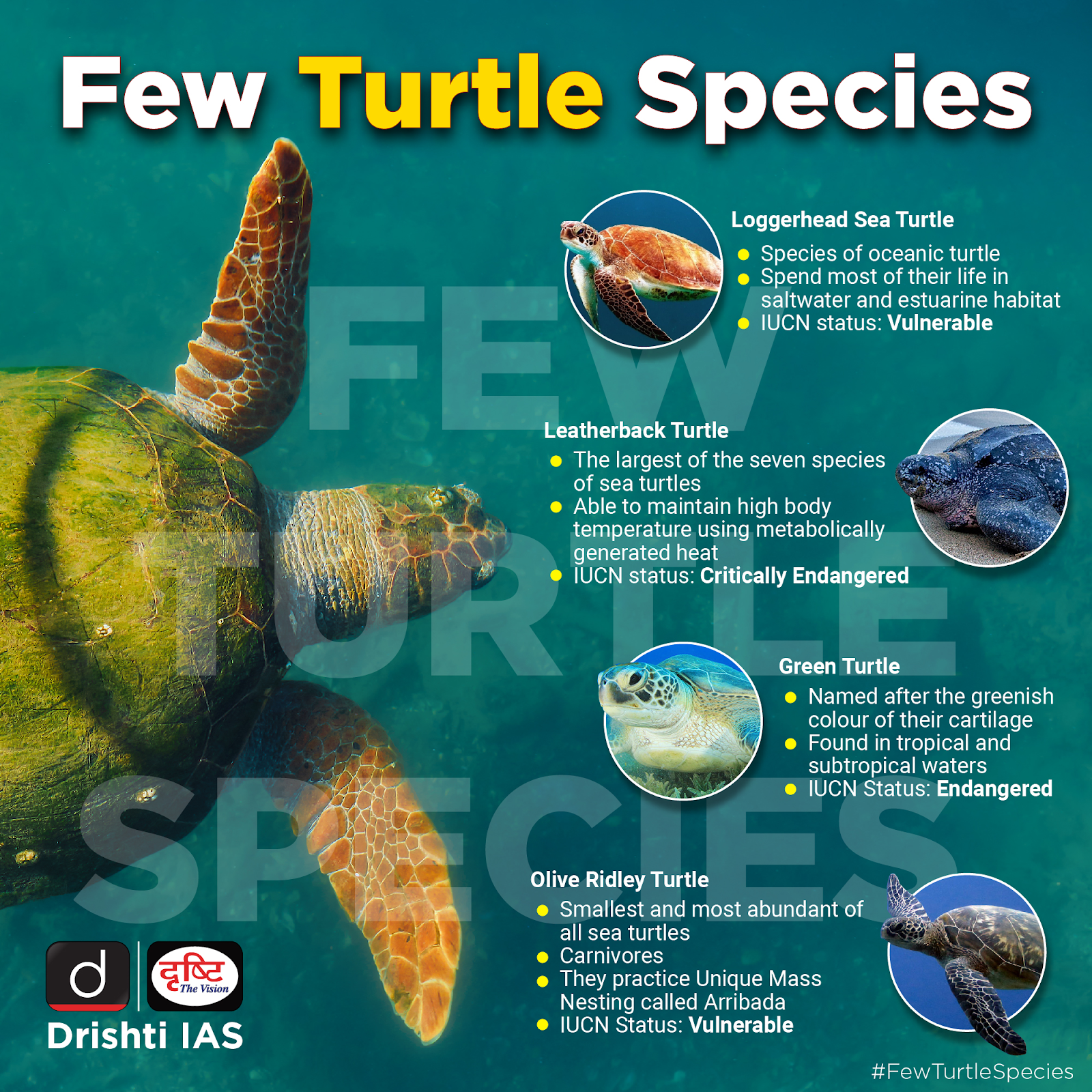
- About: The Loggerhead sea turtle (Caretta caretta) is a large omnivorous marine reptile recognized as one of the seven extant species of sea turtles.
- It is named for its distinctive large, block-like head, which supports powerful jaw muscles capable of crushing hard-shelled prey.
- Global Distribution: The loggerhead turtle is found across the Atlantic Ocean, Pacific Ocean, and Indian Ocean, as well as the Mediterranean Sea, with ten recognized subpopulations.
- Threats: Due to warming oceans and dwindling marine food supplies, female loggerheads are now breeding less frequently—shifting from every two years to a four-year gap—and producing fewer eggs per nest.
- As "capital breeders," these turtles rely on stored energy from foraging over several years to reproduce. Both males and females undertake breeding migrations spanning hundreds to thousands of kilometres between feeding grounds and nesting beaches. Satellite data shows a decline in ocean chlorophyll, indicating a reduction in food supply that is eroding their energy reserves.
- Conservation Status: The species is assessed as 'Vulnerable' by the IUCN. It was included in Appendix II of the Convention on the Conservation of Migratory Species of Wild Animals (CMS) in 1979 and upgraded to Appendix I in 1985. In India, it is protected under Schedule I of the Wildlife Protection Act, 1972.
- International Cooperation Mechanisms: The loggerhead is covered by multiple CMS instruments, including Memorandums of Understanding (MOUs) for the Atlantic Coast of Africa and the Indian Ocean-SouthEast Asia regions, and a Single Species Action Plan for the South Pacific Ocean.
| Read More: World Turtle Day 2025 |
India–Germany Cooperation in Telecom and Digital Transformation
A meeting was held between India and Germany to advance cooperation in telecommunications and digital transformation under the Indo-German Strategic Partnership, building upon the Joint Declaration of Intent (JDI) signed during the India–Germany Summit 2026.
- JDI Framework: The JDI establishes a forward-looking, non-binding framework for structured collaboration in telecommunications and digital governance. It reflects shared values of openness, trust, innovation, and resilience in digital ecosystems.
- India's Digital Transformation Showcase: India highlighted its digital achievements, including:
- Over 1.23 billion telecom subscribers and nearly a billion internet users.
- 5G coverage extends to approximately 99.9% of districts.
- Data tariffs averaging around USD 0.10 per GB (among the lowest globally)
- Unified Payments Interface (UPI) processing approximately 250 billion transactions annually and being adopted by multiple partner countries as a model for interoperable digital payments.
- German Technological Expertise: Germany shared its advancements in quantum encryption and secure information transport, including a successful demonstration of quantum communication over a 35 km link for 11 consecutive days.
- Priority Areas for Collaboration: Both sides identified key focus areas, including 5G/5G-Advanced, early engagement on 6G standardization, network modernization, trusted telecom architectures, supply chain resilience, AI at the edge, industry-grade network slicing, and Open RAN (Radio Access Network) ecosystems.
- Multilateral Cooperation: India sought Germany’s support for:
- India’s candidature for Director, Radiocommunication Bureau at the International Telecommunication Union (ITU)
- India’s re-election to the ITU Council for the term 2027–2030
- India’s proposal to host the ITU Plenipotentiary Conference in 2030.
| Read More: India–Germany Relations |
Second Phase of Vibrant Village Programme
The Centre is set to launch the Second Phase of the Vibrant Village Programme (VVP), significantly expanding its strategic scope beyond the China border to now include 1,954 strategic villages along the borders with Pakistan, Nepal, Bangladesh, Bhutan, and Myanmar.
- The VVP: It was launched in 2023, originally to assist development in villages along the China border.
- The VVP-II, a Central Sector Scheme (100% Centre funding), was cleared by the Union Cabinet in April 2025.
- States Covered Under VVP-II: The programme spans Arunachal Pradesh, Assam, Bihar, Gujarat, Jammu and Kashmir, Ladakh, Manipur, Meghalaya, Mizoram, Nagaland, Punjab, Rajasthan, Sikkim, Tripura, Uttarakhand, Uttar Pradesh, and West Bengal.
- Financial Outlay: The VVP-II has a total outlay of Rs 6,839 crore to be implemented until FY 2028-29, with a proposed expenditure of Rs 3 crore per village.
- Strategic Objective: The programme aims to prevent the migration of border populations to urban areas, which creates a security vacuum and leads to demographic changes by creating sustainable livelihood opportunities.
- Role of Border Population: The initiative seeks to make local residents the "eyes and ears" of the Border Guarding Forces and wean them away from illicit activities and trans-border crimes.
- Comprehensive Development: The strategy involves the saturation of existing government schemes, strengthening basic infrastructure, and developing these villages as "growth centres" to ensure economic and cultural assimilation with the nation.
- Trust Building: The MHA emphasizes "culturally sensitive" outreach activities to build trust between border security agencies and local communities, encouraging them to report suspicious activities.
| Read more: Vibrant Villages Programme |
India–UK Offshore Wind Taskforce
India and the United Kingdom have launched the India–UK Offshore Wind Taskforce under the India-UK Vision 2035 and the 4th Energy Dialogue to accelerate cooperation in offshore wind energy development.
- Pillars of Cooperation: 3 core pillars of cooperation were outlined:
- Ecosystem planning and market design (including seabed leasing and revenue certainty),
- Infrastructure and supply chains (port modernisation, local manufacturing),
- Financing and risk mitigation (blended finance, institutional capital).
- Synergy with Green Hydrogen Mission: Offshore wind energy can power coastal industrial and green hydrogen clusters. India has achieved competitive prices through its National Green Hydrogen Mission.
- Strategic Importance: Offshore wind is recognized as strategically important for India’s energy transition, particularly for enhancing grid stability, energy security, and industrial depth.
Offshore Wind Energy
- About: It refers to the generation of electricity from wind turbines installed in marine environments such as seas or oceans, harnessing stronger and more consistent wind resources.
- Potential in India: As per the National Institute of Wind Energy, Chennai, India possesses an estimated offshore wind potential of approximately 70 GW, primarily along the coastlines of Gujarat and Tamil Nadu.
- India's non-fossil fuel capacity has surpassed 272 GW, comprising over 141 GW from solar and 55 GW from wind energy.
- Policy and Institutional Framework: The National Offshore Wind Energy Policy (2015) provides the overarching framework, with the Ministry of New and Renewable Energy (MNRE) as the nodal ministry and the National Institute of Wind Energy (NIWE) as the nodal agency for assessments and facilitation.
- To catalyse early projects, the government has introduced a Viability Gap Funding (VGF) scheme with a total outlay of Rs 7,453 crore.
| Read More: Roadmap for India's Offshore Wind Energy |
FCI–World Food Programme MoU on Rice Supply
The Food Corporation of India (FCI) and the World Food Programme (WFP) signed a Memorandum of Understanding (MoU) for the supply of rice to support global hunger relief operations.
- Humanitarian Partnership: The MoU enables FCI to supply 200,000 metric tonnes of rice (up to 25% broken) to WFP for global humanitarian assistance. The agreement is valid for 5 years and can be extended with mutual consent.
- India's Global Food Security Commitment: Through this partnership, India is exporting "hope, nutrition, and dignity" to vulnerable populations, demonstrating its resolve to stand with the international community in combating hunger and malnutrition.
World Food Programme
- Establishment and Mandate: WFP was established in 1961 by the UN General Assembly and the Food and Agriculture Organization (FAO).
- It operates under UN authority with a dual mandate to provide emergency food relief and support long-term food security and stability.
- Recognition: WFP was awarded the Nobel Peace Prize in 2020 for its efforts to combat hunger, prevent the use of starvation as a weapon of war, and promote peace through food assistance.
- India-WFP Collaboration Framework: India collaborates with WFP through several innovative initiatives like Fortified Rice Rollout, Grain ATMs (Annapurti Devices), Jan Poshan Kendra, Smart Warehousing and Mobile Storage Units (Flospans).
| Read More: India at the Forefront of Global Food Security |