
Year End Review-2025: Ministry of Micro,Small & Medium Enterprises
For Prelims: Micro, Small, and Medium Enterprises (MSME), Prime Minister’s Employment Generation Programme (PMEGP), Credit Guarantee Trust for Micro and Small Enterprises (CGTMSE), Self Reliant India (SRI) Fund, PM Vishwakarma Scheme, Raising and Accelerating MSME Performance (RAMP), World Bank, MSME Champion Scheme, ONDC (Open Network for Digital Commerce), Digital MSME 2.0.
For Mains: Achievements of the Ministry of MSME in the Year 2025, Contribution of MSMEs to Indian economy, associated challenges and way forward.
Why in News?
The year 2025 marked a period of transformative progress for India's Micro, Small, and Medium Enterprises (MSME) sector, reinforcing its pivotal role in employment generation and equitable economic development.
Summary
- In 2025, India’s MSME sector saw 7.3 crore registrations, strong credit support via PMEGP, CGTMSE, and PM Vishwakarma Scheme, driving growth, employment, exports, and innovation.
- Challenges like credit gaps, delayed payments, regulatory burdens, and skill deficits persist, necessitating financial reforms, digitalization, market access, and sustainable entrepreneurship.
What are the Major Achievements of the Ministry of Micro, Small & Medium Enterprises in the Year 2025?
- Massive Formalization: Over 7.30 crore enterprises registered on the Udyam Registration Portal and Udyam Assist Platform (UAP) by December 2025.
- Robust Credit Support: Prime Minister’s Employment Generation Programme (PMEGP) generated estimated employment for over 87 lakh persons since inception, assisting 10.71+ lakh micro-enterprises.
- Credit Guarantee Trust for Micro and Small Enterprises (CGTMSE) approved over 29 lakh guarantees worth Rs 3.77 lakh crore, with enhanced coverage to Rs 10 crore.
- Self-Reliant India (SRI) Fund provided equity funding of Rs 1,823 crore to 682 MSMEs.
- Infrastructure & Artisan Support: PM Vishwakarma Scheme achieved its target of 30 lakh beneficiary registrations, sanctioning Rs 2,257 crore in collateral-free loans (2025).
- Raising and Accelerating MSME Performance (RAMP), a World Bank-supported scheme, approved Rs 3,211.75 crore for states/UTs.
- The Micro and Small Enterprises Cluster Development Programme (MSE-CDP) and a dedicated scheme for the North Eastern Region (NER) promoted industrial clusters and infrastructure.
- Market Access & Inclusive Procurement: Public Procurement Policy mandate of 25% procurement from MSEs was exceeded, achieving 43.58% in 2024-25.
- National SC/ST Hub (NSSH) scheme increased procurement from SC/ST MSEs from Rs 99.37 crore (2015-16) to Rs 3,731.47 crore (2024-25).
- Technology & Skill Upgradation: MSME Champion Scheme (including Zero Defect and Zero Effect (ZED), LEAN, and Innovative components) saw ~2.7 lakh MSMEs register for ZED certification and received 52,369 ideas under Hackathon 5.0.
- New Technology Centres (TCs) and Extension Centres (ECs) were established, skilling thousands.
- Launched the Online Dispute Resolution (ODR) Portal for delayed payments. The CHAMPIONS Portal achieved a 99.38% grievance redressal rate.
- Khadi, Coir & Internationalization: Khadi and Village Industries (KVI) sales crossed Rs 1.27 lakh crore (till Nov 2025).
- Signed bilateral MoUs with Mauritius, Thailand, Slovakia, and Malaysia, and held Joint Working Group meetings with Japan and Taiwan.
Micro, Small, and Medium Enterprises (MSMEs)
- About: MSMEs are businesses defined and categorized based on their investment in plant, machinery, or equipment and their annual turnover.
- These enterprises are a cornerstone of the Indian economy, playing a crucial role in promoting entrepreneurship, generating widespread employment (over 12 crore people), and fostering industrial growth.
- Classification of MSMEs:
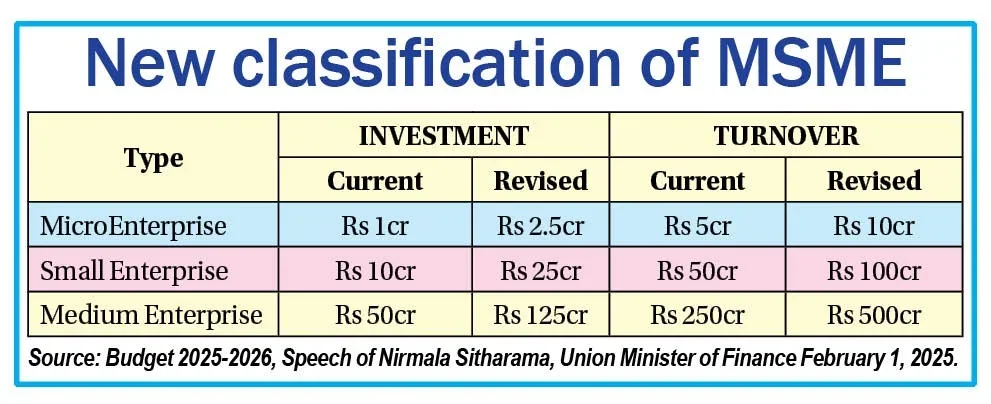
- Regulatory and Policy Framework: The primary legislation governing MSMEs is the Micro, Small, and Medium Enterprises Development Act, 2006. This Act establishes a National Board and formally defines an enterprise.
- Established in 2007, the Ministry of MSME formulates supportive policies, designs developmental programs, and oversees their implementation for the sector.
What is the Significance of MSMEs in the Growth of the Indian Economy?
- Pillar of Industrial Output: MSMEs are the structural core of India's economy, contributing around 30% to GDP and 36% to manufacturing output. They build economic resilience by driving domestic production, forming localized supply chains, and acting as essential ancillary suppliers to large-scale industries.
- Driver of Employment and Inclusive Livelihoods: The MSME sector, as India's largest non-agricultural employer, provides livelihoods for over 12 crore people. It fosters inclusive growth by absorbing semi-skilled and unskilled labor across rural and urban areas, with significant support from schemes like the PM Vishwakarma Scheme and Mudra Yojana.
- Catalyst for Exports and Global Trade Integration: MSMEs are indispensable to India's international trade, accounting for nearly 45% of its total exports. They strengthen the global footprint by dominating niche markets, exemplified by the handicraft sector contributing around 40% of global handmade carpet exports and the Agra footwear cluster representing 28% of India's footwear exports.
- Rural Industrialization and Regional Balance: The MSME sector is pivotal for realizing the PURA (Providing Urban Amenities in Rural Areas) vision by driving decentralized industrial growth. Entities like the Khadi and Village Industries Commission (KVIC) foster this by creating localized job opportunities, empowering communities, reducing migration, and ensuring balanced regional development.
- Innovation, Entrepreneurship, and Digital Transformation: MSMEs are the dynamic force powering India's 3rd-largest global startup ecosystem, fostering innovation in key sectors like e-commerce and fintech. They lead digital adoption, with 72% of transactions now digital, accelerated by initiatives like the ONDC (Open Network for Digital Commerce) and the Public Tech Platform for Frictionless Credit.
- Social Empowerment and Sustainable Development: MSMEs are a powerful instrument for social inclusion, with over 20% being women-owned and significantly supported by credit access through Mudra Yojana. Furthermore, they are leading the green transition by adopting clean energy and circular models, supported by schemes like the RAMP (Raising and Accelerating MSME Performance) programme.

What are the Key Challenges in the Growth of MSMEs in India?
- Financial Constraints and Credit Deficiency: MSMEs face a severe capital crisis due to delayed payments totalling Rs 7.34 lakh crore as of March 2024, which cripples working capital. It has a massive unmet formal credit need of around Rs 25 lakh crore, with only 19% of demand met formally, forcing reliance on expensive informal credit at rates of 30-60%.
- Burdensome Regulatory Environment: A significant compliance burden from overlapping tax, labour, and environmental laws increases costs and complexity, contributing to the high informality of over 90% of MSMEs.
- The transition to formal platforms like the Udyam portal is slow, with only 9% of registered firms having transitioned from unregistered status, which limits access to benefits and structured growth.
- Inadequate Infrastructure: Poor infrastructure, including inefficient logistics (costing 14-18% of GDP), frequent power outages, and limited digital connectivity, hinders MSME competitiveness. Technologically, they lag with only 6% using e-commerce and 45% adopting AI, restricting scalability and global value chain integration.
- Global Integration Barriers: Challenges in exporting include inadequate branding, stringent quality standards, vulnerability to global supply chain shocks (e.g., Red Sea disruptions), and high tariffs (e.g., US 50%). The "Missing Middle" problem, where 97.92% of MSMEs are micro-enterprises, further limits their capacity to compete internationally.
- Acute Skill Gaps and Sustainability Compliance Pressure: There is a persistent skill mismatch, with a 3.9% decline in knowledge-intensive hiring limiting innovation and productivity. Concurrently, MSMEs face growing pressure to meet global ESG standards, as their estimated annual production of 110 million tonnes of CO₂ and the high cost of adopting green technology pose a significant financial and competitive threat.
How can India's MSME sector be Revamped to Enhance its Competitiveness and Growth?
- Overhauling Financial Architecture: To address the massive unmet credit need, reforms should expand collateral-free lending via fintech, better integrate Mudra Yojana and CGTMSE for risk coverage. Furthermore, promoting Invoice Discounting through TReDS and strictly enforcing the 45-day payment timeline via the MSME Samadhaan Portal with automated penalties is crucial to solve the delayed payments crisis.
- Technological Integration and Digital Transformation: Accelerating AI, IoT, and automation adoption requires establishing sector-specific MSME Tech Clinics and Innovation Hubs for affordable consultancy, alongside a Digital MSME 2.0 initiative to boost ONDC integration, and cloud access.
- Market Access and Global Competitiveness: Improving exports requires creating export consortia with grant support for logistics and certifications, along with leveraging FTAs and e-commerce platforms for low-fee MSME storefronts.
- Strengthening Institutional Frameworks: Formalization should be incentivized by making Udyam registration mandatory and linking it to benefits like lower GST rates and priority lending. This should be supported by cluster-based development using Common Facility Centers (CFCs) to provide shared testing and R&D services.
- Sustainable and Inclusive Entrepreneurship: To facilitate a green transition, introduce low-interest green finance, ESG-linked credit, and tax incentives for eco-friendly practices. To promote women entrepreneurship, enhance CGTMSE credit guarantees and expand the dedicated Mudra Yojana fund.
Conclusion
In 2025, India’s MSME sector consolidated its role as an economic backbone, with 7.3 crore enterprises formalised and credit guarantees exceeding Rs 3.77 lakh crore. Sustaining this momentum requires resolving credit gaps, regulatory burdens, and technology deficits through targeted reforms, digitalisation, and sustainable, inclusive entrepreneurship to drive long-term growth.
|
Drishti Mains Question Q. Examine the role of MSMEs as the backbone of the Indian economy and discuss the key challenges hindering their integration into global value chains |
Frequently Asked Questions (FAQs)
1. What are MSMEs in India?
Micro, Small, and Medium Enterprises are defined by investment in plant, machinery, or turnover, forming the backbone of India’s economy.
2. How much do MSMEs contribute to India’s GDP and exports?
MSMEs contribute around 30% to GDP and nearly 45% to India’s total exports.
3. What is the 'Missing Middle' problem in the MSME sector?
It refers to the severe underrepresentation of medium-sized enterprises, with over 97% of MSMEs classified as micro, limiting their capacity for investment, innovation, and global competition.
UPSC Civil Services Examination, Previous Year Question:(PYQ)
Prelims
Q1. Consider the following statements with reference to India : (2023)
- According to the Micro, Small and Medium Enterprises Development (MSMED) Act, 2006, the ‘medium enterprises’ are those with investments in plant and machinery between `15 crore and `25 crore.
- All bank loans to the Micro, Small and Medium Enterprises qualify under the priority sector.
Which of the statements given above is/are correct?
(a) 1 only
(b) 2 only
(c) Both 1 and 2
(d) Neither 1 nor 2
Ans: (b)
Q2. What is/are the recent policy initiative(s)of Government of India to promote the growth of the manufacturing sector? (2012)
- Setting up of National Investment and Manufacturing Zones
- Providing the benefit of ‘single window clearance’
- Establishing the Technology Acquisition and Development Fund
Select the correct answer using the codes given below:
(a) 1 only
(b) 2 and 3 only
(c) 1 and 3 only
(d) 1, 2 and 3
Ans: (d)
Q3. Which of the following can aid in furthering the Government’s objective of inclusive growth? (2011)
- Promoting Self-Help Groups
- Promoting Micro, Small and Medium Enterprises
- Implementing the Right to Education Act
Select the correct answer using the codes given below:
(a) 1 only
(b) 1 and 2 only
(c) 2 and 3 only
(d) 1, 2 and 3
Ans: (d)
Mains
Q.1 “Industrial growth rate has lagged behind in the overall growth of Gross-Domestic-Product(GDP) in the post-reform period” Give reasons. How far are the recent changes in Industrial Policy capable of increasing the industrial growth rate? (2017)
Q.2 Normally countries shift from agriculture to industry and then later to services, but India shifted directly from agriculture to services. What are the reasons for the huge growth of services vis-a-vis the industry in the country? Can India become a developed country without a strong industrial base? (2014)
Year-End Review 2025: Ministry of Home Affairs
Why in News?
The year 2025 was a watershed year for the Ministry of Home Affairs, marked by decisive action against internal security threats and transformative reforms, advancing the vision of a Safe, Secure, and Viksit Bharat.
Summary
- In 2025, MHA achieved decisive wins against LWE and terrorism via major ops and intelligence synergy.
- Drove reforms in criminal justice, narcotics control, border management, and cyber security.
- Advanced inclusive governance through Census 2027 (with caste data), voter list purification, and cooperative federalism.
What are the key Achievements of the Ministry of Home Affairs in the Year 2025?
- Near-Elimination of Left-Wing Extremism (LWE): Landmark operations included the largest-ever anti-Naxal operation at Karreguttalu Hill (Chhattisgarh), and Operation Black Forest which resulted in the elimination of top Maoist leader Nambala Keshav Rao (Basavaraju).
- The geographical spread of LWE shrunk dramatically, with most-affected districts reduced to just 3 in 2025 (from 36 in 2014).
- Celebrated tribal festivals like Bastar Pandum and Bastar Dussehra to counter Maoist ideology and promote development.
- Strengthened Counter-Terrorism Architecture: Operation Sindoor and Operation Mahadev were launched as India's strong response to the Pahalgam terror attack, eliminating terror camps and perpetrators.
- Inaugurated the new Multi-Agency Centre (MAC) in Delhi to synergize intelligence efforts against terrorism, extremism, and organized crime.
- Launched the BHARATPOL portal with CBI for enhanced international cooperation via INTERPOL.
- Criminal Justice and Cyber Security: Adopted a 4-pronged strategy (Convergence, Coordination, Communication, Capacity). Launched the e-Zero FIR initiative via I4C for swift action on cyber financial crimes.
- Launched new campuses of the National Forensic Sciences University (NFSU) and Central Forensic Science Labs (CFSLs) in Raipur and Kolkata to boost evidence-based convictions.
- Narcotics and Border Management: The Narcotics Control Bureau (NCB) destroyed 1.37 lakh kilograms of drugs worth Rs 4,800 crore. Major seizures included 300 kg of narcotics at sea and 328 kg of methamphetamine in Delhi under Operation Crystal Fortress.
- Approved Vibrant Villages Programme-2 with an outlay of Rs 6,839 crore to transform border villages into growth centers.
- Piloted the Immigration and Foreigners Bill, 2025 and launched a new Overseas Citizenship of India (OCI) Portal and Fast Track Immigration (FTI) program for trusted travellers.
- Proactive Disaster Governance: Shifting from a reactive to a proactive model with the goal of 'Zero Casualty', the Ministry approved mitigation projects worth around Rs 4,645 crore, including an Urban Flood Risk Management Programme for 11 cities.
- Promoting Cooperative Federalism: Established Bharatiya Bhasha Anubhag to promote Indian languages in governance. Revitalised Zonal Councils, resolving over 80% inter-state issues.
- Census and Inclusive Governance: Announced that Census 2027 will be conducted in two phases and will include a Caste Census, reaffirming commitment to social justice. Emphasized purification of voter lists (SIR) to secure the electoral process
- Other Key Initiatives: Introduced bills to bar jailed individuals from holding constitutional posts (130th Constitution Amendment Bill, Removal of Ministers upon Detention).
Conclusion
In 2025, the MHA delivered decisive security gains against LWE and terrorism, implemented transformative justice and border reforms, and advanced inclusive governance, firmly establishing a framework for a secure and developed India.
|
Drishti Mains Question: Q. How do the reforms in criminal justice, cyber security, and forensic science initiated in 2025 aim to create a more victim-centric and efficient legal system? |
Frequently Asked Questions (FAQs)
1. What major achievement did MHA record against Left-Wing Extremism in 2025?
The geographical spread of LWE reduced to just 3 most-affected districts, with major Maoist leaders eliminated through large-scale operations.
2. What is the significance of the BHARATPOL Portal?
BHARATPOL enhances real-time international cooperation through INTERPOL, strengthening India’s global counter-terrorism and crime response.
3. How did MHA strengthen cyber security in 2025?
By launching e-Zero FIR under I4C and expanding forensic infrastructure, enabling faster cybercrime investigation and higher conviction rates.
UPSC Civil Services Examination, Previous Year Question (PYQ)
Prelims
Q1. Consider the following statements: (2019)
- The United Nations Convention against Corruption (UNCAC) has a ‘Protocol against the Smuggling of Migrants by Land, Sea and Air’.
- The UNCAC is the ever-first legally binding global anti-corruption instrument.
- A highlight of the United Nations Convention against Transnational Organized Crime (UNTOC) is the inclusion of a specific chapter aimed at returning assets to their rightful owners from whom they had been taken illicitly.
- The United Nations Office on Drugs and Crime (UNODC) is mandated by its member States to assist in the implementation of both UNCAC and UNTOC.
Which of the statements given above is correct?
(a) 1 and 3 only
(b) 2, 3 and 4 only
(c) 2 and 4 only
(d) 1, 2, 3 and 4
Ans: (c)
Mains
Q. What are the determinants of left-wing extremism in the Eastern part of India? What strategy should the Government of India, civil administration and security forces adopt to counter the threat in the affected areas? (2020)
Q. India’s proximity to two of the world’s biggest illicit opium-growing states has enhanced her internal security concerns. Explain the linkages between drug trafficking and other illicit activities such as gunrunning, money laundering and human trafficking. What counter-measures should be taken to prevent the same? (2018)
India’s Mega Rail Projects
Why in News?
Indian Railways is undertaking landmark 21st-century infrastructure projects that are transforming connectivity, boosting logistics, and showcasing India’s engineering capability and long-term development vision.
What are the Recent Landmark Railway Infrastructure Projects in India?
- Udhampur–Srinagar–Baramulla Rail Link (USBRL): A 272-km strategically vital railway project in the Himalayan region built at a cost of about ₹44,000 crore, providing all-weather rail connectivity to the Kashmir Valley through 36 tunnels (119 km) and 943 bridges, significantly enhancing security, mobility, tourism, and economic activity.
- Chenab Rail Bridge: Part of (USBRL), this world’s highest railway arch bridge stands 359 m above the river, spans 1,315 m, and is engineered to withstand high seismic activity and extreme wind conditions, symbolising India’s advanced engineering capabilities.
- Anji Rail Bridge: India’s first cable-stayed railway bridge, constructed over the Anji River, represents a major technological milestone in railway bridge construction in mountainous terrain.
- New Pamban Railway Bridge (Tamil Nadu): India’s first vertical-lift sea bridge, a 2.08-km structure with advanced corrosion-protection systems, ensuring long-term durability in harsh marine conditions and maintaining critical rail connectivity to Rameswaram, a major pilgrimage and tourism centre.
- Network Expansion: Since 2014, Indian Railways has significantly improved connectivity in the North-East by laying over 1,679 km of new tracks, electrifying 2,500+ route km, and constructing 470+ road overbridges/underbridges.
- Capital Connectivity Milestone: Commissioning of the Bairabi–Sairang new line has connected Aizawl to the national rail network for the first time, making it the fourth North-Eastern capital with rail connectivity.
- Infrastructure Modernisation & Integration: 60 stations are being redeveloped under the Amrit Bharat Station Scheme, while key projects like Sivok–Rangpo, Dimapur–Kohima, and Jiribam–Imphal are advancing, strengthening economic and social integration of the region with the rest of India.
- Dedicated Freight Corridor (DFC) Network Expansion: The Eastern Dedicated Freight Corridor (Ludhiana–Sonnagar, 1,337 km) has been fully commissioned and the Western Dedicated Freight Corridor (Jawaharlal Nehru Port Trust(JNPT)–Dadri, 1,506 km; 93.2% commissioned), together covering 2,843 km (96.4% operational).
- It will significantly reduce passenger-route congestion, lowering logistics costs, cutting transit time and strengthening industrial and port connectivity to drive faster economic growth.
- High Speed Rail: The Mumbai–Ahmedabad High-Speed Rail Project, implemented by National High Speed Rail Corporation Limited(NHSRCL), features advanced tunnelling works in Maharashtra and rolling-stock depots at Surat and Ahmedabad, representing India’s leap towards world-class high-speed rail connectivity by drastically reducing travel time between two major economic hubs.
Frequently Asked Questions (FAQs)
- What is special about the Chenab Rail Bridge?
It is the world’s highest railway arch bridge (359 m above river). - What makes the New Pamban Bridge unique?
It is India’s first vertical-lift sea railway bridge. - How has rail connectivity improved in the North-East?
Through new tracks, electrification, Aizawl’s first rail link and station redevelopment. - What are Dedicated Freight Corridors (DFCs)?
Exclusive freight routes to reduce congestion and logistics cost.
UPSC Civil Services Examination, Previous Year Question (PYQ)
Q. With reference to bio-toilets used by the Indian Railways, consider the following statements: (2015)
- The decomposition of human waste in the biotoilets is initiated by a fungal inoculum.
- Ammonia and water vapour are the only end products in this decomposition which are released into the atmosphere.
Which of the statements given above is/are correct?
(a) 1 only
(b) 2 only
(c) Both 1 and 2
(d) Neither 1 nor 2
Ans: (d)
India as the World’s Fourth Largest Economy
The Government announced that India has surpassed Japan to become the world's fourth-largest economy with a GDP of USD 4.18 trillion and is the fastest-growing major economy. Currently, India is behind the United States (USD 30.6 trillion), China (USD 19.4 trillion), and Germany (USD 5 trillion).
- Immediate Expectations: India is poised to displace Germany from the third rank in the next 2.5 to 3 years with a projected GDP of USD 7.3 trillion by 2030.
- GDP in PPP Terms: India's economy ranks 3rd globally in Purchasing Power Parity (PPP) terms at USD 14 trillion, behind China (USD 33 trillion) and the United States (USD 25 trillion).
- The IMF projects India’s GDP (PPP) could reach USD 20.7 trillion by 2030 and potentially become the world's second-largest PPP economy by 2038 with a GDP of USD 34.2 trillion.
- Robust Growth Momentum: India’s real GDP grew by 8.2% in Q2 (July, August, and September) of 2025-26, marking a six-quarter high, reflecting the economy's resilience against global trade uncertainties.
- International Projections: The World Bank projects a 6.5% growth rate for India in 2026, while the IMF raised its forecast to 6.6% for 2025.
- The Asian Development Bank lifted its 2025 forecast to 7.2%, and Moody's expects India to remain the fastest-growing G20 economy.
- Supportive Macroeconomic Indicators: Inflation is low, unemployment is declining, and strong credit flow and urban demand support sustained growth.
- Vision 2047: India’s long-term vision targets high middle-income status by 2047, anchored in structural reforms, economic resilience, and social progress.
| Read More: Targeting Higher Growth Rate for India |
India–Maldives Infrastructure Cooperation
The Ministry of Civil Aviation asked the Airports Authority of India (AAI) to examine the Maldives’ proposal to engage Indian companies for the management of Hanimaadhoo airport.
- Context: This move follows the 2012 cancellation of the USD 511 million GMR airport contract and the 2014 award of construction work to Beijing Urban Construction Group (China).
- The issue was subsequently resolved in 2016, when the Singapore Arbitration Centre awarded USD 270 million in compensation to GMR for wrongful termination.
- Hanimaadhoo International Airport: It is located on the island of Hanimaadhoo in Haa Dhaalu Atoll. India extended a USD 800 million Line of Credit (LoC) via EXIM Bank of India for the redevelopment of Hanimaadhoo airport.
- The Maldives is a chain of low-lying coral islands and atolls located in the north-central Indian Ocean, south-west of India and Sri Lanka, extending across the equatorial region.
- Strategic Significance: This development signals renewed bilateral engagement and strengthens India’s role in connectivity, development assistance and strategic influence across the Indian Ocean Region (IOR).
- Airports Authority of India (AAI): It is a statutory body under the Ministry of Civil Aviation constituted under the Airports Authority of India Act, 1994, and operational since 1 April 1995 following the merger of the National Airports Authority and the International Airports Authority of India.
- It develops, maintains, and manages India’s civil aviation infrastructure, including airport operations and passenger and cargo terminals.
| Read more: India and Maldives |
Supreme Court Stays its Aravallis Judgment
The Supreme Court (SC) has kept in abeyance its November 2025 judgment that upheld a restrictive definition of the Aravalli hills based on 100-metre elevation and 500-metre cluster criteria.
- Suo Motu Cognisance: Taking suo motu cognisance, the SC noted that in Rajasthan, only 1,048 of 12,081 hills would qualify under the 100-metre criterion, and could strip lower hill ranges of environmental protection.
- Proposal for Expert Committee: The SC proposed a high-powered expert committee to assess the short- and long-term ecological impacts of sustainable or regulated mining in areas excluded by the current definition.
Aravalli Range
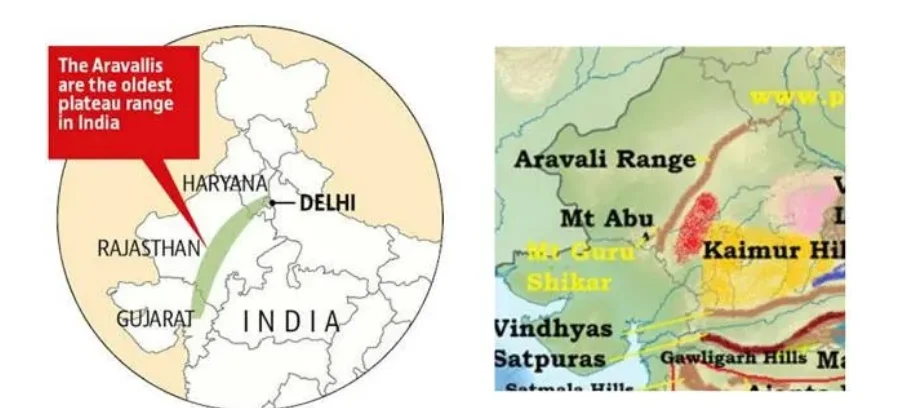
- About: It is one of the world’s oldest fold mountain systems, dating to the Proterozoic era, and stands as a classic example of an ancient, highly eroded mountain system.
- Geographical Extent: The range runs diagonally (northeast–southwest, 690–800 km) across Gujarat, Rajasthan, Haryana, and Delhi.
- Physiographic Divisions: The Aravallis are divided into two major sections:
- Sambhar–Sirohi Range: Southern section, more elevated and forested, includes Guru Shikhar (highest peak, Mount Abu, Rajasthan).
- Sambhar–Khetri Range: Northern section, lower and more eroded.
- Climatic and Environmental Role: It acts as a crucial natural barrier against the Thar Desert’s eastward spread, while also playing a vital role in groundwater recharge and local climate regulation.
- It forms a crucial watershed divide between the Indus and Ganga river systems.
- Drainage: Banas and Sahibi (tributaries of the Yamuna), Luni, flowing westwards into the Rann of Kutch (inland drainage).
| Read More: Protection of Aravalli Hills |
Pralay Missile
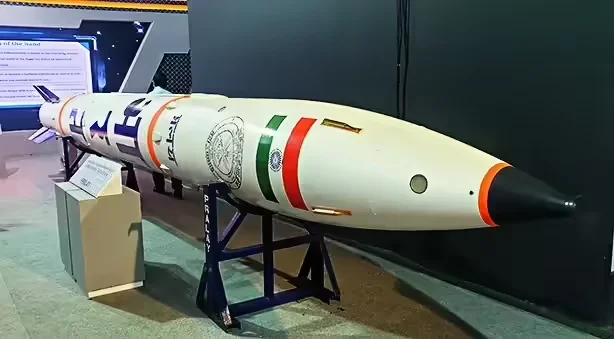
The Defence Research & Development Organisation (DRDO) successfully conducted a salvo launch of two indigenously developed Pralay missiles from the same launcher off the coast of Odisha.
- The test is part of a rapid series of missile tests, including the Pinaka Long-Range Guided Rocket and the K-4 submarine-launched ballistic missile, showcasing India's focus on modernizing and diversifying its missile arsenal.
Pralay Missiles
- About: It is a solid-propellant, surface-to-surface, short-range (150 km to 500 km), quasi-ballistic missile and a payload capacity of 500 kg to 1000 kg.
- Warhead Capability: It is capable of carrying multiple types of warheads against various targets and can be launched from a mobile launcher.
- Guidance & Navigation: Equipped with an advanced Inertial Navigation System (INS) and a Radio Frequency (RF) seeker for high precision and in-flight manoeuvrability.
- Operational Advantage: Its quasi-ballistic trajectory (lower altitude with in-flight manoeuvres) makes it harder to intercept compared to traditional ballistic missiles.
| Read More: India's Advancements in Ballistic and Air Defence Systems |