
Republic Day 2026
For Prelims: Constitution of India, Purna Swaraj, Vande Mataram, Government of India Act, 1935, Bankim Chandra Chatterjee
For Mains: Historical significance of Republic Day and Purna Swaraj, Transition from colonial rule to constitutional democracy
Why in News?
Republic Day 2026 marked the 77th anniversary of the Constitution of India coming into force on 26th January 1950, and was celebrated around the theme “150 Years of Vande Mataram.”
- The observance blended constitutional values with cultural expression and public participation, featuring 30 tableaux from States, Union Territories, and Ministries under the sub-themes Swatantrata ka Mantra – Vande Mataram and Samriddhi ka Mantra – Atmanirbhar Bharat.
- The celebration also saw the parade debut of the newly raised Bhairav Battalion, a specialised assault infantry unit. In addition, a military contingent from the European Union participated. It was the EU’s first participation at such an event outside Europe.
Summary
- Republic Day 2026 marked the 77th anniversary of the Constitution under the theme “150 Years of Vande Mataram,” celebrating India’s constitutional legacy through cultural tableaux, public participation, and military display.
- The occasion also highlighted national service and sacrifice through Padma Awards, gallantry medals, and defence decorations, reflecting India’s democratic values, unity, and institutional strength.
What is the Historical Significance of Republic Day?
- The Purna Swaraj Resolution: In December 1929, the Indian National Congress passed the historic ‘Purna Swaraj’ (Complete Independence) resolution at its Lahore Session (presided over by Jawaharlal Nehru).
- It was decided that 26th January 1930, would be observed as Purna Swaraj Day across India. On this day, Indians pledged to reject British dominion status and fight for complete self-rule.
- From 1930 to 1947, 26th January was celebrated as "Independence Day" or "Poorna Swaraj Day."
- Transition from Independence to Republic: The Constituent Assembly first met in December 1946 at the Constitution Hall (now Central Hall of Parliament), formally initiating India’s constitution-making process.
- On 15th August 1947, India achieved independence from colonial rule but continued as a British Dominion with King George VI as the head of state until the Constitution came into force.
- The constitutional transition was completed on 26th November 1949, when the Constituent Assembly formally adopted the Constitution, a date explicitly recorded in the Preamble.
- On 26th January 1950, the Constitution of India came into force, deliberately chosen to honour the Purna Swaraj Declaration of 1930.
- With this, the Government of India Act, 1935 was replaced.
- India formally became a Sovereign Democratic Republic.
- The President of India replaced the British Monarch as the Head of State, symbolizing the true essence of a Republic.
- Later, the 42nd Constitutional Amendment (1976) added the words Socialist and Secular to the Preamble.
What are the Key Highlights of the Tableaux Displayed at the 77th Republic Day Parade?
- Assam: Highlighted Asharikandi village and its centuries-old terracotta craft tradition.
- Gujarat: Paid tribute to Madam Bhikaji Cama, the revolutionary who unfurled the first version of the Indian flag in Germany (1907).
- Depicted the evolution of the Indian National Flag from 1906 to 1947. It concluded with a sculpture of Mahatma Gandhi with the Charkha, linking Swadeshi to modern Atmanirbhar Bharat.
- Uttar Pradesh: Highlighted Bundelkhand’s cultural heritage alongside modern development.
- Maharashtra: It showcased Ganeshotsav as a social movement initiated by Lokmanya Tilak for national unity
- West Bengal: It honoured the origins of the national song Vande Mataram, composed by Bankim Chandra Chatterjee.
- It featured statues of freedom fighters such as Subhas Chandra Bose, Matangini Hazra, and Khudiram Bose, highlighting Bengal’s pivotal role in India’s freedom struggle.
- Punjab: Paid a solemn tribute to Sri Guru Tegh Bahadur Sahib Ji on the 350th year of his martyrdom, honouring him as Hind Di Chadar (Protector of India).
- Kerala: Featured the Kochi Water Metro (India's first water metro) and celebrated the state's achievement of 100% Digital Literacy.
- Tri-Services (Department of Military Affairs): Under the theme “Operation Sindoor – Victory Through Jointness” showcased India’s integrated military strength.
- The tableau featured Rafale jets with SCALP missiles, the BrahMos cruise missile, the S-400 air defence system, and HAROP loitering munitions, symbolising the shift towards joint warfare.
- Ministry of Culture: It artistically traced the 150-year journey of Vande Mataram.
- Ministry of Home Affairs (NDMA & NDRF): Commemorated recovery after the 2001 Bhuj Earthquake.
What are the Key Highlights of the 77th Republic Day?
- Padma Awards 2026: 131 Padma Awards, including 5 Padma Vibhushan, 13 Padma Bhushan, 113 Padma Shri.
- Armed Forces Gallantry Awards: 70 Armed Forces personnel awarded gallantry medals, including Ashok Chakra, Kirti Chakra, Shaurya Chakra, Sena, Nao Sena, and Vayu Sena Medals
- Military Decorations: The President conferred 301 defence decorations, including Param Vishisht Seva Medals, Uttam Yudh Seva Medals, Ati Vishisht Seva Medals, Yudh Seva Medals, Bar to Sena Medal, Sena Medals (Devotion to Duty), Nao Sena Medals, Vayu Sena Medals, Bar to Vishisht Seva Medals, and Vishisht Seva Medals.
- Param Vishisht Seva Medals: Recognize distinguished service of exceptional order.
- Uttam Yudh Seva Medals: Awarded for distinguished service during war or conflict.
- Ati Vishisht Seva Medals: Recognize distinguished service of exceptional order.
- Yudh Seva Medals: Awarded for distinguished service during war or hostilities.
- Bar to Sena Medal (Devotion to Duty): Awarded to recipients of Sena Medal for further acts of devotion.
- Vishisht Seva Medal: High-order service, with a Bar for subsequent awards.
- PTM and TM Medal: The President conferred the President’s Tatrakshak Medal (PTM) and Tatrakshak Medal (TM) for Indian Coast Guard personnel.
- These awards recognise their acts of conspicuous gallantry, exceptional devotion to duty, and distinguished/meritorious service.
- Services Personnel: A total of 982 personnel from Police, Fire Services, Home Guard & Civil Defence (HG&CD), and Correctional Services have been awarded Gallantry and Service Medals.
- Police Gallantry Medals: Announced twice a year, these medals acknowledge bravery and exemplary conduct by police personnel.
- The President’s Medal for Gallantry is awarded for exceptional courage in saving lives or preventing crime, while the Police Medal for Gallantry recognizes acts of bravery during duty.
- President’s Medal for Distinguished Service (PSM): Awarded for special distinguished service records.
- Medal for Meritorious Service (MSM): Given for valuable service characterized by dedication and devotion to duty.
- Police Gallantry Medals: Announced twice a year, these medals acknowledge bravery and exemplary conduct by police personnel.
- Jeevan Raksha Padak Awards: Given to a person for meritorious act of human nature in saving the life of a person
- The awards are given in three categories: Sarvottam, Uttam, and Jeevan Raksha Padak. Persons of all walks of life are eligible for these awards. The award can also be conferred posthumously.
- Sarvottam Jeevan Raksha Padak: For conspicuous courage in saving a life under very dangerous circumstances.
- Uttam Jeevan Raksha Padak: For courage and prompt action in saving a life under great danger.
- Jeevan Raksha Padak: For courage and prompt action in saving a life under conditions involving grave bodily injury.
Key Facts About Vande Mataram
- Origin & Composition: Vande Mataram (also pronounced Bande Mataram), composed by Bankim Chandra Chatterjee, was first published in Bangadarshan in 1875 and later included in Anandamath (1882).
- It is set to music by Rabindranath Tagore, it emerged as a powerful symbol of India’s cultural and political identity, embodying unity, sacrifice, and devotion.
- National Status: On 24th January 1950, Dr. Rajendra Prasad, the first President of India, announced that while Jana Gana Mana would be the National Anthem, Vande Mataram, for its key role in the freedom movement, would be honoured equally as the National Song.
- India’s Constitution does not explicitly mention a national song. However, Article 51A(a) asks citizens to respect the Constitution, National Flag and National Anthem.
- Role in Freedom Movement:
- Adoption by Congress: In 1896, Gurudev Rabindranath Tagore sang Vande Mataram at the Kolkata session of the Indian National Congress.
- At the Varanasi session of the Indian National Congress (1905), the song 'Vande Mataram' was adopted for all-India occasions.
- Mass Mobilisation & Press: Bande Mataram Sampradaya (1905) formed in North Calcutta to promote devotion to the motherland.
- English daily Bande Mataram launched in 1906 under Bipin Chandra Pal, later joined by Sri Aurobindo. It propagated ideas of Swadeshi, unity, and resistance.
- Anti-Partition & Student Movements: Vande Mataram was first used as a political slogan on 7th August 1905 during student processions at Calcutta Town Hall, becoming the rallying cry of the Swadeshi and anti-partition movement.
- Its mass appeal prompted Lord Curzon to order arrests for singing it.
- Influence on Indian Revolutionaries Abroad:
- In 1907, Madam Bhikaji Cama raised the tricolour flag for the first-time outside India in Stuttgart, Germany. The words Vande Mataram were written on the flag.
- In August 1909, when Madan Lal Dhignra was hanged in England, his last words before he went to the gallows were “Bande Mataram.”
- In October 1912, Gopal Krishna Gokhale was welcomed in Cape Town with a grand procession chanting “Vande Mataram.”
- Adoption by Congress: In 1896, Gurudev Rabindranath Tagore sang Vande Mataram at the Kolkata session of the Indian National Congress.
Frequently Asked Questions (FAQs)
1. Why is Republic Day celebrated on 26 January?
It marks the enforcement of the Constitution in 1950 and commemorates the Purna Swaraj Declaration of 1930, linking freedom struggle with constitutional governance.
2. What was the theme of the 77th Republic Day (2026)?
The theme was “150 Years of Vande Mataram,” highlighting national unity, freedom, and cultural heritage.
3. What is the significance of Padma Awards announced on Republic Day?
Padma Awards recognise exceptional civilian contributions across fields like arts, public service, science, sports, and social work.
4. What do Gallantry and Service Medals signify?
They honour bravery, devotion to duty, and distinguished service by Armed Forces and civil services personnel.
5. What are Jeevan Raksha Padak Awards?
These awards recognise acts of exceptional courage in saving human lives, and are open to civilians and posthumous recognition.
UPSC Civil Services Examination, Previous Year Questions (PYQs)
Prelims
Q. What was the exact constitutional status of India on 26th January 1950? (2021)
(a) A Democratic Republic
(b) A Sovereign Democratic Republic
(c) A Sovereign Secular Democratic Republic
(d) A Sovereign Socialist Secular Democratic Republic
Ans: (b)
Mains
Q. Discuss each adjective attached to the word ‘Republic’ in the ‘Preamble’. Are they defendable in the present circumstances? (2013)
Padma Awards 2026
Why in News?
On the eve of the 77th Republic Day 2026, the President approved the 2026 Padma awards list of 131 recipients, comprising 5 Padma Vibhushan, 13 Padma Bhushan, and 113 Padma Shri awards.
- The major awardees include actor Dharmendra Singh Deol and former Kerala Chief Minister VS Achuthanandan, who have been honoured with the Padma Vibhushan posthumously.
What are Padma Awards?
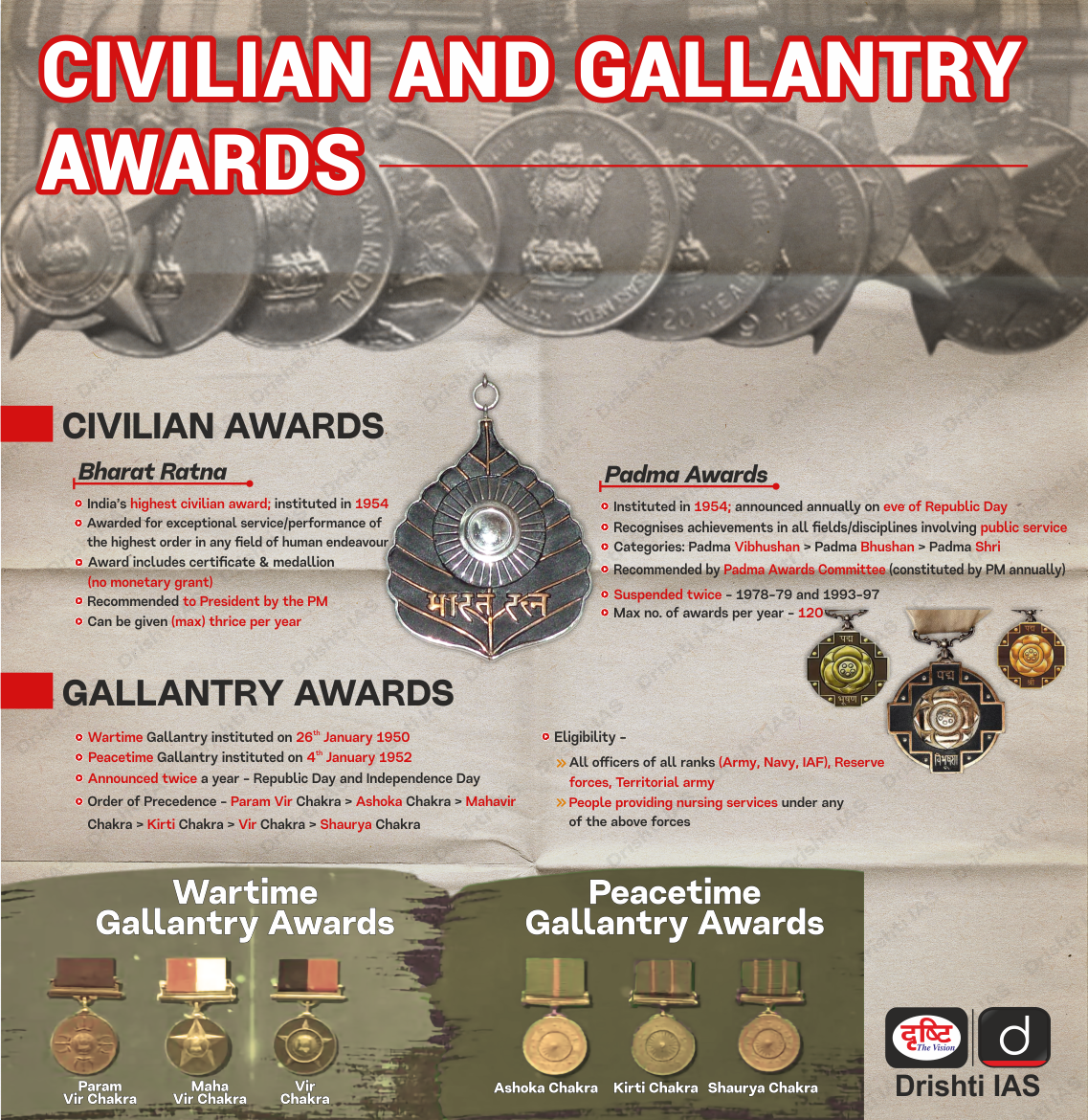
- About: The Padma Awards, alongside the Bharat Ratna, are the nation's premier awards for recognizing distinguished contributions across all fields of public service and human endeavour.
- Historical Evolution: The Padma Awards were instituted in 1954. Initially, two civilian awards were created, i.e., Bharat Ratna (the highest) and Padma Vibhushan (with three classes). In 1955, Padma Vibhushan classes were restructured into the three distinct awards in descending order of prestige:
- Padma Vibhushan: For "exceptional and distinguished service"; the 2nd-highest civilian award after the Bharat Ratna.
- Padma Bhushan: For "distinguished service of high order".
- Padma Shri: For "distinguished service in any field.
- Constitutional Provisions: Article 18(1) of the Indian Constitution abolishes all titles (e.g., Rai Bahadur, Nawab) and prohibits the State from conferring titles on any person, citizen or non-citizen. However, the prohibition has two explicit exceptions, i.e., military and academic distinctions.
- Judicial Stand: In the Balaji Raghavan v. Union of India, 1996, the Supreme Court (SC) held that National awards like Bharat Ratna, and Padma awards are state recognitions of exceptional work and merit, not hereditary or personal distinctions and hence can be conferred to meritorious individuals.
- Similarly, in Indira Jaising v. Supreme Court of India, 2017, the SC ruled that the designation ‘senior advocate’ is a professional demarcation of experience and proficiency, not a title, and thus does not violate Article 18.
- Broad Scope: Awards are given across diverse disciplines, including Art, Social Work, Public Affairs, Science & Engineering, Civil Service, and more.
- Eligibility: All individuals, irrespective of race, occupation, rank, or gender—including Indian citizens, foreigners, NRIs, PIOs, and OCIs—are eligible for these awards.
- Since 2014, the government has been recognizing "unsung heroes" with the Padma Awards, transforming them into the "People's Padma".
- Selection Process: It is governed by the Padma Awards Committee, which is appointed annually by the Prime Minister. The committee is chaired by the Cabinet Secretary and includes the Home Secretary, Secretary to the President, and 4–6 eminent persons. Its recommendations are submitted to the Prime Minister and the President of India for final approval.
- Based on the committee recommendations, it is announced annually on the eve of Republic Day and formally conferred by the President of India in March/April, with recipients receiving a Sanad (certificate), medallion, and replica.
- Key Regulations: Generally not conferred posthumously (with rare, highly deserving exceptions).
- A higher category Padma award is only granted after at least five years since the previous Padma award.
- The award is not a title and cannot be used as a prefix or suffix.
- Capped at a maximum of 120 awards per year (excluding posthumous, NRI, foreigner, and OCI recipients).
- Suspension of the Awards: The annual awards have been suspended on two occasions:
- 1978–79: By the Morarji Desai-led Janata Party government, which deemed them "worthless and politicized."
- 1993–97: Due to protracted litigation (the Balaji Raghavan case, 1996), challenging their constitutional validity in the courts.
Frequently Asked Questions (FAQs)
1. What are Padma Awards?
Padma Awards are India’s premier civilian honours, instituted in 1954 to recognise distinguished and exceptional service in diverse fields of public service and human endeavour.
2. Why are Padma Awards not considered “titles” under Article 18?
The Supreme Court held that Padma Awards are non-hereditary recognitions of merit, not prefixes or suffixes, and hence do not violate Article 18(1).
3. Who oversees the selection of Padma Award recipients?
The Padma Awards Committee, chaired by the Cabinet Secretary and appointed by the Prime Minister, scrutinises nominations and submits recommendations.
UPSC Civil Services Examination, Previous Year Questions (PYQs)
Q. Consider the following statements in respect of Bharat Ratna and Padma Awards: (2021)
- Bharat Ratna and Padma Awards are titles under the Article 18(1) of the Constitution of India.
- Padma Awards, which were instituted in the year 1954, were suspended only once.
- The number of Bharat Ratna Awards is restricted to a maximum of five in a particular year.
Which of the above statements are not correct?
(a) 1 and 2 only
(b) 2 and 3 only
(c) 1 and 3 only
(d) 1, 2 and 3
Ans: (d)
National Girl Child Day 2026
Why in News?
National Girl Child Day is observed annually on 24th January, serving as a critical platform to reaffirm India's commitment to eradicating gender discrimination and accelerating girls' empowerment through holistic development.
What is National Girl Child Day?
- About: Initiated in 2008 by the Ministry of Women and Child Development (MWCD), the day serves as a platform to raise awareness about gender discrimination, promote equal opportunities, and foster an environment where girls can thrive as empowered citizens.
- The day highlights girls' rights, education, health, and nutrition, addressing issues like gender bias, female foeticide, and child marriage.
- Initiatives for Girl Child Development and their Outcomes:
|
Initiative |
Key Features |
Outcomes |
|
Beti Bachao Beti Padhao (BBBP) |
Launched in 2015. Focus on preventing gender-biased sex selection, ensuring survival & protection, promoting education. Part of Mission Shakti’s ‘Sambal’ sub-scheme. |
Sex Ratio at Birth (SRB) rose from ~918 (2014-15) to 930 (2023-24). Increased girls’ enrolment in secondary education. |
|
Mission Shakti |
Umbrella scheme (2022) with two sub-schemes: Sambal (safety/security) & Samarthya (empowerment). Aims for life-cycle support. |
Ensures convergence of schemes like BBBP, One Stop Centres, Pradhan Mantri Matru Vandana Yojana. |
|
Samagra Shiksha |
Integrated scheme for school education (pre-school to Class XII). Focus on bridging gender/social gaps, separate toilets, stipends, gender-sensitive teaching. |
Gross Enrolment Ratio (GER) for girls at the secondary level reached 80.2% in 2024–25. 97.5% schools have girls’ toilets. |
|
Vigyan Jyoti (DST) |
Encourages girls in Classes IX-XII (especially rural) to pursue STEM via counselling, lab visits, workshops, etc. |
Supported 80,000+ meritorious girls across 300 districts in 35 States/UTs. |
|
Prohibition of Child Marriage Act, 2006 & Bal Vivah Mukt Bharat campaign |
Prohibits child marriage; 2024 campaign aims for child marriage-free India by 2030. |
Legal backbone to prevent early marriage; campaign aims for 10% reduction in prevalence by 2026. |
|
Scheme for Adolescent Girls (SAG) |
For girls aged 14-18 years in Aspirational districts & North Eastern States. Provides nutrition (600 kcal/day, 18-20g protein and micronutrients for 300 days) & non-nutrition components (Iron-Folic Acid, health check-ups, skilling). |
24.08 lakh+ adolescent girls registered on Poshan Tracker (Dec 2024). |
|
Sukanya Samriddhi Yojana (SSY) |
Savings scheme for girl child’s education/marriage. Launched in 2015 as part of BBBP. |
Over 4.2 crore accounts opened (as of Nov 2024), promoting financial inclusion and long-term security. |
Frequently Asked Questions (FAQs)
1. What is National Girl Child Day and when is it observed?
National Girl Child Day is observed annually on 24 January to promote the rights, education, health, safety, and welfare of girls in India.
2. What is the primary objective of Beti Bachao Beti Padhao (BBBP)?
BBBP (2015) aims to prevent gender-biased sex selection, ensure girls’ survival and protection, and promote girls’ education, contributing to improved SRB.
3. What is Mission Shakti and what are its sub-schemes?
Mission Shakti (2022) is an umbrella scheme with Sambal (safety/security) and Samarthya (empowerment), integrating interventions like BBBP, One Stop Centres, PMMVY, etc.
UPSC Civil Services Examination Previous Year Question (PYQ)
Q. Which of the following gives ‘Global Gender Gap Index’ ranking to the countries of the world? (2017)
(a) World Economic Forum
(b) UN Human Rights Council
(c) UN Women
(d) World Health Organization
Ans: (a)
Q. Two of the schemes launched by the Government of India for Women’s development are Swadhar and Swayam Siddha. As regards the difference between them, consider the following statements: (2010)
- Swayam Siddha is meant for those in difficult circumstances such as women survivors of natural disasters or terrorism, women prisoners released from jails, mentally challenged women etc., whereas Swadhar is meant for holistic empowerment of women through Self Help Groups.
- Swayam Siddha is implemented through Local Self Government bodies or reputed Voluntary Organizations whereas Swadhar is implemented through the ICDS units set up in the states.
Which of the statements given above is/are correct?
(a) 1 only
(b) 2 only
(c) Both 1 and 2
(d) Neither 1 nor 2
Ans: (d)
MSDE–WEF India Skills Accelerator
Why in News?
The Ministry of Skill Development and Entrepreneurship (MSDE), has signed a Memorandum of Understanding with the World Economic Forum (WEF) to strengthen India’s skills and Technical and Vocational Education and Training (TVET) ecosystem.
- Under the MoU, the partners will launch a Skills Accelerator in India to scale innovative solutions and address emerging skill gaps.
What is the MSDE- WEF India Skills Accelerator?
- About: It is a multistakeholder platform that brings together government, industry, academia, and global institutions to address current and emerging skill gaps in India’s workforce.
- Objectives: The Accelerator aims to align skilling initiatives with evolving industry and global labour-market needs while scaling innovative skilling models and strengthening public–private partnerships.
- It will support flexible, industry-linked curricula, integrate vocational and higher education pathways, enable mutual recognition of qualifications, and promote innovative, outcome-based financing for skilling.
- Importance: By strengthening the TVET ecosystem, the initiative enhances global employability of Indian youth and helps convert India’s demographic advantage into a skilled, future-ready workforce.
- It complements the National Education Policy (NEP) 2020 by integrating vocational education with general education and fostering lifelong learning.
- The initiative is positioned as a central pillar for Viksit Bharat @2047, aiming to convert India’s demographic advantage (over 500 million people under 25) into economic leadership.
What are the Key Initiatives Driving India’s TVET Landscape?
|
Scheme/ Programme |
Target Group |
Key Features / Objectives |
|
Youth across India |
|
|
|
Youth, including rural population |
|
|
|
Non-literates, neo-literates, school dropouts (15–45 years) |
|
|
|
Apprentices and industrial establishments |
|
|
|
Youth seeking long-term vocational training |
|
Frequently Asked Questions (FAQs)
1. What is the India Skills Accelerator?
It is a multistakeholder platform under the MSDE–WEF partnership to address present and future skill gaps through industry-aligned skilling models.
2. What are the key objectives of the MSDE–WEF MoU?
To align skilling with global labour-market needs, strengthen public–private partnerships, and scale innovative TVET solutions.
3. How does the initiative support NEP 2020?
It integrates vocational education with general and higher education, promotes flexible curricula, and encourages lifelong learning.
4. Why is the Skills Accelerator significant for India’s demographic dividend?
It enhances employability of over 500 million youth under 25 by creating a future-ready, globally competitive workforce.
5. Which major schemes form the backbone of India’s TVET landscape?
Skill India Mission, PMKVY, Jan Shikshan Sansthan, National Apprenticeship Promotion Scheme, and Craftsmen Training Scheme.
UPSC Civil Services Examination Previous Year Question (PYQ)
Prelims
1. With reference to Pradhan Mantri Kaushal Vikas Yojana, consider the following statements: (2018)
- It is the flagship scheme of the Ministry of Labour and Employment.
- It, among other things, will also impart training in soft skills, entrepreneurship, and financial and digital literacy.
- It aims to align the competencies of the unregulated workforce of the country to the National Skill Qualification Framework.
Which of the statements given above is/are correct?
(a) 1 and 3 only
(b) 2 only
(c) 2 and 3 only
(d) 1, 2 and 3
Ans: (c)
Sikkim Sundari
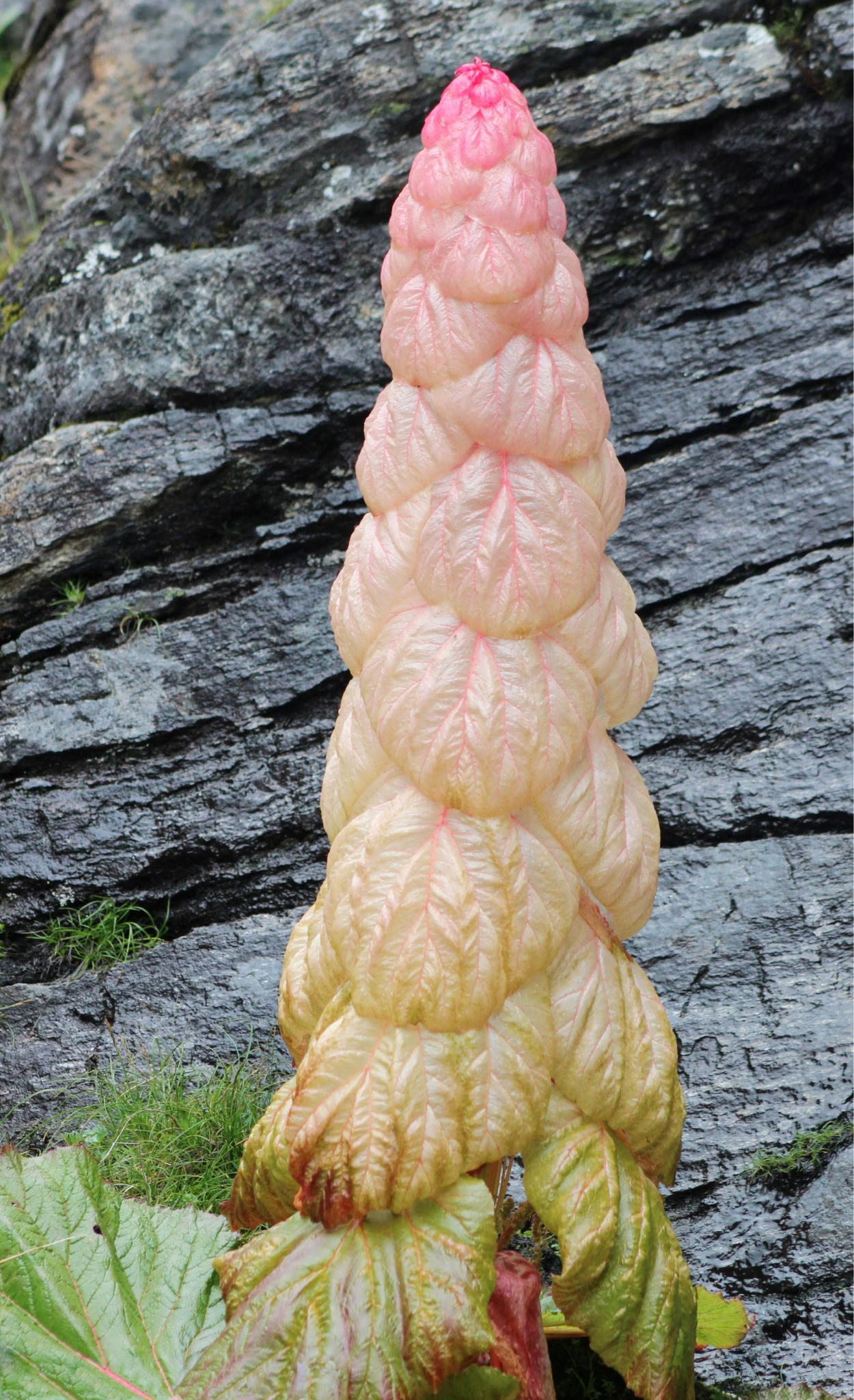
Sikkim Sundari (Rheum nobile), a rare high-altitude Himalayan plant, has drawn attention for its unique biology and striking appearance.
Sikkim Sundari
- About: Rheum nobile, commonly known as padamchal, or Sikkim Sundari, is a giant herbaceous perennial plant native to the high-altitude alpine zones of the Himalayas (4,000–4,800 meters).
- Belongs to the Polygonaceae family and is found in North Sikkim (trekking routes near alpine passes and glacial valleys), Nepal, Bhutan, Tibet, and Myanmar. Typically grows on open alpine slopes, rock ledges, glacial valleys, and tundra-like environments.
- Distinctive Morphology: Its tall, translucent bracts form a natural glasshouse that traps heat, protects the flowers from freezing winds and intense UV radiation, and gives the plant a luminous, tower-like appearance against the Himalayan landscape.
- Remarkable Life Cycle: A monocarpic plant (one that flowers only once in its lifetime), it spends 7–30 years as a low rosette storing energy before a single dramatic bloom into a tall pagoda-like spike, after which it sets seed and dies.
- Cultural & Medicinal Use: Stems are locally consumed for their acidic flavor (chuka), and it has traditional medicinal applications in Himalayan and Tibetan medicine.
| Read More: Indian Himalayan Region |
Tamil Nadu Opposes UGC Circular on Third Language
Tamil Nadu has formally opposed the University Grants Commission's (UGC) circular mandating a third language in higher educational institutions, characterizing it as an "indirect attempt to impose Hindi" and reaffirming the State's steadfast commitment to its historic two-language policy.
- Rejection of Three-Language Formula: Tamil Nadu categorically rejected the three-language formula prescribed in the Centre’s National Education Policy (NEP), 2020, viewing the recent UGC circular as an infringement on State policy.
- The NEP 2020 promotes multilingualism by requiring students to learn three languages, with at least two being native Indian languages (including a regional language). The third language can be English or another modern Indian/foreign language.
- Adherence to Two-Language Policy: The State Education Policy of Tamil Nadu continues to uphold the two-language formula (Tamil and English), a policy originally formulated by former Chief Minister C.N. Annadurai in 1968.
- The State government stated that under no circumstances will it accept any alteration to its language policy.
- The issue also highlights Centre–State tensions over education, which falls under the Concurrent List of the Constitution.
- In 2022, the Assembly unanimously urged the Union government not to implement recommendations of the Parliamentary Committee on Official Language, which included proposals to make Hindi the medium of instruction in central institutions.
| Read more: Three Language Formula and Autonomy in Language Policy |
ASEAN–India Digital Ministers’ Meeting
The 6th ASEAN–India Digital Ministers’ Meeting (ADGMIN) was co‑chaired virtually by India and Vietnam, focusing on the theme “Adaptive ASEAN: From Connectivity to Connected Intelligence”.
- The ADGMIN is an annual forum of Telecom and Digital Ministers from the 11 ASEAN Member States and ASEAN’s Dialogue Partners, including Australia, China, India, and the US.
Key Highlights of the 6th ADGMIN Meeting
- Joint Statement: The meeting acknowledged the adoption of the ASEAN–India Joint Statement on Advancing Digital Transformation (2024), aimed at strengthening cooperation on Digital Public Infrastructure (DPI), Financial Technology, Cybersecurity, Artificial Intelligence (AI), capacity building, and sustainable financing.
- Work Plans & Funding: Progress on the ASEAN-India 2025 Digital Work Plan was reviewed, and a new ASEAN-India Digital Work Plan for 2026 was welcomed.
- The meeting also announced the operationalization of the special ‘ASEAN-India Fund for Digital Future’ to support collaborative initiatives between India and ASEAN in the domain of digital transformation and related technologies like Cybersecurity.
- India's Digital Showcase: India highlighted its rapid digital transformation, including near-universal 4G coverage, the world's fastest 5G rollout, BharatNet for rural broadband, and its emergence as a mobile manufacturing hub.
- It offered to share expertise in its DPI (Aadhaar, UPI, DigiLocker) and the Sanchar Saathi initiative.
- Focus on Artificial Intelligence: India outlined its IndiaAI Mission with a focus on Safe and Trusted AI and expressed readiness to collaborate with ASEAN on AI capacity building, standards development, and practical use cases.
| Read More: Forging a New Era of India-ASEAN Relations |
56th Statehood Day of Himachal Pradesh
The Prime Minister conveyed warm greetings to the people of Himachal Pradesh on their 56th Statehood Day on 25th January, 2026.
Himachal Pradesh
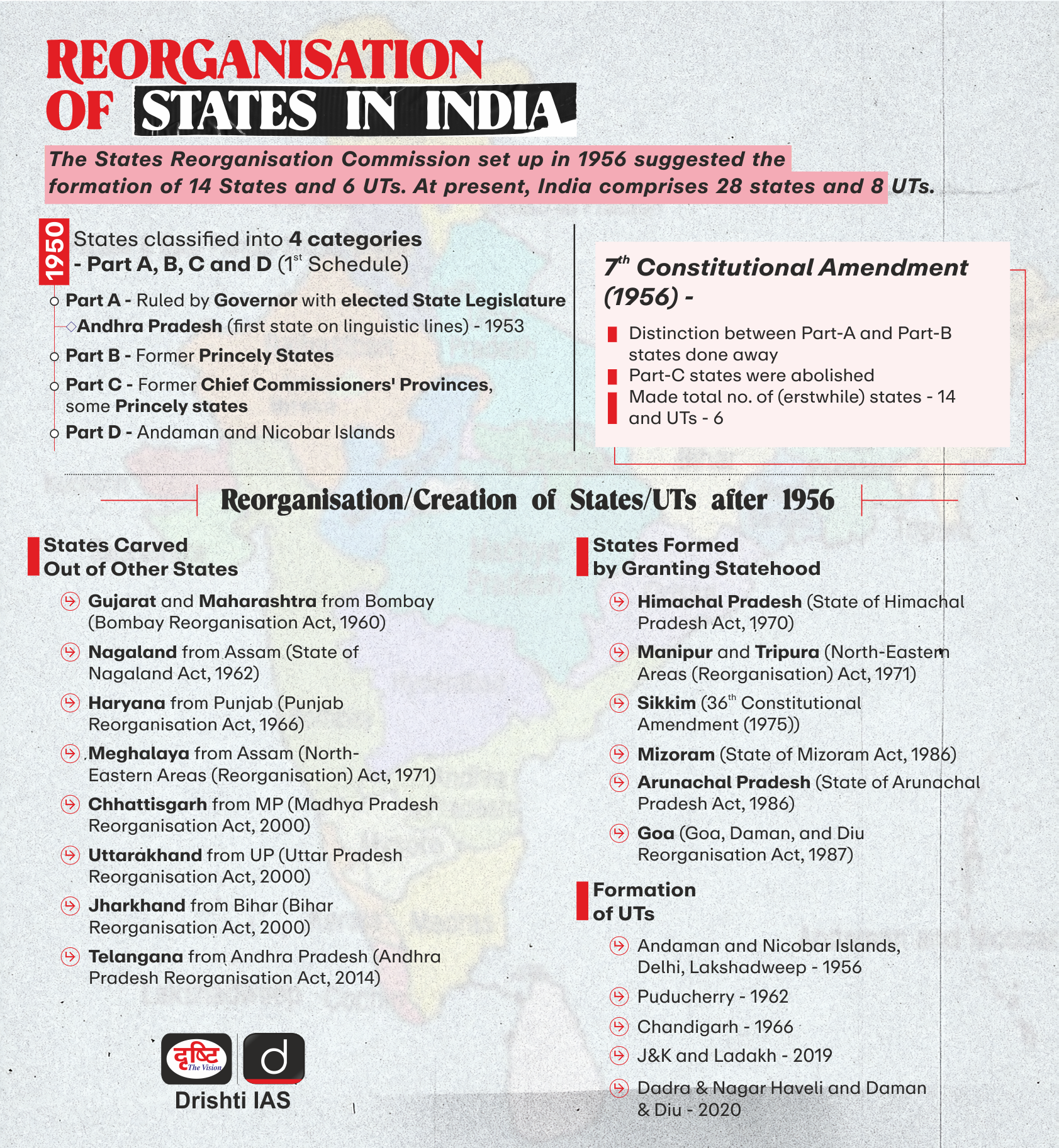
- Evolution of Statehood: Himachal Pradesh first became a Chief Commissioner’s Province on 15th April 1948, and then transitioned to a Part C State on 26th January 1950 upon the implementation of the Indian Constitution.
- It remained a Part-C State until 1956, when the States Reorganisation Commission (SRC) abolished the Part A, B and C classification of States.
- It was made a Union Territory on 1st November 1956 based on the recommendations of the SRC formed in 1953.
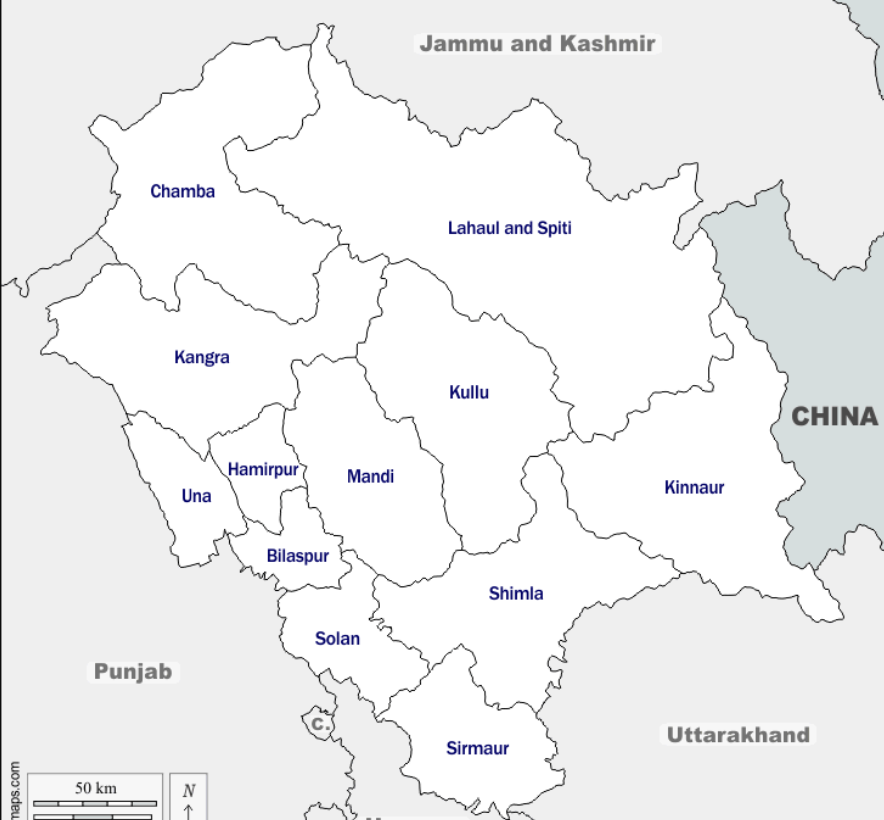
- A major territorial change occurred on 1st November 1966, when hill areas from Punjab (including Kangra, Kullu, Lahaul-Spiti) were merged into Himachal Pradesh, though it remained a Union Territory.
- It attained full statehood on 25th January 1971, becoming India’s 18th state, as established by the State of Himachal Pradesh Act, 1970.
- Geographical Context: The name means "lap of snow" (Hima + Anchal). It shares borders with Jammu & Kashmir, Ladakh, Punjab, Haryana, Uttarakhand, and an international border with China.
Note: Uttar Pradesh Day is observed annually on 24th January to mark the state's foundation. This date commemorates the renaming of the former United Provinces to Uttar Pradesh on 24th January 1950.
- The day was officially designated for celebration by the state government in 2017, with the inaugural festivities held in 2018.
| Read More: Reorganisation of States in India |
SC Directs States on Police–Media Briefing Policy
The Supreme Court (SC) of India has directed all State governments to formulate a comprehensive policy for police media briefings within three months, modeled on the manual prepared by amicus curiae Gopal Sankaranarayanan, to ensure a balance between transparency and the rights of the accused.
- Background Case: The directive stems from a batch of petitions led by the People’s Union for Civil Liberties (PUCL) (a civil rights NGO).
- This same NGO was central to the landmark 2014 Supreme Court judgment (PUCL vs State of Maharashtra case (2014)) that laid down 16 mandatory guidelines for investigating police encounters and extra-judicial killings.
- Gopal Sankaranarayanan Police Manual: It considers international best practices and Union government views.
- The manual aims to establish a “principled, rights-compatible and investigation-safe framework” that safeguards the dignity, privacy, and fair-trial rights of victims, witnesses, and suspects while meeting the public's need for accurate information.
- The manual asserts that police media briefings should serve specific purposes: to prevent harm, correct rumours, enlist public cooperation, and maintain law and order.
- Combating Misinformation: Acknowledging the "social media age," the Court emphasized that police must release only correct, verified, and necessary information to prevent the spread of fake news that could disrupt public order.
| Read more: Strengthening Policing for India's Future |
Granth Kutir
Recently, the President of India inaugurated the Granth Kutir at Rashtrapati Bhavan.
Granth Kutir
- About: Granth Kutir is a dedicated book house showcasing India’s classical knowledge traditions.
- It houses works in 11 Indian classical languages such as Tamil, Sanskrit, Kannada, Malayalam and Marathi, with a collection of around 2,300 books and nearly 50 manuscripts.
- Several manuscripts are handwritten on traditional materials such as palm leaf, paper, bark, and cloth.
- Coverage: The collection covers epics, philosophy, linguistics, history, governance, science, devotional literature, and the Constitution of India.
- Collaboration: It has been developed through collaboration among central and state governments, universities, research institutions, cultural organisations, and individual donors.
- The initiative is supported by the Ministry of Education, the Ministry of Culture, and expert guidance from Indira Gandhi National Centre for the Arts (IGNCA).
- Significance: It aims to enhance public awareness of India’s cultural and literary heritage and promote unity in diversity.
- It supports the Gyan Bharatam Mission and reinforces efforts to preserve, promote, and transmit India’s classical languages and knowledge systems.
| Read more: Revival of National Mission for Manuscripts (NMM) |