
Agreements on Reciprocal Trade
For Prelims: World Trade Organization, General Agreement on Tariffs and Trade, TRIPS, Free trade agreements (FTAs), Regional Comprehensive Economic Partnership (RCEP), Agreements on Reciprocal Trade
For Mains: Shift from Multilateralism to Bilateralism, Agreements on Reciprocal Trade
Why in News?
The US administration has aggressively pursued "Agreements on Reciprocal Trade" (ARTs) with developing nations such as Bangladesh, Malaysia, Cambodia, and El Salvador, alongside an interim framework with India.
- Negotiated under the threat of sweeping punitive tariffs, these ARTs mark a fundamental departure from the rules-based multilateralism of the World Trade Organization (WTO).
- For developing countries, this shift from "fair-play" global rules to "power-based" bilateral negotiations carries profound economic, strategic, and legal implications.
Summary
- US-led Agreements on Reciprocal Trade (ARTs) bypass WTO rules, weakening MFN principles, dispute settlement, and collective bargaining, thereby exposing developing countries to coercive market access, digital sovereignty risks, and fragmented global trade.
- India is strengthening FTAs, supply chain resilience, and Global South cooperation while protecting digital sovereignty and advocating WTO reforms to preserve a rules-based, inclusive multilateral trading system.
What is the Traditional Multilateral Trade Framework?
- The Interwar Context: Following the destructive protectionist policies (like high tariffs) of the 1930s that exacerbated the Great Depression, the international community recognized the need for a cooperative economic system.
- GATT (1947): The General Agreement on Tariffs and Trade (GATT) was established after World War II.
- It acted as a provisional legal agreement to minimize barriers to international trade by eliminating or reducing quotas, tariffs, and subsidies.
- The WTO (1995): The GATT was ultimately replaced by the World Trade Organization (WTO) following the Uruguay Round of negotiations (1986-94).
- Core Principles of the Multilateral Framework:
- Most-Favoured-Nation (MFN) Rule: This is the bedrock of the WTO. It dictates that a country cannot normally discriminate between its trading partners.
- If a nation grants someone a special favor (such as a lower customs duty rate for one of their products), it must extend it to all other WTO members.
- National Treatment: Imported and locally-produced goods should be treated equally once the foreign goods have entered the market.
- The same principle applies to foreign and domestic services, as well as to foreign and local trademarks, copyrights, and patents.
- One-Country, One-Vote:Unlike the International Monetary Fund (IMF) or World Bank where voting power is weighted by financial contribution, the WTO operates by consensus. Every member country, regardless of its economic size, has an equal say.
- Most-Favoured-Nation (MFN) Rule: This is the bedrock of the WTO. It dictates that a country cannot normally discriminate between its trading partners.
- Allowed Exceptions: While the WTO is based on non-discrimination, GATT Article XXIV permits preferential deals like Free Trade Areas and Customs Unions (CUs) on a non-MFN basis.
- A Free Trade Area must cover substantially all trade among members, while a Customs Union (CU) must also adopt a common external trade policy toward non-members. These conditions ensure regional trade blocs strengthen, rather than undermine, multilateral trade.
- WTO-Plus Obligations: Many modern free trade agreements (FTAs) (like the Regional Comprehensive Economic Partnership (RCEP) agreement) go beyond standard WTO mandates to include rules on labor, the environment, and foreign investment.
- Mandatory Scrutiny: Crucially, standard FTAs must be legally notified to the WTO. This allows countries that might be adversely affected by the agreement to question and scrutinize its terms.
Significance for Developing Countries
- Collective Bargaining: The consensus-based approach gives developing nations the agency to form coalitions (like the African Union) to bargain effectively against developed economic powers.
- Protection against Coercion: A rules-based system protects smaller economies from unilateral, strong-arm tactics of larger economies thereby ensuring disputes are settled legally rather than through economic might.
- The Doha Declaration on TRIPS and Public Health (2011) which allowed countries like India to bypass patents (Compulsory Licensing) during health emergencies to ensure affordable medicines.
- Special and Differential Treatment (S&DT): The framework officially recognizes that developed and developing countries are on different playing fields.
- S&DT provisions allow developing countries longer time periods to implement agreements and commitments, along with measures to increase their trading opportunities.
- However, Since December 2019, the WTO Appellate Body has been non-functional because the US has blocked the appointment of new judges. This has led to a shift from a "Rules-based system" back to a "Power-based system."
What are the Agreements on Reciprocal Trade (ARTs)?
- Independent Category: Unlike traditional FTAs, the ARTs signed by the US are not established under GATT Article XXIV.
- Lack of WTO Linkage: These agreements operate outside the WTO’s institutional framework, bypassing standard legal oversight and preventing scrutiny by the WTO or other member countries.
- Driven by "America First": ARTs are deeply rooted in unilateral US interests, allowing the US to maintain inconsistent tariff rates while strong-arming trade partners into eliminating or drastically reducing their own tariffs on US goods.
- The US ARTs are imperial in nature and are an attempt to deracinate trade multilateralism.
How do ARTs Threaten Multilateralism and Collective Bargaining?
- Erosion of the WTO Shield: The WTO was designed with a "one-country-one-vote" principle to prevent larger economies from bullying smaller ones.
- Because ARTs bypass the WTO framework entirely, developing countries lose the protection of collective bargaining.
- Loss of Dispute Settlement: Standard FTAs have institutional links to the WTO, allowing smaller countries to challenge unfair practices.
- ARTs lack an impartial, third-party dispute resolution mechanism, leaving developing nations vulnerable to unilateral US interpretations of the agreement.
- Fragmenting Global Trade: By abandoning the Most-Favoured-Nation (MFN) principle, ARTs fragment the global trading system into isolated, transactional hubs centered around US interests, making global supply chains less predictable for smaller economies.
- Coercive Market Opening: Developing countries are often brought to the negotiating table under the threat of severe tariffs (sometimes up to 50% under US emergency economic powers).
- This forces them to grant sweeping market access for US agricultural and manufactured goods, which can overwhelm local farmers and Micro, Small, and Medium Enterprises (MSMEs).
- "Poison Pill" Clauses: Recent ARTs feature unprecedented geopolitical conditionalities.
- For example, agreements with Malaysia and Cambodia include clauses designed to deter their economic integration with China, limiting their ability to attract clean energy investments or sign trade deals with "non-market economies."
- Prohibiting Digital Taxes: Most ARTs include strict "WTO-plus" provisions that ban countries from imposing customs duties on electronic transmissions or digital services.
- For developing economies (like India) attempting to build digital infrastructure, the inability to levy digital taxes (such as equalisation levies on massive foreign tech giants) results in a massive loss of potential sovereign revenue.
- Unrestricted Data Flows: These agreements often mandate free cross-border data flows, stripping developing countries of their right to enforce data localization laws, which are vital for protecting citizen privacy and fostering domestic tech innovation.
India's Trade Strategy in a Multipolar World
- From Cautious to Proactive Engagement: Historically hesitant (as seen by its exit from RCEP in 2019), India is now concluding comprehensive FTAs with advanced, high-value economies (EU, UK, UAE).
- India's FTA network is projected to cover 71% of its export basket by 2026, up from just 22% in 2019.
- While developed countries utilise 70–80% of their FTAs, India’s utilisation rate remains low at around 25%, mainly due to complex rules of origin and limited awareness among MSMEs.
- To address this, India is reviewing its FTAs and Double Taxation Avoidance Agreements (DTAAs) to simplify procedures, improve compliance, and enhance export competitiveness.
- Ambitious Export Targets: The Foreign Trade Policy of 2023 sets a definitive goal to elevate India's total exports to two trillion dollars by the year 2030.
- Total exports (merchandise and services) hit an all-time high of USD 825.25 billion in 2024–25, reflecting a robust 6.05% annual growth.
- Capitalizing on the "China Plus One" Strategy: India is leveraging geopolitical rifts to embed itself into Global Value Chains (GVCs).
- Agreements like the pax silica framework prioritize collaboration in critical sectors like rare earths, semiconductors, and high-tech electronics, reinforcing India as a reliable alternative manufacturing hub.
- Strategic Autonomy and Market Diversification: By diversifying export destinations across Europe, the Middle East, and the Americas, India is aggressively hedging against policy volatility, single-market overdependence, and global supply chain shocks.
- Leveraging Services and Digital Strength: New-generation FTAs include specific provisions for cross-border digital trade, professional mobility, and mutual recognition of qualifications, allowing India to capitalize on its massive IT and skilled manpower dividend.
- Diplomatic and Strategic Autonomy: Engaging with multiple global powers across different continents allows India to diversify its export destinations, avoid overdependence on any single geography, and enhance its influence in shaping global trade norms.
- Synergy with Domestic Policy: India's external integration is deeply calibrated with domestic structural capacity building, leveraging initiatives like production-linked incentives and infrastructure expansion to achieve the vision of a developed nation.
What Measures can Safeguard Multilateralism Amid the Rise of ARTs?
- Reaffirm Commitment to WTO-Centric Multilateralism: India should work with the Global South to strengthen the WTO dispute settlement system, advocate restoration of the Appellate Body, and promote transparency by ensuring all trade agreements comply with WTO notification norms.
- Adopt a Calibrated Engagement Strategy: Engage in bilateral agreements selectively, ensuring policy space for tariffs, digital taxation, and data governance.
- Avoid commitments that undermine strategic autonomy, especially in emerging sectors like AI, semiconductors, and clean energy.
- Protect Digital Sovereignty and Fiscal Space: With data often described as the “new oil,” India’s vast digital user base generates high-value data that fuels innovation, economic growth, and strategic leverage.
- Therefore, India must preserve the right to impose digital taxes and enforce data localisation to protect privacy, ensure fair revenue from global tech firms, and promote domestic innovation, while advocating a balanced global framework on cross-border data flows that supports trade without compromising sovereign control.
- Strengthen Domestic Economic Resilience: Enhance MSME competitiveness, agricultural safeguards, and industrial policy (PLI schemes) to withstand coercive market opening.
- Invest in supply chain resilience to leverage China Plus One opportunities without overdependence.
- Promote Inclusive and Development-Oriented Trade Norms: Push for reform of global trade rules to reflect developmental asymmetries and climate responsibilities.
- Integrate labour, environment, and sustainability standards without allowing them to become disguised protectionism.
- Advance South–South Cooperation: Deepen trade ties within BRICS, African Union, and ASEAN partnerships to reduce vulnerability to unilateral pressures.
- Encourage regional value chains like India-Middle East-Europe Economic Corridor (IMEC) that are equitable and development-friendly.
- Encourage regional value chains like India-Middle East-Europe Economic Corridor (IMEC) that are equitable and development-friendly.
Conclusion
Rather than accepting ARTs as a new “gold standard,” India and other developing nations must champion a reformed, inclusive, and rules-based multilateral trading system. A balanced approach—combining strategic engagement, domestic capacity building, and coalition-led diplomacy—will ensure that global trade remains fair, predictable, and development-oriented.
|
Drishti Mains Question: Q. "In a multipolar world, trade agreements have evolved from mere economic pacts into crucial instruments of strategic statecraft." Discuss. |
Frequently Asked Questions (FAQs)
- What are Agreements on Reciprocal Trade (ARTs)?
ARTs are US-led bilateral trade arrangements outside the WTO framework that demand reciprocal tariff concessions under strategic pressure. - How do ARTs differ from WTO-compliant Free Trade Agreements?
Unlike FTAs under GATT Article XXIV, ARTs bypass WTO notification, MFN principles, and dispute settlement mechanisms. - Why are ARTs considered a threat to developing countries?
They weaken collective bargaining, enforce coercive market access, and restrict digital taxes and data localisation. - What is Special and Differential Treatment (S&DT) in WTO?
S&DT provides developing nations longer implementation timelines and enhanced market access to address developmental asymmetries.
UPSC Civil Services Examination, Previous Year Questions (PYQs)
Prelims:
Q1. The terms ‘Agreement on Agriculture’, ‘Agreement on the Application of Sanitary and Phytosanitary Measures’ and ‘Peace Clause’ appear in the news frequently in the context of the affairs of the (2015)
(a) Food and Agriculture Organization
(b) United Nations Framework Conference on Climate Change
(c) World Trade Organization
(d) United Nations Environment Programme
Ans: C
Q2. In the context of which of the following do you sometimes find the terms ‘amber box, blue box and green box’ in the news? (2016)
(a) WTO affairs
(b) SAARC affairs
(c) UNFCCC affairs
(d) India-EU negotiations on FTA
Ans: A
Mains:
Q1. What are the key areas of reform if the WTO has to survive in the present context of ‘Trade War’, especially keeping in mind the interest of India? (2018)
Q2. “The broader aims and objectives of the WTO are to manage and promote international trade in the era of globalisation. But the Doha round of negotiations seem doomed due to differences between the developed and the developing countries.” Discuss in the Indian perspective. (2016)
Adolescent Mental Health Crisis
For Prelims: Economic Survey 2025-26, Attention Deficit Hyperactivity Disorder (ADHD), Poverty, WHO, National Education Policy (NEP) 2020, Rashtriya Kishor Swasthya Karyakram (RKSK), Tele MANAS, Adolescent Friendly Health Clinics (AFHCs), District Mental Health Programme (DMHP), Kiran Helpline, Manodarpan.
For Mains: Scenario of mental health in India, Factors behind adolescent mental health crisis in India, measures required to improve adolescent mental health in India.
Why in News?
Recent tragic incidents involving adolescents have spotlighted India’s deepening child and teenage mental health crisis, rooted in early vulnerability and worsened by an unregulated digital environment.
- The Economic Survey 2025-26 has acknowledged these challenges, proposing preventive strategies and sparking discussions on regulatory measures for social media use.
Summary
- India faces a high prevalence and severe treatment gap in adolescent mental health.
- Digital overuse, academic pressure, stigma, and systemic shortages worsen vulnerabilities.
- Strengthened school interventions, expanded tele-mental health, regulatory reforms, and increased funding are essential to prevent future crises
What is Fueling the Adolescent Mental Health Crisis in India?
- Academic and Competitive Pressure: The education system's focus on high-stakes examinations and cut-throat competition creates chronic anxiety. Parental and societal expectations tied to academic success as a path to social mobility lead to a fear of failure, with board exam-related stress being a major trigger for depression, especially in higher classes.
- Pervasive Digital Impact: The widespread use of smartphones among over 800 million Indians has led to excessive screen time and internet addiction. This contributes to cyberbullying, body shaming, and sleep disruption, blurring the lines between online and real life and exacerbating anxiety and social withdrawal.
- Dysfunctional Family Dynamics: Family environments marked by parental discord, over-control, neglect, or excessive expectations are strongly linked to poor mental health outcomes. An emphasis on achievement over emotional well-being fosters feelings of inadequacy and heightened pressure in adolescents.
- Socio-Economic and Environmental Stressors: Factors like urbanization, poverty, migration, and violence increase vulnerability. Gender disparities are notable, with females often reporting higher rates of anxiety and depression due to social norms and discrimination.
- Systemic Gaps and Stigma: Persistent stigma discourages help-seeking, leading families to intervene only during crises. This is compounded by a severe shortage of mental health professionals (far below the WHO norm of 3 per 100,000) and a lack of school-based support, which delays early intervention.
- Lingering Pandemic Effects: The Covid-19 pandemic introduced acute stressors like social isolation, bereavement, and disrupted routines, which amplified pre-existing vulnerabilities and triggered a surge in mental health symptoms among adolescents.
What is the Scenario of Mental Health in India?
- Widespread Prevalence: One in ten adults in India currently suffers from a mental disorder. Over 15% of the adult population needs active intervention, indicating a widespread public health concern.
- The lifetime risk is even higher, with nearly 14% of Indians likely to face a mental health issue at some point in their lives.
- Vulnerable Adolescents: Population-level data from the National Mental Health Survey 2015–16 suggests that 7% to 10% of Indian adolescents have diagnosable mental health conditions. Additionally, 5% to 7% of school-aged children have Attention Deficit Hyperactivity Disorder (ADHD).
- Suicide as a Youth Epidemic: Suicide is a leading cause of death among Indian youth aged 15–29, with India's suicide rate at 12.6 per 100,000—significantly above the global average of 9.2.
- Urban-Rural Burden: The prevalence is notably higher in urban areas (13.5%) compared to rural areas (6.9%). This is likely linked to higher stress levels, isolation, and competitive pressures in cities.
- Human and Economic Cost: India bears an immense burden of disease, measured at 2443 disability-adjusted life years (DALYs) per 100,000 population.
- The financial toll is projected to be a staggering USD 1.03 trillion in economic losses between 2012 and 2030, stemming from lost productivity and healthcare costs.
- Critical Treatment Gap: There is a staggering 70% to 92% treatment gap for individuals with mental disorders who do not receive any treatment. India has only 0.75 psychiatrists per 100,000 people, which is just one-fourth of the WHO's recommended ratio of 3 per 100,000.
Initiatives Related to Mental Health in India
What Measures are Required to Improve Adolescent Mental Health in India?
- Strengthen School-Based Interventions: Integrate mandatory socio-emotional learning (SEL) and life skills education into curricula, aligned with National Education Policy (NEP) 2020 and Rashtriya Kishor Swasthya Karyakram (RKSK) priorities.
- All schools should appoint qualified counsellors, following the Kota model, and train teachers to identify early signs of student distress—a framework that can be replicated nationwide.
- Scale up Tele MANAS with adolescent-specific modules and multilingual support for 24/7 confidential access. Strengthen Adolescent Friendly Health Clinics (AFHCs) under RKSK.
- Peer-Led and Community-Based Support: Train adolescents as peer supporters using frameworks like UNICEF-NIMHANS "I Support My Friends" to enable first-line support and link peers to professional help. Foster community networks and helplines, especially for marginalized groups.
- Address Systemic and Structural Barriers: Increase budgetary allocation for mental health to expand infrastructure, including 25 Centres of Excellence and district-level integration via the District Mental Health Programme (DMHP).
- The Union Budget 2026-27 proposed a second NIMHANS campus to be established in northern India, which currently lacks a national-level mental health institute. The National Mental Health Institutes in Ranchi and Tezpur will be elevated to Regional Apex Institutions.
- Regulate Risk Factors and Build Evidence: Enforce protective measures against risk factors like excessive social media use (e.g., Australia became the world's first country to ban social media for children under 16 years old) and cyberbullying (implement NCPCR guidelines on Preventing Bullying and Cyberbullying: Guidelines to. Schools (2024)). Strengthen surveillance, longitudinal research, and state-level disaggregated data collection to monitor trends and inform culturally sensitive adaptations.
- Enhance Family and Parental Involvement: Launch awareness campaigns and parenting programs to equip families with tools for supportive communication and to address high parental pressure. Utilize frontline workers (e.g., ASHAs) through platforms like RKSK to foster open discussions and reduce stigma at the household level.
Conclusion
India’s escalating adolescent mental health crisis demands a systemic, preventive, and rights-based response. Bridging the treatment gap, strengthening school and family ecosystems, regulating digital risks, and expanding community-based services are imperative. Sustained funding, stigma reduction, and institutional accountability will be crucial to transform fragmented interventions into a resilient, youth-centric mental health framework.
|
Drishti Mains Question: Q. Analyze the key factors fueling India's adolescent mental health crisis and propose a way forward, considering its profound socio-economic consequences |
Frequently Asked Questions (FAQs)
1. What is the prevalence of mental health conditions among Indian adolescents?
According to the National Mental Health Survey, 7% to 10% of Indian adolescents have diagnosable mental health conditions, and 5% to 7% of school-aged children have ADHD.
2. What is India's psychiatrist-to-population ratio, and how does it compare to WHO standards?
India has only 0.75 psychiatrists per 100,000 people, which is just one-fourth of the WHO's recommended ratio of 3 per 100,000.
3. What are the key government initiatives for mental health in India?
Key initiatives include the National Mental Health Programme (NMHP), Tele MANAS, the Mental Healthcare Act 2017, and school-based programs like Manodarpan.
UPSC Civil Services Examination, Previous Year Questions (PYQs)
Mains
Q. In order to enhance the prospects of social development, sound and adequate health care policies are needed particularly in the fields of geriatric and maternal health care.Discuss. (2020)
Q. Appropriate local community-level healthcare intervention is a prerequisite to achieve ‘Health for All’ in India. Explain. (2018)
Carbon Capture and Utilisation Technologies
Why in News?
Carbon Capture and Utilisation (CCU) is an emerging climate mitigation technology that captures industrial CO₂ emissions and can help power India's journey toward a circular economy and net-zero by 2070.
What is Carbon Capture, and Utilisation?
- About CCU: CCU refers to technologies that capture CO₂ emissions from industrial sources or directly from the air and convert them into useful products like fuels, chemicals, and building materials.
- Unlike Carbon Capture and Storage (CCS), which permanently stores CO₂ underground, CCU puts the captured carbon to economic use.
- Relevance for India: As the world's 3rd-largest CO₂ emitter (after China, the United States), with emissions driven by power, cement, steel, and chemicals, India needs CCU to decarbonize "hard-to-abate" industrial processes that are difficult to transition with renewable energy alone.
- Current Status and Initiatives in India:
- Government Initiatives: An allocation of Rs 20,000 crore has been announced in the Union Budget 2026-27 to support the development and deployment of Carbon Capture, Utilisation and Storage (CCUS) technologies across key industries, including the chemicals sector, over the next 5 years.
- The Department of Science and Technology has created a specific R&D roadmap for CCU.
- The Ministry of Petroleum and Natural Gas has presented a draft 2030 roadmap for CCUS.
- Private Sector Projects: Ambuja Cements (with IIT Bombay) is working on an Indo-Swedish pilot to convert captured CO₂ into fuels and materials.
- JK Cement is collaborating on a CCU testbed to capture CO₂ for applications such as lightweight concrete blocks and olefins.
- Organic Recycling Systems Limited (ORSL) is leading India’s first pilot-scale Bio-CCU platform, valorising CO₂ from biogas streams into bio-alcohols and speciality chemicals.
- Government Initiatives: An allocation of Rs 20,000 crore has been announced in the Union Budget 2026-27 to support the development and deployment of Carbon Capture, Utilisation and Storage (CCUS) technologies across key industries, including the chemicals sector, over the next 5 years.
- Global Best Practices: The EU Bioeconomy Strategy and Circular Economy Action Plan explicitly support CCU for converting CO₂ into feedstocks, linking it to circularity and sustainability targets.
- A project in Belgium is trialing technology to convert captured CO₂ into carbon monoxide for steel and chemical production.
- The US uses a combination of tax credits and funding to scale CCUs.
- The UAE’s Al Reyadah project and planned CO₂-to-chemicals hubs leverage CCU with green hydrogen.
- Key Challenges for India:
- Cost Competitiveness: CCU is energy-intensive and expensive; without policy incentives, products cannot compete with cheaper fossil-based alternatives.
- Infrastructure Readiness: Requires co-located industrial clusters and reliable CO₂ transport, which are unevenly developed.
- Policy and Standards Gap: The absence of clear standards, certification, and market signals creates investor uncertainty.
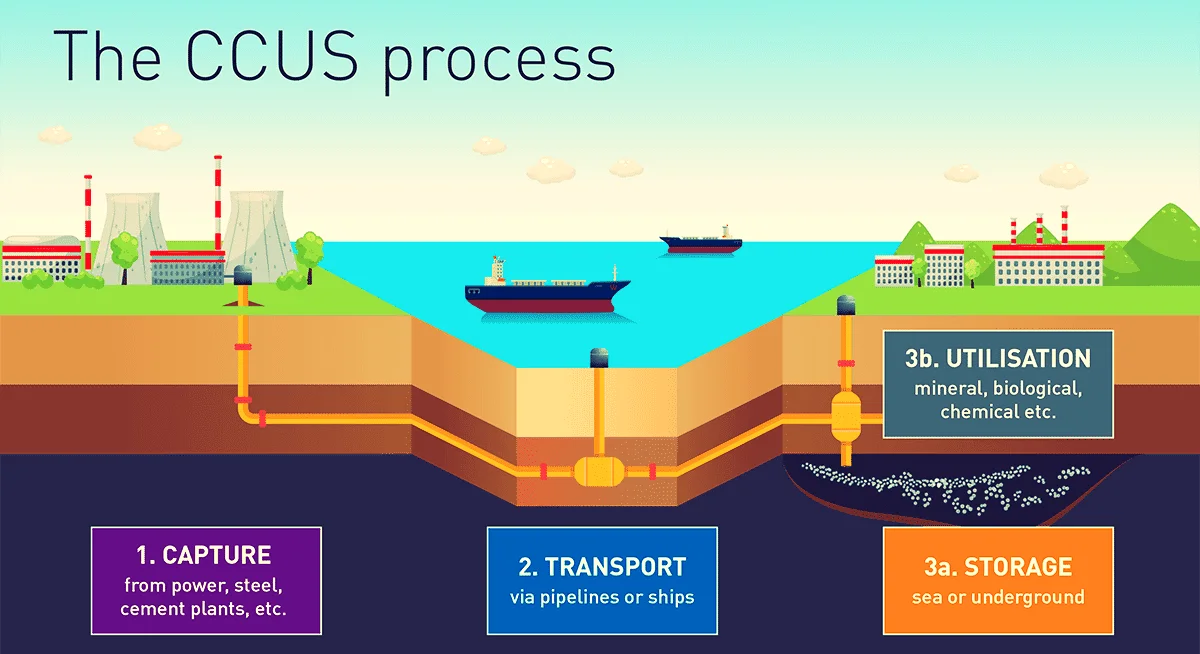
What are the Various Carbon Capture Utilisation Technologies?
Capture Phase
- Post-combustion capture: Separation from flue gases after fuel combustion, typically using chemical solvents (e.g., amine-based absorption).
- Pre-combustion capture: Conversion of fuel into a syngas mixture, followed by CO₂ separation before combustion.
- Oxy-fuel combustion: Burning fuel in nearly pure oxygen to produce a CO₂-rich exhaust stream for easier capture.
- Direct air capture (DAC): Extraction of CO₂ directly from ambient air using sorbents or solvents, though more energy-intensive due to lower atmospheric concentrations.
Utilisation Phase
- Direct Use (Non-Conversion): This pathway leverages CO₂ for its physical properties without altering its molecular structure. Key applications include:
- Enhanced Oil Recovery (EOR): Injecting captured CO₂ into depleting oil fields to extract more oil. It is the most mature application but is controversial as it enables further fossil fuel extraction.
- Food and Beverage Industry: Used for carbonating drinks and in modified atmosphere packaging to extend shelf life.
- Greenhouses and Algae Cultivation: CO₂ acts as a fertiliser to boost plant growth and cultivate algae.
- Refrigerants and Dry Ice: Used in industrial cooling systems and for transport cooling.
- Conversion into Chemicals and Fuels: This involves chemically transforming CO₂ into complex molecules, requiring significant energy and catalysts.
- Synthetic Fuels (E-fuels): Combining captured CO₂ with green hydrogen creates "drop-in ready" fuels like methanol, gasoline, or jet fuel. However, they are energy-intensive to produce and release CO₂ back into the atmosphere when burned.
- Chemicals: CO₂ can be used to produce polymers, plastics, and urea (a key fertilizer ingredient).
- Mineralisation (CO₂ to Minerals): This mimics natural processes by reacting CO₂ with minerals or industrial alkaline wastes to form stable, solid carbonates, permanently locking the CO₂ away.
Frequently Asked Questions (FAQs)
1. What is Carbon Capture and Utilisation (CCU)?
CCU captures CO₂ from industrial sources or air and converts it into useful products like fuels, chemicals, and building materials, supporting a circular carbon economy.
2. How is CCU different from CCS?
CCS stores CO₂ underground permanently, whereas CCU reuses captured CO₂ for economic applications.
3. Why is CCU important for India?
India, the 3rd-largest CO₂ emitter, needs CCU to decarbonise hard-to-abate sectors like cement and steel that cannot rely solely on renewable energy.
UPSC Civil Services Examination, Previous Year Questions (PYQs)
Prelims
Q1. Consider the following agricultural practices: (2012)
- Contour bunding
- Relay cropping
- Zero tillage
In the context of global climate change, which of the above helps/help in carbon sequestration/storage in the soil?
(a) 1 and 2 only
(b) 3 only
(c) 1, 2 and 3
(d) None of them
Ans: (b)
Q2. In the context of mitigating the impending global warming due to anthropogenic emissions of carbon dioxide, which of the following can be the potential sites for carbon sequestration? (2017)
- Abandoned and uneconomic coal seams
- Depleted oil and gas reservoirs
- Subterranean deep saline formations
Select the correct answer using the code given below:
(a) 1 and 2 only
(b) 3 only
(c) 1 and 3 only
(d) 1, 2 and 3
Ans: (d)
Training of Large Language Models
Why in News?
At the India-AI Impact Summit 2026, Sarvam AI unveiled two indigenous Large Language Models (LLMs), marking a significant step in India’s AI ecosystem.
- The models are designed to be less power- and compute-intensive while improving performance in Indian languages, highlighting India’s growing capability in training cost-efficient, locally relevant LLMs.
How are Large Language Models (LLMs) Trained?
- LLM: A Large Language Model (LLM) is an artificial intelligence system built using transformer-based neural networks that can understand, interpret, and generate human language.
- Trained on massive datasets, LLMs use deep learning to identify patterns in text and learn how words and sentences relate to each other.
- Their performance depends on data quality, and they are further improved through fine-tuning for specific tasks such as translation, summarization, and question answering.
Training
- Data Collection & Pre-processing: LLM training begins with collecting a massive corpus of text from sources like the internet, books, Wikipedia, and code repositories.
- The text is converted into tokens (small units of words or subwords) so machines can process it.
- The data is then cleaned to remove spam, duplicates, bias, and harmful content, ensuring the model learns accurate and high-quality language patterns.
- Pre-training (Self-Supervised Learning): In the pre-training stage, the model learns language patterns using next-token prediction, where it predicts the next word in a sentence.
- Most modern LLMs use the Transformer architecture with self-attention, enabling them to understand relationships between distant words.
- This stage produces a base model that understands grammar, facts, and reasoning but cannot yet follow instructions effectively.
- Supervised Fine-Tuning (Instruction Tuning): During supervised fine-tuning, the model is trained on curated prompt–response pairs created by human experts.
- This teaches the model how to respond to instructions, answer questions, and perform tasks like summarization.
- As a result, the model learns the format of conversations and becomes more useful for real-world applications.
- Alignment using RLHF: In the alignment stage, developers use RLHF (Reinforcement Learning from Human Feedback) to ensure the model produces safe, unbiased, and helpful responses.
- The model generates multiple answers, which humans rank based on quality and safety.
- A reward model learns these preferences, and the LLM is optimized to produce responses aligned with human values and ethical standards.
- Limitations of Training LLMs in India: Indian AI models face several bottlenecks, including the scarcity of high-quality datasets in Indian languages, which affects accuracy and inclusivity.
- Many models consume more tokens by translating inputs into English to improve performance, increasing computational costs.
- Additionally, training LLMs in India remains challenging due to limited capital availability and the lack of immediate commercial use cases, which constrains large-scale investment in domestic AI development.
Note: Early Large Language Models (LLMs) with hundreds of billions or even trillions of parameters processed queries by activating all parameters during inference, making them computationally expensive and resource-intensive.
- The new models use Mixture of Experts (MoE), an AI model architecture where only a small subset of parameters (“experts”) is activated for each query, instead of using the entire model.
- This makes LLMs faster, cheaper, and more compute-efficient, enabling cost-effective deployment in resource-constrained environments like India.
- Indian models such as Sarvam’s 105B parameter LLM and BharatGen’s multilingual 17B model use efficiency-focused approaches to support local languages and sectors like education and healthcare.
IndiaAI Mission
- Launched in March 2024 with an outlay of Rs 10,372 crore, the IndiaAI Mission aims to build a comprehensive AI ecosystem in India.
- Under the mission, the government has commissioned over 36,000 Graphics Processing Units (GPUs) in Indian data centres and is expanding capacity by adding 20,000 more, targeting over 100,000 GPUs by the end of 2026.
- Startups such as Sarvam AI have received subsidised access to compute infrastructure for AI training and inference. Sarvam AI was granted access to 4,096 GPUs from the common compute cluster, with subsidies amounting to nearly Rs 100 crore.
- The mission also supports talent development for over 13,500 students, is establishing India Data and AI Labs, and promotes sovereign foundational models trained on Indian datasets, with financial assistance covering compute and related costs to boost open-source innovation and startup growth.
Frequently Asked Questions (FAQs)
- What is a Large Language Model (LLM)?
An LLM is a transformer-based AI system trained on massive datasets to understand and generate human language using deep learning. - What is Mixture of Experts (MoE) architecture in AI?
MoE activates only a subset of model parameters per query, reducing compute costs and improving efficiency in LLM deployment. - What is the objective of the IndiaAI Mission?
It aims to build a sovereign AI ecosystem through compute infrastructure, indigenous models, datasets, and talent development. - Why are indigenous LLMs important for India?
They improve Indian language support, ensure data sovereignty, and reduce dependence on foreign AI platforms. - How does RLHF improve AI models?
Reinforcement Learning from Human Feedback aligns AI outputs with human values, ensuring safety, accuracy, and ethical responses.
UPSC Civil Services Examination Previous Year Question (PYQ)
Prelims
Q. With the present state of development, Artificial Intelligence can effectively do which of the following? (2020)
- Bring down electricity consumption in industrial units
- Create meaningful short stories and songs
- Disease diagnosis
- Text-to-Speech Conversion
- Wireless transmission of electrical energy
Select the correct answer using the code given below:
(a) 1, 2, 3 and 5 only
(b) 1, 3 and 4 only
(c) 2, 4 and 5 only
(d) 1, 2, 3, 4 and 5
Ans: (b)
CBDC Pilot for Food Subsidy Distribution
India has launched a Central Bank Digital Currency (CBDC)-based food subsidy distribution pilot under Pradhan Mantri Garib Kalyan Anna Yojana (PMGKAY) in Puducherry, marks a significant reform in the delivery of food subsidy through the Public Distribution System (PDS) by integrating the Digital Rupee (e₹) into the Direct Benefit Transfer (DBT) framework.
- Programmable and Purpose-Bound Usage: A defining feature of this initiative is that the Subsidy is credited as programmable CBDC tokens directly into beneficiary wallets.
- They are redeemable exclusively for the purchase of entitled foodgrains at authorized Fair Price Shops (FPS), ensuring targeted usage and completely eliminating the possibility of fund diversion.
- System Efficiency and Transparency: This digital cash mechanism is instant, highly secure, and fully traceable, which significantly reduces friction, plugs leakages, and enhances accountability in the national food security ecosystem.
- The pilot is being implemented in coordination with the Government of Puducherry, Reserve Bank of India, Public Financial Management System (PFMS), and Canara Bank.
- Following its rollout in Puducherry, the initiative will be expanded in phases to other Union Territories and beneficiaries.
Central Bank Digital Currency
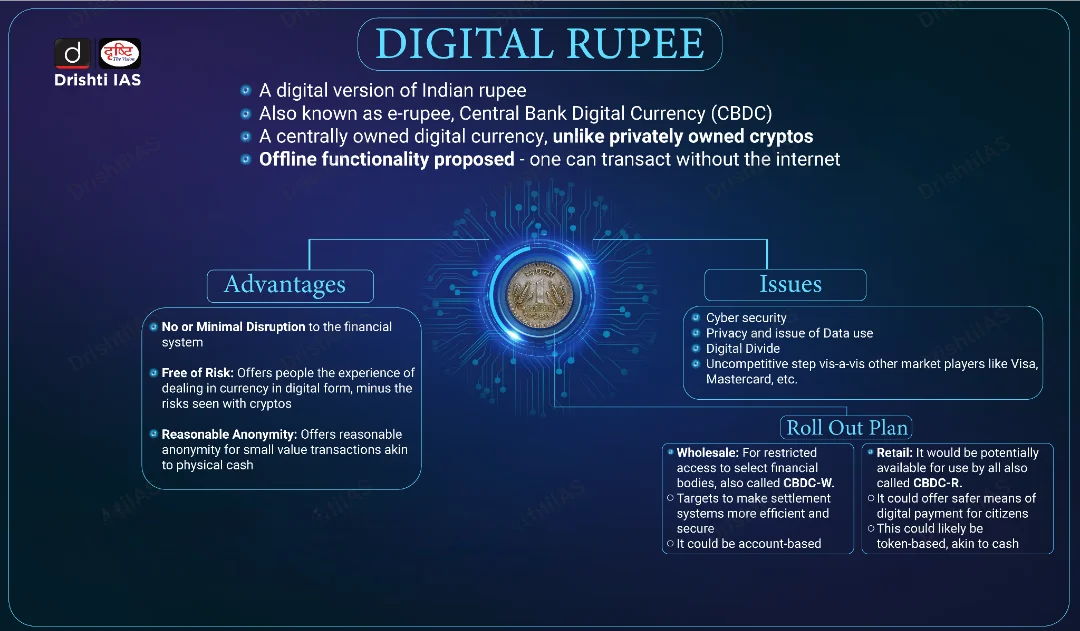
- About: It is the digital form of a country's fiat currency. Unlike the digital money in your traditional bank account (which is a liability of a commercial bank), a CBDC is issued directly by the country's central bank and represents a direct sovereign liability.
-
Digital Rupee (e₹) is India's official CBDC. It is recognized as legal tender, meaning it holds the exact same value as physical cash and can be exchanged one-to-one with paper currency.
-
-
Retail CBDC (e₹-R): Designed for the general public and everyday businesses. It operates via digital wallets provided by banks, offering a safe store of value and enabling instant peer-to-peer and peer-to-merchant transactions.
-
Because it mimics physical cash, no interest is paid on the wallet balance.
-
Wholesale CBDC (e₹-W): Restricted to financial institutions and intermediaries. It is engineered to streamline large-value transactions like secondary market trades in Government Securities and inter-bank lending by drastically reducing settlement costs and mitigating counterparty settlement risks.
-
Distinct from UPI: While Unified Payments Interface (UPI) is simply a payment interface that moves existing money between traditional bank accounts.
-
The Digital Rupee transactions settle instantaneously wallet-to-wallet without needing the commercial bank's backend ledger. However, for maximum convenience, e₹ apps are fully interoperable with existing UPI QR codes.
-
| Read more:Central Bank Digital Currency |
Reserve Bank of India’s Switch Auction
The Reserve Bank of India (RBI) has announced a Rs 25,000 crore switch auction of Government Securities (G-Secs) to manage debt maturity and reduce redemption pressure in FY27, after earlier conducting two such operations totaling Rs 84,804 crore.
- Redemption pressure is defined as the financial burden on the government when a large volume of bonds or debt instruments mature at the same time, requiring repayment or refinancing.
- Switch Auction: It is a debt management tool used by the RBI to help the government manage its repayment burden. In this process, the government replaces short-term bonds that are nearing maturity with new long-term bonds, thereby postponing repayment obligations.
- Shifting the Maturity Profile: The recent Rs 25,000 crore switch auction aims to reduce the heavy redemption pressure in FY27, when Rs 5.47 lakh crore worth of bonds are due.
- By extending maturities beyond FY32, the RBI helps smooth the government’s debt profile, reduce refinancing risks, and maintain fiscal stability.
- Effective Fiscal Management: Given that the government's gross market borrowing is already budgeted at a substantial 17.2 lakh crore rupees, utilizing switch auctions helps to seamlessly ease the maturity profile and manage repayment obligations without requiring immediate, large-scale cash liquidity.
| Read more: Quantitative Instruments of Monetary Policy |
India-Sweden SITAC Partnership
The IndiaAI Mission and Business Sweden signed a Statement of Intent (SoI) on the sidelines of the India AI Impact Summit 2026 to strengthen bilateral cooperation in Artificial Intelligence (AI) and digital technologies.
- Launch of SITAC: The partnership will establish the Sweden–India Technology and Artificial Intelligence Corridor (SITAC). This will serve as the flagship platform for structured engagement between government agencies, industry, startups, and academic institutions of both nations.
- Focus on Real-World Impact: The collaboration emphasizes the development and deployment of AI solutions for real-world industrial and societal outcomes, leveraging AI for innovation, economic growth, and sustainable development while addressing associated risks.
- Synergy of Strengths: The partnership aligns the IndiaAI Mission's goal of building a national AI ecosystem (through access to compute, data, and talent) with Sweden’s strengths in industrial innovation, advanced R&D, and responsible AI implementation.
Other India-Sweden Technological Partnership
- Joint Declaration on India-Sweden Innovation Partnership for a Sustainable Future (2018): It is the foundational framework for India-Sweden technological partnership, structured around co-funding and co-creation to address societal challenges in sectors like smart cities, AI, and green energy.
- India–Sweden Industry Transition Partnership (ITP) (2023): It focuses on decarbonising heavy industries like steel and cement through joint innovation, knowledge sharing, and pilot projects involving low-carbon technologies, carbon capture, hydrogen use, and AI optimisation.
|
Read More: India Sweden Innovation Meet |
ECI-SEC National Declaration 2026
The conference of the Election Commission of India (ECI) and State Election Commissioners (SECs) adopted the National Declaration 2026 to enhance federal coordination in electoral processes after a 27-year gap.
- Pure Electoral Rolls as Bedrock: The National Declaration emphasized that the preparation of "pure electoral rolls" (error-free and updated) is the bedrock of democracy, highlighting the need for transparent and efficient election conduct.
- Core Objective: The conference aimed at synergizing the laws and processes for elections to Panchayats and Municipal bodies (conducted by SECs) with those for Parliament (President, Vice-President, Lok Sabha, Rajya Sabha) and State Legislatures (State Legislative Assemblies and Councils) (conducted by ECI).
- ECI proposed that the National Round Table Conference be held annually, ideally alongside global conferences chaired by the ECI, and invited SECs to participate in its international engagements.
- A joint legal and technical team will review SECs’ suggestions, with a state/UT-wise roadmap to be submitted within three months.
- Sharing of Technological Resources: The ECI offered to share its technological assets with the SECs to improve efficiency, including:
- ECINET Portal: For better electoral roll management and coordination.
- EVMs (Electronic Voting Machines): Sharing of infrastructure for local body polls.
- IIIDEM: Extending the facilities of the India International Institute of Democracy and Electoral Management (IIIDEM) for training and capacity building.
- Publication on IICDEM 2026: A publication titled “A Confluence of Democracies” was also released, documenting the India International Conference on Democracy and Election Management (IICDEM) 2026 and the adoption of the Delhi Declaration 2026.
| Read More: Election Commission of India |