
Fiscal Health Index 2026
For Prelims: Fiscal Health Index, NITI Aayog, Comptroller and Auditor General, Gross State Domestic Product (GSDP), Fiscal deficit
For Mains: Fiscal federalism and the role of states in India’s public finance architecture, Debt sustainability and fiscal discipline in Indian states, Significance of Fiscal Health Index for improving state finances
Why in News?
NITI Aayog released the second edition of the Fiscal Health Index (FHI) 2026 to evaluate the fiscal performance of Indian states. The index provides a data-driven framework to assess fiscal sustainability, compare state finances, and guide reforms.
- The report gains significance as global public debt has surged to about USD 102 trillion in 2024, increasing pressure on public finances worldwide.
Summary
- Fiscal Health Index (FHI) 2026, released by NITI Aayog, evaluates the fiscal performance of Indian states using five pillars—Quality of Expenditure, Revenue Mobilisation, Fiscal Prudence, Debt Index, and Debt Sustainability—and expands coverage to include North-Eastern and Himalayan states, highlighting wide variations in fiscal discipline and debt levels.
- The report stresses that strong state finances are crucial for India’s macroeconomic stability, recommending measures such as improving tax mobilisation, controlling committed expenditure, enhancing capital spending, strengthening fiscal transparency, and adopting medium-term fiscal planning.
What is the Fiscal Health Index?
- About: The FHI is a comprehensive framework developed by NITI Aayog to assess and compare the fiscal performance of Indian states.
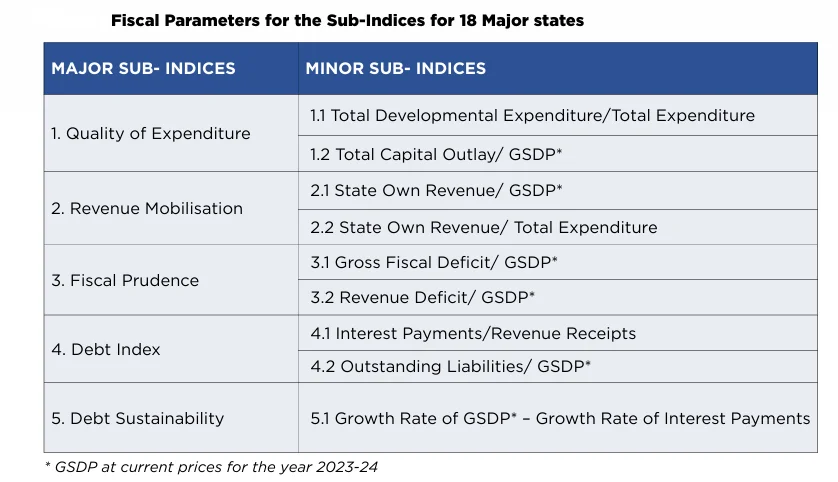
- It evaluates states across five key pillars: Quality of Expenditure, Revenue Mobilisation, Fiscal Prudence, Debt Index, and Debt Sustainability.
- The index uses data verified by the Comptroller and Auditor General (CAG), ensuring rigour and transparency.
- The goal is to guide reforms, encourage evidence-based policymaking, and enable peer benchmarking across states.
- FHI 2026: It analyses fiscal trends over a decade from FY 2014-15 to FY 2023-24 providing a longitudinal perspective on how states are progressing or regressing.
- The second edition expands coverage from 18 General Category States to also include 10 North-Eastern and Himalayan States, making the index more inclusive of India's diverse fiscal landscape.
- Sub-indicators for NE states have been refined to reflect their unique challenges such as geographic remoteness, sparse population density, limited own-revenue capacity, elevated committed expenditures, and greater dependence on Union transfers.
- NE and Himalayan states are ranked separately from general category states to ensure fair and contextually appropriate comparison.
- The edition retains the same five pillars for major states while improving the depth of narrative insights and trend analysis.
- The second edition expands coverage from 18 General Category States to also include 10 North-Eastern and Himalayan States, making the index more inclusive of India's diverse fiscal landscape.
What are the Key Highlights of the FHI 2026?
18 Major States
- Achievers (Top Performers): Odisha, Goa, Jharkhand.
- Odisha continues to lead the rankings, driven by controlled deficits, stable revenues, and improving scores year-on-year.
- Achiever states share common traits: own-tax shares above 60%, capital outlay of around 4–5% of Gross State Domestic Product (GSDP), fiscal deficits below 3% of GSDP, moderate debt levels under 25% of GSDP, and contained interest burdens.
- Goa and Odisha record high State Own Revenue ratios, reflecting strong tax bases and greater fiscal autonomy.
- Front-Runners: Gujarat, Maharashtra, Chhattisgarh, Telangana, Uttar Pradesh, Karnataka.
- Gujarat and Maharashtra maintain low debt levels and contain interest burdens, supporting fiscal sustainability.
- Performers: Madhya Pradesh, Haryana, Bihar, Tamil Nadu, Rajasthan.
- Bihar has improved from Aspirational to Performer, signalling better deficit management.
- Karnataka and Telangana moved from Front Runner to Performer, highlighting slight fiscal slippage.
- Tamil Nadu has slipped from Performer to Aspirational, indicating emerging fiscal pressures.
- Aspirational (Bottom Performers): West Bengal, Kerala, Andhra Pradesh, Punjab.
- These states face persistent revenue and fiscal deficits, often breaching FRBM (Fiscal Responsibility and Budget Management) norms.
- Debt levels range between roughly 35–45% of GSDP, significantly above the national comfort zone.
- Committed expenditure accounts for about 50–60% of revenue receipts, leaving little room for developmental spending.
- Interest payments exceed 15–20% of revenue receipts, further compressing fiscal flexibility.
- Punjab, Kerala, and West Bengal face the most elevated debt and interest commitments among all major states.
.webp)
North-Eastern and Himalayan States
- Achievers: Arunachal Pradesh and Uttarakhand.
- Arunachal Pradesh ranks first due to high expenditure quality, prudent debt management, and controlled deficits, occasionally recording fiscal surpluses.
- Uttarakhand performs strongly because of relatively higher own-revenue mobilisation, giving it greater fiscal autonomy.
- Performers: Assam, Meghalaya, Mizoram, Sikkim, Tripura.
- Tripura performs well in debt sustainability, while Mizoram faces challenges due to weaker debt sustainability indicators.
- Sikkim shows lower performance in fiscal prudence, and Nagaland struggles with weak revenue mobilisation and expenditure quality.
- Aspirational: Himachal Pradesh, Manipur, Nagaland.
- Himachal Pradesh and Manipur remain at the bottom due to weak revenue bases, high committed expenditure (salaries and pensions), and persistent deficits.
- Their debt levels are high, around 40–50% of GSDP, increasing debt-servicing pressures and limiting fiscal flexibility.
.webp)
What is the Significance of the Fiscal Health of States?
- Macroeconomic Stability of India: States account for about one-third of India’s total government debt, making their fiscal position crucial for national fiscal sustainability.
- When states face fiscal stress, it can trigger inflationary pressures, crowd out private investment, and force the central government to step in with bailouts, destabilising the broader economy.
- India’s overall public debt is around 82% of GDP, so responsible fiscal management by states is essential to keep the debt burden under control.
- Large Role in Public Spending and Development: State governments undertake a large share of spending on health, education, infrastructure, and welfare programmes, which directly affect citizens’ well-being and development outcomes.
- Strong fiscal health allows states to invest more in capital expenditure, helping reduce regional disparities and supporting long-term economic growth.
- Rising Debt and Fiscal Pressures: The debt-to-GSDP ratio of states increased from about 16.7% in 2013-14 to nearly 23% in 2022-23, indicating rising borrowing pressures.
- The combined fiscal deficit of states increased to around 3.2% of GDP in FY25, reflecting growing fiscal pressures on state governments which can threaten fiscal sustainability if not managed carefully.
What Policy Measures are Recommended by the FHI 2026 to Strengthen State Finances?
- Boost Revenue: Broaden the GST tax base, improve tax compliance, and strengthen state own-tax revenues such as property tax, excise, and stamp duties. Improve digital tax administration and data analytics to reduce tax evasion.
- Control Spending: Curb "committed expenditures" (like massive pension and salary bills) and rationalise subsidies to restore fiscal flexibility.
- The 16th Finance Commission (2026–31) called for rationalising subsidies, particularly unconditional cash transfers that account for about 20.2% of total subsidy spending.
- Improve Capital Outlay: Focus on improving the composition and quality of capital spending to drive long-term growth.
- Plan for the Future: Follow FRBM targets by keeping the state fiscal deficit around 3% of GSDP.
- The 16th Finance Commission (2026–31) also recommended reducing the Centre’s fiscal deficit to 3.5% of GDP by 2030–31 to maintain fiscal discipline and sustainable debt levels.
- Enhance Transparency: Implement tighter controls on off-budget borrowings, improve cash management, and utilize verified CAG data for better public financial management.
Conclusion
The Fiscal Health Index 2026 highlights that strong state finances are vital for India’s macroeconomic stability. By using this benchmarking tool, states can identify fiscal weaknesses, undertake targeted reforms, reduce regional disparities, and strengthen fiscal governance to support the vision of Viksit Bharat @2047.
|
Drishti Mains Question: “Fiscal health of states is central to India’s macroeconomic stability.”Examine in the context of the Fiscal Health Index 2026. |
Frequently Asked Questions (FAQs)
1. What is the Fiscal Health Index (FHI)?
The FHI is a framework developed by NITI Aayog to assess and compare the fiscal performance of Indian states based on indicators such as revenue mobilisation, expenditure quality, fiscal prudence, and debt sustainability.
2. Which pillars are used to evaluate states under the Fiscal Health Index?
The index evaluates states across five pillars: Quality of Expenditure, Revenue Mobilisation, Fiscal Prudence, Debt Index, and Debt Sustainability.
3. Which states are the top performers in the Fiscal Health Index 2026?
Among major states, Odisha, Goa, and Jharkhand are ranked as Achievers due to strong revenue mobilisation, low fiscal deficits, and moderate debt levels.
4. Why are North-Eastern and Himalayan states ranked separately in FHI 2026?
They face structural constraints such as difficult terrain, sparse population, limited revenue capacity, and higher service delivery costs, requiring context-specific evaluation.
UPSC Civil Services, Previous Year Questions (PYQ)
Prelims
Q1. In the context of governance, consider the following: (2010)
- Encouraging Foreign Direct Investment inflows
- Privatization of higher educational Institutions
- Down-sizing of bureaucracy
- Selling/offloading the shares of Public Sector Undertakings
Which of the above can be used as measures to control the fiscal deficit in India?
(a) 1, 2 and 3
(b) 2, 3 and 4
(c) 1, 2 and 4
(d) 3 and 4 only
Ans: D
Q2. Which one of the following is likely to be the most inflationary in its effect? (2021)
(a) Repayment of public debt
(b) Borrowing from the public to finance a budget deficit
(c) Borrowing from the banks to finance a budget deficit
(d) Creation of new money to finance a budget deficit
Ans: (d)
Q3. Which of the following is/are included in the capital budget of the Government of India? (2016)
- Expenditure on acquisition of assets like roads, buildings, machinery, etc.
- Loans received from foreign governments
- Loans and advances granted to the States and Union Territories
Select the correct answer using the code given below:
(a) 1 only
(b) 2 and 3 only
(c) 1 and 3 only
(d) 1, 2 and 3
Ans: (d)
Mains
Q1. One of the intended objectives of the Union Budget 2017-18 is to ‘transform, energise and clean India’. Analyse the measures proposed in the Budget 2017-18 to achieve the objective. (2017)
Q2. Distinguish between Capital Budget and Revenue Budget. Explain the components of both these Budgets. (2021)
Q.3 Do you agree with the view that steady GDP growth and low inflation have left the Indian economy in good shape? Give reasons in support of your arguments. (2019)
Denial of Public Spaces to Scheduled Castes
Why in News?
Data from the National Crime Records Bureau Crime in India 2023 report highlights a rise in cases where Scheduled Castes (SCs) were denied access to public spaces under the Scheduled Castes and Scheduled Tribes (Prevention of Atrocities) Act, 1989.
NCRB Data on Denial of Access to Public Spaces
- Out of 180 cases of denial of access to public spaces reported nationwide, 173 were from Uttar Pradesh, making the state a clear outlier in this category.
- The trend has been rising since 2017, largely driven by increased reporting and registration of cases in Uttar Pradesh.
- The State’s share in total reported cases rose from about 68% in 2018 to nearly 80% in 2019.
- The concentration became even more pronounced in 2022, when over 98% of all such cases reported nationwide came from Uttar Pradesh.
- In comparison to SCs, cases involving Scheduled Tribes (STs) being denied access to public spaces remain relatively low across the country.
What are the Underlying Reasons for the Denial of Public Spaces?
- Caste-Based Spatial Segregation: In many rural areas, informal caste geographies still exist where dominant castes control temples, water bodies, cremation grounds, and village pathways.
- Despite modernization, orthodox notions of ritual purity dictate access to specific public goods, particularly water sources and religious sites.
- The entry of an SC individual is still perceived by conservative elements as "polluting" the shared commons.
- Such practices reflect continuing forms of untouchability, despite its abolition under Article 17 of the Constitution of India, and undermine the anti-discrimination guarantee of Article 15 which ensures equal access to public spaces.
- Despite modernization, orthodox notions of ritual purity dictate access to specific public goods, particularly water sources and religious sites.
- Dominance of Local Power Structures: Village governance structures and informal caste councils often reinforce social hierarchy.
- The vast majority of rural SC populations remain landless agricultural laborers. Land ownership and economic dependence allow dominant groups to enforce exclusion through intimidation or social boycott to deter marginalized groups from claiming their legal rights to public spaces.
- Weak Enforcement of Anti-Atrocity Laws: Although the SC/ST (Prevention of Atrocities) Act, 1989 criminalizes the denial of access to public spaces for Scheduled Castes, gaps in enforcement continue to persist.
- In many cases, victims face delays in First Information Report (FIR) registration, inadequate police investigation, and low conviction rates in atrocity cases, which weaken the deterrent effect of the law and allow discriminatory practices to continue.
- Limited Awareness of Legal Rights: Many marginalized communities are unaware of protections under the SC/ST (Prevention of Atrocities) Act, 1989 and constitutional safeguards.
- Lack of legal literacy prevents victims from reporting discrimination or seeking institutional redress.
What are the Legal and Institutional Protections to Democratize Public Spaces?
- Article 15: Prohibits discrimination on grounds of caste and guarantees equal access to public spaces such as shops, wells, tanks, roads, and public places.
- Article 17: Abolishes untouchability and declares its practice in any form a punishable offence.
- Article 21: Guarantees the right to life with dignity, which courts have repeatedly interpreted to include the right to live free from discrimination and social exclusion.
- 73rd Constitutional Amendment Act, 1992: Mandates reservation for Scheduled Castes (SCs), Scheduled Tribes (STs), and women in Panchayati Raj Institutions, ensuring their participation in local governance and more inclusive control over village resources and public spaces.
- SC/ST (Prevention of Atrocities) Act, 1989: Criminalizes acts such as denying SC/ST individuals entry to public places, temples, water sources, and community resources.
- Protection of Civil Rights Act, 1955: Provides legal safeguards against practices arising from untouchability, including denial of access to public facilities.
- National Commission for Scheduled Castes: Monitors safeguards for SC communities and investigates complaints related to discrimination.
- Judicial Pronouncements:
- State of Karnataka v. Appa Balu Ingale (1995): Supreme Court of India held that the objective of Article 17 of the Constitution of India and related laws is to free society from blind adherence to discriminatory caste practices that no longer have any legal or moral basis.
- Arumugam Servai v. State of Tamil Nadu (2011): The Supreme Court of India directed district administrations to ruthlessly eradicate everyday spatial segregation practices, such as the discriminatory "two-tumbler system" in public tea stalls.
What Steps can be Taken to Democratize Public Spaces in India?
- Ensure Spatial Justice: Locate public facilities (Panchayat Bhavans, Anganwadis, PDS shops, wells) in neutral or SC-dominated areas to break traditional caste-based spatial segregation, forcing dominant castes to share spaces rather than gatekeeping them.
- Link Funds to Social Audits: Make Gram Sabha social audits mandatory and link development grants to certification that no untouchability or spatial exclusion exists.
- Official Accountability: Strictly enforce Section 4 of the Scheduled Castes and Scheduled Tribes (Prevention of Atrocities) Act, 1989, which penalizes public officials who neglect duties such as registering FIRs or protecting victims.
- Establish Exclusive Special Courts: Set up district-level exclusive courts to ensure speedy trials in atrocity cases, reducing pendency and improving deterrence.
- Behavioural Change Campaigns: Promote constitutional values and anti-caste reform ideas of B. R. Ambedkar, Jyotirao Phule, and Periyar E. V. Ramasamy.
Conclusion
The denial of access to public spaces reflects the persistence of caste hierarchies in everyday life. Addressing this challenge requires strong law enforcement, socio-economic empowerment, and a deeper societal commitment to constitutional morality and equality.
Frequently Asked Questions (FAQs)
1. What does Article 17 of the Constitution of India provide?
Article 17 of the Constitution of India abolishes untouchability and makes its practice in any form a punishable offence.
2. What is the objective of the SC/ST (Prevention of Atrocities) Act, 1989?
TheScheduled Castes and Scheduled Tribes (Prevention of Atrocities) Act, 1989 criminalizes caste-based atrocities, including denial of access to public places, and provides special courts, victim protection, and relief measures.
3. What is the significance of Article 15(2) of the Constitution?
Article 15(2) of the Constitution of Indiaprohibits discrimination in access to public places such as shops, wells, tanks, and roads maintained with public funds.
4. Which law punishes practices arising from untouchability?
TheProtection of Civil Rights Act, 1955, provides penalties for enforcing social or religious disabilities arising from untouchability.
5. What was the significance of the Supreme Court judgment in State of Karnataka v. Appa Balu Ingale (1995)?
InState of Karnataka v. Appa Balu Ingale (1995), the Supreme Court of India emphasized that Article 17 aims to eliminate discriminatory caste practices lacking any legal or moral basis.
UPSC Civil Services Examination Previous Year Question (PYQ)
Mains
Q1. Has caste lost its relevance in understanding the multi-cultural Indian Society? Elaborate your answer with illustrations. (2020)
Q2. “Caste system is assuming new identities and associational forms. Hence caste system cannot be eradicated in India.” Comment. (2018)
Q3. What are the two major legal initiatives by the State since Independence addressing discrimination against Scheduled Tribes (STs)? (2017)
Q4. Mahatma Gandhi and Dr. B.R. Ambedkar, despite having divergent approaches and strategies, had a common goal of amelioration of the downtrodden. Elucidate. (2015)
Alternative Heating Technologies Amid Global Gas Supply Risks
Why in News?
The US–Israel conflict with Iran has increased risks in the Strait of Hormuz, a key global oil and gas transit route. As India imports nearly half of its natural gas, reduced gas supplies to industries have highlighted the need for alternative heating technologies such as electrified heat and concentrated solar thermal systems.
What are the Key Heating Technologies for Industrial Applications?
Concentrated Solar Thermal (CST) Technology
- Mechanism: Unlike Solar Photovoltaic (PV) panels that use semiconductors to convert sunlight into electricity (electrons), CST systems use mirrors or reflective surfaces to concentrate sunlight onto a receiver.
- The receiver captures heat and stores it in a Thermal Energy Storage (TES) medium such as oil, molten salt, or phase-change materials.
- The stored heat can be used directly for industrial processes, helping decarbonise sectors requiring thermal energy.
- Heat Generation: It heats a fluid (such as water, thermal oil, or molten salt) to extreme temperatures (up to 400°C), generating raw, intense heat.
- Industrial Application: It is highly suitable for industries like textiles, where processes such as scouring and bleaching require steam at temperatures between 100°C and 180°C.
- Grid Independence: CST can generate thermal energy on-site and store it in insulated tanks.
- This thermal storage is significantly cheaper than lithium-ion batteries and allows factories to operate 24/7 without drawing power from the national grid.
- India's Potential: According to the Ministry of New and Renewable Energy (MNRE), India has a CST potential of 6.4 GW.
Electromagnetic Induction Heating
- Traditional industrial boilers burn fuel to heat an intermediary medium (like air or steam), which then heats the product. This leads to massive thermal losses. Induction heating eliminates the intermediary, generating heat directly inside the target material.
- Mechanism:
- Electromagnetic Field: An alternating electric current (AC) is passed through a copper coil, creating a rapidly fluctuating magnetic field.
- Eddy Currents: When a conductive metal is placed inside this magnetic field, it induces small, localized electrical currents within the metal, known as Eddy Currents.
- Joule Heating: As these eddy currents flow, they face the natural electrical resistance of the metal. This resistance converts the electrical energy directly into heat from the inside out (a process known as Joule Heating).
- Key Advantages for Industry:
- Unmatched Efficiency: Because no heat is lost to the surrounding air or exhaust flues, thermal efficiency can exceed 90%.
- Rapid and Precise: It heats materials almost instantly and allows for highly localized heating (useful in automotive and metal forging industries).
- Zero Direct Emissions: When powered by renewable energy, it completely eliminates the carbon footprint of the heating process.
Plasma Torches
- While induction is excellent for metals, heavy industries like ceramics and cement require sustained, ultra-high temperatures (often exceeding 1,000°C) that standard electric heaters cannot achieve.
- Plasma arc technology provides a clean alternative to gas flames for these extreme thermal needs.
- Mechanism:
- Electric Arc Generation: The process begins by striking a high-voltage electric arc between two electrodes inside the torch.
- Ionization of Gas: A working gas (like argon or nitrogen) is forced through this intense electric arc.
- The extreme energy strips electrons from the gas atoms, transforming the gas into Plasma (widely known as the fourth state of matter).
- Thermal Energy Release: As this highly energized plasma jet exits the torch, it releases massive amounts of thermal energy onto the target material.
- Key Advantages for Industry:
- Ultra-High Temperatures: Plasma torches can easily generate core temperatures ranging from 5,000°C to over 10,000°C (hotter than the surface of the sun), making them ideal for smelting and advanced ceramics.
- Controlled Chemical Environments: By using specific inert or reactive gases to create the plasma, industries can control the chemical atmosphere, preventing materials from oxidizing (rusting) during the heating process.
- Fuel Substitution: It provides a direct, electrified replacement for highly polluting coal or natural gas furnaces in heavy manufacturing.
Global Best Practices in Solar-Based Industrial Heating
- Oman – Miraah Project: Integrates a large concentrated solar thermal (CST) plant with gas-fired operations, reducing gas use by nearly 80% through daytime solar steam generation.
- Spain – Solar Heat for Industrial Processes: Developed plug-and-play solar thermal units that can be easily installed and connected to existing industrial steam systems.
- Denmark – Heat Purchase Agreements: Industries buy heat from external providers operating CST or induction systems, supported by large-scale thermal storage to store excess heat.
Frequently Asked Questions (FAQs)
1. What is Concentrated Solar Thermal (CST) technology?
CST uses mirrors to concentrate sunlight onto a receiver to generate high-temperature heat, which can be stored in Thermal Energy Storage (TES) systems for industrial applications.
2. What is the estimated potential of CST in India?
According to the Ministry of New and Renewable Energy (MNRE), India has an estimated CST potential of about 6.4 GW.
3. How does induction heating work?
Induction heating uses alternating current to create a magnetic field, inducing eddy currents in conductive materials, which produce heat through Joule heating.
4. What are plasma torches used for in industry?
Plasma torches generate extremely high temperatures (5,000–10,000°C) and are used in smelting, ceramics, and other high-temperature industrial processes.
5. Why is electrifying industrial heat important for India?
It reduces dependence on imported fossil fuels, enhances energy security, and helps achieve industrial decarbonisation and climate goals.
UPSC Civil Services Examination, Previous Year Questions (PYQs)
Prelims
Q. Consider the following statements about 'PM Surya Ghar Muft Bijli Yojana' : (2025)
- It targets installation of one crore solar rooftop panels in the residential sector.
- The Ministry of New and Renewable Energy aims to impart training on installation, operation, maintenance and repairs of solar rooftop systems at grassroot levels.
- III. It aims to create more than three lakhs skilled manpower through fresh skilling, and up-skilling, under scheme component of capacity building.
Which of the statements given above are correct?
A. I and II only
B. I and III only
C. II and III only
D. I, II and III
Ans: D
Mains
Q. Access to affordable, reliable, sustainable and modern energy is the sine qua non to achieve Sustainable Development Goals (SDGs).” Comment on the progress made in India in this regard. (2018)
Kisan Credit Card Scheme
The Kisan Credit Card (KCC) scheme, supported by the Modified Interest Subvention Scheme (MISS), aims to ensure timely, affordable, and collateral-free institutional credit for farmers and allied sectors, thereby improving agricultural productivity and financial security.
- Evolution of KCC: The KCC Scheme, launched in 1998, provides short-term institutional credit to farmers for crop cultivation, post-harvest needs, and allied activities.
- To make credit affordable, the government introduced the Modified Interest Subvention Scheme (MISS) in 2006–07, offering concessional interest rates and support during natural calamities.
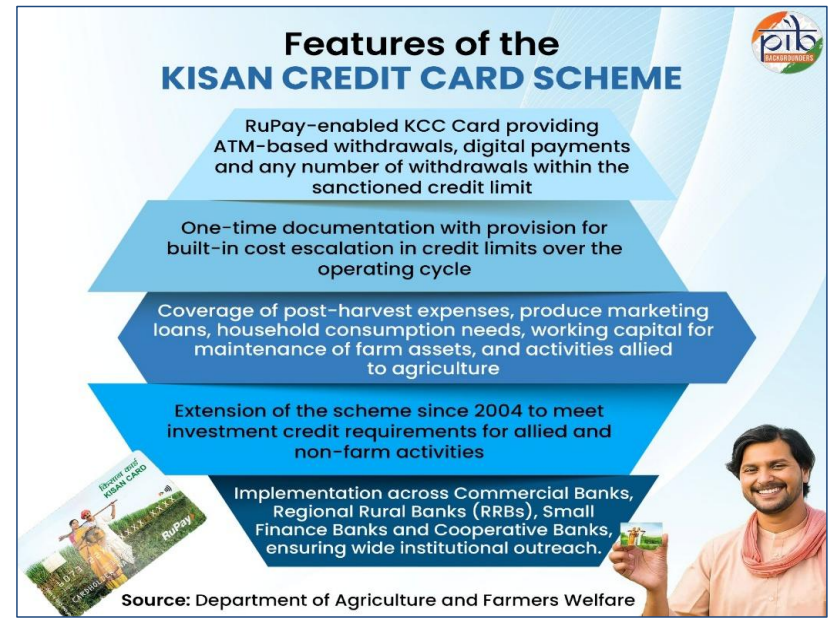
- The Revised KCC (2020) provides integrated, single-window credit through a RuPay-enabled card with digital payments and flexible withdrawals via commercial, regional rural, and cooperative banks.
- Eligible Beneficiaries: The KCC covers owner-cultivator farmers, joint borrowers, tenant farmers, oral lessees, and sharecroppers, along with Self-Help Groups (SHGs) and Joint Liability Groups (JLGs) to promote inclusive access to institutional credit.
- Credit under KCC & MISS (2025–26): The KCC crop loan limit was raised from Rs 3 lakh to Rs 5 lakh, with the fisheries and allied activities credit limit increased to Rs 5 lakh.
- The collateral-free loan limit was enhanced to Rs 2 lakh per borrower, while short-term crop loans up to Rs 3 lakh are available at 7% interest with a 3% subvention (under MISS), reducing the effective rate to 4%.
- It offers flexible revolving credit for up to 5 years, allowing farmers to withdraw funds as needed, along with interest relief during natural calamities (no interest for up to 1 year, extendable to 5 years in severe disasters).
- Farmer Onboarding & Digital Reforms: A simplified KCC application with PM-KISAN data and the Kisan Rin Portal (2023) enables faster loan processing and improved transparency in agricultural credit delivery.
- Scale & Impact of KCC: Over 7.72 crore KCCs are active with outstanding credit of Rs 10.2 lakh crore, supported by 457 banks, reflecting wide institutional outreach and expanding credit access to agriculture and allied sectors like animal husbandry and fisheries.
- Government Initiatives: The government has strengthened KCC accessibility through awareness campaigns, a nationwide KCC Saturation Drive under Atmanirbhar Bharat Abhiyan, and the introduction of RuPay-enabled KCC cards, promoting digital transactions, financial inclusion, and wider access to institutional agricultural credit.
| Read more: Kisan Credit Card |
V.O. Chidambaranar Port: India's First Digital Twin Port
The V.O. Chidambaranar Port (Tamil Nadu) has become the 1st port in India to launch a Digital Twin initiative for port management, aligning with Maritime India Vision 2030 and Amrit Kaal Vision 2047.
- Digital Twin Platform: It creates a real-time virtual replica of the port's infrastructure, operational assets, and maritime ecosystem by integrating advanced technologies such as IoT sensors, GPS tracking, LiDAR mapping, drone imaging, and CCTV networks.
- Key Technological Features: It enables real-time operational monitoring of berth occupancy, vessel movements, crane utilisation, and yard capacity. It supports predictive maintenance of cargo handling equipment through AI-based asset monitoring, minimising downtime and improving reliability.
- Expected Outcomes and Benefits: Reduction in vessel turnaround time by up to 25%.
- Improved equipment availability and operational reliability
- Enhanced safety through predictive alerts
- Optimised energy utilisation leading to lower carbon emissions
V.O. Chidambaranar Port
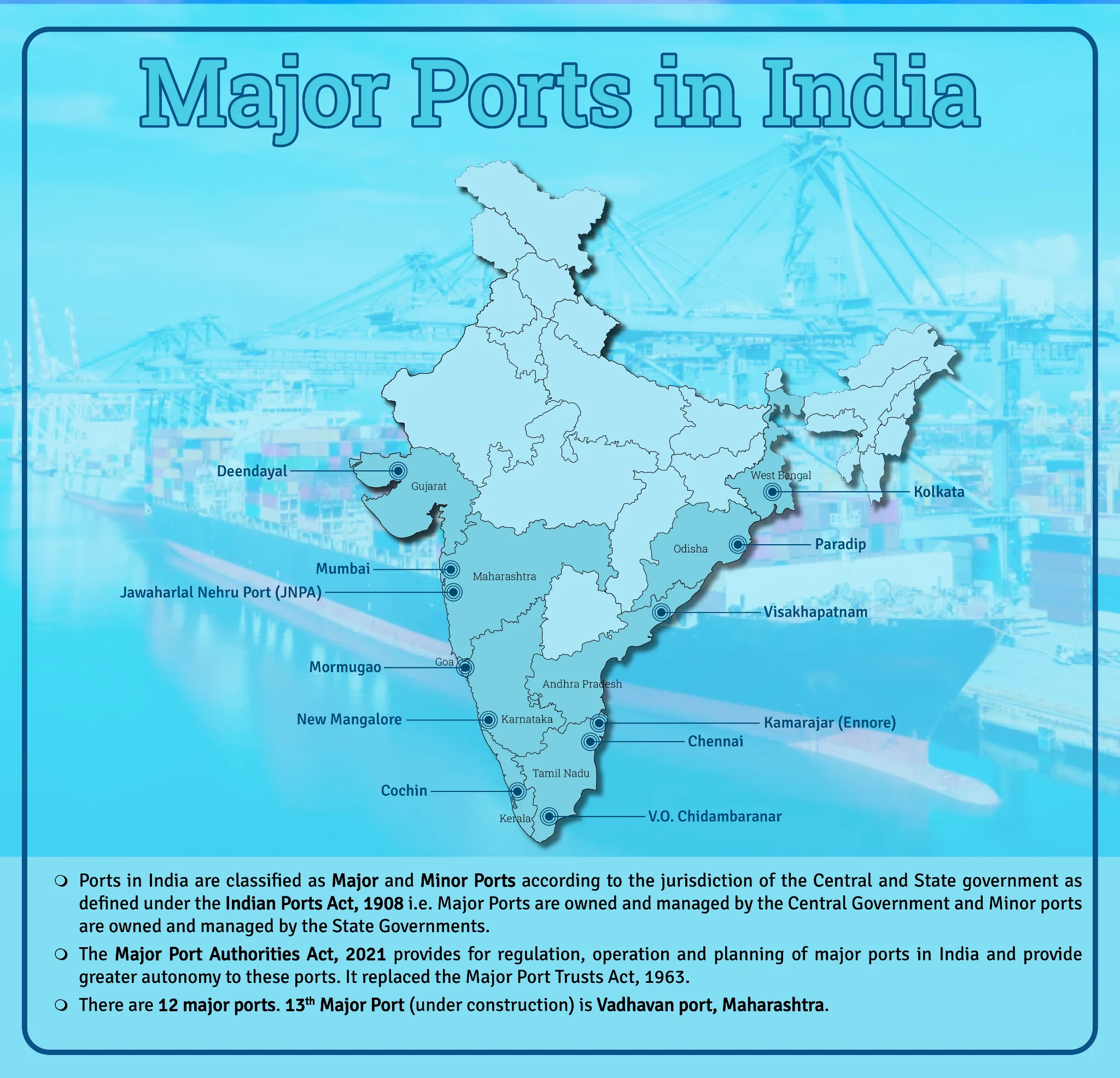
- About: The V.O. Chidambaranar Port (formerly Tuticorin Port) is one of India's 13 major ports, operating as an artificial, all-weather deep-sea port on the Coromandel Coast.
- Historical Significance: Originally established as Tuticorin Port, it was declared a major port in July 1974 and renamed in 2011 to honour V.O. Chidambaram Pillai (V.O.C.), freedom fighter and entrepreneur who founded the Swadeshi Steam Navigation Company in 1906 to challenge British maritime monopoly.
- Strategic Geographical Location: Situated at Thoothukudi (Tuticorin), Tamil Nadu in the Gulf of Mannar, the port enjoys a strategic position near the East-West international sea routes.
- Operational Significance and Rankings: It ranks as the 2nd-largest port in Tamil Nadu (after Chennai port) and the 3rd-largest container terminal in India, serving as a crucial gateway for trade with the Mediterranean, Europe, and the United States, handling diverse cargo including containers, coal, salt, and fertilisers.
| Read More: India to Develop Six Mega Ports by 2047 |
US Launches Section 301 Probe into India
The US has launched a Section 301 investigation under the Trade Act, 1974 into 16 major trading partners, including India, over alleged structural excess capacity in manufacturing sectors.
- Trigger for the Probe: The move follows the US Supreme Court striking down tariffs imposed under emergency powers, prompting the administration to use Section 301 to sustain trade pressure.
- Legal Basis: The probe is initiated under Section 301 of the US Trade Act, 1974, which empowers the Office of the United States Trade Representative (USTR) to investigate foreign trade practices deemed "unfair" or burdensome to American commerce.
- Rationale for the Investigation: The USTR will investigate whether these countries maintain "structural excess capacity" in manufacturing through policies such as government subsidies, state-owned enterprise activity, subsidised lending, currency practices, suppressed wages, and lax labour or environmental standards, which could distort trade and harm American industries.
- A US 2025 official order noted India's USD 58 billion bilateral trade surplus with the US, highlighting surplus sectors like textiles and automotive goods.
- It observed structural excess capacity in industries such as solar module manufacturing, which is nearly triple the annual domestic demand, along with significant excess in petrochemicals and steel.
- Potential Consequences: If violations are found, the US can impose tariffs, import restrictions, or suspend trade concessions. Notably, in 2018, the US used Section 301 to impose tariffs of up to 25% on approximately USD 370 billion of Chinese imports over technology transfer and intellectual property concerns.
- WTO Compatibility Debate: The legality of Section 301 has been contested. In 1998, the European Union (EU) challenged it at the WTO, with India, Brazil, China, and others joining as third parties. A WTO panel concluded that key provisions of the law did not conflict with global trade obligations.
| Read More: US Priority Watch List, India–US Trade Deal 2026 |
Shortage of Cybersecurity Talent in India
India's enterprise sector is facing an unprecedented security crisis as a massive deficit in skilled cybersecurity professionals leaves critical digital assets vulnerable to increasingly sophisticated cyberattacks.
- Talent Deficit: India has approximately 380,000 cybersecurity professionals against an enterprise demand of more than 1.2 million, creating a massive workforce gap. Experts indicate a 30-40% shortfall in roles requiring deep cloud, platform, and enterprise risk experience.
- The deficit is particularly acute in niche domains such as identity and access architecture, threat intelligence, platform security, privileged access management, digital forensics, and cloud-native security—areas essential for modern enterprise defence.
- Extended Hiring Cycles: Cybersecurity roles now have some of the longest hiring cycles in the technology sector, with average time-to-fill exceeding 90 days. Offer acceptance rates have dropped to nearly 70% from the earlier 80-85%.
- Leadership Vacuum: The shortage creates a "strategic vacuum". Prolonged vacancies lead to slower threat detection, fragmented incident response, higher remediation costs, and delayed compliance.
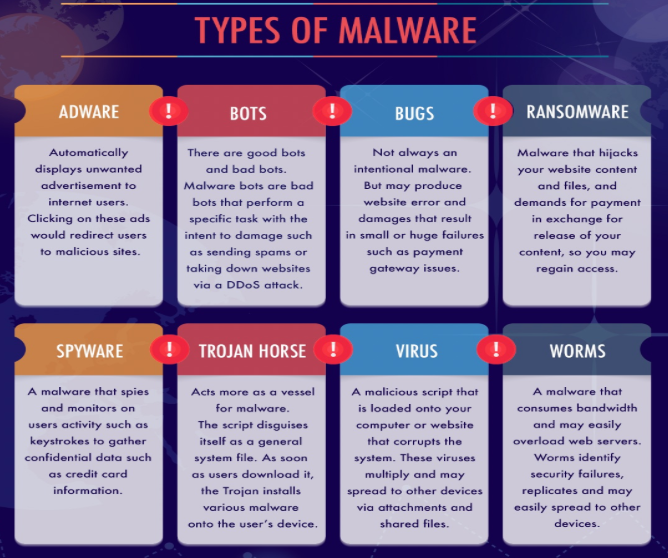
- Threat Landscape Escalation: Spyware attacks surged 273% in the first half of 2025 targeting corporate India's "data goldmine" of sensitive deals, financial flows, and intellectual property. Password-stealing malware rose by nearly 18% to 111,281 incidents.
- A report by the Data Security Council of India (DSCI) recorded 265.52 million malware detections across enterprise endpoints between October 2024 and September 2025—equivalent to approximately 505 detections every minute.
- Organisational Adaptation Strategies: Research shows 92% of senior IT security professionals in India prefer outsourcing security operations or adopting Security Operations Center as a Service (SOCaaS) models for specialised expertise and round-the-clock monitoring.
| Read More: Global Cybersecurity Outlook 2025 |