
Year End Review-2025: Department of Atomic Energy | 15 Dec 2025
For Prelims: Nuclear Power, Nuclear Power Corporation of India Limited (NPCIL), National Thermal Power Corporation (NTPC), Atomic Energy Commission (AEC), Pressurized Heavy Water Reactors (PHWRs),
For Mains: Key Achievements of Department of Atomic Energy (DAE) in the Year 2025
Why in News?
The Department of Atomic Energy (DAE) released its Year-End Review for 2025, showcasing a remarkable progress in nuclear power generation, healthcare (e.g., cancer care), etc, contributing to rare earth exploration, and achievements in high-tech national security systems.
Summary
- DAE is rapidly expanding nuclear capacity through projects like the Mahi Banswara NPP and new PHWR approvals, achieving record power generation.
- It has advanced cancer care, indigenous radiopharmaceuticals, medical device sterilization, high-yield crops, irradiation facilities, and national security systems
What are the Key Achievements of the Department of Atomic Energy (DAE) in the Year 2025?
- Nuclear Power Expansion: The foundation stone was laid for the Mahi Banswara Nuclear Power Plant (NPP) in Rajasthan, executed by the Nuclear Power Corporation of India Limited (NPCIL)-National Thermal Power Corporation (NTPC) Joint Venture ASHVINI.
- Atomic Energy Commission (AEC) approved an additional 10 units of 700 MWe Pressurized Heavy Water Reactors (PHWRs), signalling expansion beyond the existing 22.5 GW target for 2032.
- NPCIL achieved its highest-ever electricity generation of 56,681 million units in FY 2024-25, avoiding ~49 million tons of CO2 emissions.
- Healthcare & Radiopharmaceuticals: The Homi Bhabha Cancer Hospital and Research Centre was inaugurated in Bihar, extending advanced oncology services to Eastern India.
- Tata Memorial Hospital recognized as an International Atomic Energy Agency (IAEA) Rays of Hope Anchor Center, affirming its global leadership in cancer treatment, research, and capacity building.
- Strategic & High-Technology Autonomy: DAE developed India’s first Certified Reference Material (CRM) for Rare Earth Elements (REEs) – Ferrocarbonatite, gaining a crucial tool for defence, electronics, and green technology.
- First Electronics-grade (99.8% purity) Boron-11 Enrichment Facility, commissioned at Talcher, Odisha, provides ultra-high-purity material for semiconductor manufacturing.
- Contributions to National Security: DAE entities developed Weapon Control System for Astra Missile, and Integrated Power & Pyro Relay Units for Agni missiles.
- Agricultural & Societal Applications: New high-yield, early-maturing mutant crop varieties like TBM-9 banana and RTS-43 Sorghum have been notified. This has taken the number of varieties released by BARC to 72.
- Gamma radiation processing facilities increased to 40 across the country enhancing food preservation, safety, and agricultural productivity.
- Institutional Excellence: DAE hosted the 18th International Olympiad on Astronomy & Astrophysics (IOAA 2025). Homi Bhabha National Institute (HBNI) secured top rankings in National Institutional Ranking Framework (NIRF) 2025 and Nature Index 2024-25, highlighting research excellence.
India's Nuclear Energy Ecosystem
- About: India's nuclear energy ecosystem is a state-led framework under the Department of Atomic Energy (DAE), aimed at energy security through indigenous technology and a 3-Stage Nuclear Power Programme.
- Current Capacity and Targets: India’s current nuclear power capacity is 8.18 GW, with the government targeting an increase to 22.48 GW by 2031–32.
- Small Modular Reactors (SMRs): The 2025-26 Budget launches a Nuclear Energy Mission to develop and deploy 5 indigenous SMRs by 2033. SMRs are advanced reactors with a capacity of up to 300 MW(e) per unit, roughly one-third of the generating capacity of traditional reactors.
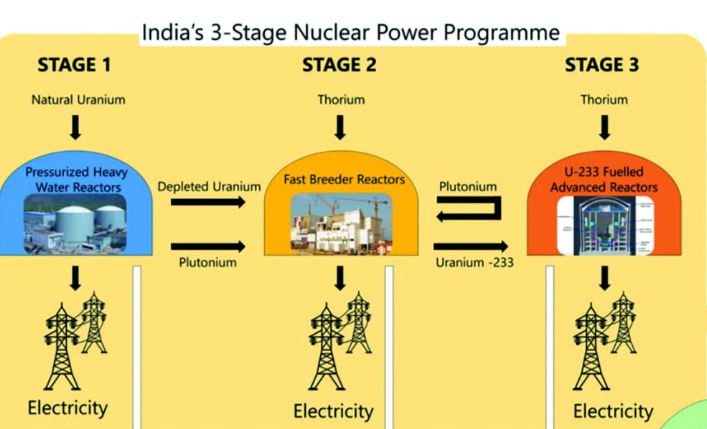
- India's 3-Stage Nuclear Power Program: The strategy uses different reactors to transition to thorium-based power.
- Stage I: PHWRs use natural uranium (U-238) with heavy water; spent fuel is reprocessed to obtain plutonium.
- Stage II: Fast Breeder Reactors (FBRs) use plutonium from Stage I and breed U-233 from thorium.
- Stage III: Thorium-based reactors use U-233 and thorium, aiming to make U-233 India’s primary nuclear fuel.
Conclusion
In 2025, DAE advanced India’s nuclear power, healthcare, strategic capabilities, high technology, agriculture, and research, strengthening national security, scientific excellence, and societal development, while achieving global recognition in innovation, education, and institutional performance.
|
Drishti Mains Question: Q. The Department of Atomic Energy's mandate extends far beyond nuclear power generation. In light of its 2025 achievements, analyse its role as a catalyst for strategic autonomy, healthcare innovation, and agricultural development in India. |
Frequently Asked Questions (FAQs)
1. What is the Mahi Banswara Nuclear Power Plant?
It is a 4-unit PHWR NPP in Rajasthan, laid by the Prime Minister in 2025, executed by NPCIL-NTPC JV 'ASHVINI'.
2. Which DAE hospital was recognized by IAEA in 2025?
Tata Memorial Hospital was recognized as a “Rays of Hope” Anchor Center for cancer treatment and research.
3. What is the significance of Ferrocarbonatite (BARC B1401)?
It is India’s first Certified Reference Material for Rare Earth Elements, aiding defence, electronics, and green technologies.
UPSC Civil Services Examination, Previous Year Questions (PYQs)
Prelims
Q. In India, why are some nuclear reactors kept under “IAEA safeguards” while others are not? (2020)
(a) Some use uranium and others use thorium
(b) Some use imported uranium and others use domestic supplies
(c) Some are operated by foreign enterprises and others are operated by domestic enterprises
(d) Some are State-owned and others are privately owned
Ans: (b)
Mains
Q. With growing energy needs should India keep on expanding its nuclear energy programme? Discuss the facts and fears associated with nuclear energy. (2018)