
Securing India in the Age of AI Warfare | 11 Mar 2026
For Prelims: Artificial Intelligence (AI), Deepfake, IndiaAI Mission, India AI Impact Summit 2026, Sarvam AI, BharatGen Param2, Digital Public Infrastructure, Intellectual Property, Semiconductors, Digital Literacy.
For Mains: Use of AI in promoting national security, Threats posed by weaponisation of AI to India's national security, Steps needed by India to promote national security in the age of AI weaponisation.
Why in News?
The growing use of Artificial Intelligence (AI) in defence, surveillance, and geopolitics has intensified debates on AI sovereignty, highlighting its significance as a national security priority for countries like India.
Summary
- AI is reshaping national security, offering both strategic advantages and critical threats. India faces risks from autonomous weapons, cyber-attacks, disinformation, and bioweapons.
- To safeguard its sovereignty, India must build indigenous AI capabilities, secure data infrastructure, establish regulatory frameworks, and foster global partnerships for resilient defence.
How AI is Increasingly Used to Promote National Security?
- Enhancing Military Precision: AI is being directly integrated into combat for lethal operations. Examples include the US military's use of Anthropic's Claude model in Operation Roaring Lion that killed Iran's Supreme Leader Ayatollah Ali Khamenei and Israel's "Where's Daddy?" AI tool for tracking Hamas terrorists, which helps reduce collateral damage.
- Strengthening C4ISR Systems: AI is crucial for modernizing the military's "nervous system" by being integrated into C4ISR (Command, Control, Communications, Computers, Intelligence, Surveillance, and Reconnaissance). It accelerates decision-making by processing vast data, enabling predictive analytics to preempt adversary moves.
- For maritime domain awareness, it analyses satellite and ship data to identify "dark ships" involved in smuggling or illegal fishing.
- Countering Asymmetric Threats: AI is vital for internal security against non-state actors. A major concern is that cheap autonomous weapon systems (like AI-powered drones) could enhance the destructive potential of terrorists, necessitating the development of AI-driven counter-drone and surveillance systems.
- Hardening Critical National Infrastructure: AI provides proactive cyber defence by detecting anomalies in power grids and networks, and enhances the physical security of sensitive sites like military bases and nuclear facilities through AI-powered video analytics that recognize suspicious behaviour.
- Countering Disinformation & Protecting Societal Cohesion: AI is a dual-edged tool for information warfare. Security agencies use AI to detect coordinated disinformation campaigns and bot networks, as well as to develop algorithms for identifying deepfakes, thereby preserving the integrity of public discourse and trust.
AI sovereignty
- About: AI sovereignty refers to a nation's independent control over its AI ecosystem—compute infrastructure, data, algorithms, and governance—to align technology with national priorities, security requirements, and strategic interests.
- India's Policy Prioritization: As of March 2026, AI sovereignty is a central policy focus, driven by the IndiaAI Mission and highlighted at the India AI Impact Summit 2026 amidst US-China AI rivalry. Key Developments include:
- Infrastructure: India has expanded national compute capacity to over 58,000 GPUs via the IndiaAI Compute Portal. Major private commitments include Reliance Industries (USD 110 billion over 7 years) and Adani Group (USD 100 billion for renewable-powered AI data centers by 2035).
- Indigenous Models: India is fostering domestic foundational models with multilingual capabilities, such as Sarvam AI, BharatGen Param2, emphasizing integration with Digital Public Infrastructure.
- India's Pragmatic Approach: India adopts an application-led strategy focusing on domestic data utilization and multilingual models rather than seeking full self-sufficiency in frontier hardware. This involves leveraging partnerships with global firms (e.g., NVIDIA, OpenAI, Google, Microsoft) for localized infrastructure while building indigenous capabilities.
Read More: Sarvam AI and the Sovereign AI in India
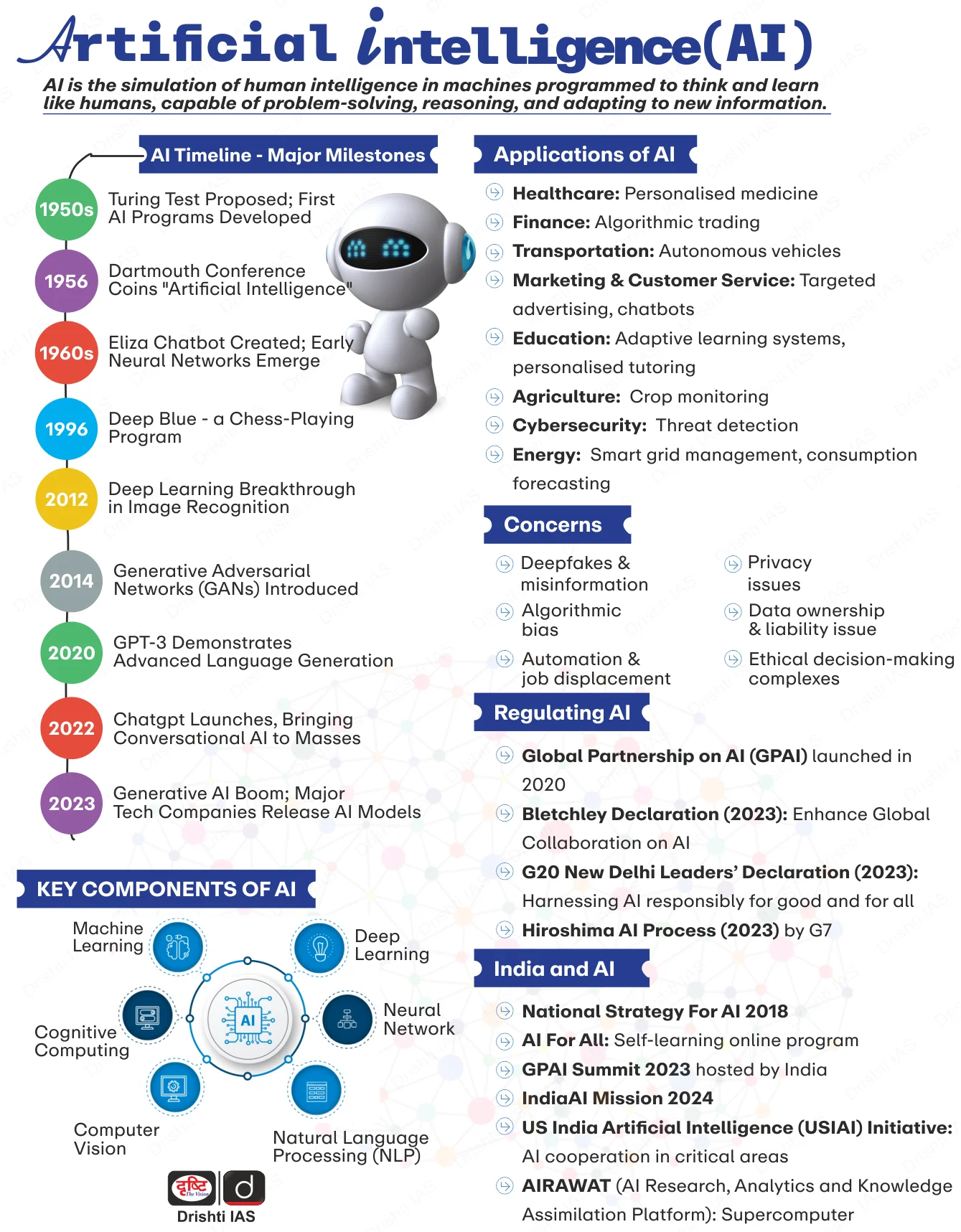
How Weaponisation of AI Poses a Threat to India's National Security?
- Threat to Military Dominance: AI enables asymmetric warfare, allowing adversaries to challenge India's conventional edge through lethal autonomous weapons (LAWS), drone swarms, and AI-enhanced Anti-Access/Area Denial (A2/AD) strategies by China in the Indian Ocean Region. Additionally, system glitches along the LoC/LAC risk triggering inadvertent conflicts due to dangerous escalation dynamics.
- E.g., In early 2026, China showcased that a single soldier can control a swarm of more than 200 drones with autonomous cooperation for reconnaissance and strike missions. It can complicate India’s defense strategy.
- AI-Enabled Cyber Threat: Adversaries can use AI for adaptive cyber-attacks on the power grid (causing cascading blackouts), the financial system (paralysing banks), and defence networks (stealing secrets or disrupting command during crises).
- In May 2025, the Pakistani military launched a cyber attack codenamed "Iron Wall" on India, causing a massive power grid failure that collapsed power systems across 23 states.
- Weaponisation of Information: Deepfakes and disinformation can be micro-targeted to exacerbate communal tensions, erode trust in institutions, and influence voting behaviour in India's massive elections, threatening the country's democratic and social stability.
- In the 2024 general elections, AI-generated deepfakes of political leaders were used to spread disinformation, exacerbating communal divisions and inciting violence across India.
- Threats to Economic Sovereignty: AI-powered cyber-espionage enables the large-scale theft of intellectual property from India's booming pharma, space, and IT sectors. Furthermore, adversaries can use AI to map and weaponise supply chains, identifying and disrupting critical dependencies to cripple defence production.
- Chinese state-linked actors like APT41 have targeted Indian and multinational pharma firms to steal proprietary drug formulas, including treatments for diabetes and obesity.
- AI-Powered Bioweapons: The convergence of AI with synthetic biology poses an emerging catastrophic risk. Adversaries or non-state actors could use generative AI models to design novel pathogens, toxins, or gene-editing payloads that bypass existing vaccines or target specific ethnic populations.
- Data Poisoning: By introducing hidden biases or backdoors, adversaries could cause critical systems to malfunction at a crucial moment—e.g., a facial recognition system failing to identify a known terrorist, or an autonomous vehicle misclassifying an obstacle—without any visible signs of hacking.
What Steps are Needed by India to Promote National Security in the Age of AI Weaponisation?
- Building an Indigenous Defence AI Ecosystem: India needs a powerful Defence AI Agency (DAIA) to bypass bureaucracy and spearhead AI integration. This must be complemented by time-bound National Defence AI Missions like Project Drona (AI-powered drone swarms), Project Kavach (cyber defence for critical infrastructure), and Project Netra (real-time battlefield surveillance).
- Securing the Nation's "AI Backbone": India must create a National Secure Data Set of labelled, security-related data for training algorithms. This requires simultaneous investment in sovereign AI infrastructure, including domestically designed semiconductors and high-performance computing centres located entirely within India to process sensitive defence applications securely.
- Infrastructure Resilience: To deter adversaries, India must develop credible offensive cyber capabilities. Critically, the government must mandate "AI-safe" design standards for all new critical infrastructure projects (power plants, grids) to build resilience.
- Cognitive Security: To protect its social fabric, India must establish a National Cognitive Security Centre. Its mandate would include real-time deepfake detection, neutralising bot networks, and launching large-scale digital literacy campaigns to immunise citizens against AI-generated disinformation.
- Robust Regulatory: Formulate comprehensive guidelines for LAWS and AI-driven cyber warfare, emphasising human oversight to prevent escalation risks in nuclearised South Asia.
- Global Partnerships: Deepen alliances (e.g., via the India AI Impact Summit 2026) for technology transfers while advocating for equitable AI norms in international forums.
Conclusion
The weaponisation of AI presents an unprecedented challenge to India's national security, threatening its military dominance, social cohesion, and economic sovereignty. A comprehensive strategy involving indigenous AI development, robust cyber defences, cognitive security measures, and global diplomatic engagement is essential to transform these vulnerabilities into strategic strengths.
|
Drishti Mains Question: Examine the concept of AI sovereignty. Why is it becoming a central pillar of India's national security policy, and what challenges does India face in achieving it? |
Frequently Asked Questions (FAQs)
1. What is AI sovereignty?
AI sovereignty refers to a nation’s independent control over AI infrastructure, data, algorithms, and governance to align technological development with national security and strategic interests.
2. What are C4ISR systems in modern warfare?
C4ISR (Command, Control, Communications, Computers, Intelligence, Surveillance, and Reconnaissance) systems integrate advanced technologies, including AI, to improve real-time data analysis, situational awareness, and military decision-making.
3. How does AI pose a threat to national security?
AI can enable autonomous weapons, cyber-attacks, deepfake disinformation campaigns, and data poisoning, which can disrupt critical infrastructure, democratic processes, and military operations.
UPSC Civil Services Examination Previous Year Question (PYQ)
Prelims
Q. With the present state of development, Artificial Intelligence can effectively do which of the following?(2020)
- Bring down electricity consumption in industrial units
- Create meaningful short stories and songs
- Disease diagnosis
- Text-to-Speech Conversion
- Wireless transmission of electrical energy
Select the correct answer using the code given below:
(a) 1, 2, 3 and 5 only
(b) 1, 3 and 4 only
(c) 2, 4 and 5 only
(d) 1, 2, 3, 4 and 5
Ans: (b)
Mains
Q. Introduce the concept of Artificial Intelligence (AI). How does AI help clinical diagnosis? Do you perceive any threat to privacy of the individual in the use of AI in healthcare? (2023)