
India-EU FTA | 28 Jan 2026
For Prelims: European Union, Free Trade Agreement (FTA), TRIPS, G20, G7, Operation Atalanta, Indo-Pacific Oceans Initiative (IPOI), International Solar Alliance, Quality Control Orders (QCOs), Non-tariff Barriers, Schengen Area.
For Mains: Key highlights of the India–EU FTA and India-EU relations, Opportunities and challenges associated with India–EU FTA and way forward.
Why in News?
India and the European Union (EU) have concluded negotiations for a comprehensive Free Trade Agreement (FTA), marking a transformative step in their economic relations. The EU is India's 22nd FTA partner.
- The concluded India–EU FTA will now undergo language finalisation and legal scrubbing, followed by translation and ratification by all 27 EU Member States and the European Parliament before it enters into force.
Summary
- India-EU concluded negotiations for a FTA that offers unprecedented market access and boosts for labour-intensive sectors & services.
- Its success is challenged by EU's stringent regulations (CBAM, EUDR) acting as non-tariff barriers.
- Sustainability requires managing asymmetries, securing equitable carve-outs, and deepening strategic cooperation.
What are the Key Highlights of the India–EU FTA?
European Union Commitments
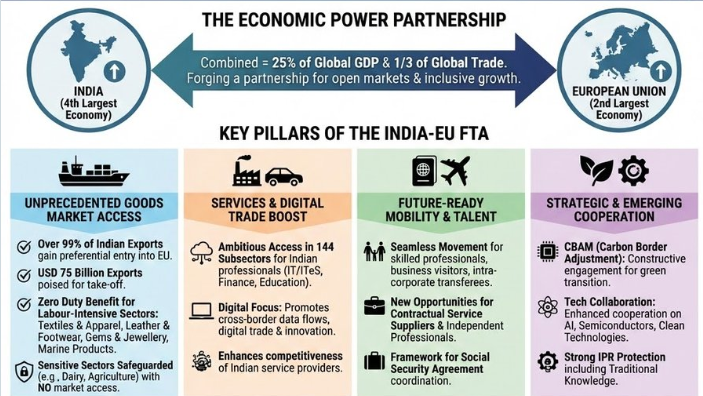
- Comprehensive Market Access: The European Union committed to open 97% of its tariff lines, covering 99.5% of India’s exports by value, offering India one of the deepest preferential market access arrangements it has ever received.
- Labour-Intensive Sector Advantage: Key employment-generating sectors such as textiles, apparel, leather, footwear, marine products, gems and jewellery, toys, and sports goods, currently facing EU duties of 4–26%, will enter the EU market at zero duty, covering exports worth about USD 33 billion.
- Services Market Liberalisation: The EU made binding commitments across 144 services subsectors, including IT/ITeS, digital services, professional services, education, and business services, ensuring regulatory certainty and non-discriminatory treatment for Indian service providers.
- Farm Exports: The FTA provides India preferential access to the EU market for key agricultural and processed food exports, improving their competitiveness. This is expected to boost farmer incomes, promote value-added agri-exports, and strengthen rural and women-led livelihoods.
- Professional Mobility Framework: The FTA establishes a clear framework for temporary movement of professionals such as intra-corporate transferees, contractual service suppliers, and independent professionals along with provisions for dependents, students, and future social security arrangements.
- Regulatory and Standards Cooperation: Enhanced cooperation on Sanitary and Phytosanitary (SPS) and Technical Barriers to Trade (TBT) was agreed upon to reduce non-tariff barriers, enable conformity assessment recognition, and improve market predictability.
India’s Commitments
- Calibrated Tariff Liberalisation: India committed market access on 92.1% of its tariff lines, covering 97.5% of EU exports. Critical sectors including dairy, cereals, poultry, soymeal, and select agricultural products remain protected, while automobiles, wines, and spirits are subject to gradual liberalisation to shield MSMEs and farmers.
- Services Sector Opening: India opened 102 services subsectors, including telecom, financial, maritime, environmental, professional, and business services, providing EU firms a stable and predictable operating environment.
- MSME-Friendly Rules of Origin: Product-specific rules of origin aligned with global value chains were adopted, allowing self-certification through Statements of Origin and special flexibilities for MSME-dominated sectors such as shrimps, prawns, and downstream aluminium products.
- Balanced IPR and Digital Trade Framework: India reaffirmed TRIPS-compliant intellectual property protection while safeguarding public interest, protecting the generic pharmaceutical industry, recognising the Traditional Knowledge Digital Library, and balancing cross-border digital trade with data localisation and digital sovereignty.
What is the Significance of the India–EU FTA?
- Geoeconomic Diversification: The FTA advances the China-plus-one strategy by positioning India as a trusted manufacturing and services alternative for the EU. In a global order where trade and technology are increasingly weaponised through sanctions and export controls, the agreement creates a rules-based “zone of trust” between two democratic blocs, especially for sensitive sectors such as semiconductors, AI, defence manufacturing, and green technologies.
- Increased Indian competitiveness: To access the EU market, Indian manufacturing will undergo a quality overhaul (Sanitary and Phytosanitary measures, technical standards). This "standards upgrade" (Brussels Effect) will make Indian goods globally competitive, not just in Europe but in US and Japanese markets as well.
- Strategic Leverage: The FTA connects India, the world's fourth-largest economy, with the EU, the second-largest, together representing 25% of global GDP and one-third of global trade. This creates a massive economic bloc, offering India strategic weight and deep integration with a leading technology superpower.
- Green and Digital Modernization Engine: The FTA focuses on digital trade rules and green transition, aiming to boost India's digital economy through secure data flows and AI-driven green industrial development.
India-EU Relations
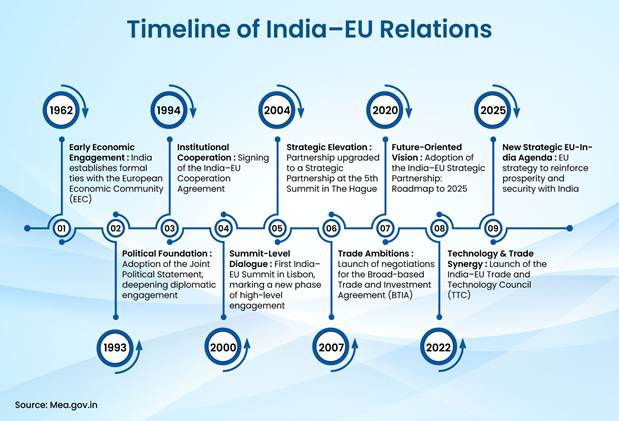
- Historical Foundation: Bilateral relations date to 1962. The relationship was institutionalized by a 1993 Joint Political Statement and a 1994 Cooperation Agreement, upgraded to a ‘Strategic Partnership’ in 2004.
- Institutional Architecture: The bilateral relationship is guided by the ‘India–EU Strategic Partnership: A Roadmap to 2025’. The multi-tiered institutional architecture is presided over by their annual Summits, which began with the inaugural one in Lisbon in June 2000.
- High-Level Engagements: Characterized by frequent leaders' meetings on sidelines of G20, and G7 summits. Both established the India–EU Trade and Technology Council (TTC) in 2022 as a key strategic mechanism.
- Economic & Trade Relations: The EU is India's largest goods trading partner (USD 135 billion in FY 2023–24). Bilateral trade in services was at a record USD 53 billion in 2023. EU investments in India exceed USD 117 billion.
- Strategic & Security Cooperation: India and the EU have strengthened naval cooperation through joint exercises like Maritime Partnership Exercise with EUNAVFOR Atalanta (Operation Atalanta). The EU joined the Indo-Pacific Oceans Initiative (IPOI) in 2023 and is an Indian Ocean Rim Association (IORA) dialogue partner.
- Climate & Connectivity Initiatives: India – EU Clean Energy and Climate Partnership (CECP) established in 2016 focuses on clean energy and climate-friendly technologies. The EU is a partner to the International Solar Alliance and a member of Coalition for Disaster Resilient Infrastructure (CDRI).
- Both sides launched an India–EU Connectivity Partnership in 2021 and are co-partners in the India-Middle East-Europe Economic Corridor (IMEC).
- Multifaceted Sectoral Cooperation: Extensive collaboration in Science & Technology (India is an associate member of CERN), Space (ISRO launched ESA's Proba-3 Mission in 2024), Digital transition, Water (India–EU Water Partnership), and Migration (Common Agenda on Migration and Mobility).
European Union
- About: A supranational political and economic union created post-World War II to promote peace and economic cooperation, notably between France and Germany.
- Historical Evolution: Originated from the 1951 European Coal and Steel Community (ECSC). Key treaties include:
- 1951: Establishment of the European Coal and Steel Community (ECSC).
- 1957: Treaties of Rome created the European Economic Community (EEC) and the European Atomic Energy Community (Euratom).
- 1992: The Maastricht Treaty formally established the European Union.
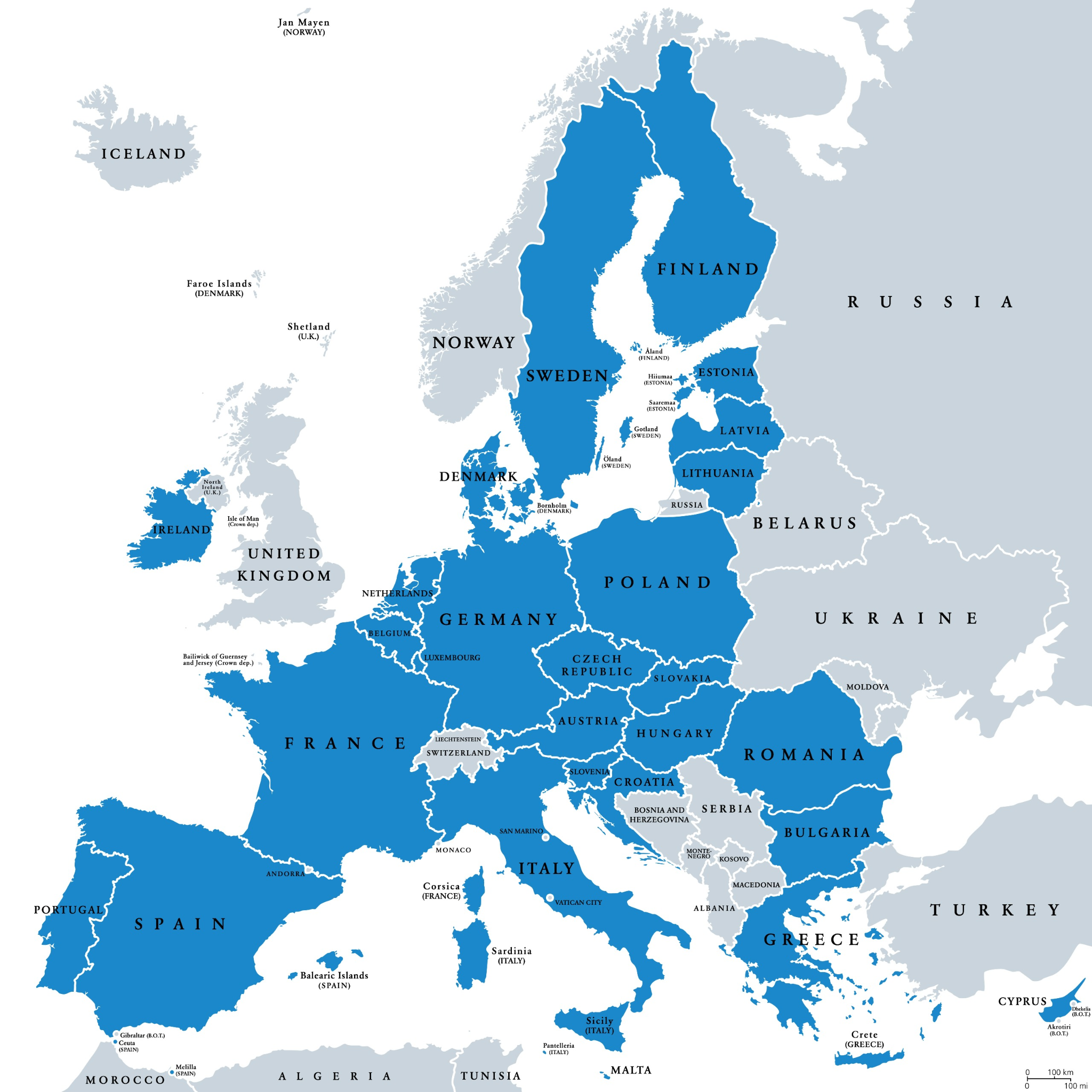
- 2020: The United Kingdom withdrew (Brexit), reducing membership from 28 to 27.
- Aims: Key aims include establishing a single internal market with the Four Freedoms (goods, services, capital, people) and promoting sustainable development.
- Key Features: Operates a Single Market and a Customs Union. The Schengen Area enables border-free travel. Four non-EU countries (Iceland, Norway, Switzerland, and Liechtenstein) are also part of Schengen.
- 20 member states use the euro (Eurozone), with Bulgaria set to join in 2026.
What Concerns are Associated with the India–EU FTA?
- EU's Regulatory Onslaught as Non-Tariff Barriers (NTBs): The EU’s inclusion of environmental and labor standards in trade agreements raises concerns about green protectionism, where such norms may function not as neutral regulations but as de-facto non-trade barriers.
- Carbon Border Adjustment Mechanism (CBAM): This carbon tax directly impacts key Indian exports like steel, aluminium, and chemicals. From 2026, Indian steel exports could face a 20–35% tax equivalent, potentially wiping out gains from tariff elimination.
- EU Deforestation Regulation (EUDR): The EUDR bans imports of commodities like coffee, rubber, and wood produced on land deforested after 2020. Small Indian farmers must geotag plots and prove traceability, a compliance burden unaffordable for most smallholders.
- Corporate Sustainability Due Diligence (CSDDD): Effective from 2027, this directive forces companies to audit their value chains for human rights and environmental risks. Indian manufacturers are concerned about sharing sensitive supplier data, viewing it as a business risk.
- Industrial Accelerator Act: This proposed act may introduce local content norms (minimum domestic value addition). This would put pressure on imports, including from India.
- Asymmetry in Market Access and Tariff Concessions:
- Pre-existing Low EU Tariffs: Over 75% of India's exports to the EU already attract less than 1% tariff without the FTA. Therefore, the significant market access gains for Indian goods are limited.
- High Indian Tariffs: India's average tariffs (10–12%) on EU goods are much higher than the EU's (3–4%) on Indian goods. India will have to offer deep tariff cuts on a broad range of European goods, while the relative gain in EU market access is smaller.
- Competition from Zero-Duty Countries: Competitors like Bangladesh, Vietnam, and Ethiopia already have zero-duty access to the EU via other schemes, putting Indian exports at a potential disadvantage even with the FTA.
- Lack of Parity and Carve-outs: The EU has granted exemptions and carve-outs to the US from some environmental regulations. Indian experts argue that giving large polluters a carve-out while pushing developing countries like India to comply risks dampening any tariff advantage. India has likely pushed for parity on such exemptions.
- EU's Concerns Regarding Indian Local Laws: The EU views India's Quality Control Orders (QCOs)—mandatory standards requiring facility audits—as major non-tariff barriers. The EU stridently opposes these, arguing they obstruct market access.
What Measures are Required to Strengthen India-EU Economic Relations?
- Proactively Address the Core Asymmetries: To counterbalance trade asymmetry, India must aggressively leverage its access to 144 services subsectors and professional mobility, while attracting EU manufacturing investment to ascend the value chain.
- Mechanisms for Dialogue & Dispute Prevention: Establish the proposed ‘Rapid Response Forum’ to promptly tackle new non-tariff barriers such as EU regulations and QCOs through senior-level intervention, preventing disputes from escalating.
- Equitable Carve-outs and Transition Periods: To protect competitive sectors like steel and aluminium, India must secure exemptions from regulations like CBAM similar to those granted to the US Simultaneously, it should negotiate extended transition periods for rules such as EUDR and CSDDD to ease adaptation.
- Build Strategic Partnership Beyond Trade: Integrating the trade agreement with the IMEC corridor will build resilient supply chains and cut logistical costs. Simultaneously, strengthening Indo-Pacific collaboration through the IPOI and TTC creates shared geopolitical stakes that sustain the long-term partnership.
Conclusion
The India-EU FTA is a strategic milestone with significant potential, but its sustainability hinges on effectively managing regulatory asymmetries, ensuring fair carve-outs, and leveraging services and mobility gains to create a balanced, mutually beneficial partnership that transcends mere tariff liberalization.
|
Drishti Mains Question: Evaluate the opportunities and challenges presented by the India-EU FTA for India's Micro, Small, and Medium Enterprises (MSMEs). |
Frequently Asked Questions (FAQs)
1. What level of tariff liberalisation has India secured under the FTA?
97% of EU tariff lines covering 99.5% of trade value offer preferential access to Indian exports.
2. What are the major regulatory concerns for India under the FTA?
EU measures like CBAM, EUDR, CSDDD, and other non-tariff barriers (NTBs) may offset tariff gains for Indian exporters.
3. What is the primary purpose of the proposed 'Rapid Response Forum' in the FTA?
The 'Rapid Response Forum' is proposed to swiftly address emerging non-tariff barriers and trade disputes through high-level intervention.
UPSC Civil Services Examination Previous Year Questions (PYQs)
Prelims
Q. Consider the following statements: (2023)
The ‘Stability and Growth Pact’ of the European Union is a treaty that
- limits the levels of the budgetary deficit of the countries of the European Union
- makes the countries of the European Union to share their infrastructure facilitie
- enables the countries of the European Union to share their technologie
How many of the above statements are correct
(a) Only one
(b) Only two
(c) All three
(d) None
Ans: (a)
Q. The term ‘Digital Single Market Strategy’ seen in the news refers to (2017)
(a) ASEAN
(b) BRICS
(c) EU
(d) G20
Ans:(c)
Q. ‘European Stability Mechanism’, sometimes seen in the news is an (2016)
(a) agency created by EU to deal with the impact of millions of refugees arriving from Middle East
(b) agency of EU that provides financial assistance to eurozone countries
(c) agency of EU to deal with all the bilateral and multilateral agreements on trade
(d) agency of EU to deal with the conflicts arising among the member countries
Ans: (b)
Mains
Q. The expansion and strengthening of NATO and a stronger US-Europe strategic partnership works well for India.' What is your opinion about this statement? Give reasons and examples to support your answer. (2023)