
Limits of Household Stability
For Prelims: Union Budget, Reserve Bank of India, Foreign Portfolio Investment, Consumer Price Index (CPI)
For Mains: Household savings and debt trends in India, Role of private consumption in India’s growth model, Fiscal consolidation versus welfare expenditure
Why in News?
As the Union Budget 2026 approaches, India’s macroeconomic indicators present a picture of aggregate stability and relative strength amidst global uncertainty.
- However, a deeper analysis of the Reserve Bank of India’s (RBI) Financial Stability Report ( 2025) and Annual Report 2024–25 reveals a concerning structural shift that households are saving less, borrowing more, and increasingly absorbing economic risks that were previously shared by the State.
Summary
- Despite stable macro indicators ahead of Union Budget 2026, RBI data reveal declining and volatile household savings, rising debt, and increasing reliance on credit to sustain consumption, shifting economic risk from the State to households.
- Debt-financed consumption and growing unsecured credit threaten financial stability, widen inequality, strain banks, and weaken India’s demographic dividend, underscoring the need to boost real incomes, savings, and social safety nets.
What are the Concerns Regarding the Household Stability?
- Declining and Volatile Household Savings: Net financial savings recovered to 7.6% of GDP in the last quarter of 2024-25, but this came after a compression to about 3-4% of GDP in the preceding quarter.
- Such volatility weakens households’ capacity to absorb income, health, or employment shocks.
- Rising Household Debt: Household debt increased from about 36% of GDP in 2021 to 41.3% in March 2025.
- According to the RBI’s Annual Report 2024–25, real income growth remains uneven, income gains are concentrated in formal sectors, while informal and self-employed workers face stagnant or volatile earnings, constraining consistent savings.
- Borrowing Driven Consumption: Stable consumption despite weak income growth indicates rising reliance on credit.
- Private consumption contributes nearly 60% of GDP. Dependence on debt-supported consumption increases the risk of abrupt spending contraction during economic stress.
- Debt-financed consumption offers limited adjustment space during downturns and heightens vulnerability to interest-rate changes.
- Faster Growth of Financial Liabilities: While gross household financial assets stood at 106.6% of GDP, liabilities rose to 41.3% of GDP by March 2025. Faster liability accumulation explains the compression of net financial savings.
- Rising Exposure to Unsecured Retail Credit: Rapid growth in unsecured personal loans and credit cards increases household vulnerability, as these loans carry higher interest rates and limited repayment flexibility during stress periods.
- A rising share of fresh savings is offset by new borrowing, reducing households’ ability to manage shocks from unemployment, inflation, or medical emergencies.
- Fiscal Consolidation Shifting Risk to Households: Budgets 2024–25 show States and the Union prioritising capital expenditure while compressing revenue spending. With 30–32% of State revenues locked into salaries, pensions, and interest, fiscal space for income support has shrunk.
- While this investment-led strategy boosts medium-term growth, it does little to cushion short-term income shocks, leading to a quiet shift of economic risk from governments to households.
What are the Implications of Volatile Household Savings?
- Macroeconomic Implications:
- The "Savings-Investment" Gap: A decline in household savings compels the government and the private sector to depend more on Foreign Portfolio Investment (FPI) and external borrowing; however, with FPIs aggressively exiting India and withdrawing a record ₹1.66 lakh crore in 2025, this reliance heightens vulnerability to external shocks and financing stress.
- This increases India’s vulnerability to global "shocks" (like Fed rate hikes) and worsens the Current Account Deficit (CAD).
- Fiscal Deficit Crowding Out: With lower domestic savings available, the government may find it harder to fund its fiscal deficit at low interest rates.
- This could lead to higher borrowing costs for the state, "crowding out" private investment.
- The "Savings-Investment" Gap: A decline in household savings compels the government and the private sector to depend more on Foreign Portfolio Investment (FPI) and external borrowing; however, with FPIs aggressively exiting India and withdrawing a record ₹1.66 lakh crore in 2025, this reliance heightens vulnerability to external shocks and financing stress.
- Financial Systemic Implications:
- Deterioration of Bank Funding Quality: Traditionally, banks relied on low-cost, stable household deposits.
- The shift towards Financialization (households moving money to Mutual Funds/Equities) forces banks to use expensive wholesale funding, which is more volatile and squeezes bank margins (NIMs).
- Asset Quality Stress: A significant portion of current debt is unsecured retail credit (personal loans, credit cards).
- These are "first-loss" assets; if the economy slows, defaults in this segment hit bank balance sheets directly without any collateral to recover.
- Market Volatility Risk: As more households enter the stock market via systematic investment plans (SIPs) without a "safety buffer" of bank deposits, a prolonged market crash could lead to panic withdrawals, creating a feedback loop that destabilizes both the equity market and household wealth.
- Deterioration of Bank Funding Quality: Traditionally, banks relied on low-cost, stable household deposits.
- Socio-Economic Implications:
- Threat to the Demographic Dividend: If a large portion of household income is diverted to debt servicing (EMIs), investment in "Human Capital" (quality education and nutrition for children) often takes a backseat, undermining India’s long-term productivity.
- Rising Inequality: The "K-shaped" stability trend shows that while high-income households see their wealth grow via stock markets, low-income groups are borrowing to survive.
- This widens the wealth gap and can lead to social friction.
What Steps are Needed to Improve the Household Savings?
- Recalibrating Inflation Targets: The government and RBI should review the Consumer Price Index (CPI) basket to better reflect the rising costs of education and healthcare, ensuring that monetary policy accurately protects the purchasing power of the middle class.
- Incentivizing Financial Savings: Tax incentives for traditional long-term savings instruments (like PPF or long-term bank deposits) should be enhanced to discourage excessive shift toward high-risk speculative markets.
- Focus on Real Wage Growth: Policy must pivot toward creating high-quality, formal-sector jobs.
- Strengthening the manufacturing sector through Production Linked Initiative' (PLI) schemes can provide the stable income growth needed to outpace debt.
- Strengthening Social Safety Nets: By expanding the reach of affordable public healthcare and insurance (like Ayushman Bharat), the government can reduce the "precautionary" need for households to hold large sums of cash or borrow during health crises.
- Financial Literacy and Regulation: The RBI must continue its proactive stance on "macro-prudential measures," such as increasing risk weights on unsecured loans, to prevent households from falling into a permanent debt trap.
Conclusion
Stability that depends on households taking out loans to maintain demand is not self-sustaining. As the Union Budget 2026 approaches, the key fiscal task is to restore balance in the household budgeting calculus to ensure that India’s growth story is both inclusive and resilient.
|
Drishti Mains Question: How does declining household savings affect macroeconomic stability and external sector sustainability in India? |
Frequently Asked Questions (FAQs)
1. Why are household savings in India considered unstable?
Net financial savings have become volatile, falling to 3–4% of GDP in some quarters, weakening households’ ability to absorb income and employment shocks.
2. Why is rising household debt a concern despite moderate debt-to-GDP levels?
Debt growth is driven by uneven income growth and unsecured credit, making repayment vulnerable to interest-rate hikes and economic slowdowns.
3. How does debt-financed consumption impact India’s growth model?
With private consumption forming nearly 60% of GDP, reliance on credit increases the risk of abrupt demand contraction during stress periods.
4. What risks does unsecured retail credit pose to banks?
Unsecured loans are high-interest and first-loss assets, directly impacting bank balance sheets during economic downturns.
Mains
Q. Among several factors for India’s potential growth, the savings rate is the most effective one. Do you agree? What are the other factors available for growth potential? (2017)
India’s Power Sector Milestones 2025
Why in News?
The year 2025 proved to be a landmark period for the Ministry of Power, as India’s power sector achieved record milestones, establishing a strong foundation for sustainable growth and enhanced energy security.
What are the Key Achievements of the Ministry of Power in the Year 2025?
- Record Supply & Reliability: Successfully met an all-time peak power demand of 242.49 GW in FY 2025-26, reducing national energy shortages to a mere 0.03% from 4.2% in 2013-14. It significantly increased rural and urban power availability to 22.6 and 23.4 hours, respectively.
- India's power sector is poised for massive growth with a projected investment of USD 450 billion by 2032.
- Massive Capacity Expansion: Total installed power generation capacity surged to around 509 GW (as of November, 2025), a 104.4% increase since 2014, with 55.57 GW added in 2025.
- Renewable energy capacity additions since 2014 stand at 178 GW, including 130 GW solar and 33 GW wind.
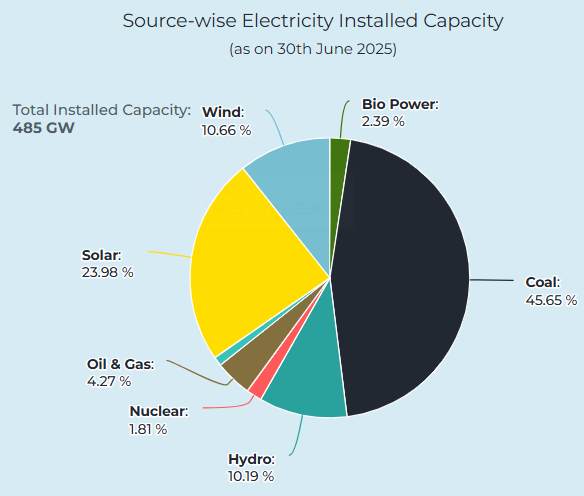
- Thermal & Coal Security: Awarded 13.32 GW of new coal capacity in FY 2025-26, with total capacity at 226.23 GW. Coal stocks were maintained at robust levels (51.7 metric ton (MT), supported by the revised SHAKTI Policy 2025 to enhance coal allocation and energy security.
- Storage & Transmission Push: Set targets for 57 GW of Pump Storage Projects (PSP) by 2031-32 and 43,220 MWh of Battery Energy Storage System (BESS) under Viability Gap Funding (VGF) Schemes.
- The National Electricity Plan (2023-32) aims to expand the transmission network to 6.48 lakh Circuit Kilometers (ckm) by 2032 and approved 25.8 GW of RE-linked Inter State Transmission projects in 2025.
- Currently, India’s national power transmission network stands at around 5 lakh ckm.
- Distribution Reforms & Consumer Focus: Under the Revamped Distribution Sector Scheme (RDSS), sanctioned 19.79 crore prepaid Smart meters, reducing AT&C losses to 16.16% and the Average Cost of Supply (ACS) and the Average Revenue Realized (ARR) gap to Rs 0.11/kWh.
- It also provided electricity connections to 13.65 lakh households under PM-JANMAN and DA-JGUA (Dharti Aaba Janjatiya Gram Utkarsh Abhiyan) initiatives.
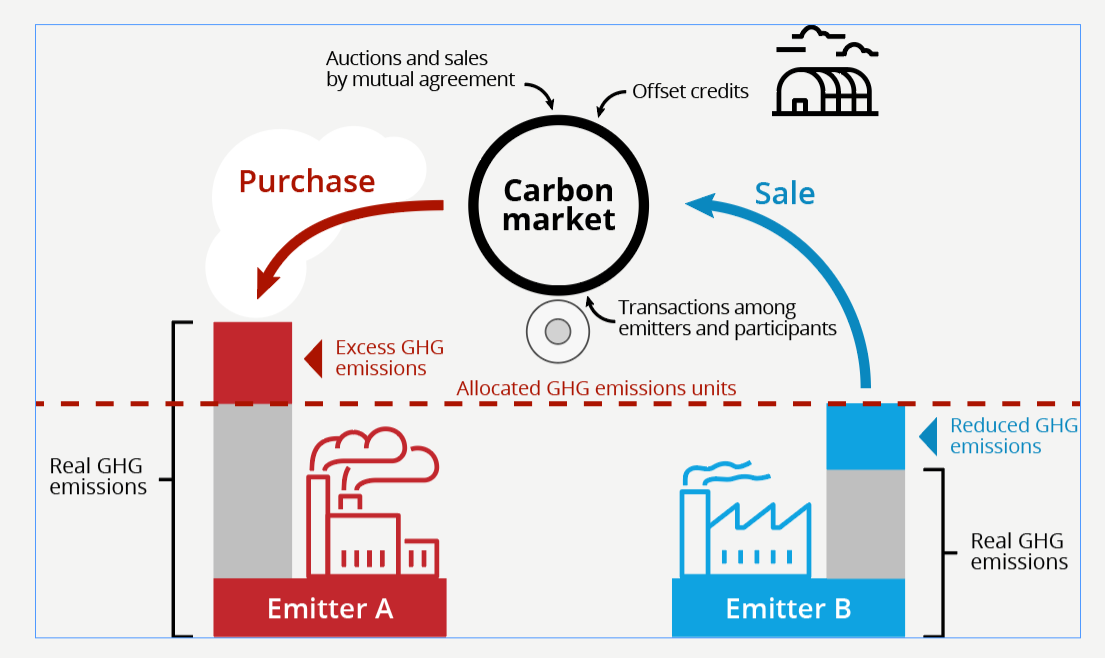
- Energy Efficiency & Carbon Market Launch: Introduced the Carbon Credit Trading Scheme (CCTS) for compliance (covering Aluminium, Cement etc.) and offset mechanisms.
- Expanded the Standards & Labelling programme to 41 appliances and launched the ADEETIE (Assistance in Deploying Energy Efficient Technology in Industries and Establishments) scheme for MSME energy efficiency.
- Critical Regulatory Reforms: Late Payment Surcharge Rules, 2022 drastically reduced legacy dues of DISCOMs from Rs 1,39,947 crore to Rs 8,005 crore. The Electricity (Amendment) Rules, 2025 allowed consumer-owned energy storage.
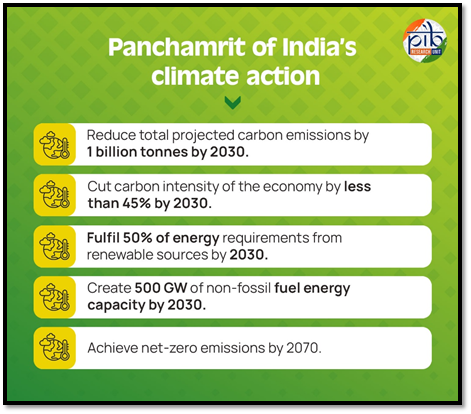
- Climate Commitment Achieved: Achieved its Nationally Determined Contributions (NDCs) target of 50% cumulative non-fossil electric capacity nearly five years early, with the share rising from 32% in 2014 to 51% by October 2025.
Carbon Credit Trading Scheme (CCTS)
- About: CCTS represents a pivotal policy shift, moving India from a mechanism focused on energy efficiency to a comprehensive market-based system aimed at directly pricing and reducing greenhouse gas emissions (GHGs) to meet its ambitious climate targets.
- Core Objective: The CCTS is a market-based mechanism designed to decarbonize the Indian economy by pricing GHG emissions and facilitating a national carbon trading system.
- Evolution from PAT: It transitions from the Perform, Achieve, and Trade (PAT) scheme (focused on energy efficiency via Energy Savings Certificates (ESCerts)) to a focus on reducing GHG emission intensity per tonne of output.
- Key Instrument: It issues Carbon Credit Certificates (CCC), each representing a reduction of one-tonne CO2 equivalent (tCO2e).
- Dual Mechanism: Operates through:
- Compliance Mechanism: Mandates energy-intensive industries (e.g., Aluminium, Cement, Fertilizers, Iron & Steel) to meet sector-specific GHG reduction targets.
- Offset Mechanism: Allows voluntary participation from entities outside the compliance framework to earn credits.
- Sectoral Coverage: Initially targets sectors accounting for 16% of India’s total emissions (Iron & Steel, Aluminium, etc.). The power sector (40% of emissions) may be included later.
- Regulatory Framework: Overseen by the Bureau of Energy Efficiency (BEE) and the National Steering Committee for Indian Carbon Market (NSCICM).
- Strategic Importance: Directly supports India’s goal to cut emission intensity by 45% by 2030 by driving private sector investment in clean technologies, renewables, and carbon capture.
Conclusion
In 2025, India's power sector achieved transformative milestones in reliability, capacity (509.7 GW), renewables (178 GW), and reforms, dramatically reducing deficits and advancing its NDC target, thereby solidifying its path towards sustainable energy security and a robust green economy.
|
Drishti Mains Question: Examine the role of the Indian Carbon Market and the Carbon Credit Trading Scheme (CCTS) in driving industrial decarbonization and positioning India in the global green finance landscape. |
Frequently Asked Questions (FAQs)
1. What was India’s peak power demand met in FY 2025–26?
India successfully met a record 242.49 GW peak demand, with energy shortages reduced to 0.03%.
2. How much total installed power capacity did India achieve by 2025?
Installed capacity reached 509.743 GW, more than doubling since 2014.
3. What is the Carbon Credit Trading Scheme (CCTS)?
The CCTS is a market-based mechanism designed to decarbonize the Indian economy by pricing GHG emissions and facilitating a national carbon trading system.
UPSC Civil Services Examination, Previous Year Question (PYQ)
Prelims
Q. With reference to the Indian Renewable Energy Development Agency Limited (IREDA), which of the following statements is/are correct? (2015)
- It is a Public Limited Government Company.
- It is a Non-Banking Financial Company.
Select the correct answer using the code given below:
(a) 1 only
(b) 2 only
(c) Both 1 and 2
(d) Neither 1 nor 2
Ans: (c)
Mains
Q. “Access to affordable, reliable, sustainable and modern energy is the sine qua non to achieve Sustainable Development Goals (SDGs)”.Comment on the progress made in India in this regard. (2018)
Reusable Launch Vehicle (RLV) Technology
Why in News?
The global space sector is shifting from government-led exploration to private-driven commercial activity, with Reusable Launch Vehicle (RLV) technology emerging as a key disruptor.
- As the market is projected to exceed USD 1 trillion by 2030, reusability has reduced launch costs by 5–20 times, enabling more sustainable and frequent access to space.
What are the Key Facts About the Reusable Launch Vehicle (RLV) Technology?
- About: An RLV is a space launch system designed to allow for the recovery of some or all of its component stages.
- Unlike "expendable" rockets that burn up or are discarded in the ocean, RLVs return to Earth to be refurbished and flown again.
- Goal: To shift the space industry from a "disposable" model to a "transportation" model (like aviation), significantly reducing the cost of access to space.
- Scientific Constraint Behind RLVs: Rocket motion is governed by the Tsiolkovsky rocket equation, which shows that carrying fuel itself adds weight, and additional weight demands even more fuel.
- Consequently, over 90% of a rocket’s mass consists of propellant and fuel tanks, leaving less than 4% for payload.
- RLV technology addresses this inefficiency by reusing expensive rocket hardware across multiple missions, significantly reducing per-launch costs.
- Role of Staging: Staging divides a rocket into multiple propulsion units that are discarded sequentially during ascent to shed dead weight.
- This improves performance by allowing the remaining rocket to accelerate with reduced mass.
- Traditional vehicles like PSLV and LVM-3 use fully expendable staging, whereas RLV systems aim to recover and reuse critical stages, especially the first stage, combining staging with reusability for maximum efficiency.
- RLV Mechanism:
- Launch: RLV or reusable stage is launched like a conventional rocket to deliver payload to orbit.
- Stage separation: After burnout, the reusable stage separates from the upper stage.
- Re-entry control: The stage re-enters the atmosphere using guidance, navigation, and control systems to maintain stability.
- Deceleration: Aerodynamic drag and/or retro-propulsion (engine relight) are used to reduce speed and heat load.
- Recovery: The vehicle lands vertically on a pad/barge or horizontally on a runway (winged RLV).
- Vertical Take-off, Vertical Landing (VTVL): The rocket lands upright on a pad or barge using controlled engine burns.
- Horizontal Landing (Winged Body): A winged RLV glides back and lands on a runway like an aircraft.
- Refurbishment: Post-flight inspection, repair, and testing enable multiple reuses, lowering per-launch.
- Limitations:
- Thermal Stress: Re-entry generates extreme heat. Engines and materials suffer fatigue and micro-fractures, requiring expensive Thermal Protection Systems (TPS).
- Refurbishment Costs and Time: Rise with each reuse and can reduce economic gains beyond a point.
- Risk management challenges, as higher reuse demands stricter inspection and testing to maintain reliability.
ISRO's Reusability Initiatives
- Reusable Launch Vehicle – Technology Demonstrator (RLV-TD) (Pushpak): A winged technology demonstrator that simulates an aircraft-like landing.
- Indian Space Research Organisation (ISRO) successfully conducted the LEX (Landing Experiment) series (LEX-01, 02, 03) using the 'Pushpak' vehicle to test autonomous horizontal landing.
- ADMIRE: ISRO's test bed for Vertical Landing technology (VTVL), aiming to develop retro-propulsion capabilities similar to Falcon 9.
- NGLV (Project Soorya): The Next Generation Launch Vehicle is being designed to replace Polar Satellite Launch Vehicle (PSLV). It will feature a reusable first stage using vertical landing technology.
Frequently Asked Questions (FAQs)
1. What is a Reusable Launch Vehicle (RLV)?
An RLV is a launch system designed to recover and reuse rocket stages instead of discarding them, significantly reducing launch costs.
2. Why is reusability critical to the commercial space sector?
Reusability lowers launch costs by 5–20 times, enables frequent missions, and makes space access economically sustainable.
3. What scientific constraint makes space launches expensive?
The Tsiolkovsky rocket equation shows that rockets must carry enormous fuel mass, leaving less than 4% of total mass for payload.
4. How does staging improve rocket efficiency?
Staging sheds dead weight during ascent, allowing the remaining rocket to accelerate more efficiently with reduced mass.
5. What are India’s key initiatives in reusable launch technology?
ISRO is developing winged RLVs through RLV-TD (Pushpak), VTVL capability via ADMIRE, and a reusable first stage under NGLV (Project Soorya).
UPSC Civil Services Examination Previous Year Question (PYQ)
Prelims
Q. With reference to India’s satellite launch vehicles, consider the following statements: (2018)
- PSLVs launch the satellites useful for Earth resources monitoring whereas GSLVs are designed mainly to launch communication satellites.
- Satellites launched by PSLV appear to remain permanently fixed in the same position in the sky, as viewed from a particular location on Earth.
- GSLV Mk III is a four-staged launch vehicle with the first and third stages using solid rocket motors; and the second and fourth stages using liquid rocket engines.
Which of the statements given above is/are correct?
(a) 1 only
(b) 2 and 3
(c) 1 and 2
(d) 3 only
Ans: (a)
Dugong
The Expert Appraisal Committee (EAC) of the Union Ministry of Environment, Forest and Climate Change (MoEFCC) has recommended a major design overhaul of the proposed International Dugong Conservation Centre in Manora, Thanjavur (Tamil Nadu).
- The proposed centre is located within the Coastal Regulation Zone (CRZ)-III No Development Zone and overlapping CRZ-I areas containing mangroves and seagrass meadows.
Dugong
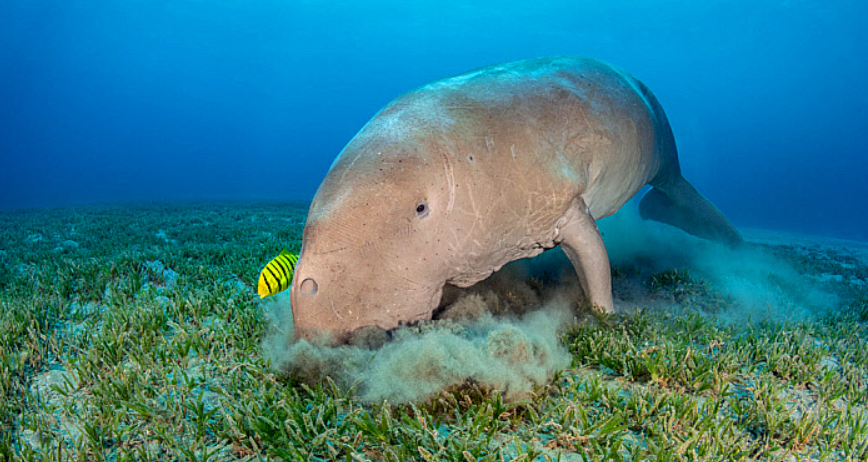
- About: The dugong is a large marine mammal featuring a dolphin-like tail, and can grow up to 10 feet in length and weigh around 420 kg. They are also called sea cows and farmers of the sea.
- Habitat & Diet: They are strictly herbivorous, feeding primarily on seagrass meadows, living in shallow, warm coastal waters (<10m depth) like bays and lagoons.
- Indian Distribution: Found in the Gulf of Kutch, Gulf of Mannar–Palk Bay, and Andaman and Nicobar Islands.
- Behaviour & Reproduction: They are long-lived (up to 70 years), typically solitary or in small pairs. They have a slow reproductive cycle, reaching maturity at 9–10 years and giving birth only every 3–5 years.
- Conservation Status: Listed as Vulnerable on the IUCN Red List, protected under Appendix I of CITES (banning international trade), and under Schedule I of the Wildlife (Protection) Act, 1972.
Seagrass
- Seagrass is an underwater flowering plant and vital wetland ecosystem that stabilizes the seafloor, supports fisheries, sequesters carbon, and shelters marine life.
- India’s largest meadows, found in the Gulf of Mannar and Palk Bay (Tamil Nadu), host its highest diversity with over 13 species, while populations in Lakshadweep, Kachchh, Andhra Pradesh, and Odisha are limited and increasingly threatened.
| Read More: Threat to Dugong Population in India |
Scientists Plan World’s First Graviton Detector
Researchers from Stevens Institute of Technology and Yale University are developing an experiment aimed at detecting gravitons, the hypothetical quantum particles believed to carry gravity, bridging the gap between quantum mechanics and general relativity.
Graviton
- About: A graviton is a hypothetical elementary particle believed to carry the force of gravity, similar to how photons carry electromagnetic force. Detecting gravitons would confirm gravity as a quantum force, a major breakthrough in physics.
- Detection Method: The proposed detector is a superfluid helium resonator, cooled to its quantum ground state to eliminate noise. When a gravitational wave passes through, it could transfer one quantum of energy (a graviton), causing a phonon (vibration) detectable by lasers.
- Detection Challenges: Gravity is the weakest of the four fundamental forces (Gravity, electromagnetism, strong and weak nuclear forces), making graviton interaction with matter extremely rare. A graviton can pass through matter almost without interaction, giving it an extremely small detection probability.
- Limitations: Even if a vibration is detected, it may still be explainable by classical gravity. Previous studies suggest that creating a detector capable of capturing a single graviton may be practically impossible.
- Significance: Successful graviton detection would be a landmark breakthrough, opening pathways toward a unified theory of physics and deeper understanding of the universe.
| Read more: Gravitational Waves |
DoT De-licenses Half of 6 GHz Band
The Department of Telecommunications (DoT) has officially de-licensed the lower half of the 6GHz frequency band for indoor use, paving the way for the adoption of WiFi 6E and WiFi 7 technologies in India.
- Spectrum: The invisible radio frequencies used for wireless communication, ranging from 20 KHz to 300 GHz (a subset of the larger electromagnetic spectrum).
- 2.4 GHz: Offers wide coverage (passes through walls) but has limited data speed.
- 5 GHz: Offers high speed but has a shorter range.
- WiFi 6: Uses both 2.4 GHz and 5 GHz simultaneously for greater efficiency.
- 6 GHz: Operates in the 5,925–7,125 MHz range, offering ultra-high theoretical speeds of 9.6 Gbps.
- Spectrum Allocation: The 6 GHz frequency range of 5,925–6,425 MHz is now license-free. This provides an "extra strand" of spectrum for routers, reducing congestion on the legacy 2.4GHz and 5GHz bands.
- This move enables “Multi-Link Operation” (MLO), a key feature of WiFi 7 that allows devices to transmit data across multiple bands (2.4GHz, 5GHz, and 6GHz) simultaneously, ensuring higher speeds and lower latency.
- Critical Use Cases: The 6GHz band is essential for high-bandwidth applications like Virtual Reality (VR), Augmented Reality (AR), and high-fidelity cloud gaming, as it allows massive data flow with minimal lag.
- Global Context: India has adopted a balanced approach similar to Europe, splitting the 6GHz band between unlicensed use (for WiFi) and licensed use (potentially for 5G/6G), unlike the US (fully de-licensed) or China (reserved for mobile).
- Operational Restrictions: The de-licensed use is strictly for indoor environments.
- It remains prohibited on moving vehicles (cars, trains) and oil rigs to prevent interference with other critical services.
- Market Impact: This decision removes regulatory uncertainty, allowing the launch of advanced hardware (e.g., Sony’s PlayStation 5 Pro) that was previously withheld from the Indian market due to spectrum restrictions.
| Read more: 6G Technology |
INSV Kaundinya Reached Oman
INSV Kaundinya reached Muscat’s Port Sultan Qaboos after completing its maiden voyage from Porbandar (Gujarat), highlighting the shared maritime heritage of India and Oman.
- Eutelsat (French satellite operator) provided high-speed satellite connectivity to the INSV Kaundinya team via its OneWeb satellite constellation.
INSV Kaundinya
- About: INSV Kaundinya is India’s first ‘stitched ship’ built using the ancient stitched shipbuilding (Tankai) method. It aims to revive the 2000-year-old Tankai method, a forgotten indigenous technique.
- Tankai Method: An ancient technique using stitched planks (with coir ropes) and no metal fasteners (like iron nails), making ships flexible and rust-proof.
- Employs indigenous materials like coir, dammar resin, and animal fat for waterproofing.
- Involves a unique hull-first construction, unlike Western frame-first methods.
- Tankai Method: An ancient technique using stitched planks (with coir ropes) and no metal fasteners (like iron nails), making ships flexible and rust-proof.
- Design & Inspiration: Modeled after vessels depicted in the 5th-century Ajanta cave paintings. The design draws inspiration from the ancient Sanskrit text Yuktikalpataru (by King Bhoja, 9th century CE) and accounts of foreign travellers.
- Features symbolic motifs like the Gandabherunda (two-headed eagle of the Kadamba dynasty emblem), Sun motifs, Simha Yali (mythical lion), and a Harappan-style stone anchor.
- Historical Significance: Named after Kaundinya, a legendary 1st-century Indian mariner to make overseas voyages with global historical impact. Kaundinya is credited with sailing to the Mekong Delta and co-founding the Kingdom of Funan (modern Cambodia), one of the earliest Indianised states in Southeast Asia.

| Read More: INSV Kaundinya |
Sexual Dimorphism and Spider Silk Quality
A study has revealed that only large adult female Darwin’s bark spiders produce the toughest silk ever recorded in nature, showing how evolution optimises energy use, body size, and ecological need.
- Darwin’s bark spider (Caerostris darwini), native to Madagascar, produces silk with a tensile strength of about 1.6 gigapascals, making it around three times stronger than iron.
- However, this ability is restricted to large adult females, not males or juveniles.
- Sexual Dimorphism and Silk Quality: The study found a clear link between sexual dimorphism and silk quality, as females are 3–5 times larger than males and face greater ecological demands.
- Researchers analysed dragline (major ampullate) silk, the main structural silk of orb webs, and showed that its exceptional strength comes from high levels of proline, an amino acid crucial for elasticity and toughness, making silk production metabolically expensive.
- To manage this energy cost, adult females produce ultra-tough silk only when necessary, building sparser webs with fewer but stronger threads, while males and juveniles spin denser webs made of cheaper, weaker silk.
- This super-tough silk supports gigantic webs built over rivers and lakes, allowing females to capture prey inaccessible to other spiders. The study concludes that silk quality is adaptively regulated, and extreme strength evolves only when it provides a clear survival advantage.
- Notably, silk elasticity remains constant across all individuals, indicating it is a genetically conserved trait.
| Read more: New Genus of Jumping Spiders |
Jamma Bane Lands of Kodagu
Karnataka has enacted the Karnataka Land Revenue (2nd Amendment) Act, 2025 to modernize the century-old land record system for the unique Jamma Bane lands in Kodagu (Coorg).
- This act seeks to resolve inheritance disputes over Jamma Bane lands by aligning their records with the Karnataka Land Revenue Act, 1964, to ensure accurate documentation of current holders, occupants, and owners.
Jamma Bane Lands
- About: Jamma Bane is a unique, hereditary land tenure system prevalent in Kodagu district (Coorg). The lands were originally granted by the erstwhile kings of Coorg and the British (between 1600 and 1800) to local communities, primarily the Kodavas, in return for military service.
- Nature of the Land: These holdings comprise both wetlands (used for paddy cultivation) and forested highlands, which have largely been converted into the region's famous coffee estates.
- Traditional Record-Keeping: Ownership is registered in the name of the original grantee (pattedar), and despite being passed down over generations, new owners' names were only added alongside the pattedar's name, not as replacements.
- This system created serious legal and economic problems, including difficulties in sale, purchase, inheritance, mutation, and access to bank loans due to lack of clear title.
Kodagu (Coorg)
- About: Kodagu, popularly known as Coorg, is a scenic, high-altitude district in Karnataka's Western Ghats, globally famed as the 'Scotland of India' for its misty hills, and lush coffee plantations. It is the source of the River Kaveri (Talakaveri), a vital peninsular river.
- Economy: An agrarian economy centered on coffee production (a leading Indian region for Robusta/Arabica). Other major crops are pepper, cardamom, and rubber.
- Culture: Home to the Kodava people, known for their martial heritage, unique festivals (Kailpodh, Puthari), and distinctive attire and traditions.
| Read More: Land Revenue Systems in British India |