
FDTL Norms and India’s Aviation Sector
For Prelims: UDAN, Digi Yatra, Foreign Direct Investment, Aviation Turbine Fuel, Sustainable Aviation Fuel, Directorate General of Civil Aviation, Airports Authority of India
For Mains: Aviation safety regulation and pilot fatigue management, Development of India's Aviation Industry, Challenges in India's Civil Aviation and Possible Reforms, Regional Connectivity and Inclusive Growth
Why in News?
IndiGo Airlines has come under scrutiny after mass flight cancellations triggered by the implementation of revised Flight Duty Time Limitation (FDTL) norms left thousands of passengers stranded, prompting the Directorate General of Civil Aviation (DGCA) to grant temporary exemptions for operational stabilisation.
What are the Revised Flight Duty Time Limitation (FDTL) Rules?
- About: FDTL norms are safety regulations issued by the Directorate General of Civil Aviation (DGCA) that prescribe how long pilots can remain on duty, how many hours they can fly, the number of night landings permitted, and the minimum rest they must receive.
- These norms are designed to prevent pilot fatigue, reduce human error, and enhance aviation safety, and are aligned with international aviation standards.
- New FDTL Rules:
- Weekly Rest Increased: Pilots must now get 48 consecutive hours of rest, up from 36 hours earlier.
- Night Landings Capped: Pilots can perform only 2 night landings, reduced from 6 earlier.
- No more than 2 continuous night duties are allowed.
- Mandatory Roster Adjustments: Airlines must redesign crew rosters as per the new limits.
- Quarterly fatigue reporting: Airlines must submit regular fatigue risk reports to the DGCA.
- Objective: Fatigue is a major operational risk in aviation, especially during early morning departures and night landings.
- The new FDTL rules aim to improve pilot alertness, reduce human error, and align India’s aviation safety standards with global norms.
Directorate General of Civil Aviation (DGCA)
- About: The DGCA headquartered in New Delhi, is India’s apex regulatory body for civil aviation safety.
- It functions as an attached office of the Ministry of Civil Aviation and is responsible for regulating air transport services, air safety, and airworthiness standards in India, in coordination with the International Civil Aviation Organisation (ICAO).
- Role of DGCA:
- Aviation Safety Regulator: Ensures air safety, flight operations safety, and airworthiness standards in India.
- Licensing Authority: Issues licenses to pilots, aircraft maintenance engineers, flight engineers, and air traffic controllers.
- Regulation of Air Transport Services: Regulates scheduled and non-scheduled flights of Indian and foreign operators.
- Accident Investigation & Prevention: Investigates aviation accidents and incidents and enforces preventive safety measures.
- Environmental Regulation: Monitors aircraft noise and engine emissions as per ICAO Annex 16.
- Legal and Policy Support: Updates Aircraft Rules, Civil Aviation Requirements (CARs) and supports new aviation laws.
What is the Status of India’s Aviation Sector?
- Global Ranking: India is the 3rd-largest domestic aviation market after the US and China.
- Passenger demand is rising due to urbanisation, tourism, and middle-class expansion.
- Passenger Traffic Growth: By 2040, the passenger traffic is expected to grow six-fold to around 1.1 billion.
- Economic Contribution: As of 2025, aviation supports over 7.7 million jobs (direct + indirect) and contributes 1.5% of India’s GDP.
- Fleet Strength:The Indian fleet accounts for around 2.4% of the total global fleet.
- Fleet size has grown rapidly due to airline expansion and new aircraft orders.
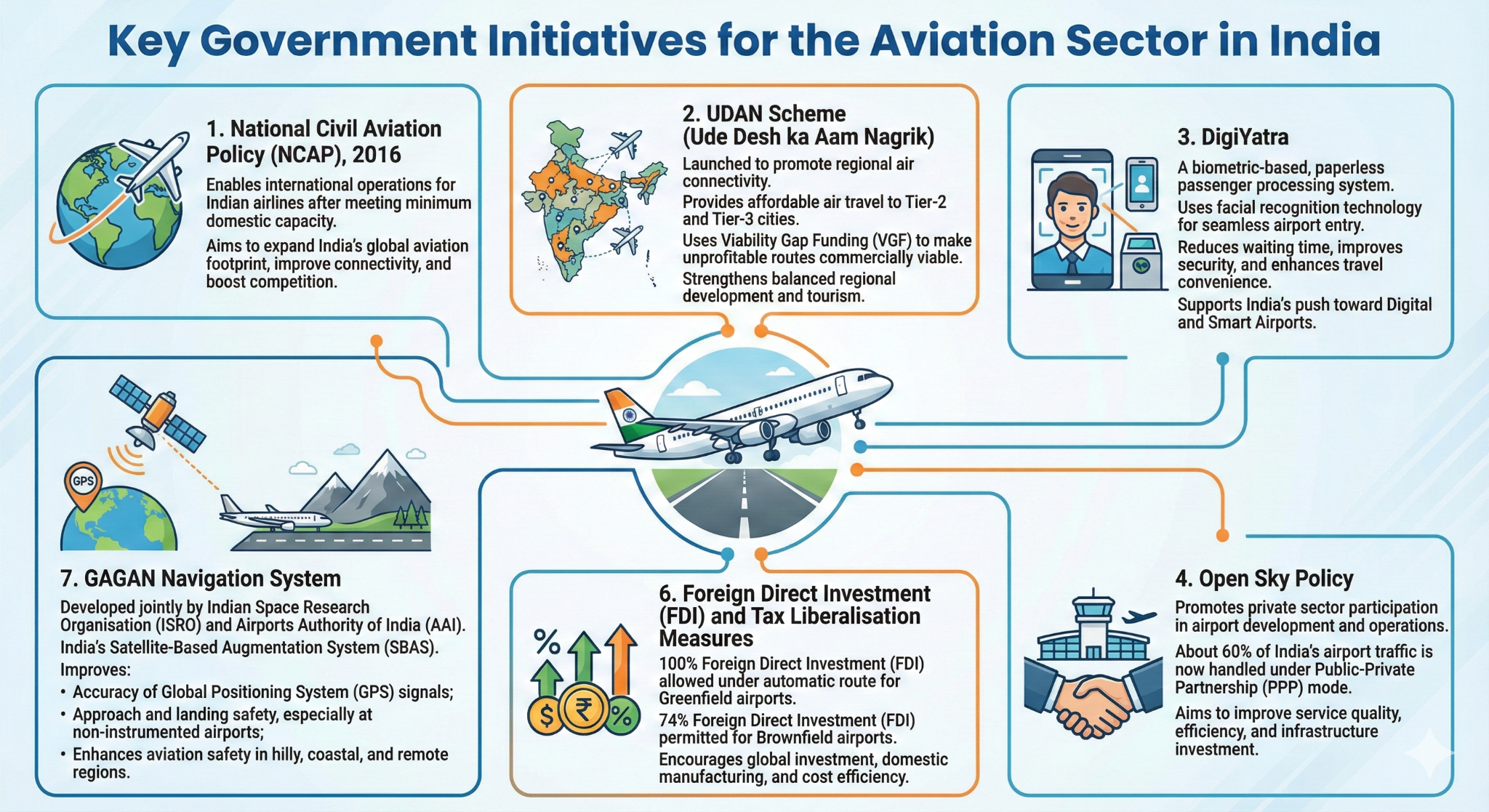
- Airport Infrastructure Expansion: Number of operational airports increased from 74 in 2014 to 163 in 2025. By 2047, India aims to have 350–400 airports.
- Strong focus on Greenfield airports and PPP-based development.
- Indian Civil Aviation Regulation:
- Air Corporations Act, 1953: Nationalised nine airline companies. Government-owned airlines dominated the sector till the mid-1990s.
- Open Sky Policy (1990–94): Allowed private air taxi operators. Ended the monopoly of Indian Airlines (IA) and Air India (AI).
- The Bharatiya Vayuyan Adhiniyam, 2024: Replaces the colonial-era Aircraft Act, 1934 and aligns India’s aviation laws with ICAO standards and the Chicago Convention.
- It promotes Make in India and Atmanirbhar Bharat in aviation manufacturing, introduces simplified licensing and regulatory processes, provides a structured appeals mechanism, and modernises India’s overall aviation governance framework.
What are the Key Challenges in India’s Aviation Sector?
- Pilot and Crew Shortages: Rapid growth in air traffic has created a mismatch between demand and availability of trained pilots, cabin crew, and maintenance staff.
- New safety norms like FDTL have further increased manpower requirements, leading to frequent flight cancellations, delays, and operational disruptions because airlines did not hire and train sufficient pilots in advance to meet the new staffing needs.
- Airport Infrastructure Bottlenecks: Major airports like Delhi, Mumbai, and Bengaluru operate near full capacity, leading to runway congestion, parking shortages, and airspace crowding, especially during peak hours.
- High Operating Costs: Airlines face heavy financial pressure due to high Aviation Turbine Fuel (ATF) prices, aircraft leasing costs in dollars, and rising maintenance expenses.
- Aggressive Capacity and Scheduling Practices: Airlines often announce ambitious flight schedules without adequate backup crews or spare aircraft, increasing the risk of mass cancellations during disruptions.
- Passenger Protection and Grievance Redressal: During large-scale disruptions, passengers face poor communication, weak compensation mechanisms, and limited legal remedies.
- Dependence on Foreign Aircraft and Supply Chains: Heavy reliance on imported aircraft, engines, and spare parts exposes the sector to global supply chain disruptions and currency volatility.
- Exchange Rate Volatility: The depreciation of the Indian rupee against the US dollar raises costs for airlines, as key expenses like aircraft leasing and fuel imports are dollar-denominated.
- Aviation Safety Risks: Recent crashes in 2025 and rising traffic highlight concerns over safety oversight and emergency response.
What Measures can Strengthen India’s Aviation Sector?
- Temporary Regulatory Relief for Stabilisation: DGCA has granted IndiGo a temporary one-time exemption from certain night-operation. This short-term relief should be used strictly for operational stabilisation, not for long-term dependence.
- FDTL norms must not be diluted, as fatigue management is critical to aviation safety.
- Build Operational Buffers: Maintain standby pilots, reserve cabin crew, and spare aircraft to handle disruptions during peak seasons and technical failures.
- Improve Passenger Communication & Compensation: Real-time updates, automatic refunds, and compensation must be strengthened to restore public trust.
- Encourage Sustainable Aviation: Promote Sustainable Aviation Fuel (SAF), energy-efficient airports, and compliance with ICAO's Carbon Offsetting and Reduction Scheme for International Aviation (CORSIA) for carbon reduction.
- Airspace Modernisation: Expedite the proposed Civil Air Traffic Management System with Advanced-Surface Movement Guidance and Control System to optimize airspace usage and reduce delays.
Conclusion
The IndiGo crisis has highlighted serious gaps in manpower planning, infrastructure readiness, and passenger protection in India’s aviation sector. While FDTL norms rightly prioritise safety, airlines must strengthen crew capacity and operational resilience. With airspace modernisation and sustainable practices, the sector can achieve safer and more stable growth.
Frequently Asked Questions (FAQs)
Q. What are FDTL norms?
FDTL (Flight Duty Time Limitation) norms are DGCA safety rules that regulate pilot duty hours, flying time, night landings, and mandatory rest to prevent fatigue.
Q. What are the key new changes under the revised FDTL rules?
Weekly rest increased to 48 hours, night landings capped at 2, no more than 2 continuous night duties, and mandatory quarterly fatigue reporting to DGCA.
Q. What is the role of DGCA in India?
DGCA is India’s apex civil aviation regulator under the Ministry of Civil Aviation, responsible for air safety, licensing, airworthiness, flight regulation, and ICAO coordination.
Q. What is India’s current global position in civil aviation?
India is the 3rd-largest domestic aviation market after the USA and China and supports over 7.7 million jobs.
Summary
- IndiGo faced mass flight cancellations after the rollout of revised FDTL norms, triggering parliamentary scrutiny and exposing manpower gaps.
- The new rules strengthen pilot rest, limit night operations, and mandate fatigue reporting to improve aviation safety.
- India’s aviation sector is rapidly expanding, but it faces challenges like crew shortages, high costs, infrastructure bottlenecks, and safety risks.
- The crisis underscores the need for strict safety enforcement, better crew planning, sustainable aviation, and airspace modernisation.
UPSC Civil Services Examination, Previous Year Questions (PYQs)
Mains
Q. Examine the development of Airports in India through joint ventures under Public–Private Partnership (PPP) model. What are the challenges faced by the authorities in this regard? (2017)
NEP 2020: India’s Innovation Push in School Education
For Prelims: National Education Policy 2020 (NEP 2020), PM e-VIDYA, DIKSHA, Gender Inclusion Fund, National Assessment Centre (PARAKH), School Innovation Ambassador Training Program (SIATP), IPR, Atal New India Challenges (ANIC).
For Mains: National Education Policy 2020 (NEP 2020) and its Role in Transforming the Education System in India, Key India’s Initiatives to Transform the Education System and its Impacts.
Why in News?
India’s education system is making headlines as it undergoes a profound transformation under the National Education Policy 2020 (NEP 2020). The government’s initiatives are moving away from rote learning to inquiry-based, experiential education, fostering creativity, critical thinking, and innovation among students.
How is NEP 2020 Transforming the School Education System in India?
- Multidisciplinary Learning: Students have flexible, multidisciplinary choices (e.g., physics with music) and begin hands-on vocational training from Grade 6 onwards.
- Integration of art, technology, and skill-based learning across levels.
- Assessment Reforms: Shift assessment from rote memorization to testing core competencies. A 360-degree Holistic Progress Card now tracks cognitive, social, and emotional development.
- Digital Integration: Digital platforms like PM e-VIDYA and DIKSHA provide access to virtual labs, teacher training, and online learning for over 25 crore students.
- Equitable and Inclusive Education: A Gender Inclusion Fund and Special Education Zones will support disadvantaged groups and regions. The focus for children with disabilities includes dedicated resource centers, assistive technologies, and inclusive education.
What is National Education Policy (NEP) 2020?
- About: NEP 2020 seeks to tackle challenges related to quality, equity, access, and affordability across all educational levels.
- It replaces the 34-year-old NEP of 1986 and is founded on the recommendations of the Dr. K. Kasturirangan Committee (2019).
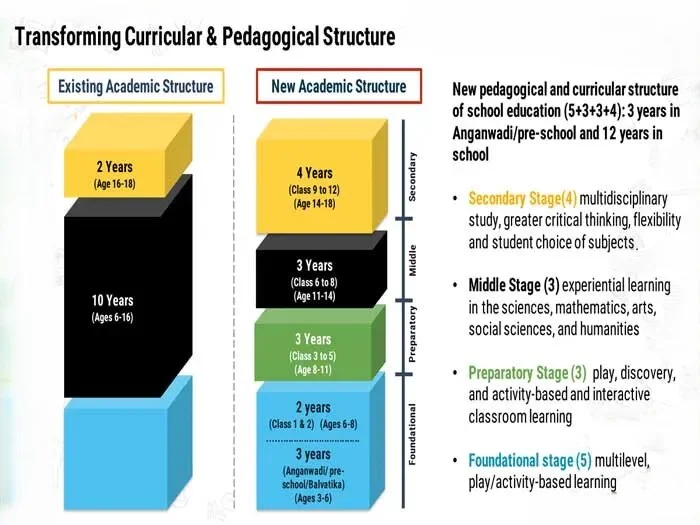
- NEP 2020 Structure: Introduces a 5+3+3+4 structure, with foundational years (ages 3–8) being 100% play-based.
- Performance Evaluation: Every textbook, question paper, and classroom activity must now assess application and innovation rather than simple recall.
- Board exams, overseen by the National Assessment Centre (PARAKH), can be attempted twice a year.
- Key Targets:
|
Key Area |
Target / Objective |
|
Universal School Enrollment |
Achieve 100% Gross Enrollment Ratio (GER) in school education (pre-school to secondary) by 2030. |
|
Out-of-School Children |
Bring 2 crore out-of-school children back into the mainstream education system. |
|
Higher Education Access |
Raise GER in higher education to 50% (from ~27%) by adding 3.5 crore new seats by 2035. |
|
Teacher Qualification |
Make a 4-year integrated B.Ed. degree the minimum qualification for all school teachers by 2030. |
|
Institutional Autonomy |
Phase out the college affiliation system and grant graded autonomy to all colleges within 15 years. |
- Key Initiatives:
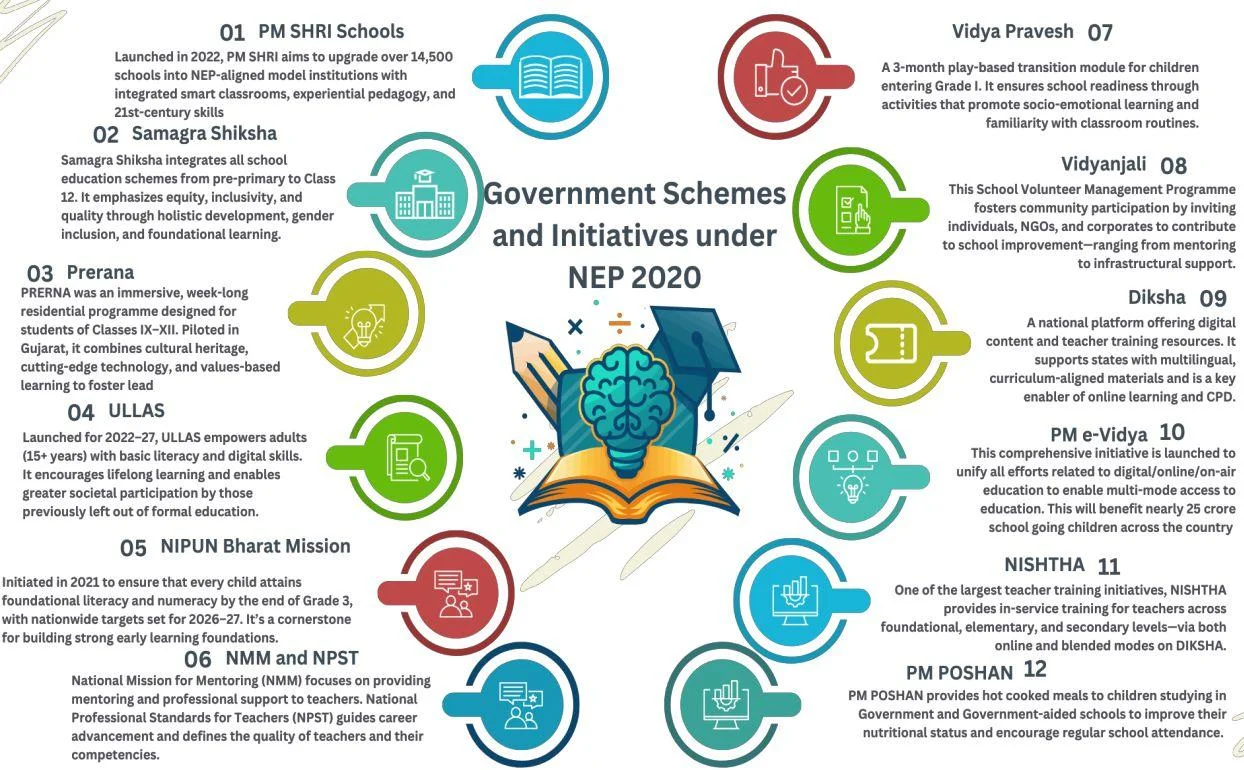
What are India’s Key Initiatives for Transforming the Education System?
- Atal Innovation Mission (AIM): AIM is a flagship initiative launched in 2016 by NITI Aayog to promote innovation and entrepreneurship across schools, colleges, and startups. Key components include:
- Atal Tinkering Labs (ATLs): Innovation labs in schools providing tools like 3D printers, robotics kits, and sensors. Over 1.1 crore students engaged.
- Atal Incubation Centres (AICs): Support startups with mentorship, seed funding, and infrastructure, incubating 3,500+ startups.
- Atal Community Innovation Centres (ACICs): Bring technology-driven innovation to underserved regions.
- Atal New India Challenges (ANIC): Fund and mentor technology-based solutions addressing national priorities
- SICs and SIATP: School Innovation Councils (SICs) have been established in schools to foster creativity, design thinking, and entrepreneurship. Activities include leadership talks, workshops, field visits, and Demo Days.
- School Innovation Ambassador Training Program (SIATP) trains teachers in design thinking, IPR, entrepreneurship, and project mentoring.
- Over 72 hours of intensive training, enabling teachers to mentor students and implement innovation-based pedagogy.
- School Innovation Ambassador Training Program (SIATP) trains teachers in design thinking, IPR, entrepreneurship, and project mentoring.
- INSPIRE Awards – MANAK: Encourages students to propose science and technology solutions addressing societal problems.
- Top innovations receive mentorship, prototypes, and national awards, fostering early-stage entrepreneurship and problem-solving skills.
- School Innovation Marathon: Students solve real-world problems aligned with Viksit Bharat 2047. Includes workshops on design thinking, robotics, and IPR.
- Viksit Bharat Buildathon 2025: Nationwide hackathon for students of classes 6–12 on themes like Vocal for Local, Atmanirbhar Bharat, and Swadeshi.
- Culminates with over 1,000 winners receiving awards from a Rs 1 crore prize pool.
How has Innovation in Education Policy Transformed School Education in India?
- Fostering Critical Thinking: Programs like ATLs, SICs, and INSPIRE Awards – MANAK cultivate hands-on problem-solving, design thinking, and STEM skills among students.
- Encouraging Entrepreneurship: Students transition from idea generation to prototyping and startup creation through ATL Student Innovator Program (SIP), Atal Incubation Centres (AICs), and Atal New India Challenges (ANIC).
- Scaling Innovations Nationally: Hackathons, innovation marathons, and Buildathons provide platforms for national-level recognition, mentoring, and funding, translating school-level ideas into impactful solutions.
- Alignment with National Goals: These initiatives promote self-reliance (Atmanirbhar Bharat), sustainability, and preparation for 2047 challenges, positioning India as a global innovation hub.
|
Drishti Mains Question: Q. The National Education Policy (NEP) 2020 aims to transform India's education system from a content-centric to a competency-based model. Critically examine the key initiatives driving this pedagogical shift and their potential impact on fostering an innovation ecosystem. |
Frequently Asked Questions (FAQs)
Q. What is the primary objective of NEP 2020?
NEP 2020 aims to promote critical thinking, creativity, and experiential learning, replacing rote memorization and enhancing STEM and vocational skills across all school levels.
Q. What are Atal Tinkering Labs (ATLs)?
ATLs are makerspaces in schools providing tools like 3D printers and robotics kits to cultivate innovation, design thinking, and hands-on STEM skills among students.
Q. What is the INSPIRE Awards – MANAK scheme?
It encourages students to propose science and technology solutions for societal problems, offering mentorship, prototypes, and national awards to foster early-stage entrepreneurship.
Summary
- NEP 2020 promotes play-based, experiential, and innovation-driven education, replacing rote learning with critical thinking and creativity.
- Atal Innovation Mission (AIM) and ATLs cultivate STEM, entrepreneurship, and design thinking, engaging over 1.1 crore students.
- Programs like SICs, SIATP, INSPIRE Awards, and national hackathons scale innovation, mentor students, and foster self-reliance.
- Digital platforms PM e-VIDYA and DIKSHA ensure nationwide accessibility, continuity, and equitable participation in India’s evolving education system.
UPSC Civil Services Examination, Previous Year Question (PYQ)
Mains
Q. National Education Policy 2020 is in conformity with the Sustainable Development Goal-4 (2030). It intends to restructure and reorient the education system in India. Critically examine the statement. (2020)
Invasive Alien Plant Species Crisis
Why in News?
A Nature Sustainability study finds that invasive alien plants are spreading across 15,500 sq km of India’s natural areas each year, causing economic losses of Rs 8.3 lakh crore over 60 years and threatening ecosystems, wildlife, agriculture, and rural livelihoods.
What are Invasive Alien Plant Species?
- About: Invasive plant species are non-native plants introduced intentionally or unintentionally into an ecosystem, where they outcompete native species and cause economic, environmental, or human health impacts.
- Invasions are being accelerated by climate change, land-use change, altered fire regimes, soil moisture changes, livestock grazing patterns, and biodiversity loss.
- Invasive Plant Species in India: Key invaders include Lantana camara, Chromolaena odorata and Prosopis juliflora.
- These invasions have spread across 266,954 sq km of natural habitats in India.
- High-risk Regions: Include the Shivalik–Terai belt, the Duar region of the Northeast, the Aravallis, the Dandakaranya forests, and the Nilgiris in the Western Ghats.
- Open ecosystems such as dry grasslands, savannas, shola grasslands, and the wet plains along the Ganga–Brahmaputra are among the most vulnerable to rapid invasive plant expansion.
- Invasive Alien Species Transforming India’s Natural Ecosystems:
- Biodiversity Erosion: Invasive plants outcompete native vegetation, leading to ecosystem homogenization, soil degradation, and large-scale ecological disruption.
- As native plants decline, herbivores lose their natural food sources, which in turn displaces predators due to shrinking prey availability.
- Livestock: Invasions reduce the availability of fodder and grazing areas essential for livestock survival.
- Humans: Invasive species reduce access to fodder, fuelwood, and fertile land, directly harming rural livelihoods.
- They also trigger health issues like respiratory problems and deepen poverty by undermining income and resource security.
- By 2022, 144 million people, 2.79 million livestock, and 2 lakh sq km of smallholder farmland were exposed to invasive species, underscoring the scale of ecological and livelihood risks.
- Biodiversity Erosion: Invasive plants outcompete native vegetation, leading to ecosystem homogenization, soil degradation, and large-scale ecological disruption.
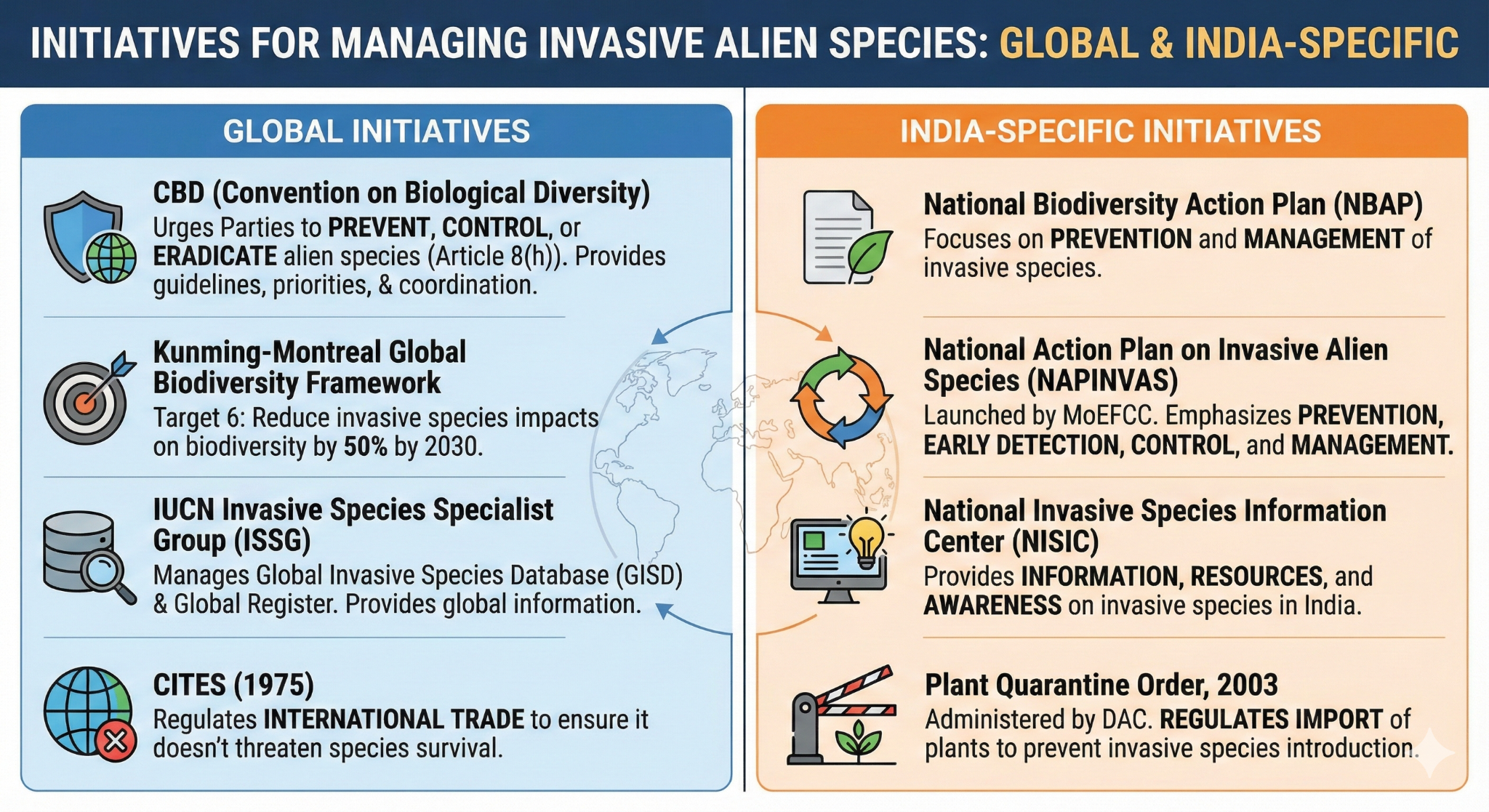
What are the Challenges and Measures for Managing Invasive Plant Species in India?
|
Challenges |
Measures Required |
|
India has no dedicated national mission or central authority to coordinate action on invasive plant species. |
Establish a National Invasive Species Mission with clear leadership and mandates. Integrate invasive control into climate adaptation, watershed management, and restoration programmes |
|
India lacks a unified national database or long-term monitoring system. |
Develop a centralised GIS-based database, early-warning system, and nationwide monitoring network |
|
Weak quarantine and biosecurity systems allowing new introductions |
Strengthen quarantine screening, border biosecurity, and import regulations for plants, seeds, and soil. |
|
There is limited scientific research on species-specific control methods and long-term ecosystem recovery. |
Increase research funding for ecological modelling, biological control, and restoration science. |
|
Manual removal is expensive, labour-intensive, and often ineffective without follow-up restoration. |
Promote community-led removal, mechanical support, and sustainable utilisation options like biofuel production. |
|
Post-removal areas are often not restored, allowing invasives to return quickly. |
Ensure active restoration using native grasses and shrubs to prevent reinvasion. |
Conclusion
India’s rapidly expanding invasive plant species threaten biodiversity, livelihoods, and ecosystem health, requiring urgent national action. A coordinated mission is vital for long-term ecological resilience.
|
Drishti Mains Question: Invasive alien plants are a symptom of systemic environmental mismanagement. Analyse the drivers, ecological impacts. |
Frequently Asked Questions (FAQs)
Q. What are invasive alien plant species?
Non-native plants introduced intentionally or accidentally that establish, spread and outcompete native species, causing ecological, economic or health harm.
Q. Why are invasions accelerating now?
Drivers include climate change, land-use conversion, altered fire regimes, changing soil moisture and increased livestock grazing, which together create favourable conditions for invaders.
Q. What measures are needed to crucial invasive species?
Create a National Invasive Species Mission, build a central GIS database and early-warning system, strengthen quarantine/biosecurity, fund species-specific research, and prioritise restoration with community participation.
Summary
- A Nature Sustainability study shows invasive alien plants are spreading across 15,500 sq km of India’s natural areas every year, severely impacting ecosystems and livelihoods.
- Species like Lantana camara, Chromolaena odorata and Prosopis juliflora now dominate large habitats, affecting 266,954 sq km of natural areas.
- By 2022, invasions had exposed 144 million people, 2.79 million livestock and 2 lakh sq km of farmland to ecological and economic risks.
- Weak biosecurity, poor monitoring and lack of a national mission hinder control efforts, highlighting the need for a coordinated strategy to protect biodiversity and rural communities.
UPSC Civil Services Examination, Previous Year Questions (PYQs)
Mains:
Q. How does biodiversity vary in India? How is the Biological Diversity Act, 2002 helpful in conservation of flora and fauna? (2018)
RBI Cuts Repo Rate to Sustain ‘Goldilocks Phase’
Why in News?
The Reserve Bank of India’s Monetary Policy Committee (MPC) has cut the repo rate by 25 basis points, reducing it to 5.25%. This marks a cumulative cut of 125 bps in 2025. RBI termed the current economic scenario as a “Goldilocks phase” — characterized by low inflation and strong GDP growth.
What is the ‘Goldilocks Phase’ in an Economy?
- About: A Goldilocks phase in the economy refers to a situation where the economy is perfectly balanced—growth is strong and sustainable without overheating, and inflation remains low and stable without slipping into weak demand or deflationary risk.
- In December 2025, RBI Governor called India’s economy a “rare Goldilocks phase” as growth stood at 8.2% in Q2 (July-September) of 2025–26 while inflation averaged 1.7% in Q2 and dipped to 0.3% in October 2025.
- Significance: In a Goldilocks phase, central banks often have more room to maneuver—they can keep rates lower for longer to boost growth, or (as in India's case) cut rates to extend the favorable cycle.
- It’s a temporary ideal window that policymakers try to protect and prolong.
What are the Key Factors that Lead to a Repo Rate Cut by the RBI?
- Sustained Disinflation: Inflation fell sharply—averaging 1.7% in Q2 of 2025-26 and dropping to 0.3% in October 2025—well below the RBI’s lower tolerance band (4% ±2%).
- This collapse in price pressures created the policy space for the RBI to cut rates without risking overheating of the economy.
- Headline inflation fell below the 2% lower tolerance band for the first time under the Flexible Inflation Targeting (FIT) regime.
- India's Goldilocks Moment: Growth remained strong at 8.2% in Q2 while inflation stayed low at 2.2%, creating ideal macroeconomic conditions for sustained economic development.
- The RBI cut rates to reinforce momentum and support domestic demand to prolong this favourable phase.
- Counterbalance External Headwinds: Weak global trade, volatile markets, and geopolitical risks threatened India’s exports and investment.
- The rate cut aimed to cushion the economy by boosting domestic demand against these external drags.
- Support for Growth Momentum: The rate cut aims to reinforce festive-season demand, the effects of GST rationalisation, and overall domestic consumption, thereby nurturing growth during this favourable macro phase.
Repo Rate
- About: The repo rate (Repurchase Agreement Rate) is the interest rate at which commercial banks borrow funds from the central bank.
- Functioning: It helps banks meet short-term liquidity needs by borrowing funds, with securities provided as collateral and repurchased later at a higher price including interest.
- Influence on Credit Costs: A higher repo rate raises loan costs and slows borrowing, while a lower repo rate lowers borrowing costs.
- Role in Monetary Policy: The central bank uses the repo rate to control money supply, inflation, and economic growth.
Flexible Inflation Targeting
- Flexible Inflation Targeting (FIT): FIT is a monetary policy framework in which the central bank’s goal is to achieve a specific medium-term inflation target, while retaining flexibility to consider short-term output and employment stabilization.
- Primary Mandate: The primary mandate of FIT is a publicly declared, specific inflation target, usually expressed as a point or a range.
- For example, in India, the RBI’s mandate is to maintain Consumer Price Index (CPI) inflation at 4%, within a band of ±2% (i.e., 2% to 6%).
- Trade-off Management: FIT formally recognizes short-term trade-offs between controlling inflation and supporting growth, giving the central bank leeway to balance these objectives while keeping inflation as the overriding nominal anchor.
What can be Implications of the RBI’s Repo Rate Cut on the Indian Economy?
- Boost to Economic Growth: Lower rates reduce borrowing costs, increase bank lending, stimulate consumption, and encourage business investment in capital expenditure.
- Inflationary Pressures: Increased liquidity may raise demand-pull inflation if the supply of goods & services is tight; the RBI’s cut reflects confidence that inflation will stay within the 2–6% target band.
- External Sector Dynamics: Reduced interest rate appeal may weaken the rupee, improving export competitiveness but raising import costs and widening the trade deficit.
- Effect on Savings: Lower interest rates reduce returns on fixed deposits and small savings, potentially discouraging household savings.
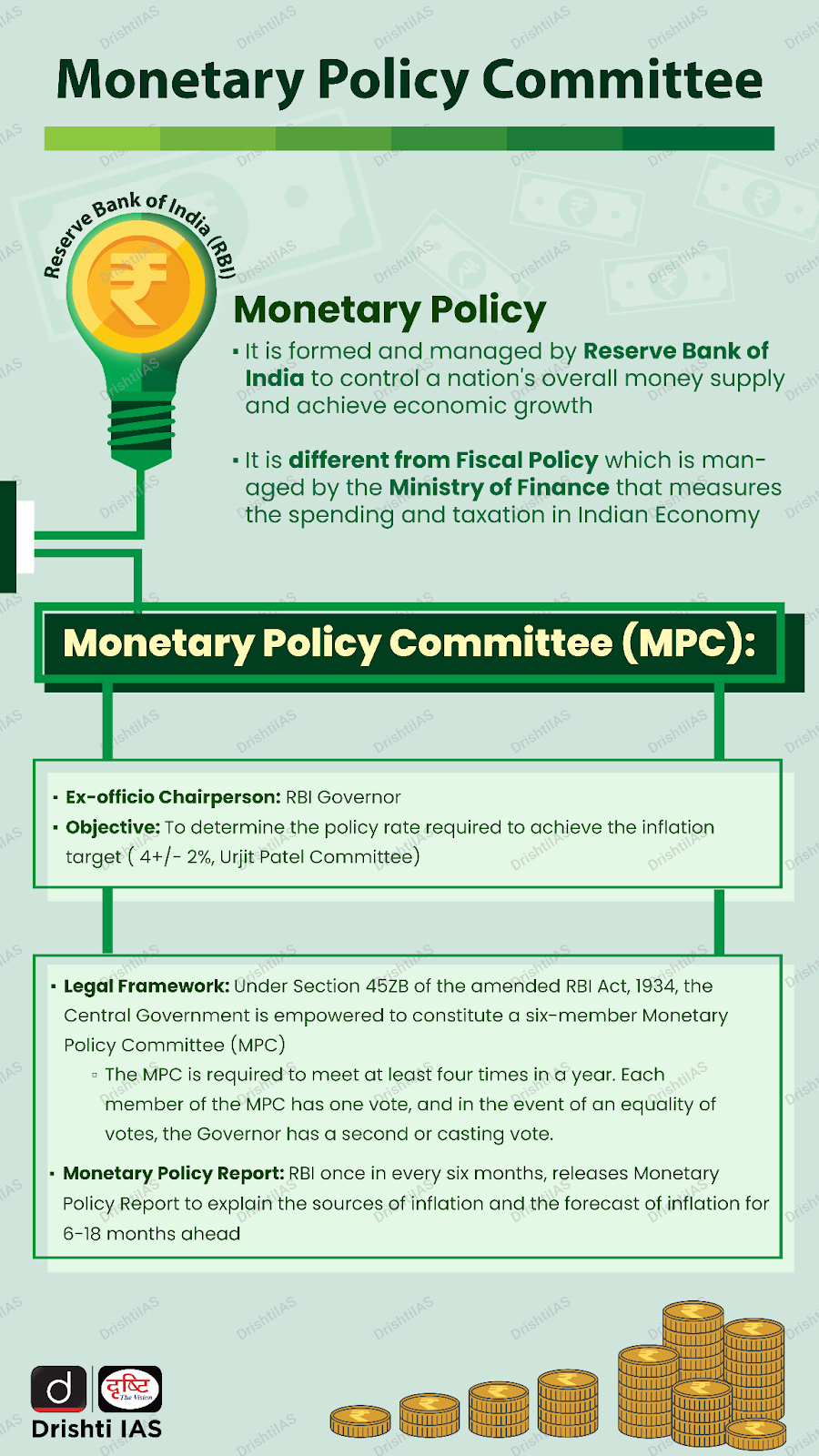
| Drishti Mains Question:
Discuss the role of the Monetary Policy Committee (MPC) in navigating the trade-off between inflation management and growth stimulation, with reference to India's recent economic data. |
Frequently Asked Questions (FAQs)
Q. What is the repo rate?
The repo rate is the interest rate at which commercial banks borrow funds from the RBI to meet short-term liquidity needs.
Q. What is a Goldilocks Moment in economics?
A period where growth is strong and inflation is low, allowing policymakers flexibility to support the economy without overheating risks.
Q. How does Flexible Inflation Targeting (FIT) work?
FIT sets a medium-term inflation target while allowing discretion to support growth and employment amidst short-term shocks.
Summary
- The RBI cut the repo rate by 25 bps to 5.25%, citing a rare Goldilocks economic phase of strong growth (~8%) and unusually low inflation (below 2%).
- The decision was enabled by sustained disinflation, which provided policy space under the Flexible Inflation Targeting framework.
- The strategic cut aims to reinforce domestic demand and prolong favorable conditions while preemptively cushioning the economy against global uncertainties.
- This reflects a calibrated move to balance growth preservation with price stability, using the flexibility within the RBI's mandate to secure the current macroeconomic momentum.
UPSC Civil Services Examination, Previous Year Questions (PYQs)
Prelims
Q. Which of the following statements is/are correct regarding the Monetary Policy Committee (MPC)? (2017)
- It decides the RBI’s benchmark interest rates.
- It is a 12-member body including the Governor of RBI and is reconstituted every year.
- It functions under the chairmanship of the Union Finance Minister.
Select the correct answer using the code given below:
(a) 1 only
(b) 1 and 2 only
(c) 3 only
(d) 2 and 3 only
Ans: (a)
Q. If the RBI decides to adopt an expansionist monetary policy, which of the following would it not do? (2020)
- Cut and optimize the Statutory Liquidity Ratio
- Increase the Marginal Standing Facility Rate
- Cut the Bank Rate and Repo Rate
Select the correct answer using the code given below:
(a) 1 and 2 only
(b) 2 only
(c) 1 and 3 only
(d) 1, 2 and 3
Ans: (b)
Mains
Q. Define potential GDP and explain its determinants. What are the factors that have been inhibiting India from realizing its potential GDP? (2020)
Q. Do you agree with the view that steady GDP growth and low inflation have left the Indian economy in good shape? Give reasons in support of your arguments (2019)
Health Security se National Security Cess Bill, 2025
Why in News?
The Lok Sabha has passed the Health Security se National Security Cess Bill, 2025, which introduces a special cess on paan masala manufacturing units and any additional goods notified by the Government.
- The revenue generated will be used to strengthen national security and improve public health infrastructure.
What are the Key Highlights of the Health Security se National Security Cess Bill, 2025?
- Purpose of the Cess: The Bill establishes a special excise cess to create a stable, rule-based revenue stream for funding India’s national security and public health needs.
- The proceeds of this cess will be credited to the Consolidated Fund of India.
- The cess is imposed on the machinery installed or the processes undertaken (whether manual or hybrid) for manufacturing specified goods, and is applicable in addition to existing duties and taxes.
- Goods Covered: Initially, the cess applies only to pan masala, but the Government is empowered to notify additional goods in the future.
- The Government may increase the cess up to twice the existing rate in public interest, exempt certain persons or processes, and add new goods to the cess schedule.
- The Bill introduces a capacity-linked monthly levy calculated using machine parameters such as maximum rated speed, pack weight or a flat monthly rate for manual process.
- Taxable Persons: Any individual or entity that owns, operates, or controls machinery or processes used for manufacturing specified goods must pay the cess.
- Liability applies regardless of the person’s existing tax status, ensuring comprehensive coverage of all producers.
- Enforcement Framework: The Bill includes a stringent enforcement system prescribing penalties, prosecution, arrest, and confiscation for violations such as undeclared machinery, cess evasion, falsification of records, or obstruction of officials.
- Appeals Authority: A multi-tier appellate mechanism allows taxpayers to challenge decisions before the Appellate Authority, then the Tribunal, and subsequently the High Court and Supreme Court, ensuring procedural fairness and legal remedy at all stages.
What is Cess?
- About: It is a tax on tax imposed by the government for a specific, earmarked purpose (public good). Cess is levied in addition to existing taxes such as excise duty or income tax.
- It is collected until enough funds are raised for the designated objective.
- Constitutional Basis: The 80th Amendment formally amended Article 270, explicitly excluding cesses and surcharges from the divisible pool (revenue from cesses is not shared with states).
- Cesses are recognized in the Constitution under Article 277 and Article 270 (which outlines the revenue-sharing framework between the Union and States).
- Examples of Cess: Education Cess, Swachh Bharat Cess, and Krishi Kalyan Cess.
Tax Vs Cess Vs Surcharge
|
Tax |
Cess |
Surcharge |
|
General compulsory levy for government revenue |
A tax on tax for a specific purpose |
Extra tax on tax applied to high-income taxpayers |
|
Used for any public expenditure |
Used only for the earmarked purpose |
Adds revenue to Union; no specific purpose |
|
Shared with states (divisible pool) |
May or May not be shared with states |
Not shared with states |
|
Permanent |
Temporary, collected till funds are adequate |
No fixed period |
|
Examples: Income Tax, GST, Customs Duty |
Examples: Education Cess, Clean Energy Cess, Swachh Bharat Cess |
Examples: Surcharge on income above ₹50 lakh |
Frequently Asked Questions (FAQs)
Q. What is the objective of the Health Security–National Security Cess Bill, 2025?
To create a stable revenue stream for funding national security and public health through a special excise cess.
Q. What is a cess in taxation?
A cess is a tax on tax levied for a specific, earmarked purpose like education, health, or sanitation.
Q. How is cess different from a normal tax?
A tax is for general revenue, while a cess is earmarked for a specific objective.
Summary
- The Health Security–National Security Cess Bill, 2025 introduces a special excise cess on pan masala manufacturing machinery to fund national security and public health.
- The cess is capacity-based, applied in addition to existing taxes, and credited to the Consolidated Fund of India.
- The government can expand it to more goods, revise rates, and grant exemptions in public interest.
- The Bill also creates a strict enforcement and multi-tier appeals framework to ensure compliance.
UPSC Civil Services Examination Previous Year Question (PYQ)
Prelims
Q. The sales tax you pay while purchasing a toothpaste is a (2014)
(a) tax imposed by the Central Government
(b) tax imposed by the Central Government but collected by the State Government
(c) tax imposed by the State Government but collected by the Central Government
(d) tax imposed and collected by the State Government
Ans: (D)
GIFT City as Reinsurance Hub
India’s plan to turn Gujarat International Finance Tec-City (GIFT City) into a global reinsurance hub, is advancing with over 10 international insurers already set up and more in line.
GIFT City
- About: GIFT City, India’s first International Financial Services Centre (IFSC), on the Sabarmati River in Gandhinagar, is a world-class financial and IT hub.
- It was established under the Special Economic Zone (SEZ) Act, 2005, and is structured into two zones i.e., GIFT SEZ for non-resident entities, and Domestic Tariff Area (DTA) for domestic commercial purposes.
- Designated as a non-resident zone under the Foreign Exchange Management Act, 1999 (FEMA).
- IFSC is a jurisdiction that provides onshore and offshore financial services to non-residents and residents (institutions), in a foreign currency.
- Objective: To attract global capital and establish India as a leading international financial centre (like Singapore and Dubai).
- Regulatory Body: Governed by the International Financial Services Centres Authority (IFSCA), a unified regulator established by the IFSCA Act, 2019.
- Functions: Functions as India’s onshore financial free zone, combining a global financial hub (banking, exchanges, reinsurance), a smart tech ecosystem for fintech, and a tax-friendly business enclave to attract international capital and services.
- Incentives Provided: It offers major incentives, including a 10-year tax holiday, no additional capital injection, and a lighter compliance regime, unlike onshore India.
| Read More: GIFT City and Bullion Exchange |
Mahaparinirvan Diwas
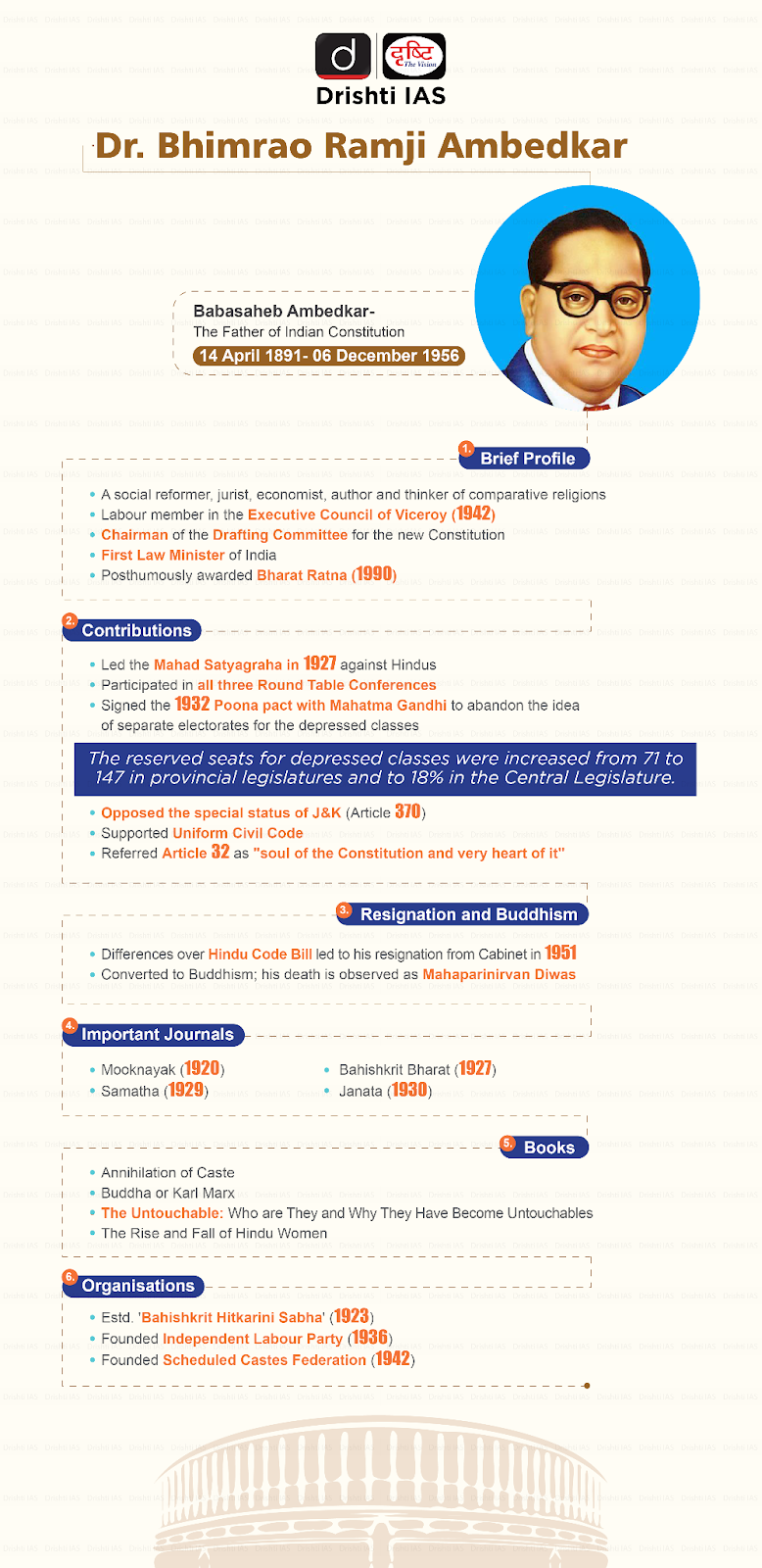
Mahaparinirvan Diwas, marking the death anniversary (6th December 1956) of Bharat Ratna Baba Saheb Dr. Bhimrao Ramji Ambedkar’s, was observed across India.
- Dr B.R. Ambedkar: Born on 14th April 1891 at Mhow, Madhya Pradesh was a jurist, economist, social reformer, and the Chief Architect of the Indian Constitution.
- Mahaparinirvan Diwas: The Mahaparinibbana Sutta records Lord Buddha’s Mahaparinirvana at 80 years.
- 6th December is observed as Mahaparinirvan Diwas to honour Dr B.R. Ambedkar, who founded Navayana Buddhism focused on social equality. His memorial is at Chaitya Bhoomi, Dadar (Mumbai).
Contributions
- Constitution: As Chairman of the Constituent Assembly’s Drafting Committee, he ensured Fundamental Rights, abolition of untouchability, federalism, minority protections, and an independent judiciary.
- Leader of Anti-Caste Movements: He led historic anti-untouchability movements such as the Mahad Satyagraha (1927) and Kalaram Temple Satyagraha (1930), represented the Depressed Classes at the Round Table Conferences, and negotiated the Poona Pact (1932) which became the foundation of reservations and affirmative action.
- Organisations Founded: Bahishkrit Hitkarini Sabha, Independent Labour Party, Scheduled Castes Federation.
- Labour Reforms: As Labour Member of the Viceroy’s Executive Council (1942–46), he played a key role in introducing the 8-hour workday, maternity benefits, labour welfare funds, and employment exchanges.
- Economic Contributions: His ideas shaped the Reserve Bank of India (1934) and Finance Commission framework.
| Read more: Philosophical Perspectives of Dr. B.R. Ambedkar |
EARTH Summit 2025
Union Home & Cooperation Minister inaugurated EARTH Summit 2025 in Gandhinagar, launching 13+ digital services under Sahakar Sarathi, including Digi Kisan Credit Card (KCC), Cooperative Governance Index, and the World’s Largest Grain Storage Application.
- EARTH Summit: The EARTH Summit series aims to build a national policy framework for rural development by integrating learnings from its three editions, first held in Hyderabad, then in Gandhinagar, and later in Delhi.
- Jointly organized by the National Bank for Agriculture and Rural Development (NABARD) and the Internet and Mobile Association of India (IAMAI), the summit places strong emphasis on reviving Gandhian Gram Swaraj, ensuring that villages remain at the heart of India’s development strategy.
- It also reaffirmed that strengthening cooperatives is essential for accelerating growth in agriculture, dairy, animal husbandry, and fisheries-the core pillars of the rural economy and crucial drivers of inclusive development.
- Sahakar Sarathi: It is a digital initiative launched under the Ministry of Cooperation and developed by NABARD to modernise and strengthen India’s cooperative banking and rural financial ecosystem.
- It aims to bring every district, central, state, agricultural and urban cooperative bank under a single, unified technology platform, reducing costs and improving efficiency for smaller cooperatives.
- Helps rural banks access modern banking technology without the financial burden of building their own infrastructure.
- Ensures that farmers with e-KCC receive digital facilities comparable to international credit cards.
| Read more: Towards a Vibrant Rural India |