
World Bank Fast-Tracks Aid Amid Middle East Crisis | 28 Mar 2026
Why in News?
The World Bank is fast-tracking aid for countries navigating the Middle East conflict, warning that rising commodity prices and logistical disruptions are severely straining emerging market economies and widening the global fallout.
- The World Bank will combine immediate financial relief, policy expertise, and private sector support to recover jobs and growth by leveraging its active portfolio, crisis toolkit, and pre-arranged financing facilities.
What are Key Facts Regarding the World Bank?
- About: The World Bank is an international financial institution that provides loans, grants, and technical assistance to the governments of low- and middle-income countries. It forms the core of the World Bank Group (WBG).
- Goals: Its primary goals are to eradicate extreme poverty and promote shared prosperity by fostering sustainable economic growth.
- This involves addressing intertwined global challenges like climate change and inequality through financial products, grants, and research.
- Historical Background: The World Bank was established in 1944 at the Bretton Woods Conference in the United States, initially as the International Bank for Reconstruction and Development (IBRD). Its early focus was on financing the reconstruction of Europe and Japan following World War II.
- It officially began operations in 1946 and has evolved significantly since the 1970s to address direct poverty alleviation.
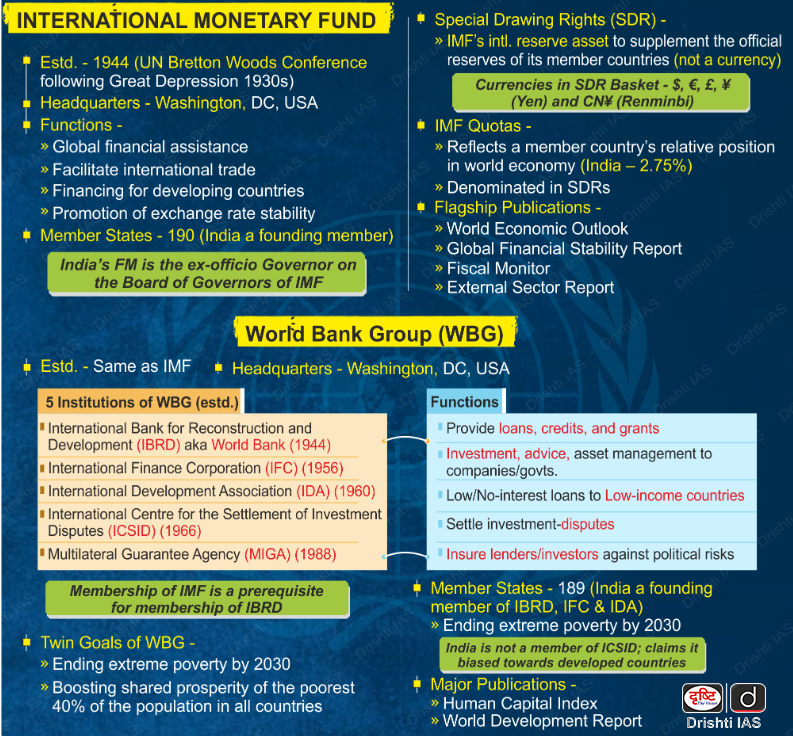
- World Bank Group: It is a family of 5 specialised organisations that collaborate to provide financing, technical expertise, policy advice, and knowledge to member nations.
- IBRD (International Bank for Reconstruction and Development): Provides loans and assistance to middle-income and creditworthy low-income countries.
- IDA (International Development Association): Provides interest-free loans (credits) and grants to the world’s poorest countries. The IBRD and IDA together make up the "World Bank."
- IFC (International Finance Corporation): Focuses on the private sector in developing countries.
- MIGA (Multilateral Investment Guarantee Agency): Promotes foreign direct investment by offering political risk insurance.
- ICSID (International Centre for Settlement of Investment Disputes): Settles investment disputes between investors and countries.
- Key Functions: Its core activities include:
- Project Financing: Funding infrastructure (roads, bridges), health programs (vaccines, clinics), and education. E.g., USD 830 million loan to support Pradhan Mantri Skilling and Employability Transformation Through Upgraded ITIs (PM-SETU) Program in India.
- Policy Advice: Helping governments reform their economies or improve public administration.
- Research and Data: It is a major source of global economic data, such as the World Development Report, Global Economic Prospects (GEP), etc.
- Membership: It has 189 member countries. To be a member of the World Bank, a country must first join the International Monetary Fund (IMF). India is a member country of both the World Bank and the IMF.
Note: India is a member of four of the five institutions in the World Bank Group, but is not a member of the ICSID, an international arbitration institution.
What is the Difference between the World Bank and the IMF?
|
Feature |
World Bank |
IMF |
|
Primary Goal |
Long-term growth and poverty reduction (development). |
Global monetary cooperation and financial stability. |
|
Leadership |
Historically led by a US citizen. |
Historically led by a European. |
|
Voting Power |
Based on Capital Shares (one vote per share of the Bank's stock). The United States holds the largest share (~15.85% of voting power). |
Based on Quotas (reflecting a country’s relative size in the global economy). The United States is the largest quota holder (~16.5% of voting power). |
|
Core Activity |
Finances roads, schools, and green energy infrastructure. |
Provides loans to stabilize currencies and fix Balance of Payments (BoP) crises. |
|
Nature of Loans |
Loans typically span 15 to 40 years (long-term). |
Loans are usually for 3 to 5 years for crisis management (short/medium-term). |
|
Funding Source |
Primarily raises money by selling bonds to private investors. |
Funded by membership "subscriptions" paid by member nations. |
Frequently Asked Questions (FAQs)
1. Where was the World Bank established, and in which year?
The World Bank was established in 1944 at the Bretton Woods Conference in the United States, initially as the International Bank for Reconstruction and Development (IBRD)
2. Which entities specifically constitute the "World Bank"?
The "World Bank" refers specifically to the IBRD (International Bank for Reconstruction and Development) and the IDA (International Development Association) combined.
3. What is the primary difference between the lending nature of the World Bank and the IMF?
The World Bank provides long-term loans (15–40 years) for development projects, while the IMF offers short-to-medium-term loans (3–5 years) to manage Balance of Payments (BoP) crises.
UPSC Civil Services Examination, Previous Year Question
Q. With reference to ‘IFC Masala Bonds’, sometimes seen in the news, which of the statements given below is/are correct? (2016)
- The International Finance Corporation, which offers these bonds, is an arm of the World Bank.
- They are the rupee-denominated bonds and are a source of debt financing for the public and private sector.
Select the correct answer using the code given below:
(a) 1 only
(b) 2 only
(c) Both 1 and 2
(d) Neither 1 nor 2
Ans: (c)
Q. India’s ranking in the ‘Ease of Doing Business Index’ is sometimes seen in the news. Which of the following has declared that ranking? (2016)
(a) Organization for Economic Cooperation and Development (OECD)
(b) World Economic Forum
(c) World Bank
(d) World Trade Organization (WTO)
Ans: (c)