
Strengthening the National Commission for Minorities | 11 Dec 2025
For Prelims: National Commission for Minorities (NCM), Statutory Body, Quasi-judicial Powers, Minority, Census 2011, High Court, NCSC, NCST.
For Mains: National Commission for Minorities, Challenges Faced by it and steps needed to strengthen it.
Why in News?
The Ministry of Minority Affairs has not committed to any timeline for filling the long-pending vacancies in the National Commission for Minorities (NCM), even after the Delhi High Court sought a response from the government over the delay.
- The NCM has been headless since April 2025, with all posts of Chairperson, Vice-Chairperson, and Members remaining vacant.
What is the National Commission for Minorities (NCM)?
- About: The NCM is a statutory body set up under the National Commission for Minorities (NCM) Act, 1992 to safeguard the rights and interests of minorities and ensure their protection and development.
- The first Commission was constituted on 17th May 1993.
- Origin: The Minorities Commission (MC) was set up in 1978 by a Ministry of Home Affairs Resolution and moved to the Ministry of Welfare in 1984. In 1988, linguistic minorities were excluded from its jurisdiction.
- Composition: The NCM consists of a Chairperson, Vice-Chairperson, and 5 Members, all nominated by the Central Government from persons of eminence, ability, and integrity.
- At least five members, including the Chairperson, must belong to notified minority communities (Muslim, Christian, Sikh, Buddhist, Parsi, and Jain).
- Mandate and Duration: It has quasi-judicial powers, and each member serves a 3-year term from the date of joining.
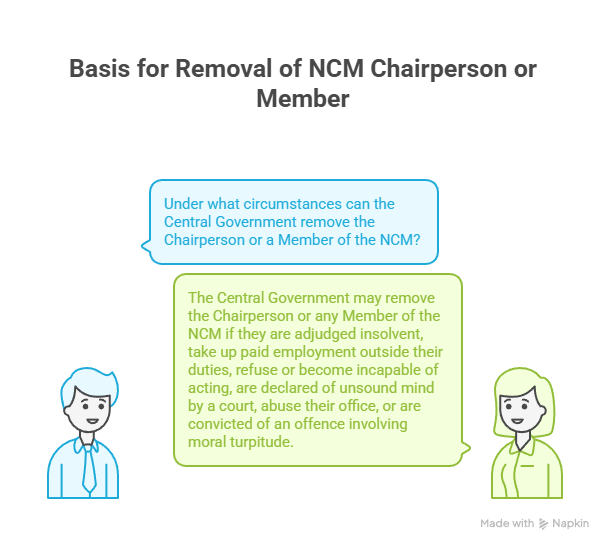
- Removal:
Who are Considered Minorities in India, and What Constitutional Safeguards are Provided to Them?
- About Minorities: The term 'Minority' is not explicitly defined in the Constitution of India; however, it recognizes the existence of religious and linguistic minorities.
- The NCM Act, 1992 provides a statutory definition, specifying a minority as a community officially notified as such by the Central Government
- Minority Communities: Under the NCM Act, 1992, the Ministry of Welfare, through a 1993 notification, officially designated five religious communities—Muslims, Christians, Sikhs, Buddhists, and Zoroastrians (Parsis)—as minority communities.
- This list was later expanded in 2014 to include Jains as the sixth notified minority community.
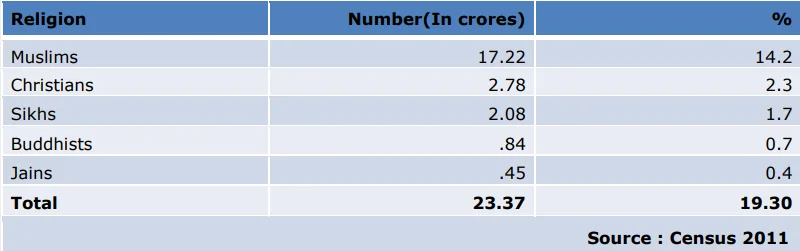
- Minorities Population:
- Constitutional Safeguards for Minorities:

What are the Major Challenges Faced by the National Commission for Minorities (NCM)?
- Chronic Vacancies: The NCM has been largely non-functional because all key positions—Chairperson, Vice-Chairperson, and Members—are vacant, despite Delhi High Court reminders to fill them.
- Limited Autonomy: Appointments are made at the Central Government’s discretion, raising concerns about the NCM’s independence and political neutrality, and undermining its role as an impartial watchdog.
- Ambiguity in "Minority" Definition: Minority status is based only on religion, excluding linguistic or ethnic minorities, raising debates on uniform recognition and state-level minorities.
- Advisory Nature and Lack of Enforcement Power: As a statutory body, the Commission can only recommend actions to the Government, but its decisions are not binding, and it cannot enforce or penalize, limiting its effectiveness.
- Erosion of Institutional Credibility: A defunct Commission increases judicial burden, as people bypass it for court intervention, and may draw international scrutiny over India’s minority protection commitments.
What Measures can Strengthen Functioning of the National Commission for Minorities?
- Legislative and Institutional Reforms: Upgrade NCM to a Constitutional body (like NCSC/NCST) or amend the NCM Act, 1992 to make its recommendations binding, and establish transparent appointment criteria to ensure independence.
- Functional Empowerment: Empower NCM to take suo motu action, impose penalties for non-compliance, and strengthen its investigation wing with a dedicated, trained team for independent probes.
- Judicial Oversight and Review: Enable courts to oversee NCM orders and use its reports in PILs, while promoting public engagement through hearings, consultations, and awareness campaigns.
- Integration with Broader Governance: Integrate NCM with monitoring of minority welfare schemes (e.g., scholarships, skill development) to assess ground-level implementation.
- Create a standing inter-ministerial committee with Home, Education, Social Justice, and Minority Affairs ministries for coordinated policy action.
- Learning from Global Best Practices: Adopt international models like South Africa’s Commission for Cultural, Religious, and Linguistic Communities or the UK Equality and Human Rights Commission for stronger enforcement mechanisms.
Conclusion
The chronic vacancies and structural weaknesses plaguing the NCM have crippled its constitutional mandate to protect minority rights. Urgent reforms, including timely appointments, legislative empowerment, and enhanced autonomy, are essential to restore its credibility as an effective watchdog and safeguard India's pluralistic fabric.
|
Drishti Mains Question: Q. "The protection of minority rights is a cornerstone of a vibrant democracy." In light of this statement, critically examine the constitutional safeguards for minorities in India and the efficacy of the National Commission for Minorities in enforcing them. |
Frequently Asked Questions (FAQs)
Q. What is the National Commission for Minorities (NCM)?
A statutory body under the NCM Act, 1992, to safeguard minority rights, with a Chairperson, Vice-Chairperson, and five Members nominated by the Central Government.
Q. Which communities are officially recognized as minorities under the NCM Act, 1992?
Six religious communities are notified: Muslims, Christians, Sikhs, Buddhists, Parsis (Zoroastrians), and Jains. Jains were added in 2014.
Q. What is the population share of minorities in India?
According to Census 2011, minorities constitute approximately 19.3% of India’s total population.
Summary
- The NCM, a key statutory watchdog for minority rights, is defunct as all posts have been vacant since April 2025, undermining its mandate.
- Its structural weaknesses include an advisory role, government-controlled appointments, and a religion-only minority definition.
- While constitutional safeguards (e.g., Article 30) exist, enforcement depends on a functional NCM; its paralysis increases judicial burden and erodes community trust.
- Urgent reforms—timely appointments, constitutional or binding statutory status, suo motu and penal powers, and transparent selection—are needed to restore its credibility and efficacy.
UPSC Civil Services Examination Previous Year Questions (PYQ)
Prelims
Q. In India, if a religious sect/community is given the status of a national minority, what special advantages is it entitled to? (2011)
- It can establish and administer exclusive educational institutions.
- The President of India automatically nominates a representative of the community to Lok Sabha.
- It can derive benefits from the Prime Minister’s 15-Point Programme.
Which of the statements given above is/are correct?
(a) 1 only
(b) 2 and 3 only
(c) 1 and 3 only
(d) 1, 2 and 3
Ans: (c)
Q. What was the exact constitutional status of India on 26th January, 1950? (2021)
(a) A Democratic Republic
(b) A Sovereign Democratic Republic
(c) A Sovereign Secular Democratic Republic
(d) A Sovereign Socialist Secular Democratic Republic
Ans: (b)
Q. The Preamble to the Constitution of India is (2020)
(a) a part of the Constitution but has no legal effect
(b) not a part of the Constitution and has no legal effect either
(c) a part of the Constitution and has the same legal effect as any other part
(d) a part of the Constitution but has no legal effect independently of other parts
Ans: (d)
Mains
Q. Whether the National Commission for Scheduled Castes (NCSC) can enforce the implementation of constitutional reservation for the Scheduled Castes in the religious minority institutions? Examine. (2018)