
State of the World's Migratory Species | 09 Mar 2026
For Prelims: World’s Migratory Species Report 2024, Convention on the Conservation of Migratory Species of Wild Animals (CMS), IUCN Red List Category, Highly Pathogenic Avian Influenza (HPAI) H5N1, Olive Ridley Turtle, Bonn Convention, Central Asian Flyway (CAF), Amur Falcon, Snow Leopard, Great Indian Bustard, United Nations Environment Programme (UNEP), National Biodiversity Strategy and Action Plan (NBSAP), Environmental Impact Assessment, BBNJ Treaty, Renewable Energy.
For Mains: Key Findings of the Interim Update to the UN State of the World’s Migratory Species Report 2024, Key facts regarding migratory species, steps needed for conservation of migratory species.
Why in News?
A concerning interim update to the UN State of the World’s Migratory Species report 2024 warns that 49% of global migratory species populations protected under the Convention on the Conservation of Migratory Species of Wild Animals (CMS) are declining.
Summary
- A concerning UN interim report reveals 49% of migratory species under the Convention on Migratory Species (CMS) are declining, up from 44% in two years.
- Key threats include habitat loss, avian flu, and overexploitation.
- Despite these trends, targeted conservation efforts have successfully recovered species like the Saiga Antelope and Scimitar-horned Oryx.
What are the Key Findings of the Interim Update to the UN State of the World’s Migratory Species Report 2024?
- Population Declines and Extinction Risk: The proportion of CMS-listed species with declining populations has increased from 44% to 49% in just 2 years.
- Consequently, the percentage of species with increasing or stable trends has dropped to 38%, while those facing extinction now comprise 24% of all listed species, up from 22%.
- Deteriorating Conservation Status: Of the 386 CMS-listed species reassessed since 2022, 34 (9%) were moved to a different IUCN Red List category, with the vast majority (26 species) shifting to a more threatened category (e.g., from Endangered to Critically Endangered).
- A significant 69% of these species are migratory shorebirds, whose decline is attributed to habitat loss and degradation at key stopover and non-breeding sites.
- Emergence of New and Existing Threats:
- Avian Flu as a Major Threat: Highly Pathogenic Avian Influenza (HPAI) H5N1 has emerged as a significant new threat, causing mass mortality in a range of species, including penguins, pelicans, cranes, and aquatic mammals like fur seals and sea lions.
- Habitat Loss and Fragmentation: The expansion of linear infrastructure (roads, railways, fences) continues to fragment habitats, as seen with the drastic decline in mobility for the Mongolian Gazelle.
- Land-use changes have also led to dramatic population crashes, such as the 75% decline in the Mara-Loita Blue Wildebeest since the late 1970s.
- Overexploitation and Bycatch: For sharks and rays, overfishing and bycatch remain primary threats. Raptor populations in Africa and Eurasia are heavily impacted by illegal taking, poisoning, and collisions with energy infrastructure.
- Regional Success Stories and Recoveries: Despite the negative trends, targeted conservation efforts have led to successful recoveries for a few species:
- Scimitar-horned Oryx was reclassified from Extinct in the Wild to Endangered after reintroduction efforts in Chad.
- Saiga Antelope rebounded spectacularly in Kazakhstan, moving from Endangered to Near Threatened.
- Mediterranean Monk Seal improved from Endangered to Vulnerable due to population growth.
What are Migratory Species?
- About: Migratory species are defined as wild animals—including aquatic, avian (birds), and terrestrial species—whose populations cyclically and predictably move from one geographical area to another.
- They rely on different sites for breeding, feeding, and resting (stopovers). The loss of even one critical site along their route can threaten the entire population.
- Taxonomic Scope: Migratory species include
- Birds: Bar-tailed Godwit, Arctic Tern
- Mammals: Terrestrial mammals include Wildebeest, Saiga Antelope, etc., while Marine mammals include Humpback Whale, Gray Whale, etc.
- Fish: Salmon, European Eel, etc
- Reptiles: Leatherback Turtle, Olive Ridley Turtle, etc.
- Insects: Monarch Butterfly, Globe Skimmer dragonfly.
- Protection of Migratory Species: Migratory species are protected under CMS (1979), also referred to as the Bonn Convention. India has been a party to the CMS since 1983.
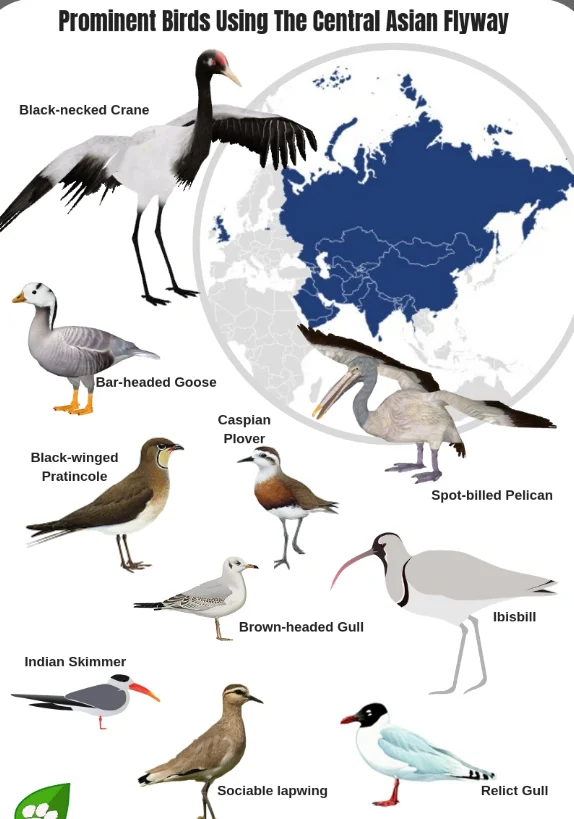
- India's Geographic Importance: India is prominent for migratory species due to its position along major global flyways, particularly the Central Asian Flyway (CAF), which supports hundreds of migratory bird populations. It also hosts important routes for marine turtles, mammals, and other taxa. Key migratory species in India are:
- Birds (Many using the CAF): Siberian Crane, Amur Falcon, Bar-headed Goose, Black-necked Crane, etc.
- Mammals: Asian Elephant, Snow Leopard, Great Indian Bustard, Pallas's Cat, etc.
- Marine species: Olive Ridley Turtle, Leatherback Sea Turtle, Hawksbill Sea Turtle, etc.
Convention on the Conservation of Migratory Species of Wild Animals (CMS)
- About: CMS, also called the Bonn Convention, is a legally binding international treaty administered by the United Nations Environment Programme (UNEP). It provides a global framework to protect migratory animals and conserve their habitats across countries.
- It was adopted in 1979 in Bonn, Germany, and entered into force on 1st November 1983.
- Objective: It addresses the unique challenges faced by migratory species which cyclically and predictably cross national boundaries during their life cycles (for breeding, feeding, or other purposes), necessitating coordinated international action beyond the scope of national measures alone.
- Two Appendices: It has two appendices:
- Appendix I: Encompasses migratory species that are endangered. Parties are required to provide strict protection, including prohibiting hunting, trapping, and poisoning, conserving or restoring habitats, mitigating migration obstacles (e.g., barriers) etc.
- There are 188 species in Appendix I. Key Indian Species in CMS Appendix I are Great Indian Bustard, Siberian Crane, Olive Ridley Turtle, Leatherback Sea Turtle etc.
- Appendix II: Covers migratory species with an unfavourable conservation status that would benefit significantly from international cooperation. This appendix supports the negotiation of targeted Agreements or MoUs among range states.
- Appendix I: Encompasses migratory species that are endangered. Parties are required to provide strict protection, including prohibiting hunting, trapping, and poisoning, conserving or restoring habitats, mitigating migration obstacles (e.g., barriers) etc.
- Governance Body: The Conference of the Parties (COP) serves as the primary decision-making body, convening periodically to review implementation, adopt resolutions, and amend appendices. CMS COP 15 will be held in March 2026 in Campo Grande, Brazil (CMS COP 14 was held in Samarkand, Uzbekistan).
What Steps are Needed for Conservation of Migratory Species?
To address escalating threats, the CMS has outlined priority actions focusing on habitat protection, combating overexploitation, reducing pollution, mitigating climate change, and strengthening its Appendices.
- Protect, Connect and Restore Habitats: Priority actions include expanding protected area coverage to key biodiversity sites while enhancing management effectiveness by integrating species priorities into National Biodiversity Strategy and Action Plan (NBSAP) and securing sufficient resources.
- Regular monitoring using standardized protocols, restoring 30% of degraded ecosystems by 2030 in line with KMGBF Target 2, and prioritizing ecological connectivity—currently below 10%—are essential.
- Additionally, infrastructure impacts must be minimized through Environmental Impact Assessment and Strategic Environmental Assessment compliance, following CMS guidance on renewable energy, linear infrastructure, and pollution.
- Tackle Overexploitation: International collaboration must be strengthened to reduce overfishing, bycatch, and illegal killing, including through fisheries monitoring, CMS engagement with fisheries bodies, and ratification of the BBNJ Treaty.
- Ensure national legislation fully protects CMS Appendix I-listed species from "take" (hunting, fishing, capturing), closely regulating exceptions.
- Reduce the Damaging Impacts of Environmental Pollution: To reduce pollution impacts on migratory species, priority actions include mitigating light pollution using CMS-endorsed guidelines, restricting underwater noise in sensitive areas with quieting technologies, and accelerating the phase-out of toxic lead ammunition.
- Additional measures involve lowering pesticide use near critical habitats, while tackling plastic pollution by eliminating problematic plastics and reducing unnecessary production.
- Address Impacts of Climate Change: Use targeted ecosystem restoration to enhance habitat quality and connectivity, lessening the impact of extreme weather events, while implementing dynamic management measures to address climate-induced shifts in migration pathways.
- At the same time, ensure that renewable energy infrastructure expansion avoids harm to migratory species by adhering to guidance from the CMS Energy Task Force.
Conclusion
Urgent, coordinated action is imperative to reverse migratory species declines. Protecting habitats, tackling overexploitation and pollution, and mitigating climate change impacts are critical priorities. The recoveries achieved demonstrate that with sustained international cooperation under CMS, safeguarding these transboundary species for future generations remains achievable.
|
Drishti Mains Question: Examine the role of the Convention on Migratory Species (CMS) in the conservation of migratory wildlife. |
Frequently Asked Questions (FAQs)
1. What is the Convention on Migratory Species (CMS)?
The CMS, or Bonn Convention, is a UNEP-administered treaty adopted in 1979 that provides a global legal framework for conserving migratory species and their habitats across national boundaries.
2. What are the two appendices under the CMS?
Appendix I lists endangered migratory species requiring strict protection. Appendix II lists species with unfavourable conservation status that benefit from international cooperation through Agreements or MoUs.
3. Which Indian species are listed in CMS Appendix I?
Key Indian species include the Great Indian Bustard, Asian Elephant, Bengal Florican, Siberian Crane, Olive Ridley Turtle, Leatherback Turtle, and Hawksbill Turtle.
UPSC Civil Services Examination, Previous Year Question (PYQ)
Prelims
Q. The most important strategy for the conservation of biodiversity together with traditional human life is the establishment of (2014)
(a) biosphere reserves
(b) botanical gardens
(c) national parks
(d) wildlife sanctuaries
Ans: (a)
Q. With reference to the International Union for Conservation of Nature and Natural Resources (IUCN) and the Convention on International Trade in Endangered Species of Wild Fauna and Flora (CITES), which of the following statements is/are correct? (2015)
- IUCN is an organ of the United Nations and CITES is an international agreement between governments.
- IUCN runs thousands of field projects around the world to better manage natural environments.
- CITES is legally binding on the States that have joined it, but this Convention does not take the place of national laws.
Select the correct answer using the code given below:
(a) 1 only
(b) 2 and 3 only
(c) 1 and 3 only
(d) 1, 2 and 3
Ans: (b)
Mains
Q. How does biodiversity vary in India? How is the Biological Diversity Act,2002 helpful in the conservation of flora and fauna? (2018)