
NITI Aayog Report on Convergence of MSME Schemes | 16 Jan 2026
For Prelims: Micro, Small and Medium Enterprises (MSMEs), GDP, Udyam Registration Portal, Udyam Assist Platform (UAP), Khadi and Village Industries, Gram Swaraj, Sustainable Development Goal, Scheme of Fund for Regeneration of Traditional Industries (SFURTI), Micro and Small Enterprises – Cluster Development Programme (MSE-CDP), ASPIRE, MSME Innovative.
For Mains: MSMEs and their role in the Indian economy, Need for convergence of various MSME schemes and NITI Aayog’s recommendations for MSME schemes convergence
Why in News?
NITI Aayog has released a report titled “Achieving Efficiencies in MSME Sector through Convergence of Schemes”, outlining a strategic roadmap to strengthen the effectiveness of government support for India’s Micro, Small and Medium Enterprises (MSMEs).
- It recommends a two-pronged approach for convergence of 18+ MSME schemes, comprising information convergence and process convergence.
- The first integrates central and state data for better decisions. The second unifies schemes to reduce redundancy and streamline service delivery, fostering a cohesive MSME ecosystem.
Summary
- NITI Aayog advocates converging 18+ MSME schemes to eliminate fragmentation.
- The sector is vital, contributing ~30% to GDP and 45% to exports.
- Fragmented schemes across ministries reduce efficiency and outreach.
- NITI Aayog’s convergence framework integrates data and processes to create a simplified, efficient, and outcome-driven MSME support system.
What are MSMEs?
- About: MSMEs are businesses defined and categorized based on their investment in plant, machinery, or equipment and their annual turnover and are the foundation stone of India’s economic framework.
- Government spending on the MSME sector has risen sharply to Rs 22,094 crores in 2023-24 from Rs 6,717 crores in 2019-20.
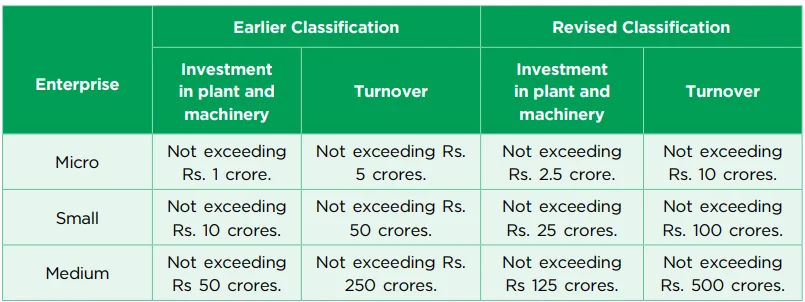
- Classification: The MSME sector is classified in accordance with the Micro, Small and Medium Enterprises Development (MSMED) Act, 2006, based on investment in plant and machinery and turnover, with a revised classification effective from 1st April, 2025.
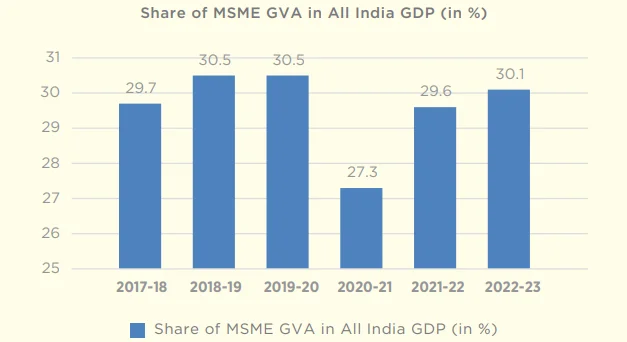
- Economic Contribution: The MSME sector contributes between 27% and 30% to India's GDP, employs 62% of the country’s workforce (approximately 28.13 crores), and accounts for about 45% of the country’s exports.
- Growth and Performance: The sector grew at an average of 8.6% between 2000 and 2016, outperforming the industrial sector (7.6%), and has the capacity to produce 6,000 distinct products.
- Formalization Initiatives: Over 90% of MSMEs in India continue to operate in the informal sector, with only 9% transitioning from unregistered status. To promote formalization, the government has introduced the Udyam Registration Portal and the Udyam Assist Platform (UAP).
- The Udyam Registration Portal enables self-registration, while the Udyam Assist Platform (UAP) help integrate Informal Micro Enterprises (IMEs) into the formal sector. There are 3.94 crore MSMEs registered on the Udyam Portal and 2.71 crore informal micro enterprises on the Udyam Assist Platform.
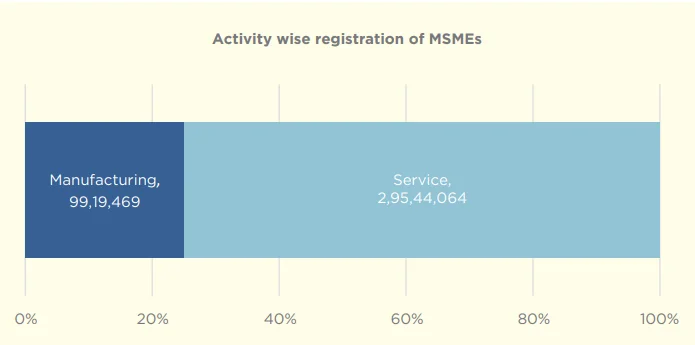
- Composition & Regional Presence: As of October 2024, 25% of registered MSMEs are in manufacturing, while 75% are involved in service activities. 51% of MSMEs are in rural areas, and 49% are in urban areas.
- Key Organizations Attached to Ministry of MSMEs:
- Office of the Development Commissioner (DC-MSME): Implements MSME policies and programs, advises on policy, offers consultancy, facilitates technology upgrades, and develops human resources through training.
- Khadi and Village Industries Commission (KVIC): Promotes rural employment through khadi and village industries by producing saleable articles, fostering self-reliance, and providing training, research, and raw materials.
- Coir Board: Develops the coir industry by promoting exports, advancing research, and improving workers' living conditions.
- National Small Industries Corporation (NSIC): Promotes MSME growth through marketing support, credit facilitation, raw material provision, and a network of technical service centers across India.
- National Institute for Micro, Small and Medium Enterprises (NIMSME): Premier training institute offering capacity-building programs for entrepreneurs and officials to enhance MSME capabilities and competitiveness.
- Mahatma Gandhi Institute for Rural Industrialisation (MGIRI): Accelerates sustainable rural industrialization by attracting professionals to Gram Swaraj, empowering traditional artisans, and encouraging innovation through R&D and pilot studies.
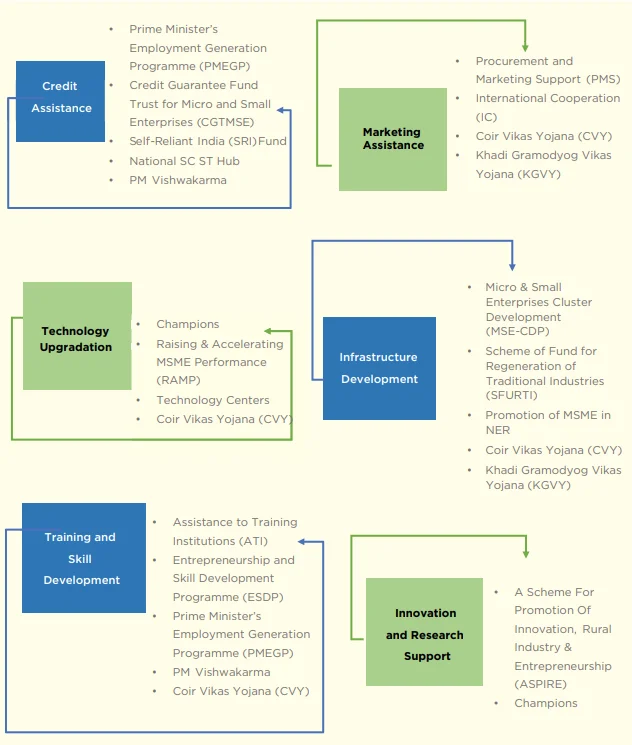
- Key MSME Schemes:
What is the Need of the Convergence of Schemes for MSMEs?
- Multiple Schemes, Similar Goals: Various ministries and departments (e.g., Ministry of MSME, Rural Development, Handicrafts, Coir Board) run programmes with overlapping objectives (e.g., for coir, leather, handicrafts, village industries). This leads to the same target beneficiaries being served by multiple, uncoordinated schemes, wasting resources.
- Enhance Efficiency and Impact of Resources: Converging schemes enables better planning and pooled central and state financial resources, preventing scattered investments. The shared use of physical and institutional infrastructure also avoids wasteful duplication, thereby improving overall cost-effectiveness.
- Simplify Access for Beneficiaries: Convergence creates a single platform for MSME scheme mobilization, enabling easier access without approaching multiple agencies. This coordinated approach minimizes confusion from similar schemes, ensuring clearer communication and higher uptake among beneficiaries.
- Improve Governance and Delivery: Information convergence integrates scattered ministry data into a single system, enabling better beneficiary tracking and informed policymaking. This unified mechanism for inspection and monitoring, using a shared resource pool, enhances accountability, and transparency.
- Align with National and Global Best Practices: The report references Sustainable Development Goal 17 (Partnerships for the goals), emphasizing multi-sectoral collaboration as key to effective governance. It also implements recommendations from past committees (like the PM's Task Force on MSMEs) that have long advocated for a single platform to ensure benefits reach targets without leakage.
What are the Key Recommendations of the NITI Aayog‘s Report for Convergence of Schemes for MSMEs?
- Centralized Portal for MSMEs: The report proposes an AI-powered centralized digital platform integrating MSME schemes, compliance, finance, and market intelligence. It would feature information, process, compliance, and market research modules, supported by AI chatbots, dashboards, and mobile access for real-time support to MSMEs.
- Convergence of Cluster Development Schemes: Integration of the Scheme of Fund for Regeneration of Traditional Industries (SFURTI) with the Micro and Small Enterprises – Cluster Development Programme (MSE-CDP).
- It proposes a dedicated sub-scheme for traditional industries, a unified governance structure under MSE-CDP, and consolidated funding with earmarked resources to preserve crafts, arts, and endangered traditional industries while improving scale and efficiency.
- Convergence of Skill Development Programmes: The report proposes rationalising skill initiatives into a three-tier structure covering entrepreneurship and business skills, MSME technical skills, and training for rural and women artisans.
- This approach merges overlapping schemes, improves coordination among institutions, and retains targeted programmes to promote inclusion, and entrepreneurship.
- Marketing Assistance Wing: To streamline MSME marketing support, the report proposes a dedicated Marketing Wing with domestic and international components.
- The domestic wing would facilitate MSME participation in national exhibitions, trade fairs, and buyer-seller meets, while the international wing would support global market access through overseas trade fairs, B2B events, and buyer-seller meets.
- MSME Innovative & A Scheme For Promoting Innovation, Rural Industry & Entrepreneurship (ASPIRE): The report recommends integrating ASPIRE into MSME Innovative as a special category for agro-rural enterprises. Existing ASPIRE funds can continue, while future MSME Innovative budgets earmark a share for agro-rural incubators. This integration broadens access to advanced incubation without restricting.
Conclusion
The NITI Aayog report underscores that convergence of MSME schemes is critical to enhance efficiency, reduce duplication, and improve service delivery. By integrating data, processes, and institutional efforts, convergence can create a unified, outcome-oriented MSME ecosystem, maximising public investment and accelerating inclusive economic growth.
|
Drishti Mains Question Examine the significance of the MSME sector for India's economy and the rationale of the MSMEs scheme convergence for strengthening the MSME sector in India. |
Frequently Asked Questions (FAQs)
1. How do MSMEs contribute to India’s economy?
MSMEs contribute 27–30% to GDP, employ 62% of the workforce, and account for ~45% of exports.
2. Why is convergence of MSME schemes needed?
To eliminate duplication and fragmentation across ministries, simplify beneficiary access, optimize resource utilization, and improve governance, as highlighted by the PM's Task Force on MSMEs and SDG 17.
3. What are the key government portals for MSME formalization?
The Udyam Registration Portal (2020) enables self-registration, while the Udyam Assist Platform (2023), with SIDBI, integrates Informal Micro Enterprises (IMEs) into the formal sector.
UPSC Civil Services Examination, Previous Year Question:(PYQ)
Prelims
Q1. Consider the following statements with reference to India : (2023)
- According to the Micro, Small and Medium Enterprises Development (MSMED) Act, 2006, the ‘medium enterprises’ are those with investments in plant and machinery between `15 crore and `25 crore.
- All bank loans to the Micro, Small and Medium Enterprises qualify under the priority sector.
Which of the statements given above is/are correct?
(a) 1 only
(b) 2 only
(c) Both 1 and 2
(d) Neither 1 nor 2
Ans: (b)
Q2. What is/are the recent policy initiative(s)of Government of India to promote the growth of the manufacturing sector? (2012)
- Setting up of National Investment and Manufacturing Zones
- Providing the benefit of ‘single window clearance’
- Establishing the Technology Acquisition and Development Fund
Select the correct answer using the codes given below:
(a) 1 only
(b) 2 and 3 only
(c) 1 and 3 only
(d) 1, 2 and 3
Ans: (d)
Q3. Which of the following can aid in furthering the Government’s objective of inclusive growth? (2011)
- Promoting Self-Help Groups
- Promoting Micro, Small and Medium Enterprises
- Implementing the Right to Education Act
Select the correct answer using the codes given below:
(a) 1 only
(b) 1 and 2 only
(c) 2 and 3 only
(d) 1, 2 and 3
Ans: (d)
Mains
Q.1 “Industrial growth rate has lagged behind in the overall growth of Gross-Domestic-Product(GDP) in the post-reform period” Give reasons. How far are the recent changes in Industrial Policy capable of increasing the industrial growth rate? (2017)
Q.2 Normally countries shift from agriculture to industry and then later to services, but India shifted directly from agriculture to services. What are the reasons for the huge growth of services vis-a-vis the industry in the country? Can India become a developed country without a strong industrial base? (2014)