
Mangroves as Ecological Buffers | 16 Dec 2025
Why in News?
A study published in Current Biology has revealed how mangrove plants survive extreme saltwater conditions, offering insights that could help develop salt-tolerant crops amid climate change and rising sea levels.
Summary
- A Current Biology study reveals that mangroves survive extreme salinity through unique cell-level adaptations such as thick cell walls and specialised salt management mechanisms.
- The findings offer actionable insights to develop salt-tolerant crops, strengthening climate resilience, food security, and sustainable agriculture amid rising sea levels.
How Mangroves Survive Saltwater?
- Unique Cellular Traits Identified: Mangroves have smaller epidermal pavement cells and thicker cell walls, which provide the mechanical strength necessary to survive in low osmotic potential conditions caused by saltwater.
- Different Salt Management Mechanisms: Some species exclude salt using a waxy root barrier that filters salt and pulls freshwater into the plant.
- Others accumulate salt and actively excrete it through specialised glands on their leaves.
- Evolutionary Adaptability: Mangroves have evolved over 30 times in the last 200 million years, showing a strong evolutionary capacity to adapt to saline environments.
- Non-dependence on Stomatal Changes:Contrary to expectations, mangroves do not increase stomatal density or reduce stomatal size—commonly seen in other drought-tolerant plants, to enhance photosynthesis or reduce water loss.
Implications
- Climate Resilience in Agriculture: Understanding mangrove cell traits can help engineer salt-tolerant crop varieties, especially for regions facing increased soil salinity due to climate change. Focused research on modifying cell size and wall properties could lead to breakthrough applications in agriculture, particularly for rice, wheat, and pulses in saline-prone areas.
- Policy and Research Alignment: These findings align with goals under the National Mission on Sustainable Agriculture (NMSA) and SDG 13 (Climate Action), offering scientific directions for crop resilience and food security.
What are the Key Facts About Mangrooves?
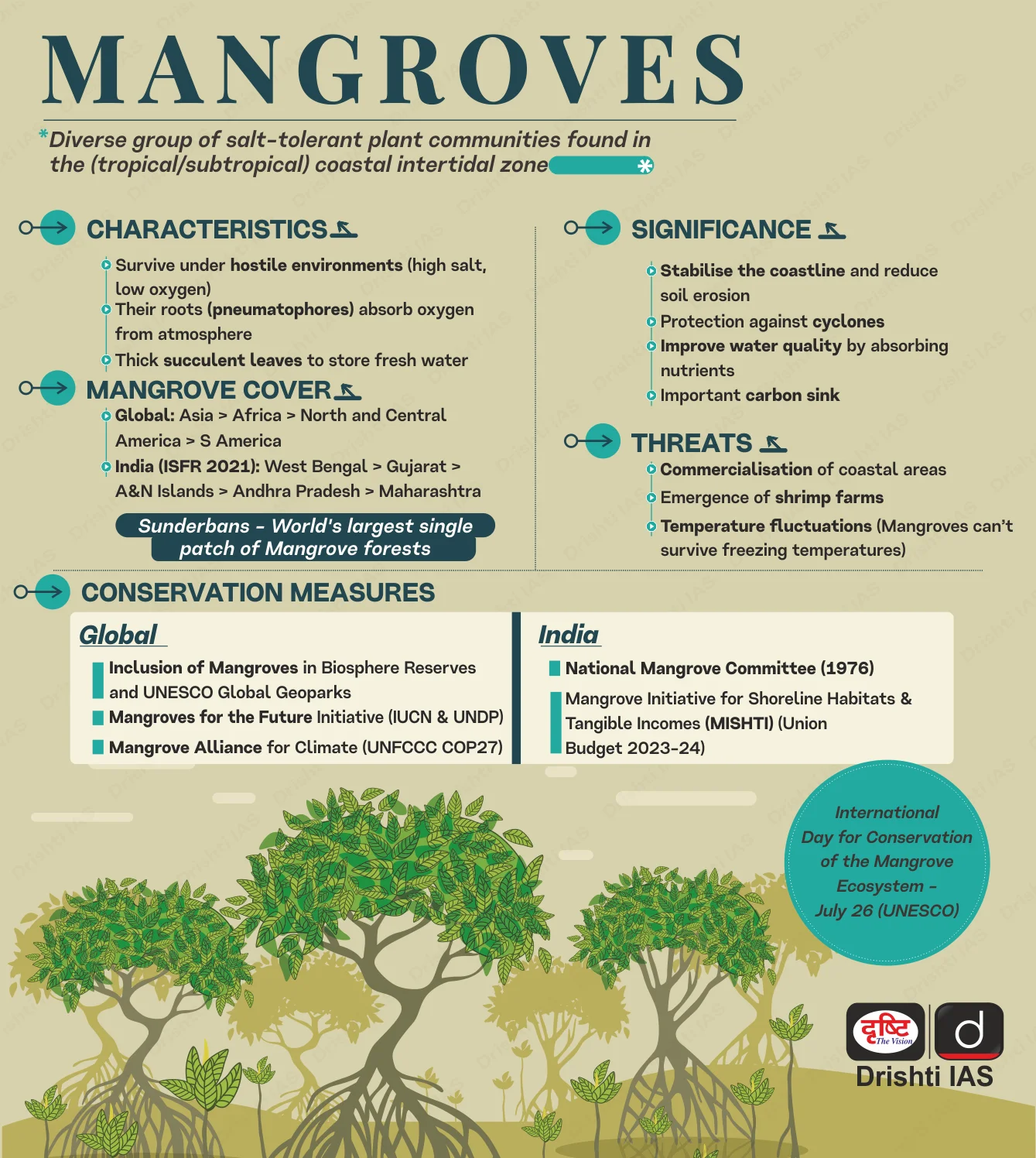
- About: Mangroves are coastal ecosystems composed of salt-tolerant trees (halophytes) and shrubs that thrive in intertidal zones of tropical and subtropical regions.
- These ecosystems thrive in high-rainfall areas (1,000–3,000 mm) with temperatures ranging from 26°C to 35°C.
- Some common mangrove trees include Red mangrove, Grey mangrove, and Rhizophora.
- Habitat: They are found in tidal flats, estuaries, and river deltas with high silt deposition and bi-daily tidal flooding.
- They thrive in saline, anaerobic (low-oxygen), slow-moving waters, where fine sediments tend to accumulate.
- Key Characteristics:
- Physiological Adaptations: They develop pneumatophores (Avicennia) for respiration, prop roots (Rhizophora) for stability, and lenticellated bark for water loss and salt secretion.
- Their salt-secreting glands aid salt excretion, while roots trap silt and sediments, stabilising coastlines and preventing erosion.
- Reproductive Adaptations: Mangroves exhibit viviparity, where seeds germinate on the tree before falling, ensuring survival in saline conditions.
- Physiological Adaptations: They develop pneumatophores (Avicennia) for respiration, prop roots (Rhizophora) for stability, and lenticellated bark for water loss and salt secretion.
- Mangroves Distribution: Thrive only in tropical and subtropical latitudes near the equator, as they cannot withstand freezing temperatures.
- Largest mangrove areas are in South and Southeast Asia, followed by South America, Africa, North and Central America, and Oceania.
- Mangroves in India: As per India State of Forest Report (ISFR) 2023, India’s mangrove cover is 4,991.68 sq. km (0.15% of total geographical area).
- West Bengal holds the largest share of India’s mangrove cover at 42.45%, followed by Gujarat with 23.32% and the Andaman & Nicobar Islands with 12.19%.
- Key Regulatory Measures: The Environment (Protection) Act, 1986, categorises mangroves as Ecologically Sensitive Areas (ESAs), restricting activities within a 50-metre buffer zone where mangrove cover exceeds 1,000 sq. m.
- It mandates compensatory replantation at a 3:1 ratio if mangroves are affected by development.
- Additional protection under the Wildlife (Protection) Act, 1972, Indian Forest Act, 1927, and Biological Diversity Act, 2002, among others.
.webp)
Significance of Mangroves:
- Climate Change Mitigation: Mangroves are major blue carbon sinks, storing 7.5–10 times more carbon per acre than tropical forests and helping reduce greenhouse gas emissions.
- Biodiversity Conservation: They serve as nursery grounds for fish and crustaceans and provide habitat for birds, reptiles, and threatened species.
- Livelihood Support: Sustain coastal and rural livelihoods through fisheries, honey collection, fuelwood, and eco-tourism.
- Disaster Risk Reduction: Mangroves act as natural barriers against storm surges, tsunamis, and coastal erosion, reducing wave energy by 5-35%.
- They lower flood depths by 15-20% and up to 70% in certain areas, playing a crucial role in disaster risk reduction.
- Nature-based Solutions: Mangrooves represent a key ecosystem-based adaptation strategy for sustainable development and climate resilience.
.webp)
|
Drishti Mains Question: Examine the role of mangroves as both ecological buffers and knowledge systems for sustainable agriculture under climate change. |
Frequently Asked Questions (FAQs)
Q. Why are mangroves able to survive in saltwater?
They possess small epidermal cells, thick cell walls, and specialised salt exclusion or salt secretion mechanisms, enabling survival under low osmotic potential.
Q. What are the two main salt management strategies in mangroves?
Salt exclusion at roots using waxy barriers and salt accumulation followed by secretion through leaf glands.
Q. Why is the mangrove study important for agriculture?
It provides a blueprint to engineer salt-tolerant crops like rice, wheat, and pulses for saline-prone regions under climate change.
Q. Why are mangroves crucial for climate action?
They are powerful blue carbon sinks, store 7.5–10 times more carbon than tropical forests, and reduce flood and storm surge impacts.
UPSC Civil Services Examination Previous Year Question (PYQ)
Prelims
Q. Which one of the following regions of India has a combination of mangrove forest, evergreen forest and deciduous forest? (2015)
(a) North Coastal Andhra Pradesh
(b) South-West Bengal
(c) Southern Saurashtra
(d) Andaman and Nicobar Islands
Ans: (d)