
International Women's Day 2026 | 09 Mar 2026
For Prelims: International Women's Day, Lakhpati Didi Initiative, Namo Drone Didi, Nari Shakti Vandan Adhiniyam, National Commission for Women , Maternal Mortality Ratio
For Mains: Women-Led Development as a pillar of Viksit Bharat 2047, Constitutional and legal safeguards for women in India
Why in News?
India observed International Women's Day (IWD) on 8th March 2026, aligned with the United Nations theme “Rights. Justice. Action. For ALL Women and Girls.”
- The occasion highlighted Nari Shakti as the foundation of India’s shift from “development for women” to “women-led development,” positioning women as key drivers of socio-economic progress toward Viksit Bharat 2047.
Summary
- On International Women’s Day 2026, India highlighted its shift toward women-led development, supported by initiatives in economic empowerment, education, defence, health, governance, and sports, along with constitutional safeguards and schemes promoting women’s participation in nation-building.
- Despite progress, issues such as limited land ownership, unpaid care burden, political underrepresentation, digital divide, violence against women, and institutional gaps remain.
- Addressing these through economic inclusion, governance reforms, digital empowerment, health systems strengthening, and safer public spaces is essential to achieve Viksit Bharat 2047.
What is International Women's Day?
- About: IWD is a global observance celebrated annually on 8th March to honor the cultural, political, and socio-economic achievements of women.
- Historical Origins: The day grew out of the labor and suffrage movements in North America and Europe during the early 20th century.
- The first National Women's Day was observed in the US by the Socialist Party of America in 1909.
- The specific date commemorates a massive strike by women in Petrograd, Russia, on 8th March 1917 (according to the Gregorian calendar).
- Their strike for "bread and peace" played a significant role in the Russian Revolution of 1917 and eventually led to women gaining the right to vote there.
- The United Nations first officially observed it on 8th March 1975 during International Women’s Year, and the United Nations General Assembly formally recognised the day in 1977, reinforcing gender equality as a fundamental human right.
- Themes for 2026:
- UN Theme: "Rights. Justice. Action. For ALL Women and Girls," focusing on removing systemic barriers and strengthening global access to justice.
- Campaign Theme: "Give to Gain," which emphasizes that when communities generously invest resources, time, and mentorship into women, society as a whole experiences reciprocal economic and social growth.
How India is Advancing Nari Shakti Across Sectors?
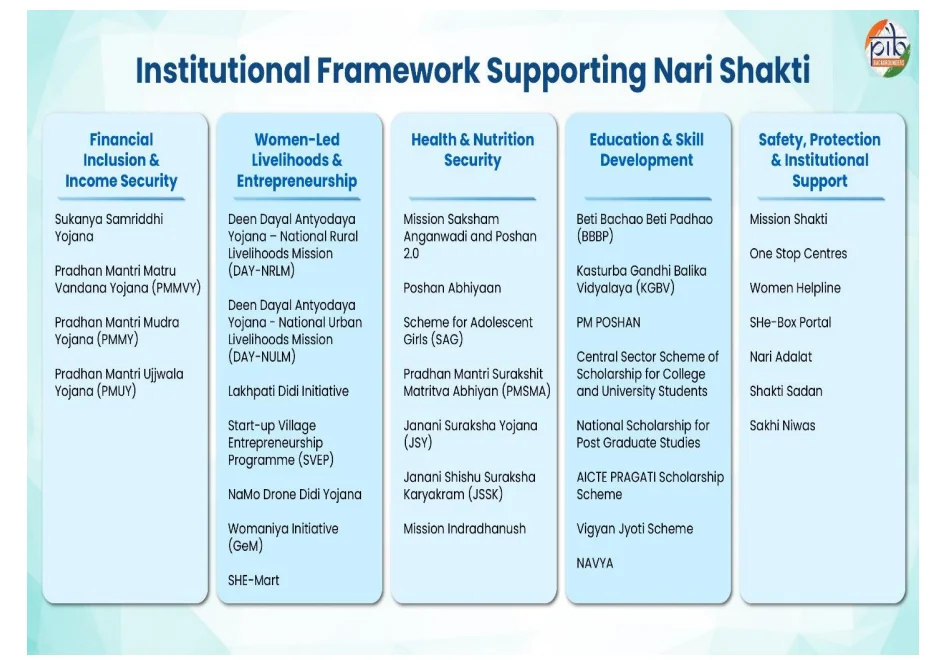
- Grassroots Economic Empowerment: The economic strategy focuses on transforming rural women from unpaid labourers into formal micro-entrepreneurs and technology operators.
- Under the Deendayal Antyodaya Yojana – National Rural Livelihoods Mission, over 10.05 crore rural women have been mobilized into more than 90 lakh Self Help Groups, creating one of the largest networks of community institutions in the world.
- The Lakhpati Didi Initiative targets to create 6 crore Lakhpati Didis, where women in Self Help Groups who are trained to earn a sustainable annual household income exceeding one lakh rupees.
- Namo Drone Didi Yojana provides an 80% subsidy to Self Help Groups to procure agricultural drones.
- It trains rural women to operate these highly technical devices for precision farming (like spraying liquid fertilizers), instantly transforming them into high-income rural tech-entrepreneurs.
- Women form the backbone of India's dairy sector. The proliferation of all-women dairy cooperatives ensures direct financial remuneration into their bank accounts, bypassing male intermediaries.
- Under the PM MUDRA Yojana, nearly 70% of collateral-free loans have gone to women-led micro-enterprises.
- Under Stand-Up India Scheme and the Startup India ecosystem, over 45% of recognized startups in India have at least one female director or partner.
- Expanding Frontiers in Defence: The Indian Armed Forces have dismantled historical glass ceilings, integrating women into prominent combat and command roles.
- The combined strength of women officers in the military has grown from approximately 3,000 in 2014 to over 11,000 in 2026.
- The systematic induction of women into the National Defence Academy ensures female cadets are trained for top military leadership right from the grassroots level.
- In Secretary, Ministry of Defence vs. Babita Puniya (2020), the Supreme Court of India granted Permanent Commission to women officers, ensuring parity in promotions and pensions.
- Women officers are now receiving Permanent Commissions across services, commanding naval warships, flying as frontline fighter pilots, and holding senior posts, including Director General of Medical Services (Army).
- Education and Leadership in STEM: The Female Gross Enrolment Ratio (GER) in higher education rose to 30.2 (2022-23) with aid from Schemes like Sukanya Samriddhi Yojana and Kasturba Gandhi Balika Vidyalayas.
- Women constituted over 53% of University Grants Commission NET-JRF scholars in STEM in FY 2024–25, indicating rising participation in research.
- Women currently constitute an impressive 43% of total graduates in Science, Technology, Engineering, and Mathematics in India, one of the highest ratios among major economies globally
- To sustain this momentum, the Union Budget for 2026-2027 explicitly provides for the establishment of dedicated women's hostels in every district, specifically designed to help female students seamlessly pursue advanced technical education.
- Women constituted over 53% of University Grants Commission NET-JRF scholars in STEM in FY 2024–25, indicating rising participation in research.
- Enhancing Dignity through Foundational Infrastructure: True empowerment requires removing the daily physical burdens that historically restricted women's time, health, and mobility.
- Under the Pradhan Mantri Ujjwala Yojana the provision of over 10.56 crore clean cooking gas connections has drastically reduced women's exposure to lethal indoor air pollution.
- Jal Jeevan Mission has helped in eliminating the grueling, time-consuming daily chore of fetching water, freeing up women's time for education and economic activities.
- Under the Swachh Bharat Mission, the construction of over 12 crore household toilets has fundamentally improved sanitation, maternal health outcomes, and the basic physical safety and dignity of rural women.
- Political Agency and Legal Safeguards: Nari Shakti Vandan Adhiniyam, the historic Constitution (106 Amendment) Act, 2023 guarantees a 33% reservation for women in the Lok Sabha and State Legislative Assemblies, ensuring that women have a direct, proportional voice in the highest law-making bodies of the nation.
- 73rd & 74th Amendments (1992) granted constitutional status to rural and urban local bodies with mandatory 33% reservation for women, leading to nearly 50% representation in many states.
- Unlike many Western nations, India granted equal voting rights to women from the very first day of the Republic.
- Mission Shakti strengthens support systems through One Stop Centres, Women Helpline, providing medical, legal, and counselling assistance to women in distress.
- The Sexual Harassment of Women at Workplace (Prevention, Prohibition and Redressal) Act, 2013 ensures safer workplaces by mandating Internal Committees and enabling online complaint redressal through the SHe-Box portal.
- In Shayara Bano v. Union of India(2017), the Supreme Court declared the practice of instant Triple Talaq unconstitutional, marking a major step toward gender justice.
- Subsequently, the Muslim Women (Protection of Rights on Marriage) Act, 2019, criminalised instant divorce, providing legal protection, dignity, and greater equality for Muslim women.
- Health: According to the Sample Registration System (SRS) Report, India’s Maternal Mortality Ratio (MMR) declined from 130 per lakh live births (2014–16) to 88 per lakh live births (2020–22).
- As per the United Nations, India’s MMR stands at 80 per lakh live births, marking an 86% decline since 1990, compared to the global reduction of 48%.
- Pradhan Mantri Surakshit Matritva Abhiyan and POSHAN Abhiyaan strengthen maternal care and nutrition services.
- Sports: The Board of Control for Cricket in India (BCCI) introduced equal match fees for its centrally contracted men and women cricketers, while the Women's Premier League has boosted financial security and visibility for women players.
- Under the ASMITA initiative, women’s sports participation is expanding nationwide, with nearly 3 lakh women participating across 2,600 leagues in 33 disciplines.
- The programme, supported by the Sports Authority of India and Khelo India, aims to identify grassroots talent and improve India’s medal prospects in global events like the Olympics.
- Under the ASMITA initiative, women’s sports participation is expanding nationwide, with nearly 3 lakh women participating across 2,600 leagues in 33 disciplines.
Note: India’s commitment to gender equality is embedded in its Constitution through provisions such as Article 15 (prohibiting discrimination and allowing special provisions for women), Article 16 (equal opportunity in public employment), Article 39 (equal livelihood opportunities), Article 42 (maternity relief and humane working conditions), and Article 243 (reservation for women in local governance).
- The National Commission for Women monitors legal safeguards, while universal adult franchise since Independence guarantees women equal participation in India’s democracy.
What are the Challenges in Advancing the Nari Shakti?
- Feminisation of Agriculture without Land Rights: Women constitute over 70% of the agricultural workforce, yet own only 13-14% of agricultural land.
- Without land titles in their name, they are not legally recognized as "farmers." Therefore, they are excluded from institutional credit, MSP procurement, and direct benefit transfers like PM-KISAN.
- "Time Poverty" Crisis: The NSO's Time Use Survey reveals a stark reality that Indian women spend roughly 7.2 hours a day on unpaid domestic/caregiving work, compared to just 2.8 hours for men.
- This "care burden" prevents women from skilling, upskilling, and entering the formal economy, trapping them in low-paying, informal, or gig work.
- Political & Governance Hurdles: While the 73rd and 74th Amendments reserved seats for women in Panchayati Raj Institutions (PRIs), grassroots reality often sees the male relatives (husbands/fathers) ("Sarpanch Pati" / "Pradhan Pati" Syndrome ) wielding the actual financial and administrative power, reducing the elected woman to a rubber stamp.
- The Nari Shakti Vandan Adhiniyam implementation is contingent upon the next Census and Delimitation exercise, delaying actual representation until at least 2029.
- Data from the Association for Democratic Reforms (ADR) often shows that political parties are highly reluctant to give electoral tickets to women for "winnable" or general seats, restricting them to reserved constituencies or women's wings.
- Health and Social Vulnerabilities: The National Family Health Survey-5 (NFHS-5) data presents a grim picture: 57% of women (15-49 years) in India are anemic.
- This leads to an intergenerational cycle of malnutrition, high Maternal Mortality Rates (MMR), low birth-weight infants, and severely impacts women's cognitive and physical productivity in the workforce.
- Son Meta-Preference, where the preference for sons leads to the notional category of “unwanted girls,” estimated at over 21 million.
- Technological & Emerging Challenges: According to the GSMA Mobile Gender Gap Report 2024, Indian women are significantly less likely to own a smartphone or use mobile internet compared to men.
- This curtails their access to digital education (EdTech), financial inclusion (FinTech), and modern job markets.
- Women account for about 43% of enrolments in STEM degrees, yet many drop out before entering the workforce. As a result, women make up only about 27% of India’s STEM workforce and around 14% of the scientific research workforce, highlighting a significant gender gap in STEM careers.
- Cyber-Violence and Deepfakes: The unchecked rise of Artificial Intelligence has led to the weaponization of technology.
- The proliferation of Non-Consensual Intimate Imagery (NCII) and deepfakes disproportionately targets women, acting as a severe deterrent to their participation in the public digital square.
- Institutional Failures: Data from the National Crime Records Bureau (NCRB) shows that the conviction rate for crimes against women remains around 25–26%, while judicial pendency exceeds 90%, reflecting serious delays in justice delivery.
- The most common offence is “cruelty by husband or relatives,” accounting for over 30% of cases, indicating the domestic sphere as a major site of violence.
- In addition, inadequate safe transport, working women’s hostels, and crèche facilities limit women’s mobility and workforce participation.
- At times, compliance costs under the Maternity Benefit (Amendment) Act, 2017 may also discourage some employers from hiring women.
What Measures can Strengthen Nari Shakti to Achieve the Vision of Viksit Bharat by 2047?
- Economic Empowerment: Adopt Kerala’s Kudumbashree land-leasing model to grant women farmer status and access to credit and Pradhan Mantri Kisan Samman Nidhi benefits.
- Bridge the “missing middle” finance gap by creating credit guarantee support for women-led MSMEs to scale beyond self-help groups.
- Recognize and support the care economy through parental leave policies and expanded CSR investments in childcare and eldercare infrastructure.
- Women in Emerging Green Economy: Train women for jobs in renewable energy, climate adaptation, and sustainable agriculture, enabling them to participate in India’s green transition.
- Governance & Political Participation: Encourage political parties to field more women by linking incentives with female representation in elections through the Election Commission of India framework.
- Establish leadership academies for elected women in Panchayats to strengthen administrative and financial decision-making capacity.
- Technology & Digital Inclusion: Support women in deep-tech entrepreneurship through incubation and innovation platforms like the Atal Innovation Mission.
- Health System Reforms: Expand services of Ayushman Arogya Mandir to include screening for women’s non-communicable diseases.
- Ensure gender-balanced clinical research through guidelines by the Indian Council of Medical Research.
- Safe Urban Spaces & Justice: Integrate Crime Prevention Through Environmental Design (CPTED) in city planning to improve women’s safety in public spaces.
- Establish specialized police investigative units for crimes against women to improve evidence collection and conviction rates.
- Strengthen Data for Gender Policy: Expand gender-disaggregated data collection in employment, digital access, land ownership, and health to enable evidence-based policymaking.
Conclusion
Achieving Viksit Bharat by 2047 relies on a definitive shift to women-led development. To truly harness Nari Shakti, India must urgently dismantle systemic barriers like the unpaid care burden, digital divide, and unequal land rights. By strictly enforcing legal safeguards and expanding grassroots economies, gender equity will transform from policy into a lived reality
|
Drishti Mains Question: Women-led development is central to India’s vision of Viksit Bharat 2047. Examine the progress made and the challenges that remain. |
Frequently Asked Questions (FAQs)
1. When is International Women’s Day observed?
International Women’s Day is observed annually on 8 March worldwide.
2. What was the United Nations theme for International Women’s Day 2026?
The United Nations theme for IWD 2026 was “Rights. Justice. Action. For ALL Women and Girls.”
3. When did the United Nations first officially observe International Women’s Day?
The United Nations first officially observed International Women’s Day on 8 March 1975 during International Women’s Year. The United Nations General Assembly formally recognised International Women’s Day in 1977.
4. What are the traditional colours associated with International Women’s Day?
The colours associated with International Women’s Day are purple (justice and dignity), green (hope), and white (purity).
UPSC Civil Services Examination, Previous Year Question (PYQ)
Mains
Q.1 “Empowering women is the key to control population growth”. Discuss. (2019)
Q.2 Discuss the positive and negative effects of globalization on women in India? (2015)
Q.3 Male membership needs to be encouraged in order to make women’s organizations free from gender bias. Comment. (2013)