
India’s Major Ports Surge with Record Cargo | 07 Apr 2026
Why in News?
India’s major ports under the Ministry of Ports, Shipping and Waterways handled 915 million tonnes of cargo in FY 2025–26, with 7.06% growth, reflecting efficiency gains under the Maritime Amrit Kaal Vision 2047.
- Further, integrating Artificial Intelligence (AI) can significantly enhance operational efficiency, logistics optimization, and decision-making, marking the next phase in India’s maritime transformation.
What are the Key Highlights of Port Performance in FY 2025–26?
- Surpassing Targets: The major ports collectively handled an unprecedented 915.17 million tonnes (MT) of cargo, successfully surpassing the annual target of 904 MT.
- Top Performers: The top performers included Deendayal Port Authority (160.11 MT), followed by Paradip Port Authority (156.45 MT) and Jawaharlal Nehru Port Authority (JNPA) (102.01 MT).
- Visakhapatnam Port Authority, Mumbai Port Authority, Chennai Port Authority, and New Mangalore Port Authority also registered strong performances.
- Highest Growth Rates: In terms of growth rate, Mormugao Port Authority, Goa, recorded the highest increase at 15.91%, followed by Kolkata Dock System (14.28%) and JNPA (10.74%).
- Factors Driving Growth:
- Digital Transformation: Adoption of smart port and digital initiatives driven by IT and automation, delivering major efficiency gains across operations.
- National Logistics Portal (Marine) and Maritime Single Window enabling unified trade facilitation from a single platform.
- Sagar Setu platform and e-Samudra; unified maritime services portal bringing all maritime services under one roof.
- One-Nation-One-Document (ONOD) and One-Nation-One-Process (ONOP) reforms standardising documentation and eliminating redundant procedures across all port ecosystems including customs, immigration, and health.
- Processes that were once handled physically are now fully digital, reducing delays, paperwork, and human error.
- Smart ports are now expected to evolve further into AI-powered intelligent ports as the next phase of transformation.
- Increased Commodity Handling: Higher volumes of key commodities such as coal, crude oil, containers, fertilizers, and petroleum, oil, and lubricants (POL) have driven overall cargo growth.
- Improved Operational Efficiency: Significant gains in turnaround time (from ~4 days in 2013–14 to less than 1 day in 2025) along with enhanced ease of doing business have boosted port performance.
- Capacity Augmentation & Modernization: Expansion and upgradation of port infrastructure supported by reforms under the Indian Ports Act, 2025 have significantly enhanced cargo handling capacity and operational efficiency.
- Digital Transformation: Adoption of smart port and digital initiatives driven by IT and automation, delivering major efficiency gains across operations.
Integrating Indian Ports with AI
- AI can enhance project planning, operational decision-making, trade facilitation, and energy rationalisation.
- A pilot by IIT-Madras for VO Chidambaranar Port (Tuticorin) demonstrated AI's potential in congestion forecasting and just-in-time berthing, saving fuel and time.
- For AI to be effective, it needs enormous data. The fragmented, vendor-led nature of existing deployments means AI should be institutionalized and treated as ‘digital public infrastructure’ (DPI) to ensure standardised data, interoperability, shared registries, and cybersecurity.
Smart Ports Vs AI (Thinking) Ports
|
Aspect |
Smart Ports |
AI (Thinking) Ports |
|
Approach & Focus |
Technology-driven, focused on automation and real-time monitoring of operations. |
Decision-driven, focused on predictive insights and outcome-based planning using AI. |
|
Functioning & Optimization |
Reacts to current events and optimizes within individual systems (silos). |
Anticipates future scenarios and optimizes across integrated systems. |
|
Decision-Making & Outcome |
Provides data visibility with limited decision support, improving speed and efficiency. |
Enables AI-backed judgement and proactive decisions, making ports smarter and future-ready. |
Ports In India
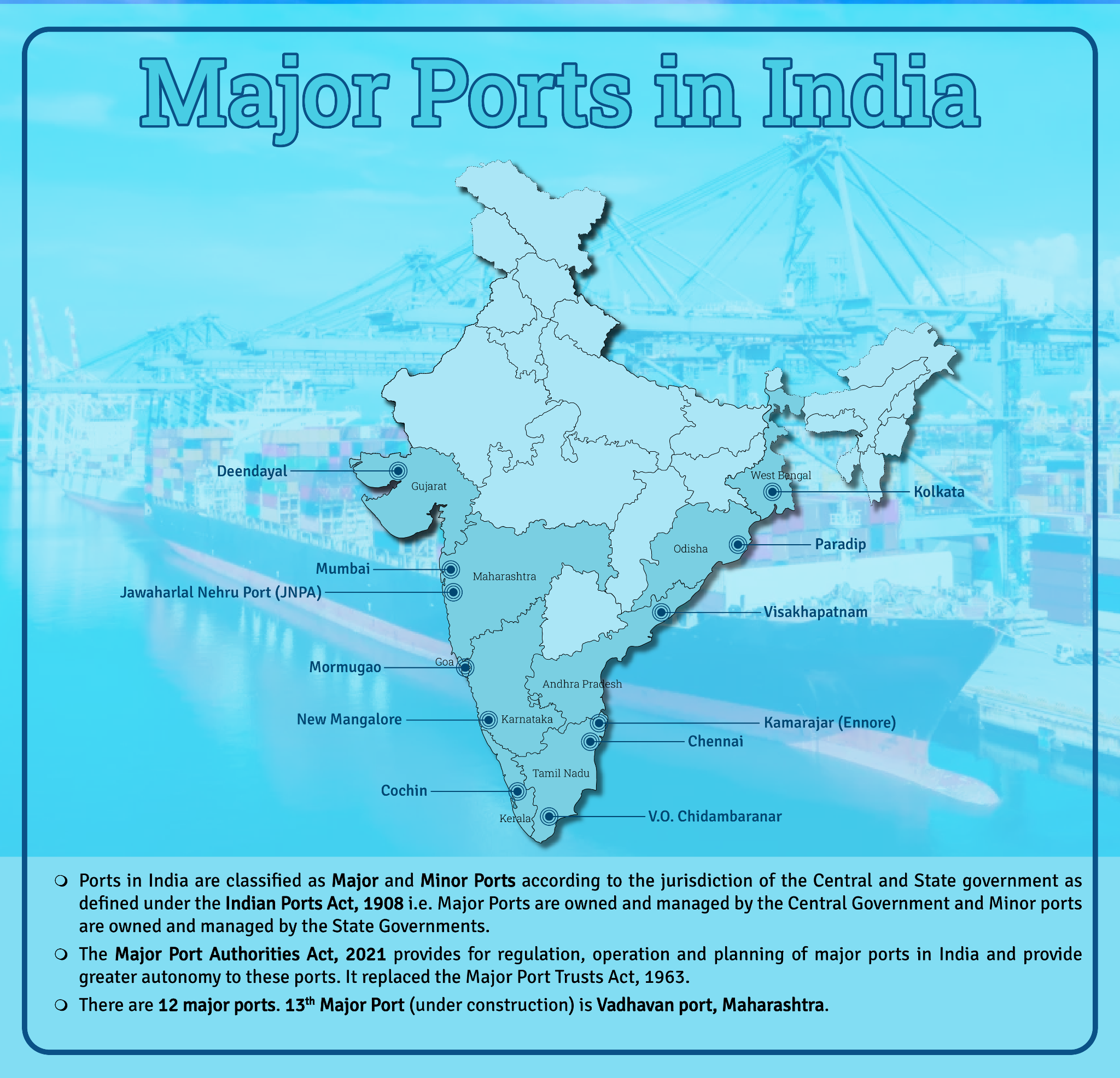
- Ports are vital to India’s economy, handling about 95% of export-import (EXIM) cargo by volume and 70% by value. India has 12 Major Ports (13th major port at Vadhavan, Maharashtra is still in development phase), wholly owned by the Government of India and governed by the Major Port Authorities Act, 2021.
- These include Deendayal, Mumbai, Jawaharlal Nehru, Mormugao, New Mangalore, Cochin, V.O. Chidambaranar, Chennai, Kamarajar, Visakhapatnam, Paradip, and Syama Prasad Mookerjee Ports.
- No major port has been privatised, as ownership of land and waterfront remains with the Government of India. However, private participation in operations exists under a landlord port / PPP model.
- Major Ports are administered by the Ministry of Ports, Shipping and Waterways, while non-major ports fall under State Governments or State Maritime Boards.
Frequently Asked Questions (FAQs)
1. What is the significance of Maritime Amrit Kaal Vision 2047?
It aims to transform India into a global maritime powerhouse through port-led development, logistics integration, and modernization.
2. What is ONOD and ONOP in port reforms?
One Nation One Document (ONOD) and One Nation One Process (ONOP) standardize documentation and procedures across ports to reduce redundancy and delays.
3. How can AI improve port operations?
AI enhances congestion forecasting, just-in-time berthing, decision-making, and energy efficiency, improving overall logistics performance.
4. What is the role of ports in India’s trade?
Ports handle about 95% of EXIM cargo by volume and 70% by value, making them critical to economic growth.
5. What is a key challenge in AI adoption in ports?
Fragmented data systems and lack of standardization, which limit interoperability and effective AI deployment.
UPSC Civil Services Examination, Previous Year Question (PYQ)
Prelims
Q. What is the importance of developing Chabahar Port by India? (2017)
(a) India’s trade with African countries will enormously increase.
(b) India’s relations with oil-producing Arab countries will be strengthened.
(c) India will not depend on Pakistan for access to Afghanistan and Central Asia.
(d) Pakistan will facilitate and protect the installation of a gas pipeline between Iraq and India.
Ans: (c)