
India Withdraws COP33 UNFCCC Host Bid | 09 Apr 2026
Why in News?
India has withdrawn its candidacy to host the 33rd Conference of Parties (COP33) to the United Nations Framework Convention on Climate Change (UNFCCC) in 2028, citing a "review of its commitments for 2028."
- Analysts suggest India withdraw to avoid logistical burdens of other "big-ticket" events (like a potential 2030 Commonwealth Games) or pressure for higher climate goals, a move experts believe could undermine its leadership of the Global South in securing climate finance.
- Following the confirmed hosts of Australia and Turkey (COP31, 2026), and Ethiopia (COP32, 2027), India’s withdrawal leaves South Korea as the only contender to fill the vacancy for COP33 in 2028.
What is the United Nations Framework Convention on Climate Change (UNFCCC)?
- About: The UNFCCC is the primary international treaty aimed at preventing "dangerous human interference with the climate system."
- It serves as the primary international treaty for coordinating a global response to stabilize greenhouse gas (GHG) concentrations and prevent dangerous human interference with the climate system.
- Establishment and Objective: Adopted in 1992 at the Rio Earth Summit and entering into force in 1994, its core objective is to ensure food security and allow sustainable economic development while ecosystems adapt to climate change.
- Principles:
- CBDR-RC: A central pillar of the UNFCCC is the principle of "Common But Differentiated Responsibilities and Respective Capabilities (CBDR-RC)."
- This acknowledges that while all nations must act, developed countries have a greater historical responsibility and more resources to lead the fight.
- Sustainable Development: It mandates that climate action should be taken in a way that allows ecosystems to adapt naturally, ensures food security, and enables economic development to proceed sustainably.
- CBDR-RC: A central pillar of the UNFCCC is the principle of "Common But Differentiated Responsibilities and Respective Capabilities (CBDR-RC)."
- Operating Mechanism:
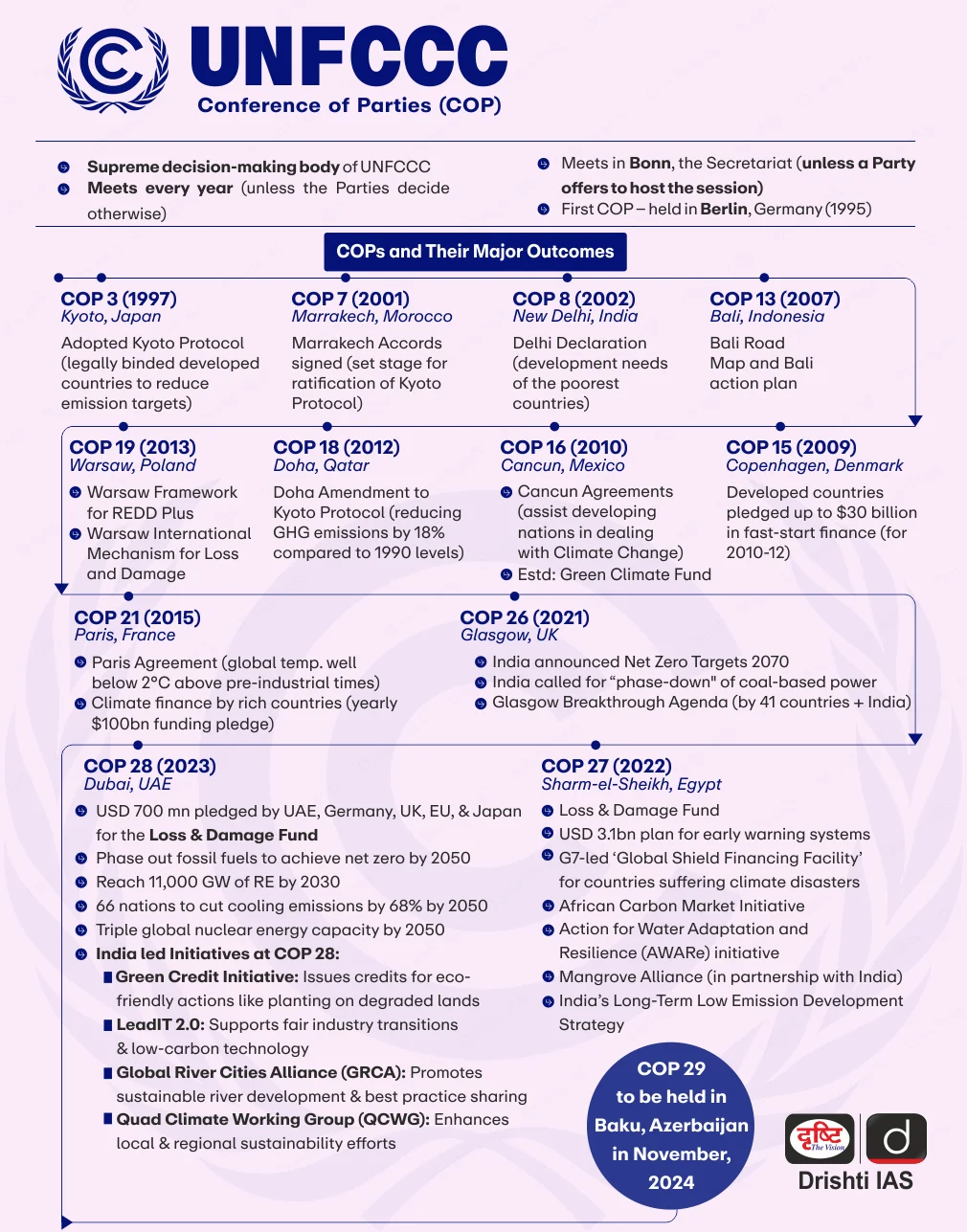
- COP (Conference of the Parties): It is the supreme decision-making body that meets annually to review progress.
- The Secretariat: Based in Bonn, Germany, it supports the global response to the threat of climate change by organizing negotiations and analyzing data.
- Transparency & Reporting: Member nations must regularly submit "National Communications" and "Biennial Transparency Reports" detailing their greenhouse gas (GHG) emissions and climate policies.
- Financial Mechanism: The UNFCCC manages several funds to help developing countries transition to clean energy and adapt to climate impacts. As of 2026, these are the primary pillars:
- Green Climate Fund (GCF): It is the world’s largest dedicated climate fund that has recently hit a milestone of USD 20 billion in total financing for over 350 projects worldwide.
- Global Environment Facility (GEF): Acts as a catalyst for environmental projects, often providing the "seed money" for large-scale energy transitions.
- Fund for Responding to Loss and Damage (FRLD): It aims to help vulnerable nations recover from immediate climate disasters (like floods or rising sea levels).
- Adaptation Fund: Specifically targets projects that help communities build resilience, such as sea walls or drought-resistant farming.
- Major Legal Instruments: It provided the foundation for the Kyoto Protocol (1997) and the landmark Paris Agreement (2015), which aims to limit global warming to well below 2°C (preferably 1.5°C).
- Hosting Rotation: The hosting of COP rotates among the UN’s 5 regional groups — African States, Asia-Pacific States, Eastern European States, Latin American and Caribbean States and Western European and other States. India is part of the Asia Pacific group. India has hosted a UNFCCC COP only once — in 2002 (COP 8) — when it was a relatively low-key affair.
- The Global Stocktake (GST): The UNFCCC operates on a 5-year "ambition cycle." The Global Stocktake is like a periodic "medical check-up" for the planet.
- The 1st GST was concluded in 2023, and the 2nd GST is scheduled for 2028.
Note: In March 2026, India announced its updated Nationally Determined Contributions (NDCs), committing by 2035 to source 60% of its installed electricity capacity from non-fossil sources, reduce emissions intensity of GDP by 47%, and increase its carbon sink by 3.5-4 billion tonnes of CO₂ equivalent.
Frequently Asked Questions (FAQs)
1. Which countries are hosting COP31 (2026) and COP32 (2027)?
COP31 (2026) will be co-hosted by Australia and Turkey, and COP32 (2027) will be hosted by Ethiopia.
2. What is the Global Stocktake (GST) under the UNFCCC?
The GST is a 5-year “ambition cycle” acting as a periodic assessment of global climate action. The first GST concluded in 2023, and the second GST is scheduled for 2028.
3. What is the significance of the CBDR-RC principle in climate negotiations?
CBDR-RC acknowledges that while all states are responsible for climate action, developed nations bear a greater historical responsibility and must provide financial and technological support to developing countries.
UPSC Civil Services Examination, Previous Year Questions
Q. With reference to the Agreement at the UNFCCC Meeting in Paris in 2015, which of the following statements is/are correct? (2016)
- The Agreement was signed by all the member countries of the UN, and it will go into effect in 2017.
- The Agreement aims to limit the greenhouse gas emissions so that the rise in average global temperature by the end of this century does not exceed 2ºC or even 1.5ºC above pre-industrial levels.
- Developed countries acknowledged their historical responsibility in global warming and committed to donate $ 1000 billion a year from 2020 to help developing countries to cope with climate change.
Select the correct answer using the code given below:
(a) 1 and 3 only
(b) 2 only
(c) 2 and 3 only
(d) 1, 2 and 3
Ans: (b)